
Sitka Mountain-ash (Sorbus sitchensis)
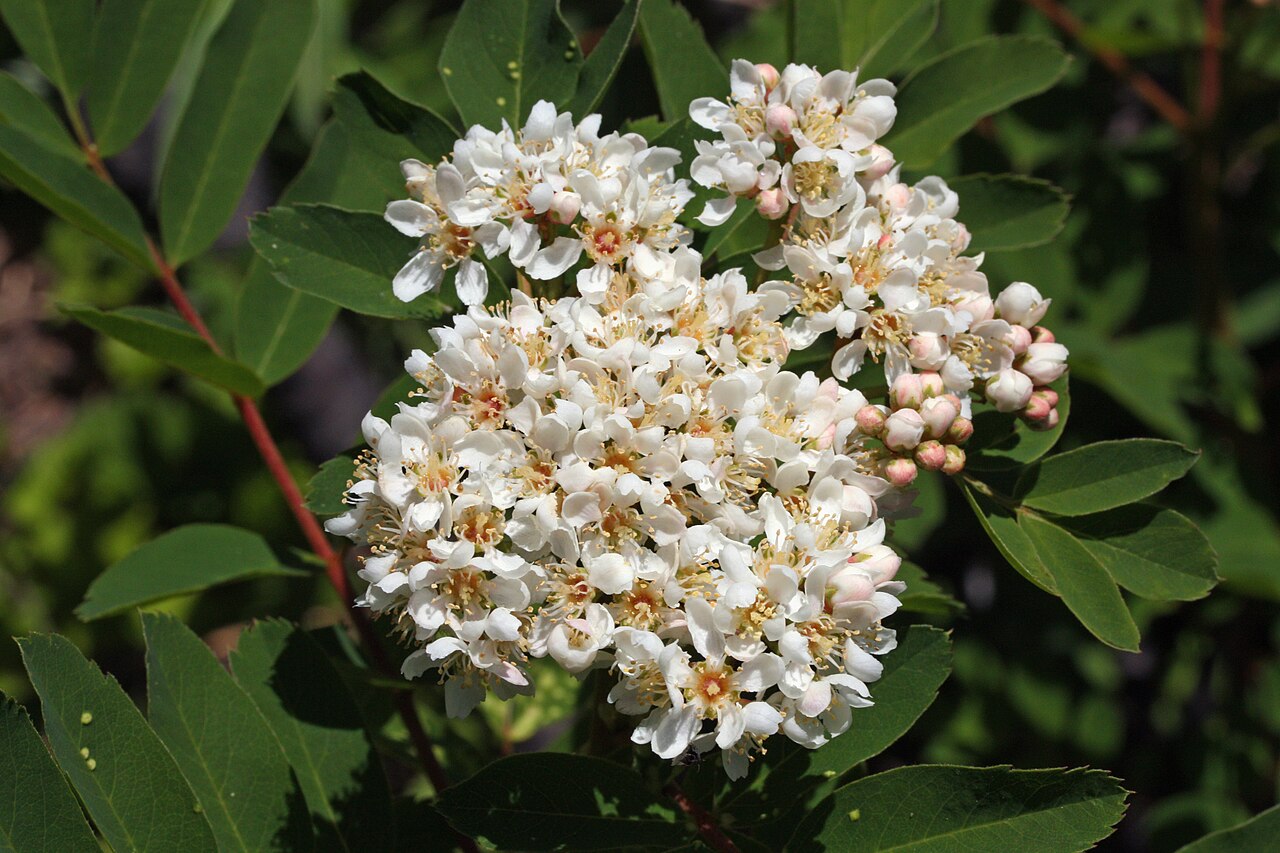
Sitka mountain-ash (Sorbus sitchensis) is a deciduous shrub of cool northwestern mountain landscapes. White flower clusters give way to red fruits above compound leaves, and the foliage adds seasonal color before dropping. Despite the name, it is a rose-family plant rather than a true ash in the genus Fraxinus. It is usually a multi-stemmed shrub, not a large street tree.
The species is also called western mountain ash, a name that can be confused with Sorbus scopulina. The leaves offer an important clue: Sitka mountain-ash commonly has rounded leaflet tips, with teeth concentrated toward the outer part of each leaflet. A photograph of red fruit alone cannot establish the species. Check leaves, young growth and a regional key together.
This guide corrects an important regional assumption. The Alaska row fits the documented range. The combined Montana–Wyoming list should not imply that the species is native in both states: the Burke Herbarium range reaches Montana, while Wyoming is not included in that treatment. Use it as a native choice in verified local habitat, not as a blanket recommendation for every Rocky Mountain garden.
Identification
A shrub, not a true ash
Plants commonly form several upright stems and reach roughly 3–13 feet, with size varying by exposure and site. Young growth may have reddish hairs. The plant belongs to Rosaceae, so its compound leaves do not make it a Fraxinus. Observe the branching, flowers and fruit before making an identification from the word ash.
Leaflets
Leaves are divided into several leaflets, commonly seven to eleven. The leaflets tend to be oblong or widest toward the outer end, with rounded tips and teeth most obvious in the upper portion. Compare multiple mature leaves. Very young growth, damaged foliage and a distant photograph can hide the characters that separate it from other mountain-ashes.
Flowers
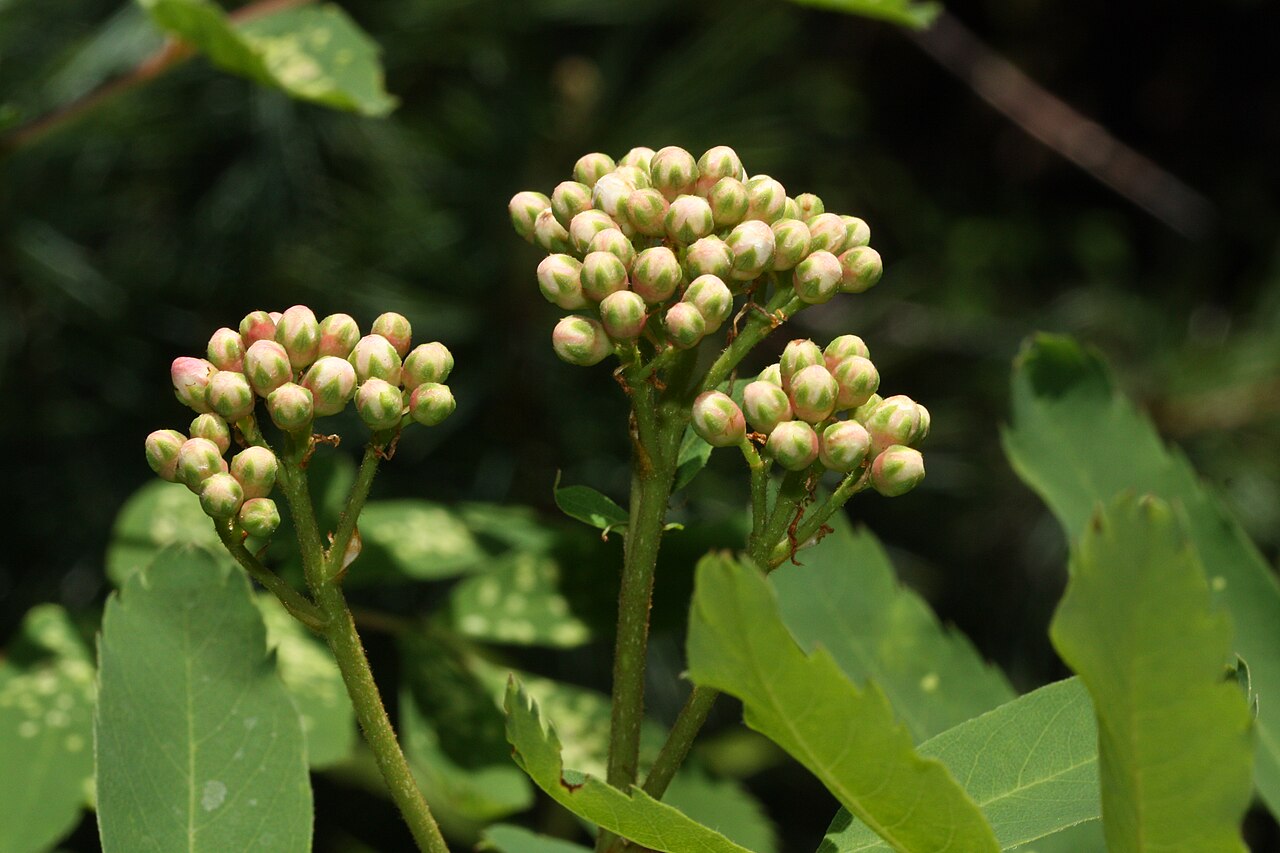
Clusters of small white flowers appear during the mountain growing season, often from June into August depending on snowmelt and elevation. Each flower has five petals and conspicuous stamens. The cluster is useful to photograph with nearby leaves; a tight crop of a white flower lacks the context needed to distinguish several rose-family shrubs.
Fruit and related species
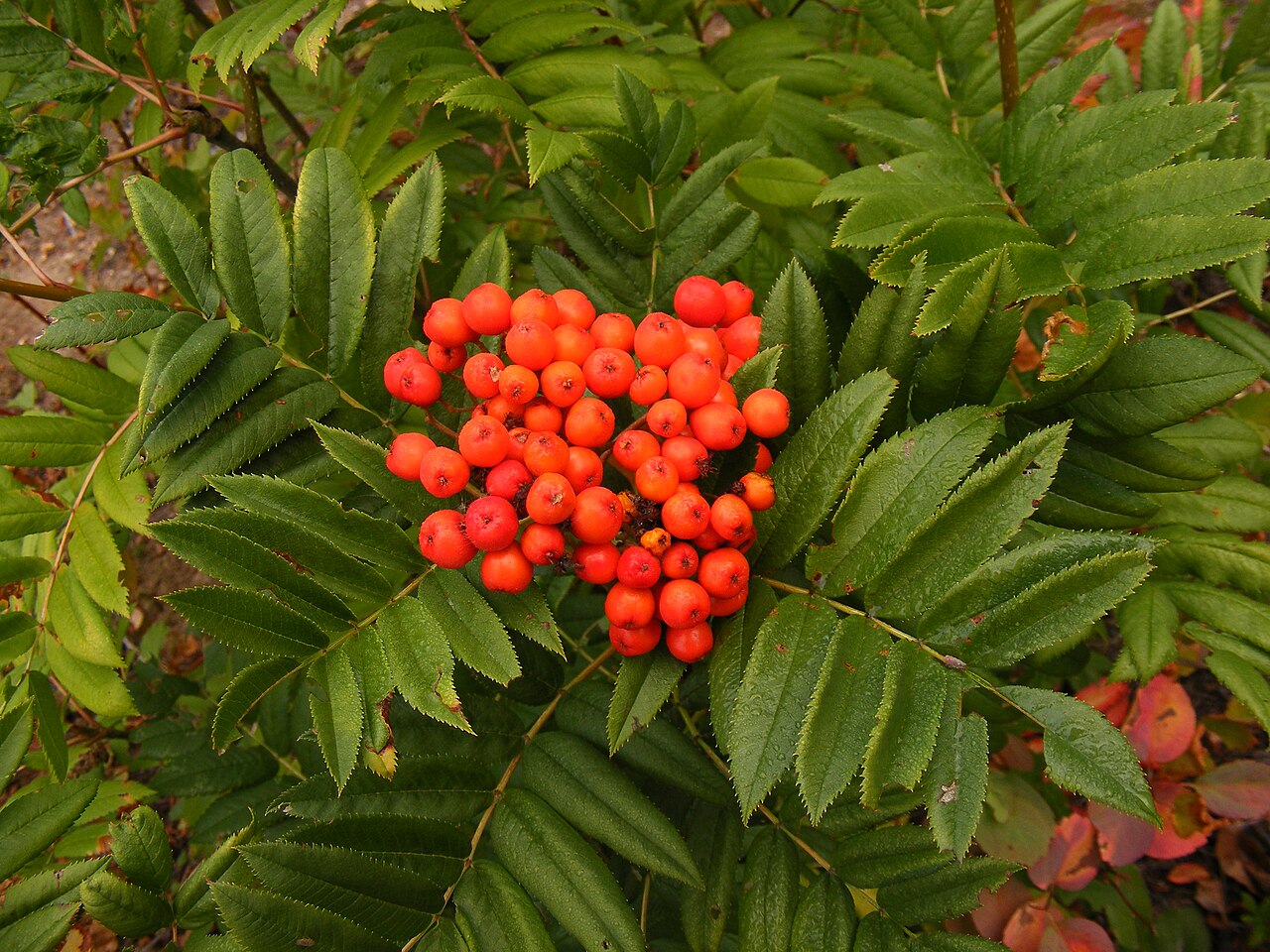
The red fruits are small pomes, botanically more like miniature apples than true berries, and may show a pale bluish surface bloom. Sorbus scopulina can look similar and shares parts of the region. European mountain-ash, Sorbus aucuparia, is introduced in the Northwest. Neither red fruit nor successful growth in a garden establishes that a mountain-ash is the native species intended here.
Quick Facts
| Scientific Name | Sorbus sitchensis |
| Family | Rosaceae |
| Plant Type | Deciduous, usually multi-stemmed shrub |
| Mature Height | About 3–13 ft (1–4 m), site dependent |
| Mature Spread | Several feet; allow room for a broad shrub |
| Growth Rate | Variable in cool mountain conditions |
| Sun Exposure | Sun to partial shade |
| Water Needs | Cool, moist but draining root zone |
| Soil Type | Mountain woodland or open-slope soils with drainage |
| Soil pH | Use locally appropriate soil; avoid forced chemistry changes |
| Bloom Time | Late spring to summer, often June–August |
| Flower Color | White |
| Fall Color | Seasonal yellow to reddish tones, variable |
| Fruit | Red pomes, sometimes with bluish bloom |
| Deer Resistant | Not guaranteed; local browsing varies |
| USDA Hardiness Zones | Cold-adapted; obtain provenance-specific nursery guidance |
Native Range
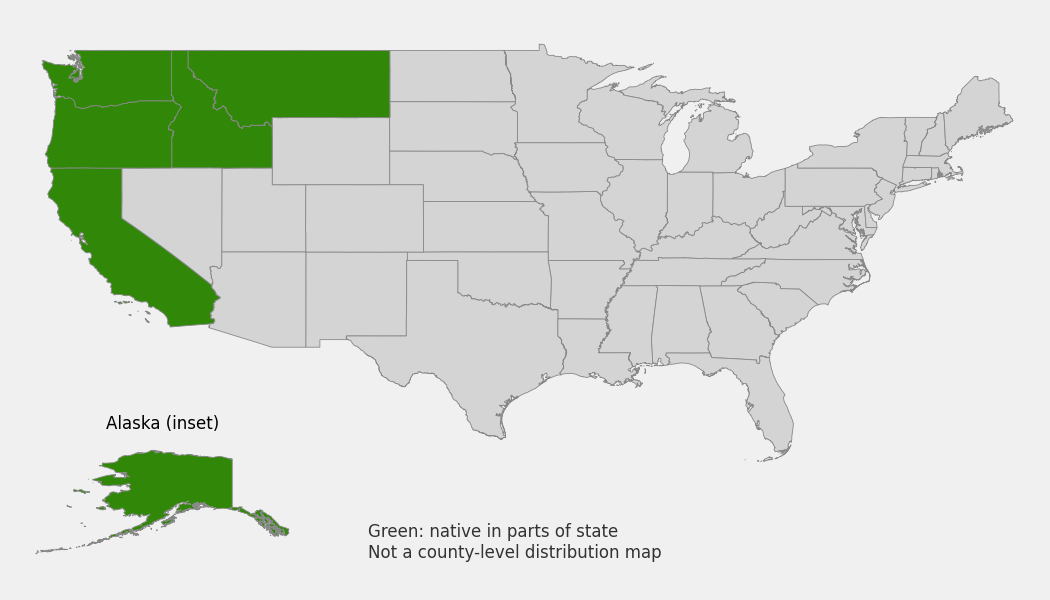
Burke Herbarium describes the native range from Alaska south to northern California and east to Alberta, Idaho and Montana. The United States map therefore shades Alaska, Washington, Oregon, California, Idaho and Montana. Shading California does not imply that a hot southern California valley is native habitat, and shading Alaska does not imply occurrence across every part of that large state.
Typical habitat includes mountain forest openings at middle to high elevations. Cool conditions, moisture availability and the length of the snow-free season influence the plant more directly than a state boundary. In a lowland garden, the question is not simply whether the shrub can survive winter, but whether its roots and foliage can cope with summer heat and drying.
Varieties have been recognized within the species, including var. sitchensis and var. grayi. This page treats the species broadly while keeping the photographed plants identified as Sorbus sitchensis. For a restoration project, determine the locally appropriate taxon and seed origin. Do not expand the map into Wyoming by borrowing the distribution of the more widespread Sorbus scopulina.
📋 Regional plant list: Alaska
Growing & Care Guide
Climate before cosmetics
Choose this shrub because the site can support a cool-climate mountain plant, not only because the red fruits look attractive. A south-facing courtyard can be much hotter than the surrounding regional climate. In a warm area, seek advice from a nursery experienced with the species and local provenance. A sheltered, cooler exposure may be more important than the broad hardiness label.
Light and soil
Sun or partial shade can work where moisture and temperature are suitable. Avoid a densely shaded corner with poor air movement as well as a baking gravel strip. Preserve a draining root zone with an organic surface layer where appropriate. A mountain plant is not necessarily a dry rock-garden plant; habitat moisture and exposure need to be considered together.
Water during establishment
Check the planted root ball and surrounding soil through the first growing seasons. Water according to actual drying rather than on a fixed calendar. If the shrub is wilting during a heat spell, distinguish a dry root ball from root damage in waterlogged soil. Mulch can moderate the surface, but deep piles against the stems create a different problem.
Planting and spacing
Allow enough room for multiple stems and seasonal arching growth. A narrow strip that requires constant removal of outer branches is a poor fit. Plant with the crown at its original level and inspect container roots before installation. Avoid disturbing an intact mountain meadow or forest opening to obtain a specimen; use nursery-propagated plants.
Pruning
Retain the natural shrub structure unless there is a clear reason to remove damaged or crossing stems. Repeated clipping can remove flower and fruit potential and obscure the plant’s character. When pruning, make modest cuts and watch how the shrub responds over a season rather than reducing it drastically in one operation. Diseased wood warrants identification of the problem and clean tools.
Propagation and provenance
Seedlings are useful for ecological plantings only when their origin is known and suitable. Mountain-ash seed may have dormancy requirements, so use a protocol appropriate to the species and seed lot instead of assuming immediate germination. Keep labels through sowing and transplanting. Material from a distant mountain system may not match the phenology or local taxon needed for restoration.
Diagnosing decline
Brown leaves can reflect heat, drought, root stress or disease, and red fruit does not compensate for a chronically unsuitable site. Inspect the base, soil moisture and pattern of injury before treating. Rose-family shrubs can have recognizable diseases, but a precise diagnosis is preferable to prophylactic spraying. Ask a local Extension or plant clinic when decline persists.
Designing for the long term
A mountain-ash planted for wildlife should be allowed to flower and fruit, with space for birds to approach and for the gardener to inspect it. Keep it away from areas where falling fruit would create an unwanted maintenance issue. Combine it with other appropriate natives rather than using a single-species row as a substitute for a diverse shrub layer.
Landscape Uses
- Cool-climate native shrub grouping in suitable northwestern habitat.
- Mountain or foothill garden with a moist, draining root zone.
- Seasonal flower and fruit accent in a mixed native shrub border.
- Locally sourced restoration material where the species is documented, not assumed.
Wildlife & Ecological Value
Flower visitors
The open white flowers expose reproductive structures to visiting insects. Observe local use rather than claiming a specialized pollinator relationship without evidence. Avoid insecticide drift during bloom, and provide additional flowering plants to cover the periods before snowmelt-season shrubs open and after their display has finished.
Fruit and birds
The red pomes are part of the shrub’s seasonal wildlife offering. Fruit availability and animal use vary with local conditions and crop size. Retaining mature fruiting branches and surrounding cover is more useful than clipping the shrub into a sterile hedge. Do not confuse wildlife use with a recommendation that people eat the fruit raw.
Browsing and cover
A multi-stemmed shrub contributes low structure, but young plants may need protection where browsing is common. Check guards periodically so they do not constrict growth. Avoid presenting the plant as deer-proof; wildlife pressure differs greatly between a remote mountain site and an urban garden with concentrated browsing.
Regional integrity
Using a native mountain-ash requires the correct species. Substituting introduced European mountain-ash because it is easier to find defeats a native-planting objective. Preserve labels and record the source. A healthy locally appropriate plant is a better ecological choice than a misidentified specimen selected only for conspicuous fruit.
Cultural & Historical Uses
Sitchensis refers to Sitka and reflects the species’ northwestern association. The older combination Pyrus sitchensis appears in botanical synonymy. Mountain-ash is a descriptive common name, not a statement that the plant is related to the true ashes. This distinction is useful when reading nursery catalogs and old regional lists.
Botanical treatments recognize variation within the species, and common names overlap with Sorbus scopulina. A plant recorded simply as western mountain ash needs further examination before it is assigned to a species. The current page uses the scientific name in the regional links so that those names do not silently collapse two different plants into one.
This guide does not provide a food-processing or medicinal recipe. Red-fruited native shrubs often accumulate generalized folklore, and transferring a use from one mountain-ash species to another is not a sound substitute for documented identification and evidence. Its well-supported garden value here is seasonal structure, flowers and fruit on an appropriately sited native shrub.
Frequently Asked Questions
Is Sitka mountain-ash native to Wyoming?
Wyoming is not included in the Burke Herbarium range used here. The combined Montana–Wyoming list applies to Montana for this species; do not borrow the range of Sorbus scopulina.
Is it a true ash tree?
No. It is a rose-family shrub in Sorbus, not a Fraxinus. The compound leaves explain the common-name resemblance but not a close relationship.
How can I separate it from other mountain-ashes?
Examine rounded leaflet tips, the distribution of teeth, young growth and reproductive characters with a regional key. Red fruit alone is insufficient.
Will it tolerate a hot dry garden?
That is not its preferred setting. It is associated with cool mountain habitats; test site suitability and local nursery experience before planting outside comparable conditions.
Should I plant a named variety for restoration?
Use the locally appropriate taxon and documented provenance. A broad species page is not a replacement for a project-specific restoration specification.
📋 Also listed: Montana & Wyoming — native range here applies to Montana
Sources & Further Reading
- Burke Herbarium: Sitka mountain-ash description
- Burke Herbarium: Sorbus distributions and comparisons
- USDA PLANTS: Sorbus sitchensis
Find Native Plants
Ask growers about nursery propagation and regional provenance. Browse our AK native plant nurseries, MT native plant nurseries, ID native plant nurseries, WA native plant nurseries, OR native plant nurseries directory for suppliers. Explore the native nursery finder.