Sweet Joe-Pye Weed (Eutrochium purpureum)
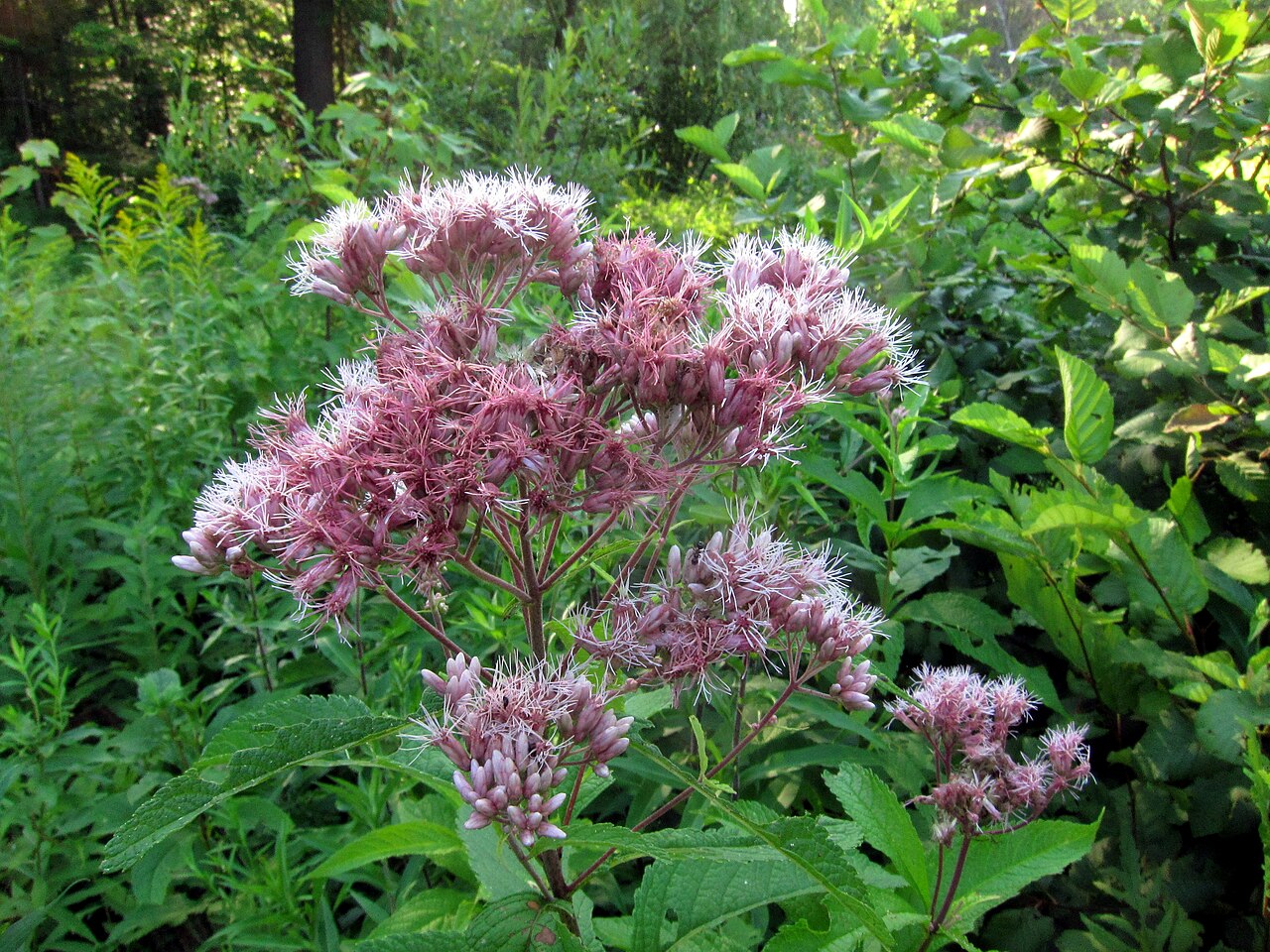
Sweet Joe-Pye weed (Eutrochium purpureum) is a tall, clump-forming perennial whose pinkish flower domes rise above summer foliage. It is particularly useful where a garden needs height without a woody shrub: a roomy border, an open woodland edge or a moist meadow planting. The flowers draw many insect visitors, and the standing seed heads extend the plant’s visual season after bloom.
This page is specifically about Eutrochium purpureum, historically Eupatorium purpureum. Joe-Pye weed is also the common name for several related species and garden selections. A link to spotted Joe-Pye weed or hollow-stemmed Joe-Pye weed is not an equivalent identification. The regional tables’ older names and one misspelling are reconciled here while keeping the plants’ actual identity clear.
Expect a substantial perennial, usually about 5–7 feet tall with a clump roughly 2–4 feet wide. A small spring shoot does not reveal its late-summer size. Give it room and dependable moisture rather than attempting to hold it at ankle height by repeated pruning. In a mixed planting, shorter perennials can occupy the foreground while the flower domes provide a background layer.
Identification
Stems and stature
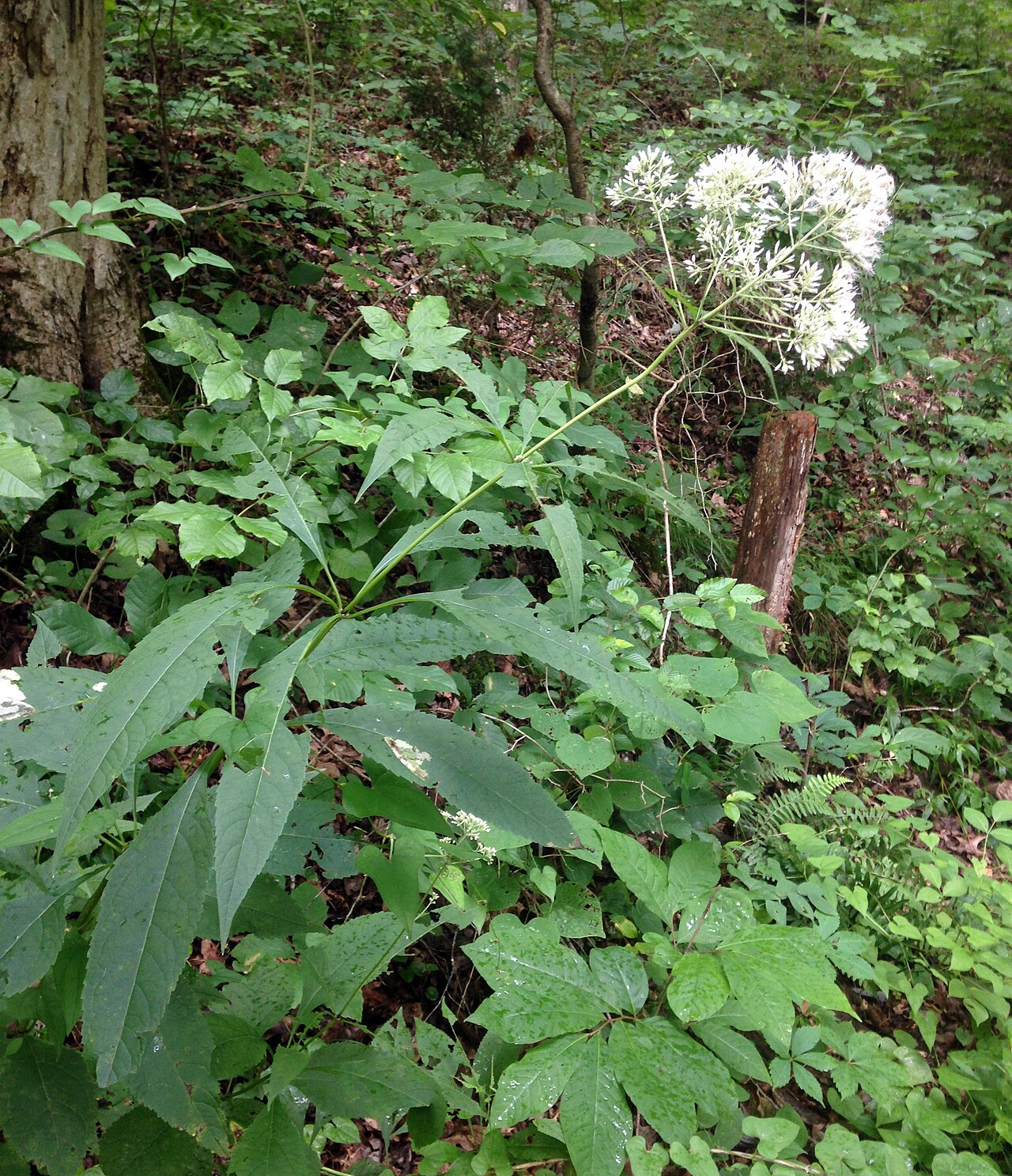
Flowering stems are erect and generally green, with purple concentrated around the leaf nodes. This pattern is a useful clue, not a complete identification by itself. The number of stems increases as a clump develops, and shaded plants may lean toward light. Compare a full flowering stem with a botanical key instead of deciding from the purple color of one stem segment.
Whorled leaves
Leaves occur in whorls, commonly three or four at a node. They are broad-lance-shaped to oval, pointed and toothed, with a paler lower surface. Photograph the attachment of several leaves to the same node when documenting a plant. A close-up that shows only a leaf blade loses one of the most informative features of the genus.
Flower heads
Numerous tiny tubular florets make up a broad, dome-shaped display in shades of dusty pink to purple. Unlike a daisy, there is no surrounding ring of large ray petals. The overall dome is composed of many small heads, so a sharp close-up and a picture of the whole cluster serve different identification purposes. Bloom commonly falls in summer into early autumn.
Seeds and similar species
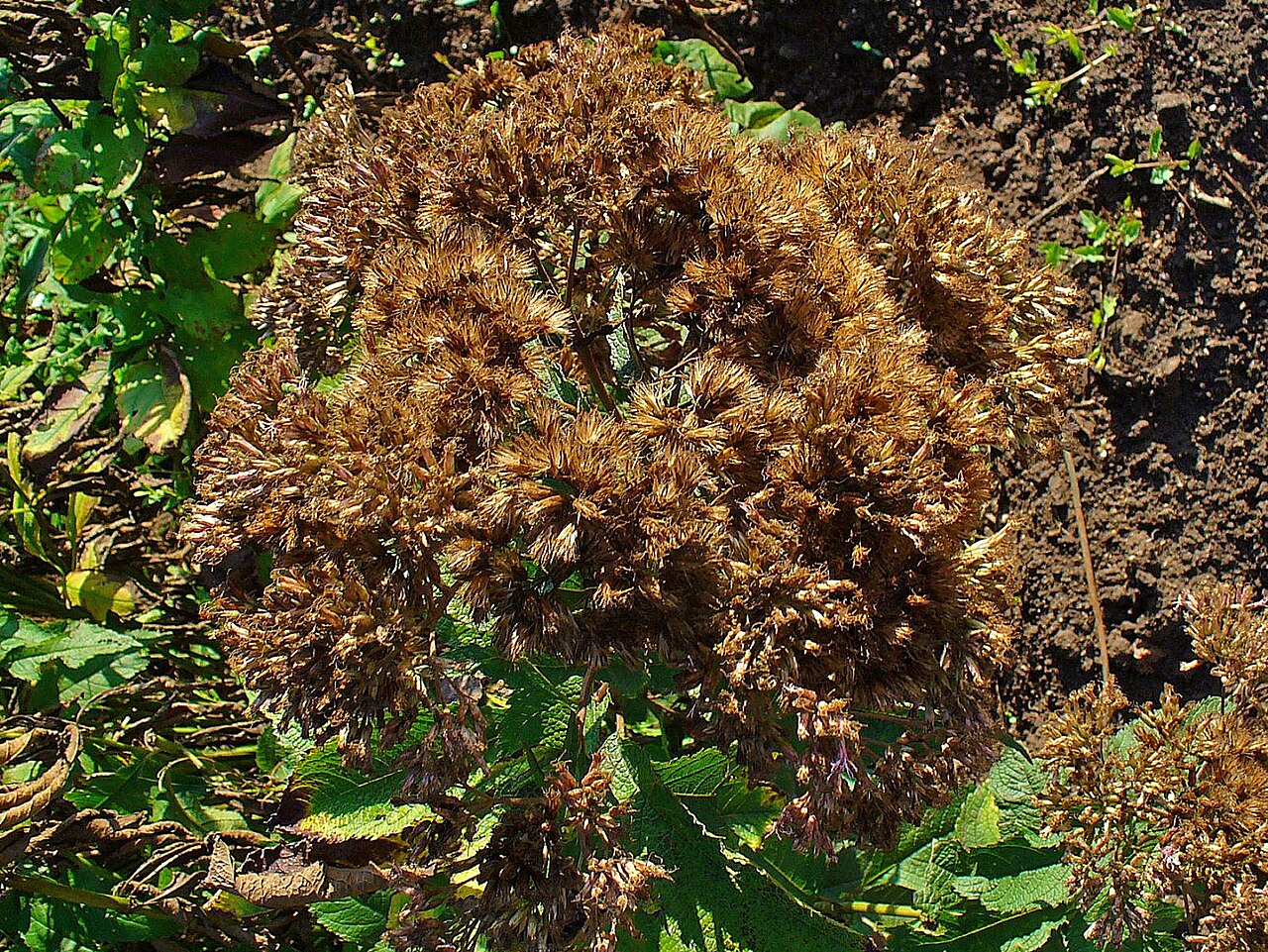
The dry fruits carry fine hairs that assist dispersal and make old flower heads fluffy. Related Eutrochium species can hybridize where they grow together, and cultivar names are sometimes used loosely in commerce. Check leaf whorls, stem markings, flower-head structure and habitat together. A plant sold as a compact Joe-Pye weed should not automatically be assigned to this species.
Quick Facts
| Scientific Name | Eutrochium purpureum; synonym Eupatorium purpureum |
| Family | Asteraceae |
| Plant Type | Clump-forming herbaceous perennial |
| Mature Height | Usually 5–7 ft |
| Mature Spread | About 2–4 ft |
| Growth Rate | Vigorous seasonal growth once established |
| Sun Exposure | Full sun to part shade |
| Water Needs | Moist soil; avoid prolonged drying |
| Soil Type | Loam, clay or sandy soil with moisture and drainage |
| Soil pH | Adaptable; site condition matters more than a narrow target |
| Bloom Time | Summer to early fall, commonly July–September |
| Flower Color | Pink to pinkish purple |
| Fall Color | Foliage declines; persistent brown seed heads |
| Fruit | Small dry, wind-dispersed fruits with hair tufts |
| Deer Resistant | Often less browsed, not deer-proof |
| USDA Hardiness Zones | Approximately 4–9 |
Native Range
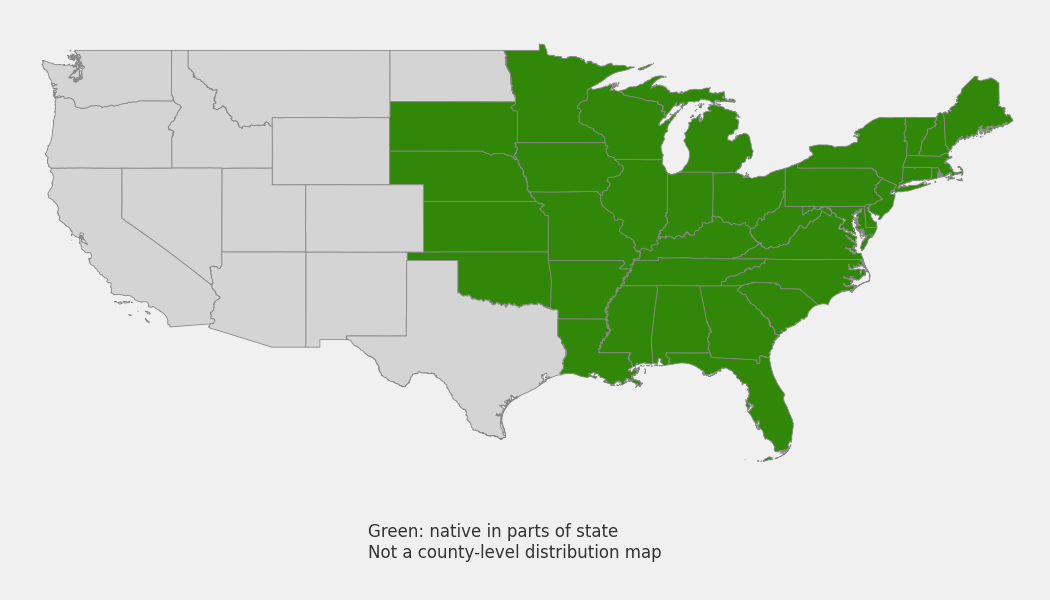
The native range covers much of eastern and central North America, extending into Ontario. For the map, the state list follows the broadly overlapping distributions reported by NC State and NatureServe, with Maine and South Dakota also represented in NatureServe’s treatment. This is a species-level summary; varieties and local records can require closer interpretation.
Natural settings include woodland borders, moist slopes, thickets and other sites with adequate summer moisture. It is not restricted to standing water, and it should not be confused with every wetland plant carrying the Joe-Pye name. The garden implication is straightforward: a fertile, moist edge with light is a better starting point than either an arid gravel bed or a permanently submerged pond shelf.
The regional lists span several parts of the native distribution, but local occurrence is still patchy. A shaded state does not mean every county or every planting site is appropriate. Where native provenance matters, ask for seed origin and species verification. A widely marketed cultivar may grow successfully without representing the local wild population. The combined Nebraska–Kansas–eastern Colorado list should not imply native status in Colorado, which is outside the native distribution used here.
📋 Regional plant list: Alabama, Georgia & Mississippi
Growing & Care Guide
Light and placement
Choose full sun to partial shade, adjusting for local heat and moisture. In hot summer climates, some afternoon shelter can reduce stress. In very dense shade, stems may become less sturdy and flowering may decline. Place the clump where mature height will not block a narrow path, window or a shorter plant that needs unobstructed light.
Moisture without stagnation
Water new plants deeply enough to moisten the developing root zone, then reassess soil moisture before repeating. The species can grow in several textures, but a compacted depression and a draining moist bed are not equivalent. If foliage wilts every afternoon, investigate whether the root ball is dry, roots are damaged, or the site is simply too exposed.
Planting and clump development
Install the crown at the nursery depth and allow room for a mature clump rather than spacing as if the plant were a small annual. Remove aggressive perennial weeds before planting; teasing them out of an established root mass later is difficult. A surface mulch can conserve moisture during establishment, but keep it from smothering the crown and emerging shoots.
Pruning decisions
Cutting back early in the season can produce shorter, branched growth, but it also changes the timing and shape of the display. Try this on only part of a planting if the goal is to compare results. Repeated late cuts can sacrifice flowering altogether. If height is persistently unacceptable, choose a genuinely smaller plant instead of imposing a maintenance cycle that defeats the reason for planting Joe-Pye weed.
Winter stems
Where site management allows, leave healthy seed heads and stems through part of winter for structure and wildlife use. Remove old growth before it tangles with the new season’s shoots. In a formal border, a selective cleanup can retain some standing stems while keeping paths clear. Diseased material should be handled according to the identified problem rather than left automatically.
Division and propagation
Established clumps can be divided when conditions allow new roots to develop without immediate heat stress. Keep divisions moist and replant promptly. Seed propagation is slower and may benefit from a cold, moist period; germination can be uneven. Seedlings from mixed Eutrochium plantings may not preserve a cultivar or even a straightforward parental identification, so label parent plants and seed lots.
Fertility and supports
A tall perennial in excessively rich soil can become harder to manage. Do not add fertilizer on a fixed schedule without assessing growth and soil needs. If stems lean, first consider light, crowding and wind exposure. Support can help a temporary problem, but moving a plant to a better site is often preferable to permanent staking of every stem.
Monitoring the planting
Check for crowding, repeated drought stress and damage at the crown. A few leaf-chewing insects are not by themselves a reason to spray a pollinator plant. Identify a pest before acting, and avoid pesticide exposure during bloom. Record the actual flowering season in your garden; that observation is more useful for designing continuous bloom than a catalog month range alone.
Landscape Uses
- Tall background layer in a moist native perennial border.
- Open woodland edge with enough light for flowering.
- Large pollinator garden with space for a mature clump.
- Naturalistic meadow margin rather than a permanently flooded pond interior.
Wildlife & Ecological Value
For pollinators
The many small flowers create a broad landing and feeding surface used by bees, butterflies and other visitors. Watching a plant across several days reveals more than a single photograph of a butterfly. Avoid spraying the flowers and combine them with earlier- and later-blooming natives to reduce seasonal gaps in forage.
For birds
Seed heads and standing stems add seasonal structure, and Extension reports bird use of the seeds. The plant should be part of a broader habitat planting with shrubs, cover and safe access to water, not treated as a complete bird garden by itself. Allow some heads to mature if seed and winter structure are among your goals.
For insects beyond flower visitors
A native perennial participates in more than nectar production: foliage and stems can support other organisms as well. Resist the expectation of flawless leaves throughout the season. Distinguish tolerable feeding from damage that threatens establishment, especially in the first year when the plant has a small reserve of roots.
Community value
A dense mass of one attractive species is not the same as a diverse meadow. Use sweet Joe-Pye weed with compatible locally native plants that occupy other heights and bloom windows. Its vigor and size need to be considered so that shorter neighbors are not gradually shaded out of the planting.
Cultural & Historical Uses
The older name Eupatorium purpureum remains common in nursery references and regional lists. The current genus Eutrochium helps distinguish Joe-Pye weeds from the many other plants once grouped broadly in Eupatorium. Keeping the synonym in a guide is useful for continuity, but an older spelling is not a reason to link the plant to a different modern species.
The common name Joe-Pye weed has a cultural history that is often retold in simplified or conflicting versions. This guide does not turn those stories into a medical recommendation or attribute a specific preparation to a community without a clear source. A species identity, a historical account and evidence of safe treatment are separate matters.
Its contemporary garden role is better documented: a large native perennial for summer display and insect visitation. Garden selections vary, and some familiar compact forms belong to related species. Preserve the botanical label when purchasing, dividing or exchanging a plant so that an attractive garden specimen does not become a new identification error in a regional list.
Frequently Asked Questions
Is Eupatorium purpureum the same plant?
Yes, that is the older combination for Eutrochium purpureum. Other species with Joe-Pye weed in their common names are not automatically synonyms.
Can I put it in dry shade?
That is not a recommended site. It tolerates partial shade but needs adequate moisture; shade tolerance does not imply drought tolerance.
Will it stay three feet tall?
The ordinary species is substantially taller, usually 5–7 feet. Verify a compact selection’s actual species and mature dimensions rather than relying on a generic Joe-Pye label.
Should I remove every spent flower?
Not necessarily. Leaving some heads permits seed development and gives winter structure. Remove unwanted seedlings or use selective deadheading where spread is a concern.
How can I tell it from spotted Joe-Pye weed?
Stem markings and leaf whorls help, but use several characters and a regional key. Hybrids and cultivated forms can make a single-character identification unreliable.
📋 Also listed: Nebraska, Kansas & Eastern Colorado — not native to Colorado
📋 Also listed: Southern New England
📋 Also listed: Iowa, Illinois & Missouri
📋 Also listed: Michigan, Minnesota & Wisconsin
Sources & Further Reading
- NC State Extension: Eutrochium purpureum
- NatureServe: range and taxonomic variation
- North Carolina flora: sweet Joe-Pye weed
- South Carolina Native Plant Society
Find Native Plants
Ask growers about nursery propagation and regional provenance. Browse our AL native plant nurseries, GA native plant nurseries, MS native plant nurseries, NE native plant nurseries, KS native plant nurseries, MA native plant nurseries, IL native plant nurseries, MI native plant nurseries directory for suppliers. Explore the native nursery finder.