
Prairie Ironweed (Vernonia fasciculata)
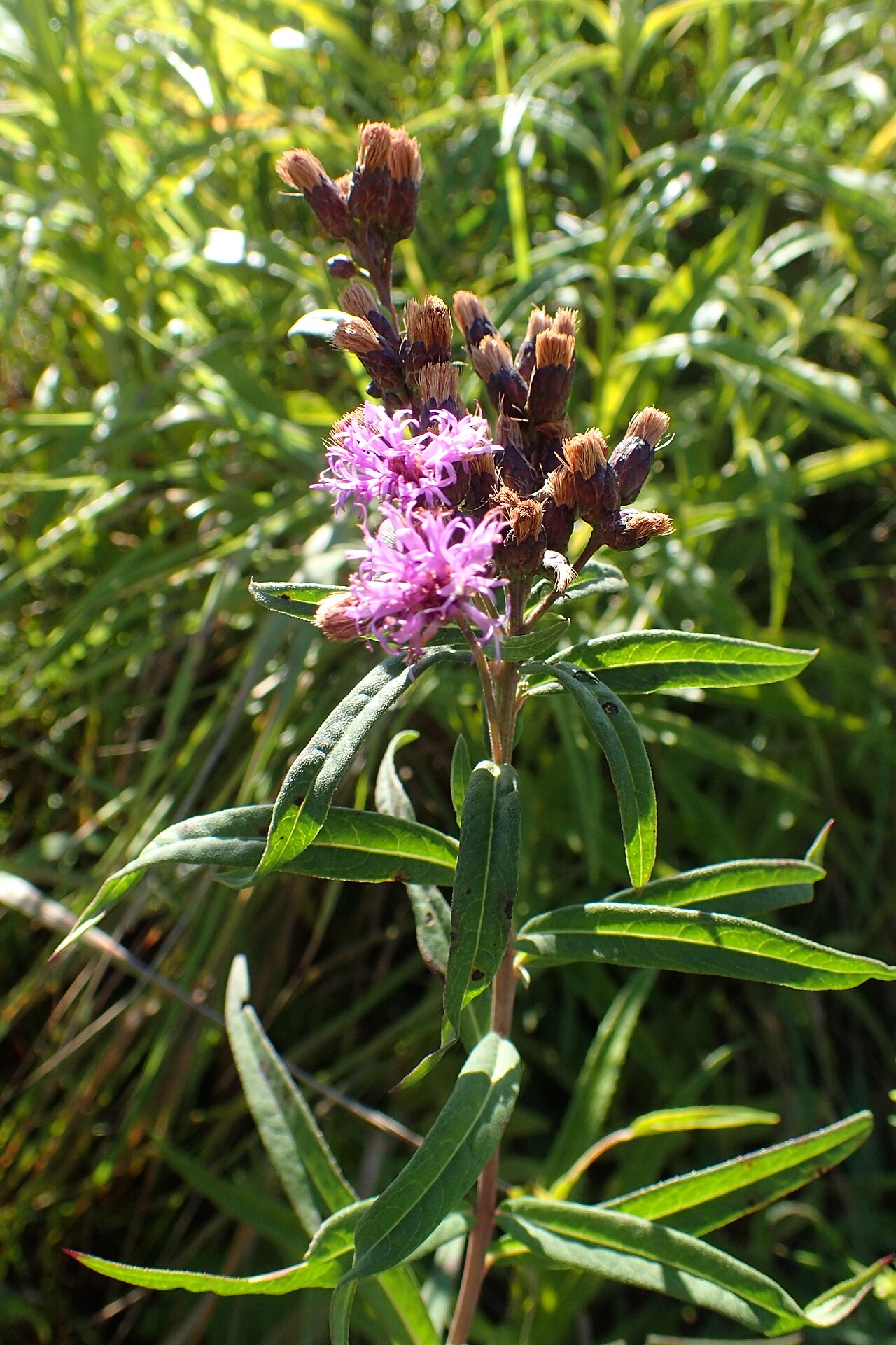
Prairie ironweed (Vernonia fasciculata) is a tall, upright native perennial with clusters of rich purple flower heads and narrow, toothed leaves. Also called smooth or fascicled ironweed, it belongs to the aster family but lacks the familiar ring of daisy petals. Each head consists entirely of small tubular florets, and the combined clusters make a strong block of color above meadow vegetation in late summer. It is especially useful where a garden has sun and dependable soil moisture.
Expect a substantial perennial, often 3–6 feet tall in regional botanical descriptions. A shorter plant on a drier site does not make it a small edging flower; plan for its mature height and give it space among compatible meadow plants. The common name ironweed reflects a durable-looking stem, not a requirement for iron fertilizer or a promise that the plant will thrive in drought. Moist prairie, shore margins, and wet meadow are better habitat models.
Prairie ironweed must be distinguished from New York ironweed, Vernonia noveboracensis, and other purple-flowered ironweeds. Earlier links in the Nebraska/Kansas and Dakota tables pointed to a different species. This page supplies the intended prairie species without treating every ironweed name as equivalent. Seed origin, leaf characters, head bracts, and a botanical identification are more useful than the common name alone when selecting plants for a regional native garden.
Identification
Stems & Growth Habit
The plant forms erect herbaceous stems that branch near the top into flower-bearing clusters. It usually retains a strong vertical outline, making it useful behind shorter meadow flowers. Stems are relatively smooth compared with some other ironweeds, but compare several characters rather than treating smoothness as the sole test. Old stems become firm and persistent after the growing season.
Leaves
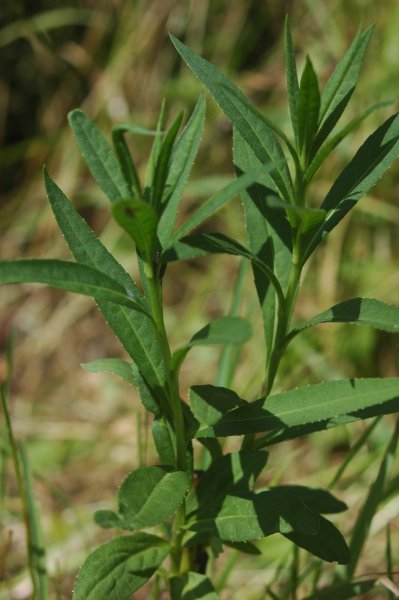
Leaves are alternate, narrow to lance-shaped, and toothed along their margins. The lower and middle leaves provide more information than the reduced leaves near the flower cluster. Their surfaces are often relatively smooth, which contributes to the name smooth ironweed. A close inspection of the underside, margins, and attachment is worthwhile when other Vernonia species grow nearby.
Flowers
Purple tubular florets form compact heads, and several heads combine into flat-topped or rounded clusters at the top of the stem. Minnesota Wildflowers describes heads with roughly 10–30 florets. There are no broad ray petals around a dark center. The overlapping bracts around the head are flattened and rounded, with fine hairs at their edges; these details help separate the species from ironweeds with more conspicuously pointed bracts.
Seeds & Late-season Heads
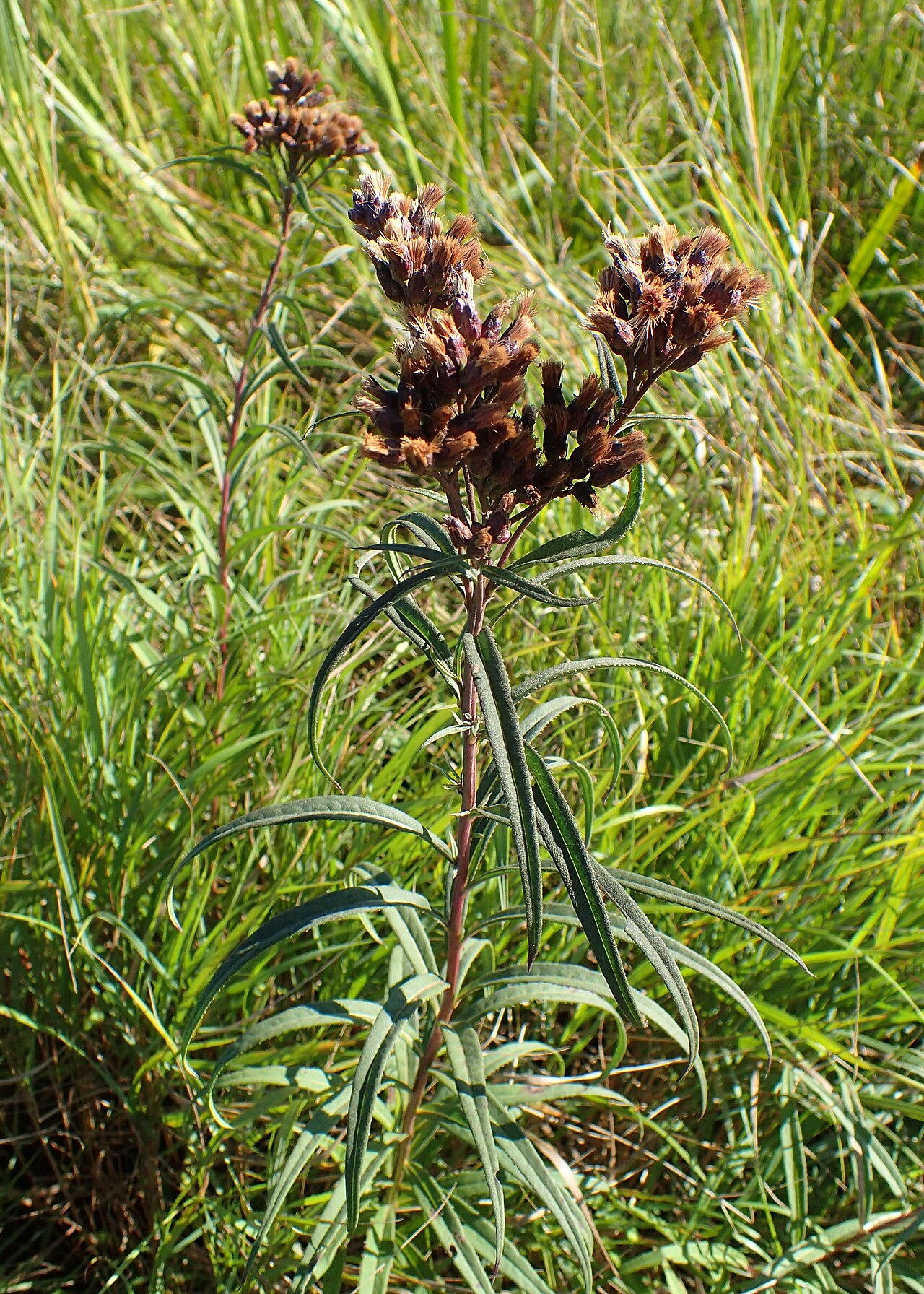
After flowering, the heads dry and become brownish with pale or rusty fluffy attachments on the fruits. These dry fruits are not berries. Allow heads to mature if you want to collect seed or permit limited self-sowing. The change from vivid purple to tawny seed structure is a normal seasonal progression rather than evidence that a flowering plant needs rescue fertilizer.
Other Ironweeds
New York ironweed, giant ironweed, and prairie ironweed differ in range and morphology. A plant photographed in a garden can be outside its native range and still be correctly identified, but a filename alone is weak evidence for a wild plant. The images selected here include documented botanical-garden material and a close leaf study; a geographically questionable generic image was not used.
Quick Facts
| Scientific Name | Vernonia fasciculata |
| Family | Asteraceae |
| Plant Type | Native herbaceous perennial |
| Mature Height | Typically 3–6 feet; site-dependent |
| Mature Spread | Clumping perennial; allow several feet of growing space |
| Growth Rate | Seasonal upright perennial growth |
| Sun Exposure | Full sun |
| Water Needs | Average to moist; best with dependable moisture |
| Soil Type | Moist prairie and meadow soils; avoid chronic drought |
| Soil pH | Adapt to local soil and source population |
| Bloom Time | July–September across much of its range |
| Flower Color | Purple to red-purple |
| Fall Color | Tawny seed heads; foliage senesces |
| Fruit | Dry one-seeded fruits with bristles |
| Deer Resistant | Often less favored than some neighbors, but browsing can occur |
| USDA Hardiness Zones | Locally adapted northern and central U.S. sources recommended |
Native Range
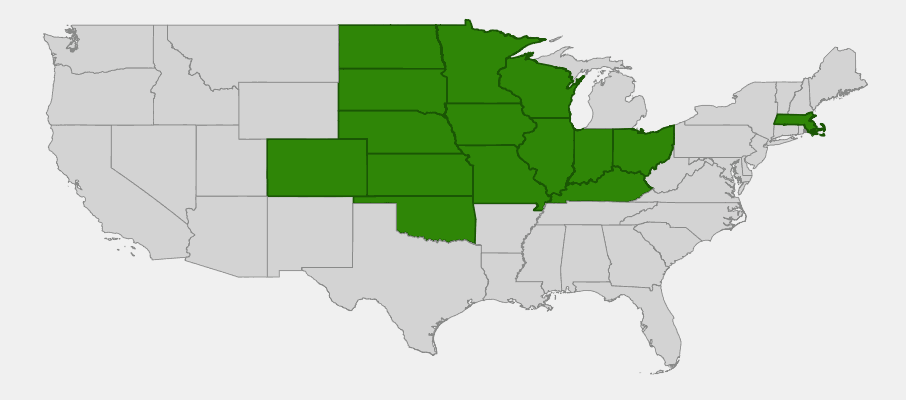
Prairie ironweed is native to central North America, including Manitoba and a broad group of central U.S. states. Kew’s native-state list includes Colorado, Illinois, Indiana, Iowa, Kansas, Kentucky, Massachusetts, Minnesota, Missouri, Nebraska, North Dakota, Ohio, Oklahoma, South Dakota, and Wisconsin. Its distribution is not continuous across every highlighted state, and peripheral records deserve local checking before restoration use.
Kew distinguishes New York occurrences as introduced rather than native. The prairie species must therefore not inherit the native range of New York ironweed simply because the two share a genus and flower color. In Canada, the documented Manitoba populations have a conservation significance that is not apparent from a continent-scale ornamental description. Consult the appropriate local conservation authority before collecting or disturbing a wild population.
Typical habitats include moist prairies, ditches, marsh edges, shores, and other sunny places with sustained moisture. The Nebraska/Kansas and Dakota list memberships are consistent with that central range. A hot, dry slope may be geographically within the range but ecologically unsuitable. Choose the microhabitat as carefully as the state, especially in regions where rainfall changes sharply from east to west.
📋 Regional plant list: Nebraska & Kansas
Growing & Care Guide
Light
Plant in full sun for strong stems and good flowering. A few hours of shade at the edge of a planting may be tolerated, but it should not be treated as a woodland understory flower. Check whether neighboring shrubs or tall grasses will shade it later in summer. In a small bed, placing the clump to the north of shorter flowers can help preserve their light while displaying the purple heads.
Soil & Water
Use average-to-moist soil and water new plants until roots establish. The species naturally occupies wetter settings than many dry-prairie flowers. Do not interpret a tough stem or the name ironweed as proof of drought adaptation. If a planting repeatedly wilts or flowers poorly in a dry site, reassess the site choice rather than increasing fertilizer. A moisture-retentive meadow position is a better long-term fit.
Planting Tips
Choose nursery-grown plants or responsibly produced seed of known origin. Set crowns at the original soil level, water in, and control competing turf during establishment. Allow for the full height and spread rather than spacing plants according to a small pot. A group can create a striking purple backdrop, but leave access for weeding and observation so the center does not become an unmanaged tangle.
Seasonal Maintenance
Leave some stems and heads standing after flowering for seasonal structure and seed development. Cut old stems when a spring cleanup is appropriate, taking care not to damage emerging growth. If seedlings appear outside the intended patch, remove or transplant them while small. Keeping a planned edge allows the plant to function naturally without overrunning a narrow path or a more delicate planting.
Pruning & Support
A well-sited plant usually provides its own vertical structure. If stems lean, examine shading, crowding, or excess fertility before adding permanent supports. A selective early-season trim can change height and flowering behavior, but it is not necessary routine care and should be tried on only part of a planting. Avoid removing all developing buds when late-season flowers are the main purpose of the bed.
Propagation
Use a documented seed protocol from a regional native-plant grower, or divide established garden clumps when conditions allow careful root handling and aftercare. Keep source information with seed and divisions. Do not collect from protected populations, including conservation-sensitive populations near the northern edge of the range. A garden-grown seed lot may contain crosses when related ironweeds flower nearby, so do not label such seedlings as restoration-grade material without further verification.
Troubleshooting
A plant that remains small may be establishing, competing with dense roots, or short of moisture. Check soil and light before assuming nutrient deficiency. Some insect feeding is expected in a native garden and does not automatically threaten the plant. If flowers, leaf shape, or bracts look unlike the description, investigate identity; no care adjustment can turn another Vernonia into prairie ironweed.
Landscape Uses
- A tall purple accent in a sunny moist native border.
- A component of locally designed wet-meadow or prairie plantings.
- A backdrop to shorter native flowers where roots can access dependable moisture.
- A close-observation planting for composite flower heads and late-season seeds.
Wildlife & Ecological Value
For Pollinators
The clustered tubular flowers attract a variety of visiting insects, including bees and butterflies. Place several compatible native species around it to extend flowering beyond the ironweed season. Avoid insecticides on blooming plants, and do not assume that a large mass of one flower replaces the diversity needed by different insects. Watch actual visitors and use that information to improve the planting.
For Birds
Standing stems and mature heads add structure to a meadow planting and keep seeds and associated insects available. This is not a claim that prairie ironweed alone supplies complete bird habitat. Combine it with locally native grasses and shrubs where space permits. Retaining a portion of the winter stems can be compatible with a tidy path or border edge.
For Other Wildlife
A native planting supports more than the large butterflies most easily noticed on flowers. Small insects can use stems, leaves, or the surrounding litter. Tolerate modest feeding where the plant remains healthy. Browse resistance is relative, and young plants may still need protection if deer or rabbits repeatedly remove new shoots.
Conservation & Habitat
The Canadian recovery strategy shows that a species familiar in gardens can be rare at the edge of its natural range. Protecting habitat, hydrology, and documented wild populations is different from growing an ornamental specimen. Use commercial propagated material for gardens and leave conservation work to locally appropriate plans. Do not move plants into wetlands simply because they are native somewhere on the continent.
Cultural & Historical Uses
The names prairie ironweed, smooth ironweed, and fascicled ironweed emphasize habitat, surface texture, and clustered growth. Older literature may use names such as Vernonia corymbosa or subordinate forms now included in the species by Kew. Such synonymy is useful for finding records, but it does not make every purple ironweed an equivalent plant.
This page corrects a practical directory problem: common-name linking had sent prairie ironweed readers to another species. Keeping the scientific identity visible allows gardeners to compare native range and moisture needs accurately. It also helps nurseries communicate what they actually sell rather than relying on a name shared across a large genus.
No unverified medicinal or ceremonial use is supplied here. The plant’s documented botanical and ecological interest is enough to justify its place in a native garden. Where it is protected or uncommon, responsible propagation and habitat conservation matter more than acquiring a wild specimen for display.
Frequently Asked Questions
Is this New York ironweed?
No. Prairie ironweed is Vernonia fasciculata; New York ironweed is V. noveboracensis. Common-name similarity caused earlier incorrect links.
Will it thrive in a dry xeric bed?
It is better suited to average-to-moist sunny soil. Choose a dry-prairie species for a site that remains droughty.
How tall should I plan for?
Allow for roughly 3–6 feet under suitable conditions rather than treating a small nursery pot as its final size.
Are the flowers crimson?
They are purple to red-purple. The old table’s crimson description was too imprecise and has been corrected.
Can I collect it from the wild?
Use responsibly propagated material. Some peripheral populations have conservation status, and collection requires permission and local legal review.
📋 Also listed: North & South Dakota
Sources & Further Reading
- Kew Plants of the World Online — Vernonia fasciculata
- Minnesota Wildflowers — Prairie Ironweed
- Missouri Department of Conservation — Prairie Ironweed
- Environment and Climate Change Canada — recovery strategy
Find Native Plants
Ask growers about nursery propagation and regional provenance. Browse our NE native plant nurseries, KS native plant nurseries, ND native plant nurseries, SD native plant nurseries directory for suppliers. Explore the native nursery finder.