Wyoming Paintbrush (Castilleja linariifolia)
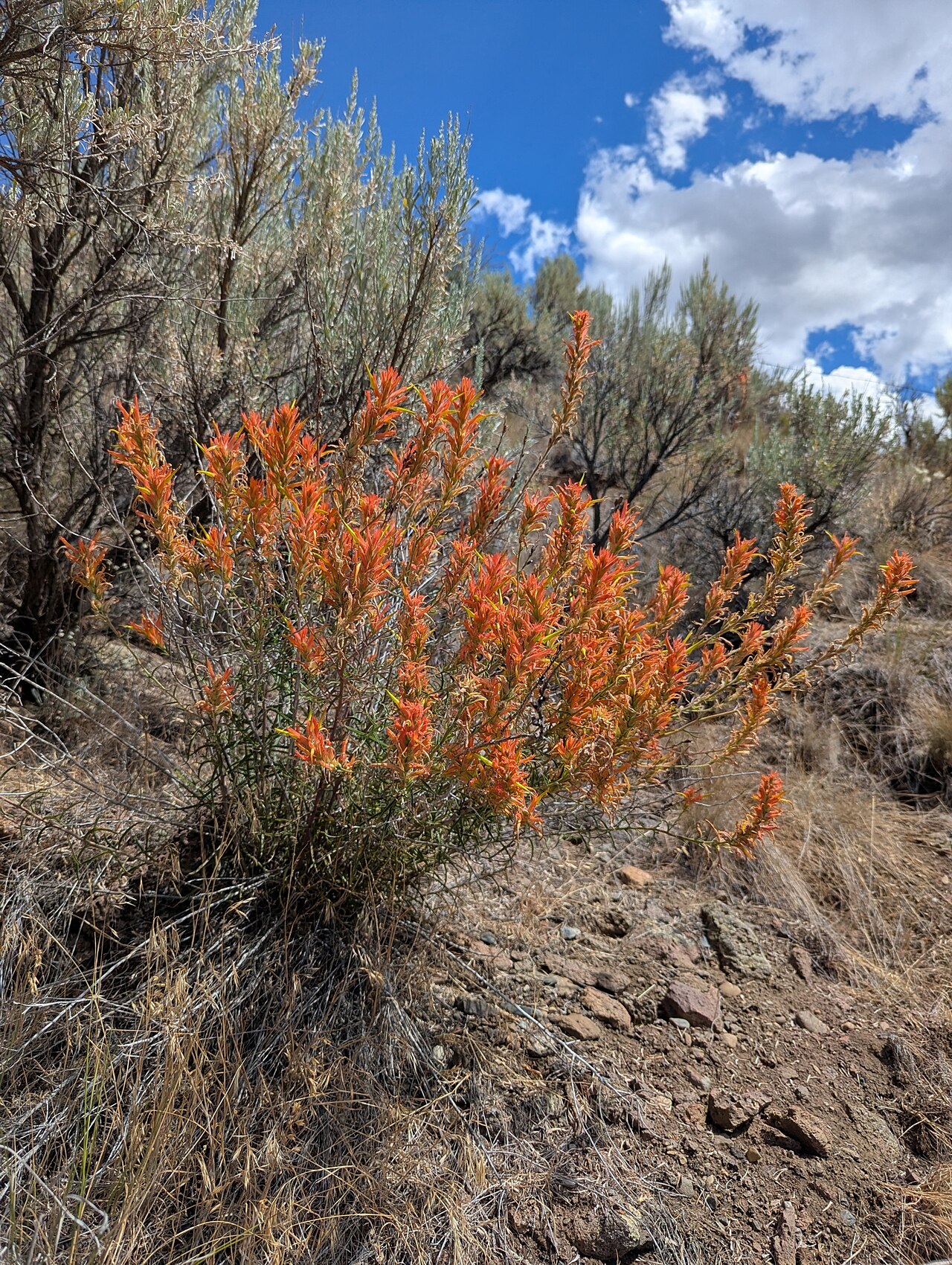
Wyoming Paintbrush (<em>Castilleja linariifolia</em>) brings narrow flames of orange and scarlet to sagebrush country, dry mountain slopes and open western woodlands. The display comes mainly from colored bracts rather than large petals. Small tubular flowers project from those bracts, providing the close-up detail behind a plant that is often noticed first as a bright patch against gray-green shrubs.
This is a western perennial, not a generic paintbrush suitable for every North American garden. It is native to Utah and Colorado, the region associated with this page, and to eight other western states. Its green leaves manufacture food, but specialized root connections can draw water and nutrients from neighboring plants. That hemiparasitic habit is central to successful establishment: a pot of paintbrush alone does not represent the entire growing system.
For a native landscape, think of Wyoming paintbrush as a member of a plant community rather than a replaceable bedding annual. Start with correctly identified nursery-grown material or documented seed, retain compatible companions, and avoid digging wild clumps. A dry sunny setting can be appropriate once established, while germinating seedlings still require attentive moisture. The distinction explains why an attractive wildflower can be challenging in an ordinary irrigated flower bed.
Identification
Growth habit
Plants produce upright flowering stems from a perennial base. The National Park Service describes a broad height range of roughly 8–31 inches; regional Forest Service accounts allow plants near three feet. Exposure, elevation and moisture affect stature, so a short individual is not automatically another species. Stems may be reddish or purplish and carry the narrow leaves that give this paintbrush its scientific name.
Leaves
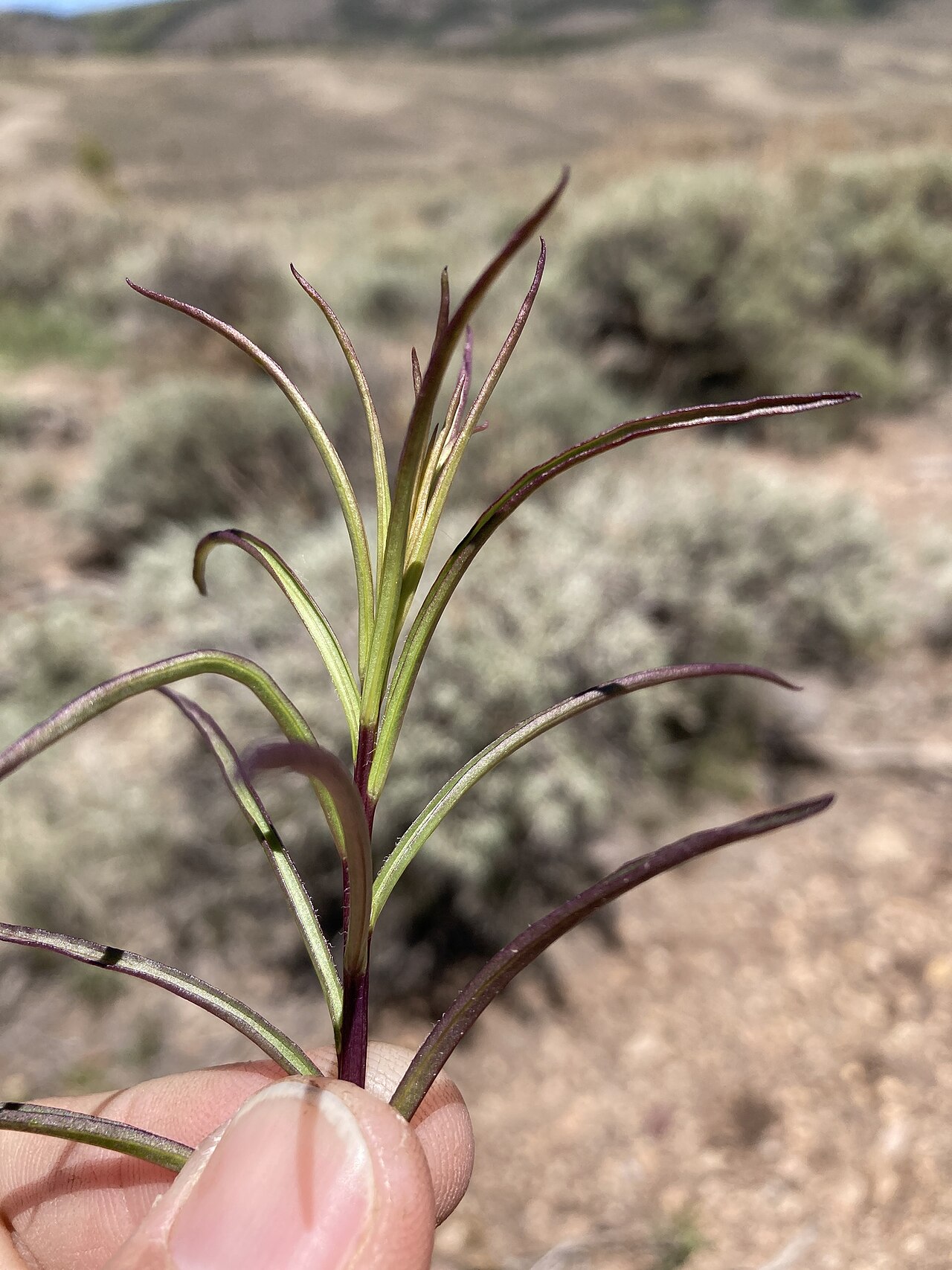
Leaves are alternate and notably narrow, sometimes divided into slender spreading lobes. The leaf segments are much finer than the broad entire leaves of scarlet paintbrush, <em>Castilleja miniata</em>. Look at several leaves along a stem rather than identifying the plant from red color alone. Hairiness varies, and the leafy upper portion can appear finely cut when the bracts are also divided.
Flowers and colored bracts
The red to orange structures surrounding the flowers are bracts, which are modified leaves. Actual flowers are slender tubes with a projecting upper lip; their greenish tips may look like small horns between the colored parts. Flowering generally falls from late spring into summer, moving later at cooler elevations. Color is useful for finding a plant, but calyx structure, leaves and locality are more useful for confirming it.
Fruit and seasonal appearance
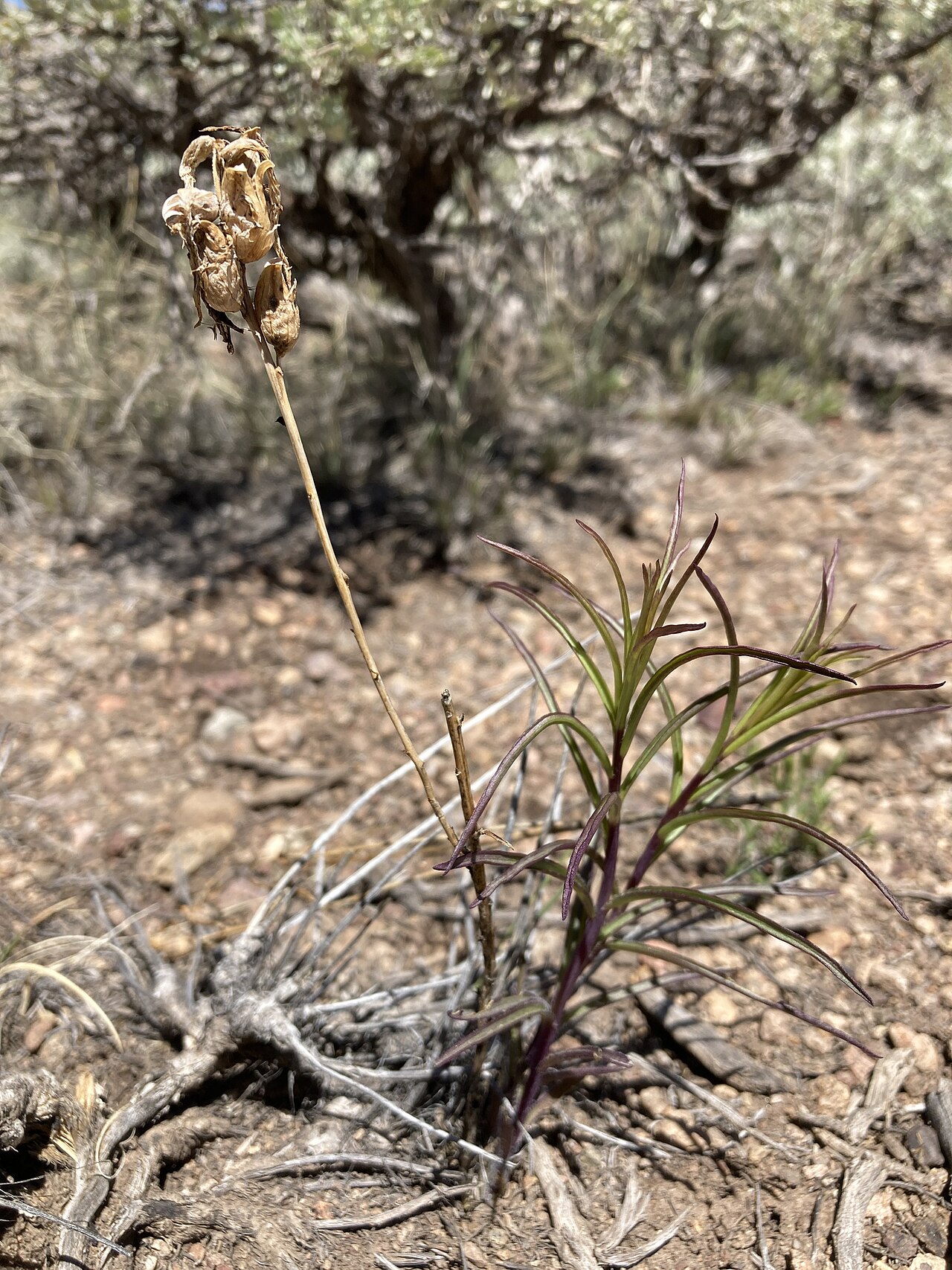
After flowering, dry capsules develop among fading bracts and release numerous small seeds. Old capsules may remain on an otherwise bare stem while new leaves appear near the perennial base. That combination is visible in the Colorado photograph below. A dormant plant should not be judged dead solely because last year’s flowering stems have dried.
Similar species
Western North America contains many paintbrush species, including forms with overlapping red or orange bracts. Wyoming paintbrush usually occupies drier sites and has narrower leaves than scarlet paintbrush. Historical spelling <em>Castilleja linariaefolia</em> appears in older lists; the accepted spelling used here is <em>C. linariifolia</em>. A regional flora or knowledgeable grower is preferable to matching a single photograph when the identity is uncertain.
Quick Facts
| Scientific Name | Castilleja linariifolia Benth. |
| Family | Orobanchaceae (broomrape family) |
| Plant Type | Herbaceous perennial; root hemiparasite |
| Mature Height | About 8–36 inches, varying by site |
| Mature Spread | Small clump; allow room for companion plants |
| Growth Rate | Establishment can be slow or unpredictable |
| Sun Exposure | Full sun to open, light woodland conditions |
| Water Needs | Low after establishment on suitable sites; seedlings need moisture |
| Soil Type | Well-drained mineral soils, including rocky slopes |
| Soil pH | Match local provenance; avoid an unsupported universal pH target |
| Bloom Time | Late spring through summer, elevation dependent |
| Flower Color | Red to orange bracts; small tubular flowers |
| Fall Color | Stems and bracts dry to brown |
| Fruit | Dry capsules with small seeds |
| Deer Resistant | Not guaranteed; protect young plants if browsing occurs |
| USDA Hardiness Zones | Use locally adapted provenance rather than a universal zone promise |
Native Range
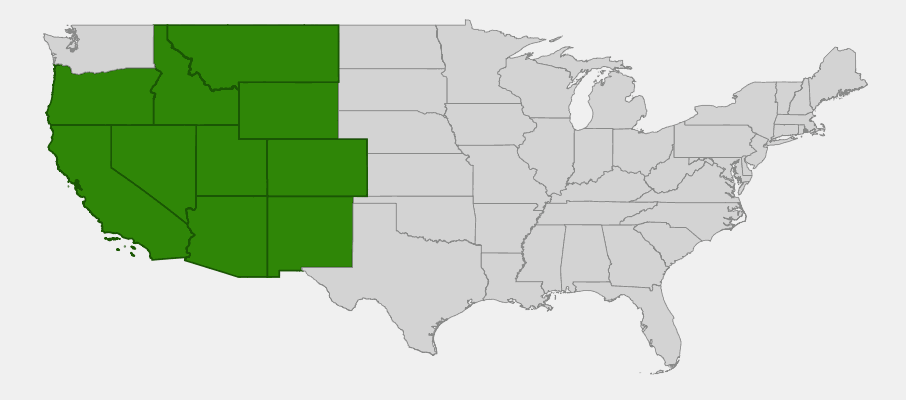
Kew’s Plants of the World Online lists Wyoming paintbrush as native in Arizona, California, Colorado, Idaho, Montana, Nevada, New Mexico, Oregon, Utah and Wyoming. The map below uses that state-level native list. Washington and the eastern states are not included, and a garden photograph outside the range would not establish nativity there.
Within those states, occurrence is patchy rather than continuous. Sagebrush vegetation, open slopes and pinyon-juniper woodland provide familiar settings. Research on Utah seed populations included both woodland and mountain-meadow origins, showing that local environment matters even within one species. A seed lot from a warmer dry slope may not behave like one from a colder mountain site.
The map is an orientation tool, not a planting prescription. Match county-level records, elevation, seasonal precipitation and plant community when choosing material for restoration. In a home garden, select a nursery that can identify the species and explain its propagation history. The same common name is applied to several different paintbrushes.
📋 Regional plant list: Utah & Western Colorado
Growing & Care Guide
Site selection
Choose an open position with good drainage and companions already suited to the same conditions. Avoid a low pocket that stays wet after irrigation. A dryland bed with mineral soil is a better starting point than a deep layer of rich compost. Observe where water collects in winter as well as in summer: crown saturation can be a different problem from short-term surface dryness.
Companion and host plants
Paintbrush roots can form haustorial connections with other plants. Nursery guidance commonly uses a modest native grass or an appropriate <em>Artemisia</em> as a companion. Do not interpret a wild plant growing beside sagebrush as proof that only that shrub can serve as a host. The practical goal is a compatible, nonaggressive neighbor with overlapping roots and similar light and water requirements.
Planting nursery material
Ask whether a purchased plant has been grown with a companion in the same container. Keep that root association intact when possible. Set the plug at its existing soil level and disturb the root ball as little as practical. Water the planting zone to settle soil, then adjust irrigation to conditions rather than following a fixed daily schedule. Mark the location so a small plant is not accidentally weeded out.
Water and establishment
A mature plant on a suitable dry slope may need little supplemental irrigation, but a small plug has not yet developed the same root access. Check moisture below the surface during establishment and water when that root zone begins to dry. Repeated light sprinkling can leave deeper roots dry while encouraging weeds. Conversely, constant saturation is not a substitute for a functioning companion-root system.
Soil and feeding
Use a well-drained substrate appropriate to local native plants. Heavy fertilizer is not a reliable solution to stalled paintbrush growth and can favor competing vegetation. If a plant struggles, first consider drainage, transplant disturbance, provenance and companion establishment. Avoid adding lime or acidifying products simply because an internet plant list supplies a pH number without evidence for this species.
Growing from seed
Fall sowing outdoors allows natural winter chilling, provided the seedbed is protected from erosion and drying. Controlled studies of Utah seed lots found that dormancy response varied markedly among populations: some lower-elevation collections responded to relatively short chilling, while a mountain collection benefited from a longer treatment. Follow the seed supplier’s documented protocol rather than treating every packet as identical.
Managing seedlings
Because the seeds are small, use a prepared fine surface and avoid deep burial. Maintain moisture through germination without sealing the surface under a heavy mulch. If raising plants in containers, arrange compatible companions early and avoid allowing a vigorous host to shade out the paintbrush. Label the seed source and treatment dates; those records are more useful than assuming one failed tray proves the species cannot grow locally.
Pruning and annual care
Leave some flowering stems to mature if seed production is wanted. Remove dead stems carefully after they have finished their seasonal role, avoiding new growth at the base. This is not a shrub that benefits from routine shearing into shape. Keep aggressive weeds from crowding the crown while retaining intentional companions; indiscriminate cleanup can remove part of the system supporting the plant.
Troubleshooting
Poor survival after transplanting is common enough that wild collection is especially inappropriate. A plant that germinates but stalls may be experiencing a mismatch in substrate, moisture or companion conditions. Examine those factors before applying pesticides or fertilizer. If a purchased plant repeatedly fails in an irrigated border, a locally easier native perennial may be a better choice than repeatedly replacing it.
Landscape Uses
- A small group in a western native planting can provide a strong seasonal accent without requiring a mass of closely spaced plants. Position it where the bracts can be seen against grasses or shrubs, while keeping enough open space for the plant to remain visible. Its slender stems are particularly effective in a naturalistic composition rather than a rigid formal border.
- For educational gardens, paintbrush illustrates a useful ecological lesson: green plants can photosynthesize and still obtain resources through root relationships. A label explaining bracts, tubular flowers and hemiparasitism makes the planting more informative than a generic “red wildflower” display. Avoid disturbing roots to demonstrate the relationship.
- Restoration use requires more than buying a packet labeled Indian paintbrush. Species identity, seed provenance, weed pressure and the surrounding community all influence results. Begin with a small documented trial, keep records through more than one season, and use locally appropriate restoration guidance before expanding a project.
Wildlife & Ecological Value
Hummingbirds and floral visitors
The tubular flowers and bright bracts are associated with hummingbird visitation, and the regional table highlights that attraction. Retaining nearby cover and a sequence of other native blooms can make the wider planting useful beyond the paintbrush’s flowering period. Avoid promising that one plant will bring a particular bird to every garden.
A community rather than an isolated specimen
The plant’s root relationships make it part of a belowground network of neighboring vegetation. Protecting that context is an ecological benefit in itself. In a garden, minimizing unnecessary soil disturbance around established plants is sensible care, especially where their companions are also native and well adapted.
Seed and habitat structure
Dry flowering stems contribute small-scale structure after the bright display fades. Leave a portion through seed maturation when practical, especially in a naturalistic planting. Where paths require tidiness, manage the edge rather than removing every stem immediately after flowering.
Cultural & Historical Uses
Wyoming paintbrush is widely recognized as Wyoming’s state flower, but its natural range extends well beyond that state. The common name should not be read as a range boundary. In Utah and Colorado it belongs to the same broader western flora, expressed through locally different soils, elevations and communities.
The botanical name refers to the narrow, flaxlike foliage. Older references may place paintbrushes in Scrophulariaceae, whereas modern classifications place <em>Castilleja</em> in Orobanchaceae. Those changes explain why an older park page can carry a different family heading without referring to a different plant.
Its horticultural appeal has sometimes encouraged attempts to move flowering plants from wild sites. A more responsible modern approach is nursery propagation and seed-source documentation. That protects existing populations and gives gardeners a better chance of obtaining plants whose growing history is known.
Frequently Asked Questions
Are the red parts the flowers?
Mostly they are colored bracts surrounding much smaller tubular flowers. Look for the projecting flower tips among the red or orange structures.
Does it need another plant nearby?
Compatible companion roots are an important part of successful cultivation. It is a green hemiparasite, not a plant that obtains all its energy from a host. Ask the nursery how its plants were raised.
Can I dig a clump from the wild?
Do not use wild digging as a propagation method. Root disturbance and loss of associated roots make survival unreliable, and collection may be prohibited. Choose nursery-grown plants or responsibly sourced seed.
Why did my seed fail despite chilling?
Seed-lot dormancy varies, and germination also depends on moisture, temperature and viable seed. Utah research found differing chilling responses among populations. Use provenance-specific guidance and keep treatment records.
Is it suitable outside the western states?
It can be attempted horticulturally elsewhere, but that does not make it native there. For an ecological native garden outside the mapped range, select a paintbrush or another wildflower naturally occurring in your region.
Sources & Further Reading
- Kew: accepted name and native distribution
- National Park Service: linearleaf paintbrush identification
- US Forest Service: comparative Castilleja seed germination
- Native Plants Journal: propagation protocol for Indian paintbrush
- Front Range Wild Ones: germination guide
Find Native Plants
Ask growers about nursery propagation and regional provenance. Browse our UT native plant nurseries, CO native plant nurseries directory for suppliers. Explore the native nursery finder.