
Plains Coreopsis (Coreopsis tinctoria)
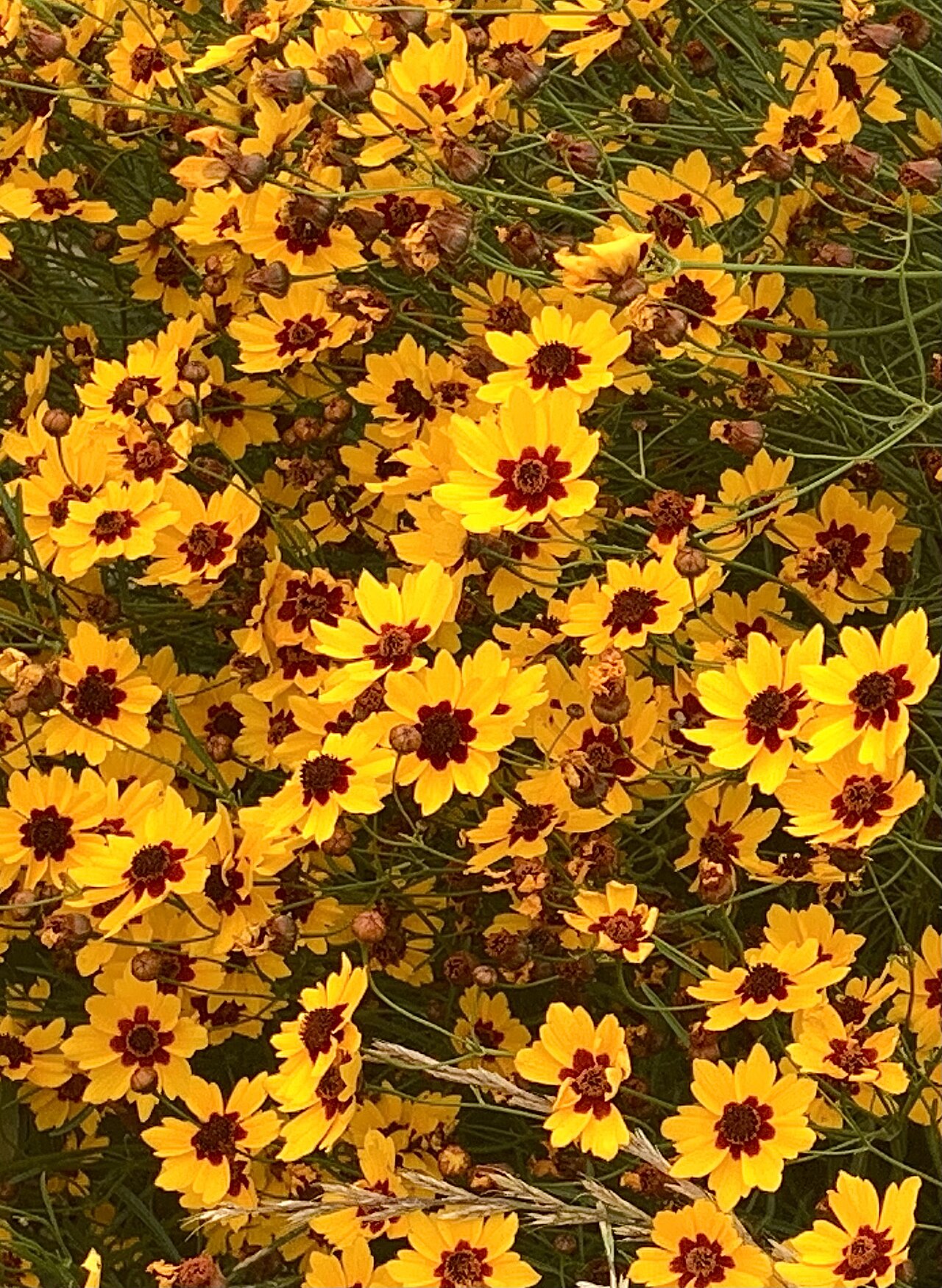
Plains coreopsis fills open sunny ground with small yellow flower heads marked by a red-brown or maroon center. Its fine foliage and branching stems give the display an airy quality rather than the heavy mass of a large sunflower. In the right setting it is an effective early contributor to a developing meadow or a colorful annual component among slower-growing native perennials.
Coreopsis tinctoria is an annual, not a long-lived perennial clump. A patch may return for several years because new seedlings replace the previous generation. This distinction explains why a planting can flourish one season and diminish as dense grasses or mulch close the bare ground needed for germination. Plan for its life cycle rather than expecting each individual plant to persist indefinitely.
The species is North American, but its precise native range is complicated by extensive cultivation and naturalization. Broad databases and regional floras disagree at the margins. It is not appropriate to describe every roadside or garden escape as native merely because the species originated on this continent. The range section below separates a conservative native core from those regional uncertainties.
Identification
Annual growth
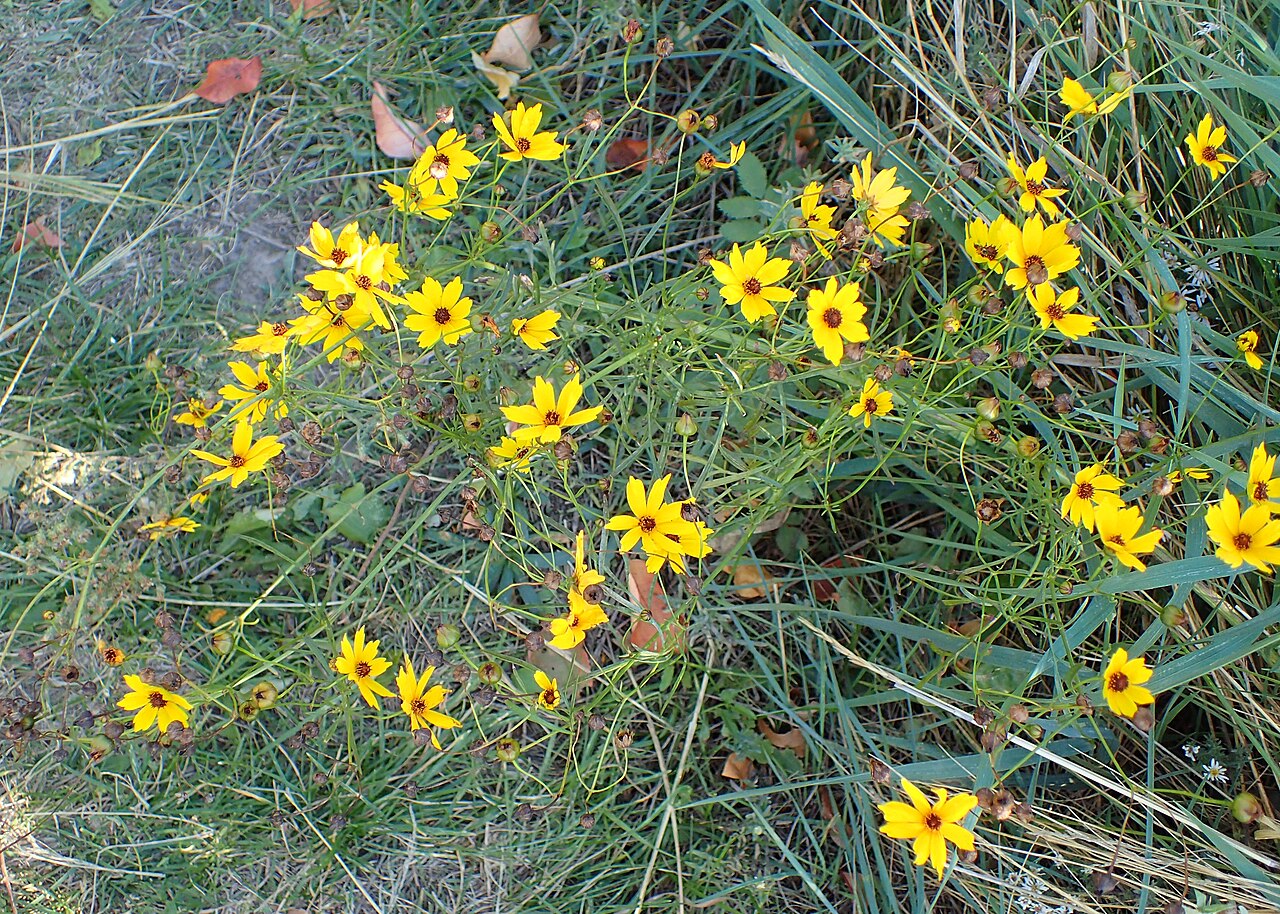
Plants develop a branching stem system from an annual root system. Some seed germinates in fall and overwinters as a low rosette, while other seedlings emerge in spring. Mature plants can reach about 2–4 feet under favorable conditions, though smaller plants occur in less favorable sites. A returning patch usually represents seedlings, not the same perennial crowns surviving year after year.
Fine leaves
Leaves are opposite and deeply divided, with particularly narrow segments toward the upper stems. This fine texture is useful for separating the species from some broader-leaved tickseeds. Look at the whole plant rather than only a flower head. Several garden Coreopsis cultivars and hybrids have superficially similar yellow-and-red flowers but a different life cycle or leaf form.
Yellow and maroon heads
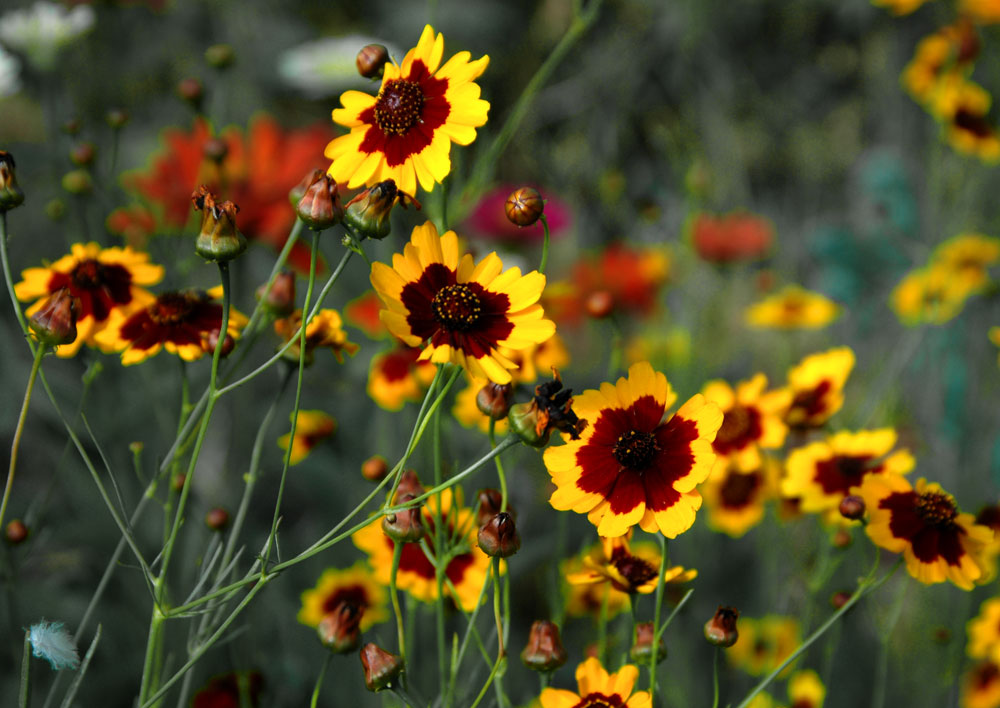
The flower heads have yellow outer rays, often with a maroon or red-brown basal area, surrounding a darker central disk. Ray tips are notched. Color proportions vary, so a broad maroon ring is not by itself a reliable cultivar or species diagnosis. The combination of flower structure, finely divided foliage, branching habit, and annual life cycle is more informative.
Seed development
As heads mature, petals fade and small dry fruits develop. Seeds can be abundant, which helps the plant recolonize open soil. A spent head is therefore part of the next generation rather than simply a blemish to remove. If you want a patch to renew itself, leave some mature heads; if you need strict boundaries, manage seed production before dispersal.
Avoiding mislabeled garden forms
The name Coreopsis is attached to many cultivated plants, including perennial hybrids. A nursery series with cream-colored flowers should not automatically be used as a photograph or description of wild C. tinctoria. For a native seed project, buy a correctly named species seed lot with known origin. Keep the package and label so later observations can be connected to the material actually planted.
Quick Facts
| Scientific Name | Coreopsis tinctoria |
| Family | Asteraceae (aster family) |
| Plant Type | Annual wildflower; may overwinter as a rosette |
| Mature Height | Commonly 2–4 feet; conditions and selections vary |
| Mature Spread | Airy branching annual; seedlings can form broad patches |
| Growth Rate | Fast within a growing season |
| Sun Exposure | Full sun; tolerates light shade |
| Water Needs | Average moisture with drainage; drought response varies by site |
| Soil Type | Well-drained sandy, loamy or clay-influenced soils |
| Soil pH | Adaptable; avoid unnecessary amendment without a soil test |
| Bloom Time | Summer, potentially continuing into fall |
| Flower Color | Yellow with maroon to red-brown markings |
| Fall Color | Annual stems brown as seed matures |
| Fruit | Small dry one-seeded fruits |
| Deer Resistant | Not a reliable exclusion strategy; local browsing varies |
| USDA Hardiness Zones | Annual life cycle; sowing season and provenance matter more than perennial hardiness |
Native Range
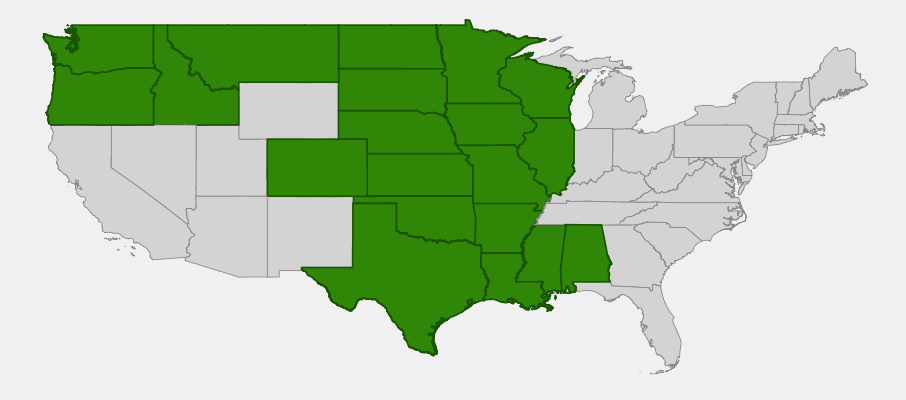
The map is a conservative summary of the central and northwestern native core supported by BONAP’s county map, rather than a complete depiction of every occurrence. It highlights Washington, Oregon, Idaho, Montana, North Dakota, South Dakota, Minnesota, Wisconsin, Iowa, Illinois, Nebraska, Kansas, Missouri, Colorado, Oklahoma, Texas, Arkansas, Louisiana, Mississippi, and Alabama. Unshaded states should not be interpreted as proof of absence; some contain naturalized populations or disputed native records.
Kew and GRIN give a much broader North American native distribution, but regional sources make important distinctions. Calflora treats California plants as nonnative, Native Plant Trust treats New England plants as introduced, and NC State describes North Carolina occurrences as naturalized. E-Flora BC distinguishes a native northwestern form from garden escapes of another variety. Those disagreements are why this guide avoids presenting a nearly nationwide occurrence map as an uncomplicated native-range map.
Illinois, Iowa, and Missouri are included in the central range used here, but a local population and its seed origin still matter for restoration. Natural habitats and established stands often include open moist ground, prairies, and disturbed sites. A packet labeled wildflower mix can contain plants from many regions, so check the actual species and source rather than assuming that every colorful annual in the mix is local.
📋 Regional plant list: Illinois, Iowa & Missouri
Growing & Care Guide
Prepare an open seedbed
Annual seedlings need contact with soil and room to grow. Remove established weeds from the intended area and create a firm surface rather than sowing into a deep layer of mulch. In a small bed, careful hand preparation is preferable to disturbing a large area unnecessarily. Do not scatter a seed packet into dense turf and expect the flowers to overcome an established root mat.
Choose the sowing season
Follow regional guidance for fall or spring sowing. In suitable climates, fall seedlings can overwinter as rosettes; elsewhere spring sowing may be more practical. A calendar date from a distant climate is not a universal rule. Consider soil moisture, expected freezing, and the seed supplier’s instructions for that particular lot. Keep a small labeled trial if you are learning how it behaves locally.
Sow shallowly
The seeds are small and should remain close to the surface with good soil contact. Avoid burying them as deeply as a large vegetable seed. A light pressing or gentle surface treatment can secure them without creating a thick covering. Water carefully so that seeds are not washed into one low corner. Label the area to prevent accidental weeding of emerging seedlings.
Light and competition
Full sun is the best general choice. Light shade may be tolerated, but dense shade and strong competition reduce the display. In a developing meadow, use the annual as one component rather than the entire planting. Perennial grasses and forbs will eventually change the available space, and a decline in coreopsis can reflect that natural change rather than a failure requiring fertilizer.
Watering
Sources describe both some drought tolerance and a preference for reliable moisture. The USDA fact sheet cautions against very dry sites and emphasizes well-drained ground with adequate moisture. Treat this as a flexible annual, not a desert plant. Water young seedlings when needed and avoid alternating severe wilting with excessive saturation. Established plants in a suitable season may need much less help than newly germinated ones.
Fertility
Do not apply a blanket high fertilizer dose simply to maximize height. A garden planting benefits from balanced growth and compatibility with its neighbors, not just maximum seed production. If soil is demonstrably deficient, use a soil test and local recommendations. Rich conditions can change the balance of a mixed planting by favoring fast-growing competitors as well as the desired annual.
Spacing and thinning
Thin crowded seedlings enough that each can develop without becoming a weak, tangled stem. Keep some variation in a meadow-style planting, but remove dense clusters that would immediately compete for the same small patch of moisture. Handle seedlings while young. A few well-spaced plants can provide a more stable display than a tightly packed mass that collapses or dries unevenly.
Deadheading or reseeding
Removing spent heads can keep an ornamental bed looking fresh, but removing every head prevents local seed renewal. Decide which goal matters most in each part of the garden. Leave a portion of the planting to mature seed and deadhead the rest if desired. Where seedlings would be unwelcome, remove heads before dispersal and inspect nearby open soil the following season.
Managing a returning patch
Because this is an annual, continued presence depends on successful reproduction or fresh sowing. Dense litter, thick mulch, or closing perennial cover can reduce recruitment. In a small garden, create a few modest open patches rather than repeatedly disturbing the whole bed. Avoid aggressive soil disturbance around established native perennials simply to preserve the annual’s original abundance.
Containers and mixed borders
A container or clearly bounded bed can be useful for observing the plant’s life cycle before including it in a larger project. Provide drainage and consistent seedling moisture, and account for the potential height of ordinary species plants. Small named selections may behave differently. Keep containers from shedding seed into sensitive natural areas where local status is uncertain.
Landscape Uses
- Provide annual color while slower native perennials establish in a suitable regional meadow planting.
- Use in a sunny mixed border where fine foliage contrasts with coarser perennial leaves.
- Grow a labeled small seed patch to observe bloom, pollinator visits, and annual renewal before scaling up.
Wildlife & Ecological Value
Flower resources
The flower heads provide pollen and nectar for a range of insects. USDA observations describe diverse visitors to Coreopsis flowers, including bees and butterflies. A varied planting with multiple bloom periods is still important; one annual species cannot supply every resource. Avoid treating open flowers with products that would harm visiting insects.
A place in succession
An annual can occupy open ground while longer-lived plants develop. That is a different ecological role from a persistent shrub or perennial clump. Allow the planting to change over time and assess whether the annual is complementing or crowding the rest of the community. Its ability to reseed is useful only where continued recruitment fits the site and regional status.
Seed boundaries
Abundant seed deserves attention near natural areas, particularly outside the well-supported native core. North American origin does not remove the need to prevent unwanted spread. Collect or remove seed heads where appropriate and do not distribute unlabeled seed from a mixed planting. Responsible garden use includes knowing both what the plant is and where it belongs.
Cultural & Historical Uses
The epithet tinctoria refers to dyeing. Cambridge University Botanic Garden describes the flowers’ use in producing a mahogany-red dye and connects that use with Zuni textile traditions. This is a cultural and material-use history, not evidence for medicinal claims or a recommendation to consume the plant.
Calliopsis and golden tickseed are additional common names, and older botanical literature includes names such as Calliopsis tinctoria. Its easy cultivation and conspicuous flowers have carried it far beyond its original populations. That horticultural success is one reason modern range descriptions require care: cultivated and naturalized records can obscure a simpler historical picture.
For a present-day native garden, the useful lesson is to keep identity and provenance attached to the seed. A correctly labeled annual can provide color and an opportunity to observe pollinators, while an anonymous mix can introduce uncertainty. Grow the plant deliberately, monitor its renewal, and avoid presenting every successful garden escape as a local native.
Frequently Asked Questions
Is plains coreopsis perennial?
No. It is an annual, though seedlings may overwinter as rosettes and a patch can return through self-sowing. Individual plants are not long-lived perennial crowns.
Why did my patch disappear after two years?
Dense vegetation, litter, or mulch may have prevented new seedlings from establishing. Annual renewal requires suitable open soil or fresh sowing.
Is it native everywhere in the United States?
No such blanket claim is appropriate. Regional floras treat some populations as introduced or naturalized, despite broader database listings. Check the range discussion and local sources.
Does it need a very dry site?
Not necessarily. It is adaptable, but USDA guidance emphasizes adequate moisture and drainage and warns against very dry sites. New seedlings particularly need attention.
Can I use any yellow-and-red Coreopsis from a nursery?
Not if the goal is this species. Some garden plants are perennial hybrids or selected forms with different traits. Look for the full name Coreopsis tinctoria and reliable source information.
Sources & Further Reading
- BONAP county map: native and introduced distribution
- USDA NRCS: calliopsis fact sheet
- Kew: broad taxonomy and range
- NC State Extension: regional naturalization and care
- Native Plant Trust: New England status
- Calflora: California status
- E-Flora BC: regional varieties
- Cambridge University Botanic Garden: dye history
Find Native Plants
Ask growers about nursery propagation and regional provenance. Browse our IL native plant nurseries, IA native plant nurseries, MO native plant nurseries directory for suppliers. Explore the native nursery finder.