
Sacred Datura (Datura wrightii)
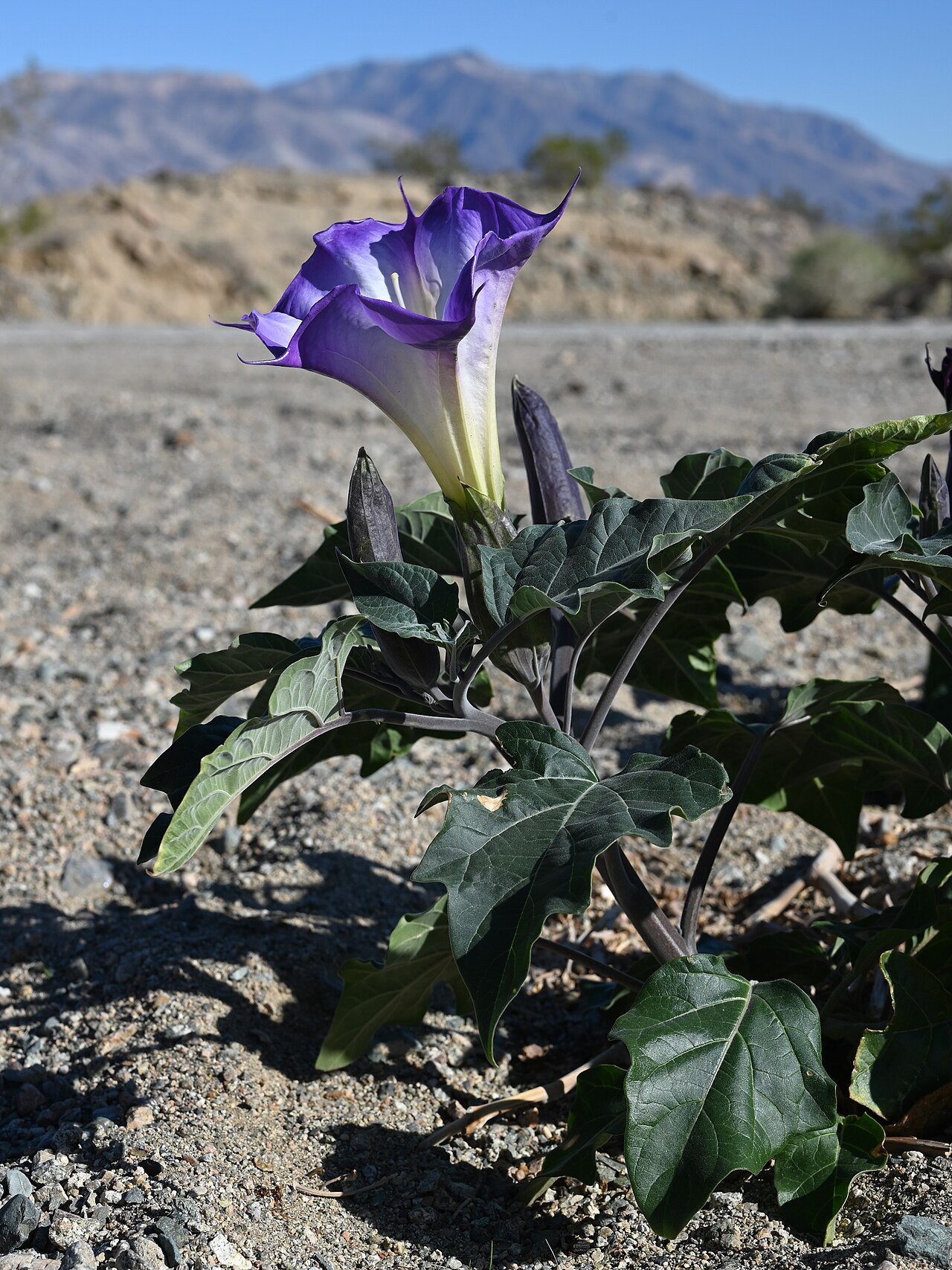
Datura wrightii, commonly called Sacred Datura, Sacred Thorn-apple, or Western Jimsonweed, is a sprawling, silvery-leaved perennial of the Solanaceae (nightshade family) native to the deserts, dry washes and disturbed open ground of the southwestern United States and adjacent northern Mexico. It is best known for its enormous, sweetly fragrant white trumpet flowers — among the largest of any wildflower in the West — which unfurl at dusk and fade by midmorning, and for its long history of ceremonial use among Indigenous peoples of the Southwest.
Sacred datura grows as a coarse, branching, ground-hugging to knee-high perennial, typically 1 to 5 feet tall and considerably wider, with broad, grayish-green, wavy-margined leaves and stout, fuzzy stems. From late spring through fall it produces a steady succession of trumpet-shaped flowers up to 8 inches long, each lasting only a night or two before giving way to the next bud. The spiny, globe-shaped seed capsules that follow are as distinctive as the flowers.
Every part of sacred datura is highly toxic, and this is central to how the plant should be gardened with: as a striking, low-water accent for xeriscapes and naturalistic desert gardens, sited away from children, pets and livestock, and never gathered for food or home remedies. Grown with that caution in mind, it is a dramatic, low-maintenance native for its home range, valued for its night-blooming flowers and as the primary host plant of the Carolina sphinx moth.
Identification
Sacred datura is a vigorous, many-branched herbaceous perennial that often dies back to the root crown in winter and resprouts each spring, though in mild areas it can persist as a subshrub. Plants typically spread 3 to 5 feet wide and grow 1 to 5 feet tall, with a sprawling, almost vine-like habit that is sometimes mistaken for a ground cover from a distance.
Stems & Leaves
Stems are stout, pale green to purplish, and covered in fine, soft hairs that give the whole plant a slightly grayish, velvety look. Leaves are large — up to 10 inches long — broadly ovate, rounded at the base and tapering to a point, with irregularly wavy or shallow-toothed margins. They are arranged alternately and have a strong, rank odor when crushed, a useful field clue along with the dense, appressed (flattened-down) hairs on the stems, which distinguish this species from the similar but less common Datura innoxia.
Flowers
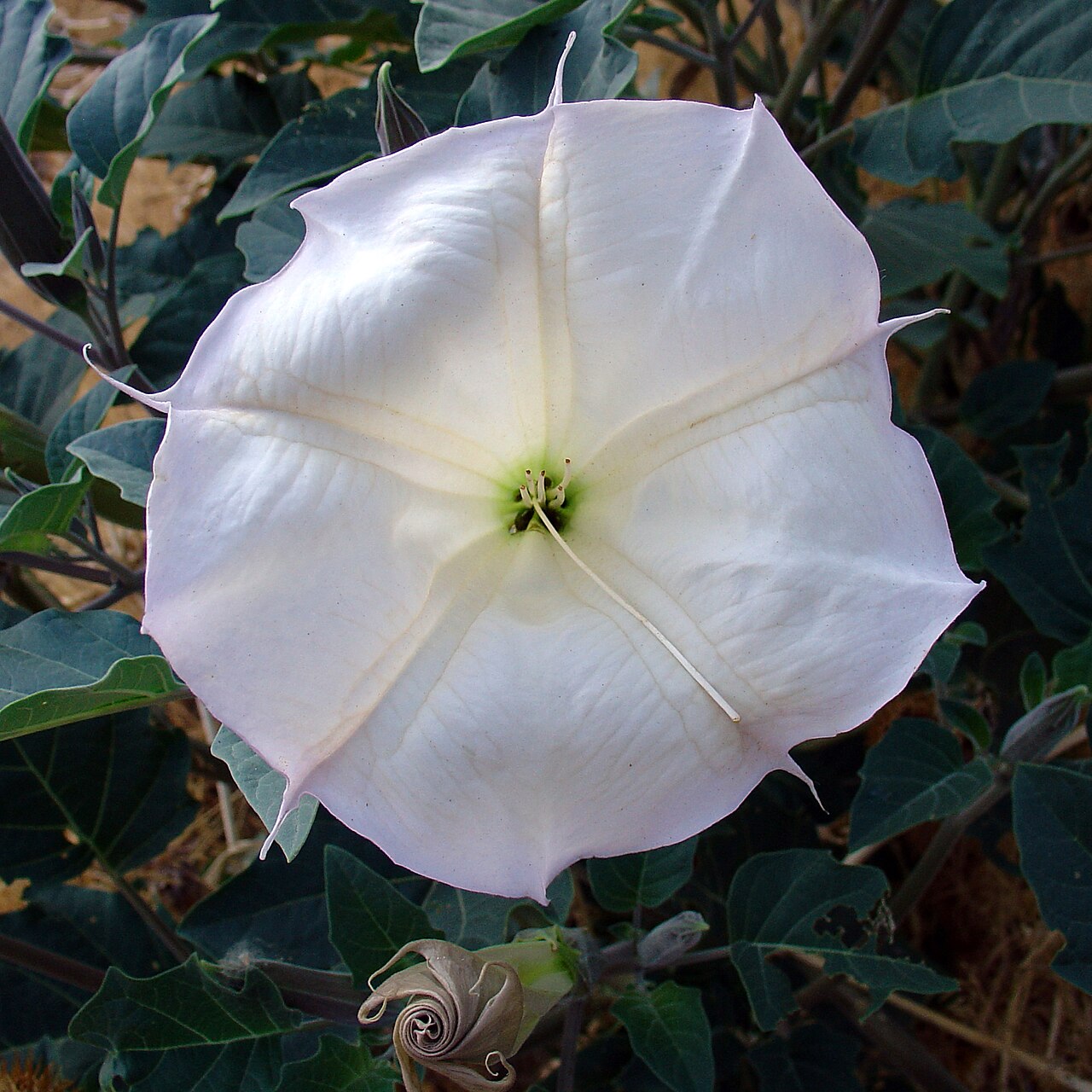
The flowers are the plant’s signature feature: solitary, upright, trumpet-shaped blooms 6 to 8 inches long and up to 7 inches across the flared rim, white with a faint lavender to purple tint that is strongest along the five pointed lobes of the rim. They open in the evening and early morning, closing as the day heats up, and release a strong, sweet fragrance that, along with their pale color, is well suited to moth pollination. Bloom continues from April through October wherever moisture allows.
Fruit & Seeds
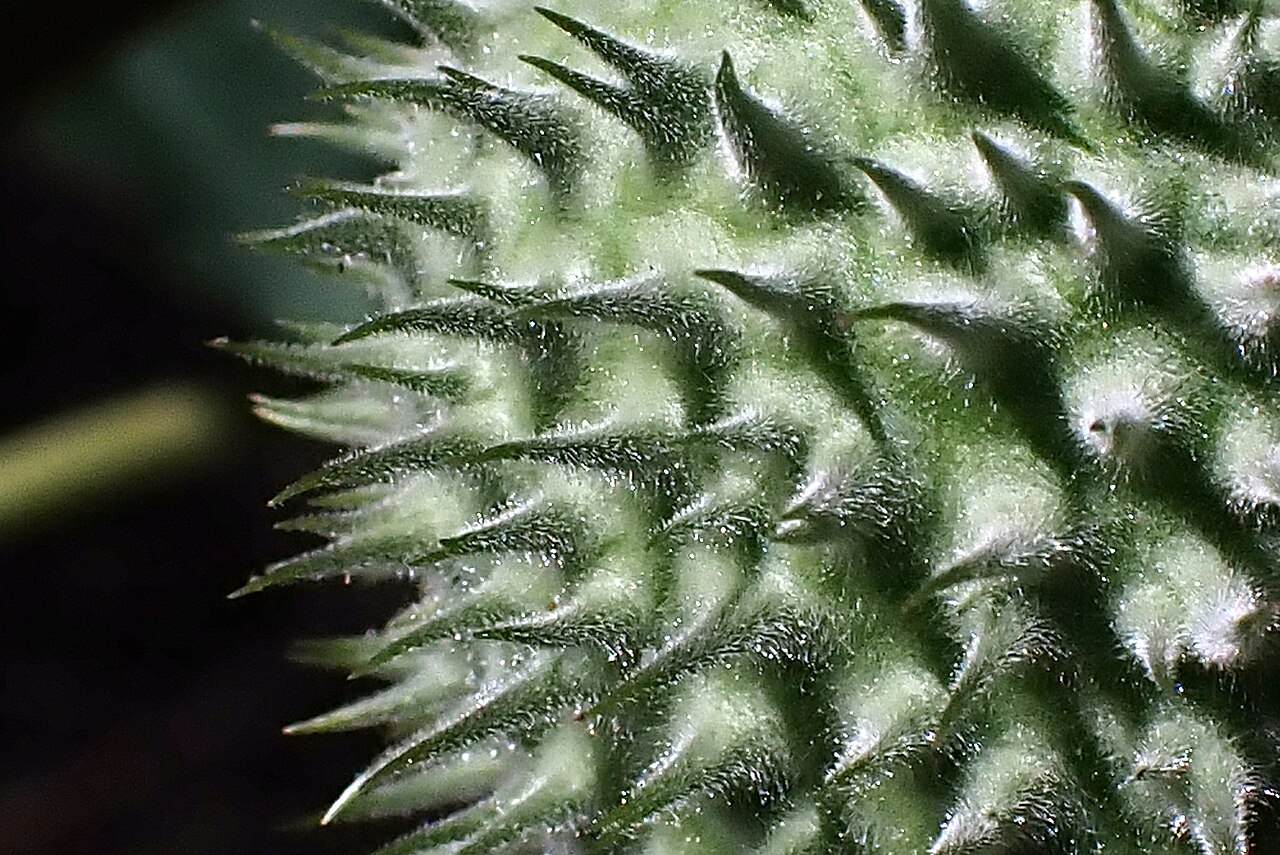
Flowers are followed by a spiny, globe-shaped seed capsule 1.5 to 2 inches across, densely covered in stout, needle-like spines and fine hairs. The capsule splits open at maturity to release numerous flattened, dark brown to black seeds. The capsules often persist on the plant well after the surrounding foliage has browned, making them a reliable identification feature into late fall.
Quick Facts
| Scientific Name | Datura wrightii |
| Family | Solanaceae (Nightshade) |
| Plant Type | Herbaceous perennial / subshrub |
| Mature Height | 1–5 ft |
| Mature Spread | 3–5 ft, sprawling |
| Growth Rate | Fast |
| Sun Exposure | Full Sun to Part Shade |
| Water Needs | Low; drought tolerant once established |
| Soil Type | Sandy, loamy or clay; must be well-drained |
| Soil pH | Adaptable; tolerates alkaline, calcareous soils |
| Bloom Time | April – October |
| Flower Color | White, lavender-tinged rim |
| Fruit | Spiny globe-shaped capsule, 1.5–2 in |
| Deer Resistant | High (toxic to browsers) |
| USDA Hardiness Zones | 7–10 |
Native Range
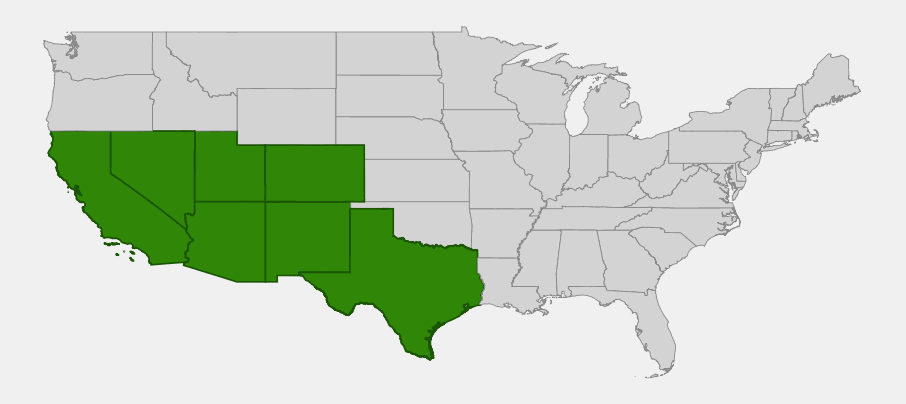
Sacred datura is native to the warm deserts and dry interior valleys of the southwestern United States, found from California east across Nevada, Utah, Arizona, Colorado and New Mexico to Texas, and south into adjacent northern Mexico. It reaches its greatest abundance in Southern California and the Mojave and Sonoran deserts, where it is a familiar sight along washes, roadsides and disturbed desert flats.
Outside this core range, sacred datura is sometimes seen much farther afield — as far as the Pacific Northwest, the Great Plains and even parts of the East Coast — but these occurrences are garden escapes or short-lived naturalizations rather than native populations. It is a true desert native only within the Southwest, and gardeners outside that region should treat it as an ornamental annual or container plant rather than a locally native species.
Within its native range, sacred datura typically grows in open, well-drained, sandy or gravelly ground: desert washes, floodplains, roadsides and other disturbed sites with full sun and excellent drainage. It is notably drought tolerant and often among the first plants to recolonize disturbed desert soil.
📋 Regional plant lists featuring Sacred Datura: Arizona & New Mexico · Utah & Western Colorado
Growing & Care Guide
Sacred datura is one of the easiest native plants to grow in its home range, thriving on neglect in hot, dry conditions that challenge most other garden plants. Its main requirements are heat, sun and sharp drainage.
Light
Give sacred datura full sun for the most compact growth and heaviest bloom. It tolerates part shade, especially in the hottest low-desert locations, but plants stretch and bloom less in shadier sites.
Soil & Water
Good drainage matters more than soil type: sacred datura grows in sandy, loamy or clay soils as long as water does not stand around the roots, and it tolerates alkaline, calcareous ground without trouble — much like desert neighbors such as Creosote Bush and Desert Willow. Established plants need very little supplemental water and are an excellent choice for a true xeriscape; occasional deep watering during the hottest stretch of summer will extend and improve bloom. Overwatering in heavy, poorly drained soil is the most common cause of root rot.
Planting Tips
Set out nursery stock or direct-sow seed in spring after the soil has warmed. Give plants 4 to 5 feet of room to spread, and choose a site away from paths, play areas and anywhere children or pets have easy access, since every part of the plant is toxic. Sacred datura self-sows readily in favorable sites, so plan for occasional seedling removal if a tidy bed is the goal.
Pruning & Maintenance
Cut plants back hard after the first killing frost, or in late winter in mild climates, to clean up the dieback and encourage vigorous new growth in spring. Deadheading spent flowers can reduce self-sowing if volunteers become a nuisance. Sacred datura has few serious pests, though flea beetles and tobacco hornworms occasionally feed on the foliage.
Landscape Uses
Sacred datura’s bold foliage and spectacular flowers suit several roles in a dry-climate garden:
- Xeriscape accent for low-water, full-sun gardens
- Night garden plant, chosen for fragrance and evening bloom
- Desert wash or rain garden restoration planting
- Moth garden centerpiece, as host plant for the Carolina sphinx moth
- Erosion control on disturbed, sandy desert soils
Wildlife & Ecological Value
Sacred datura’s unusual bloom schedule — opening at dusk and closing by midmorning — shapes a pollinator relationship built almost entirely around nighttime visitors, making it an ecological specialist within its desert habitat.
For Pollinators
The large, pale, intensely fragrant flowers are adapted for pollination by hawk moths (sphinx moths), which hover at the flowers in the evening much as hummingbirds do by day. Few other desert plants can offer moths the volume of nectar these flowers produce, making sacred datura an outsized resource for nocturnal pollinators.
For Mammals
Because every part of the plant is toxic, sacred datura is rarely browsed by deer, rabbits or livestock, which makes it one of the most reliably deer-proof flowering perennials for desert gardens. This same toxicity means it offers little food value to mammals, though it does provide cover among its sprawling foliage.
Ecosystem Role
Sacred datura is an important larval host plant for the Carolina sphinx moth (Manduca sexta), whose caterpillars — familiar to gardeners as tomato hornworms on cultivated nightshades — feed on its leaves. As one of the primary nectar sources available to desert-adapted moths after dark, it plays an outsized role in supporting nocturnal pollinator food webs, and as an early colonizer of disturbed desert ground it helps stabilize soil ahead of slower-growing perennials.
Cultural & Historical Uses
Sacred datura holds deep ceremonial significance among many Indigenous peoples of the Southwest, particularly in Southern California, where it is central to datura-based traditions historically practiced by the Chumash and Tongva peoples. Among the Chumash, a preparation of the plant was historically given to boys as part of a coming-of-age rite meant to foster spiritual growth — a practice carried real physical risk given the plant’s potency. The Zuni people historically used the powdered root in ceremonial, divinatory and medicinal contexts, including as a traditional anesthetic before bonesetting.
The common name “sacred datura” and the plant’s association with visionary or ritual use reflect this history, which anthropologists and ethnobotanists have documented across multiple Southwestern cultures. These uses were specialized, carefully controlled practices embedded in specific cultural and religious frameworks, not casual applications, given how easily the plant’s alkaloids can cause severe poisoning or death.
In more recent history, the plant’s large, sculptural flowers drew the attention of artists, most famously Georgia O’Keeffe, who painted magnified jimsonweed blooms encountered near her New Mexico home. Today, sacred datura’s cultural role in the garden is almost entirely ornamental, valued for its dramatic flowers and desert toughness rather than any of its historical uses, which are not advisable to attempt given the serious poisoning risk the plant carries.
Frequently Asked Questions
Is sacred datura poisonous?
Yes, every part of sacred datura — leaves, flowers, seeds and roots — contains dangerous tropane alkaloids and can be fatal if ingested by humans, pets or livestock. It should never be eaten or used as a home remedy, and it is best planted away from children and grazing animals.
Why do the flowers close during the day?
Sacred datura flowers are adapted to pollination by night-flying hawk moths, so they open in the cool of evening and early morning and close as temperatures rise during the heat of the day. This is a normal part of the plant’s daily cycle, not a sign of stress.
Is sacred datura the same plant as jimsonweed?
It is closely related. Common jimsonweed (Datura stramonium) is a different, more widespread weedy species with smaller flowers; sacred datura is sometimes called “western jimsonweed” because of the resemblance, but the two are distinct species with overlapping but different native ranges.
Will sacred datura survive winter?
In its native desert range (USDA zones 7–10) the top growth typically dies back after the first hard frost, but the plant resprouts from its root crown in spring. In colder climates outside its native range, it is usually grown as a warm-season annual.
Is sacred datura invasive?
Within its native southwestern range it is not considered invasive, though it does self-sow readily in disturbed ground. Outside that range it can naturalize along roadsides and waste areas in some regions, so gardeners elsewhere should be aware it is not locally native and may need deadheading to prevent spread.

Looking for a nursery that carries Sacred Datura?
Browse our native plant nursery directory: California · Nevada, New Mexico · Texas, Utah · Arizona