Butternut (Juglans cinerea)
Juglans cinerea, commonly known as Butternut or White Walnut, is a medium-sized deciduous tree of eastern North American hardwood forests, a close relative of black walnut best known for its sweet, oily nuts and its light-colored, diamond-patterned bark. It once ranged widely across the eastern United States and adjacent Canada, growing in the rich, well-drained soils of valleys and streambanks alongside other mast-producing hardwoods.
Today Butternut carries a different distinction: it is one of the most imperiled native trees in the East. A fungal disease called butternut canker, first noticed in the 1960s and now present across nearly the entire range, kills trees slowly by girdling the trunk and branches, and has eliminated or severely reduced Butternut from forests where it was once common. Planting healthy, disease-resistant stock and reporting surviving wild trees to conservation programs are now meaningful ways gardeners and landowners can support this species’ future.
Where it can still be grown, Butternut is a fast-growing, open-crowned shade tree with handsome compound foliage, spring catkins, and nuts that squirrels and people alike have harvested for generations. It is not a tree for small yards — mature specimens spread wide and drop husky nuts — but in a large rural or naturalistic planting it remains a worthwhile, historically important native.
Identification
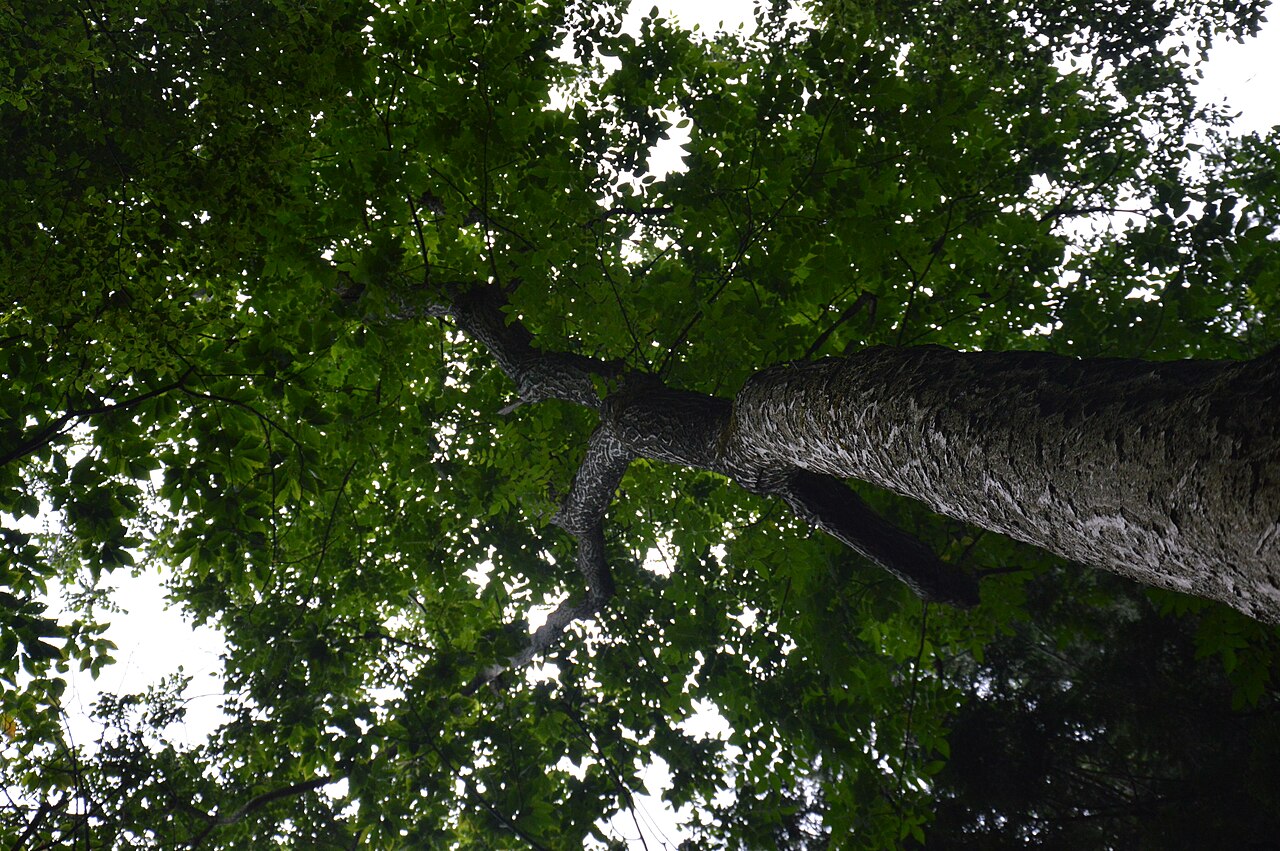
Butternut is a medium-sized tree, typically 40 to 60 feet tall, with a short trunk and a broad, open, rounded crown — notably wider and more spreading than the narrower crown of black walnut. It is relatively short-lived for a tree of its size, rarely reaching 75 years of age even without disease, and canker has made older specimens increasingly rare.
Bark & Twigs
Young bark is smooth and light gray; with age it develops into flat-topped ridges separated by shallow furrows, forming a distinctive light gray, diamond-shaped pattern that is one of the easiest ways to identify the species at a glance, even from a distance. Twigs are stout, and the pith inside a cut twig is light brown and chambered — a useful character for separating Butternut from black walnut, whose pith is darker.
Leaves
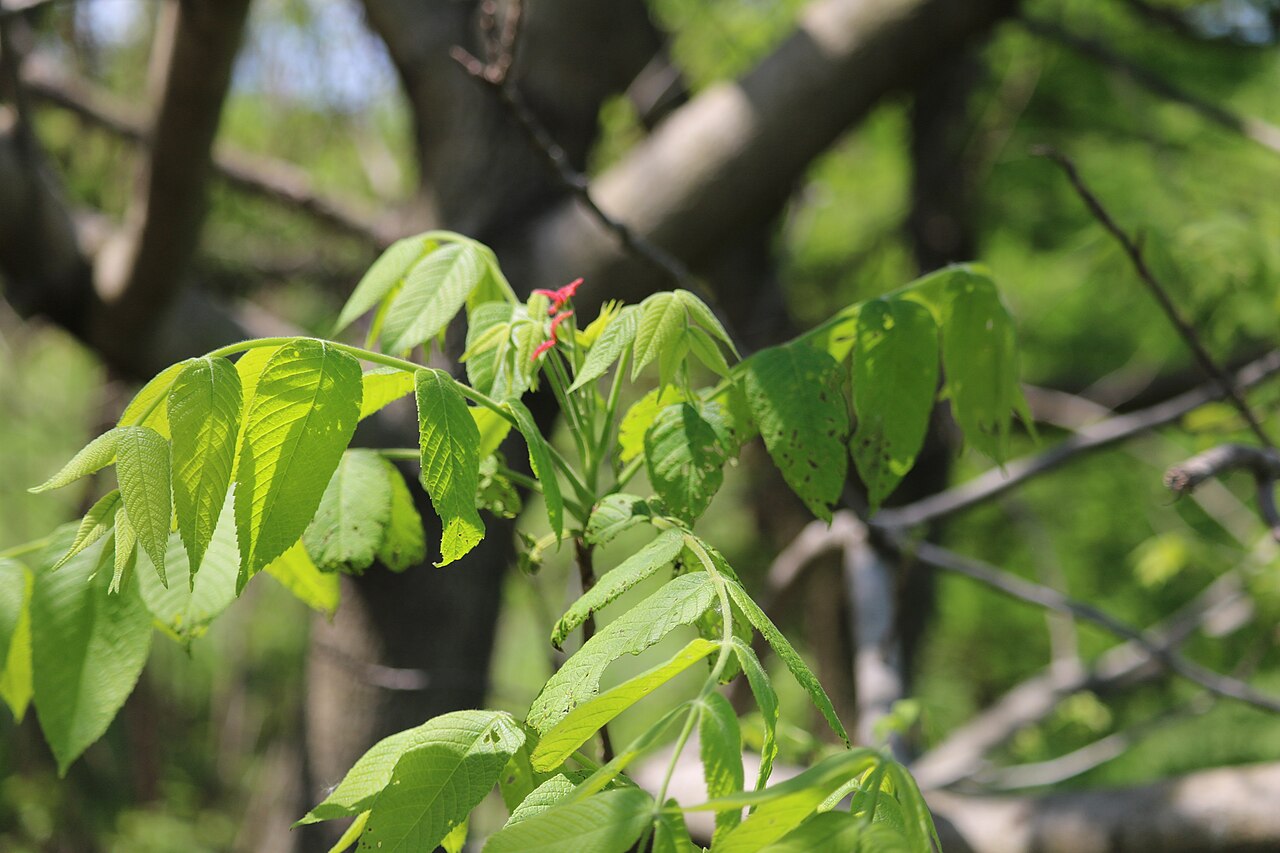
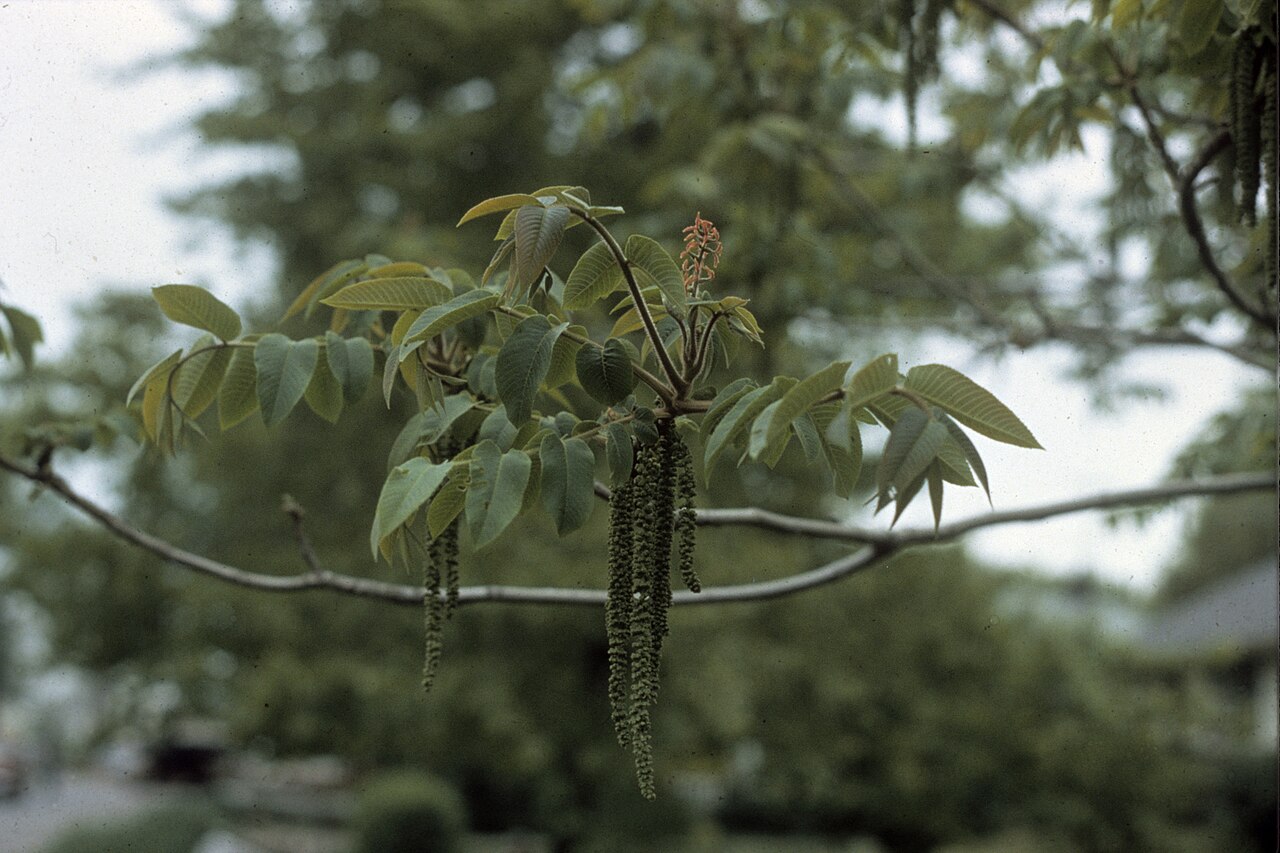
Leaves are alternate and pinnately compound, 15 to 27 inches long, made up of 11 to 19 finely toothed, oblong-lanceolate leaflets. The foliage has a soft, slightly sticky, hairy texture to the touch and releases a resinous, aromatic scent when crushed. Leaves emerge relatively late in spring and drop early in fall, giving Butternut one of the shorter growing seasons among eastern hardwoods.
Flowers & Fruit
Butternut is monoecious, bearing separate male and female flowers on the same tree. Male flowers hang in slender catkins 3 to 5 inches long; female flowers are small, in short spikes near the branch tips, each tipped with a pair of bright red-pink stigmas. Both appear in spring as the leaves unfold. The fruit is an oblong-ovoid nut, 1.5 to 2.5 inches long, enclosed in a sticky, hairy green husk that turns brown at maturity in fall. Inside, the nut itself has sharp, irregular ridges and a sweet, oily kernel considered by many to be the best-tasting of the native walnuts.
Quick Facts
| Scientific Name | Juglans cinerea |
| Family | Juglandaceae (Walnut) |
| Plant Type | Deciduous Tree |
| Mature Height | 40–60 ft |
| Lifespan | Short-lived; rarely over 75 years |
| Growth Rate | Moderate to Fast |
| Sun Exposure | Full Sun |
| Water Needs | Moderate |
| Soil Type | Rich, moist, well-drained; streambanks and lower slopes |
| Soil pH | 6.0–7.5 (neutral to slightly alkaline preferred) |
| Bloom Time | April – May |
| Fruit | Edible oily nut in a sticky husk, ripens fall |
| Conservation Status | Declining range-wide from butternut canker disease |
| USDA Hardiness Zones | 3–7 |
Native Range
Butternut is native across a broad swath of the eastern United States, from New England and the Canadian Maritimes south through the Appalachians to Georgia and Alabama, and west through the Ohio Valley and upper Midwest to Minnesota, Iowa, and Arkansas. Within this range it has always been scattered rather than dominant, growing as a minor component of mixed hardwood forests rather than forming pure stands. It does not occur natively south of the Gulf Coastal Plain or west of the Mississippi watershed’s eastern tributaries; reports from Louisiana, Oklahoma, and Texas reflect the closely related but distinct arid-adapted walnuts of those regions, not Butternut itself.
Butternut favors rich, well-drained soils in valleys, on streambanks, and on lower slopes, often over limestone bedrock. It is intolerant of shade and does not compete well in dense, mature forest, so it is most often found at forest edges, in young stands, or scattered among more dominant hardwoods such as Black Walnut (Juglans nigra), Shagbark Hickory (Carya ovata), and American Basswood (Tilia americana).
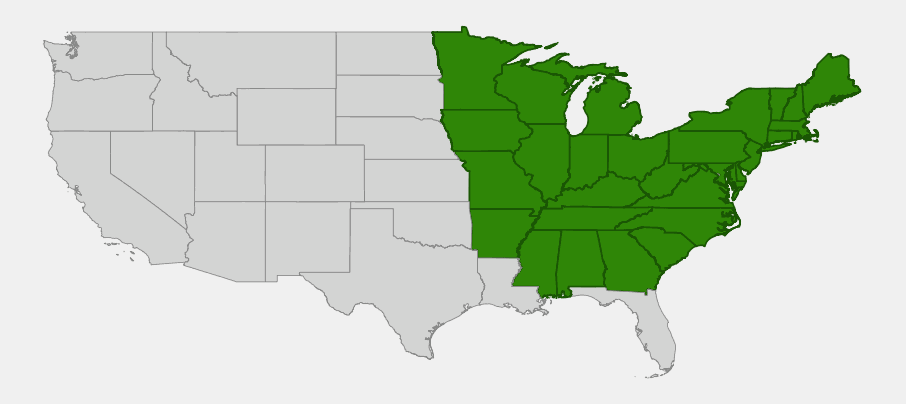
📋 Regional plant lists featuring Butternut: New Hampshire, Maine & Vermont · Connecticut, Massachusetts & Rhode Island · New York, Pennsylvania & Northern New Jersey · Delaware, Southern New Jersey & Long Island · Maryland, Virginia & West Virginia · North Carolina & South Carolina · Georgia, Alabama & Mississippi · Arkansas, Louisiana, Eastern Oklahoma & Eastern Texas · Kentucky & Tennessee · Ohio & Indiana · Illinois, Iowa & Missouri · Michigan, Wisconsin & Eastern Minnesota
Growing & Care Guide
Butternut is adaptable and easy to establish where it has room to grow, but its susceptibility to canker disease means long-term success depends as much on sourcing healthy stock as on routine care.
Light
Butternut needs full sun. It is one of the more shade-intolerant native hardwoods and will not persist as an understory tree the way sugar maple or beech can — plant it in an open site where it will not be overtopped as it matures.
Soil & Water
It grows best in rich, moist, well-drained soil, particularly on alluvial streambank soils or lower slopes with some limestone influence. A neutral to slightly alkaline pH suits it better than the strongly acidic soils tolerated by many other native trees. It does not do well in compacted, poorly drained, or consistently wet ground.
Planting Tips
Plant young trees in fall or early spring, in full sun, well away from septic systems, driveways, and other trees that may be sensitive to juglone, the allelopathic compound walnuts release into the soil (Butternut produces less juglone than black walnut, but some sensitive plants still react to it). Give it plenty of room: a mature tree’s crown can spread 40 feet or more. Because of canker disease, seek out nursery stock described as disease-resistant or sourced from surviving, apparently canker-free parent trees where available, and consider registering healthy wild trees you find with a state natural heritage program.
Pruning & Maintenance
Prune out dead or canker-damaged branches promptly and sanitize tools between cuts to avoid spreading the fungus to healthy wood. Beyond disease management, Butternut needs little routine pruning. It is otherwise a low-maintenance tree, tolerant of a range of conditions as long as sunlight and drainage are adequate.
Landscape Uses
Butternut suits large properties and restoration plantings more than small residential lots:
- Rural shade tree in open, sunny sites with room to spread
- Streambank and floodplain restoration on well-drained alluvial soils
- Wildlife and mast plantings for squirrels and other nut-eating animals
- Conservation plantings using disease-resistant stock to help rebuild declining populations
- Heritage or historical gardens reflecting the tree’s long use by Indigenous peoples and early settlers
Butternut Canker: A Species in Decline
The single most important fact for anyone growing or managing Butternut is the threat posed by butternut canker, a fungal disease first documented in the United States in the 1960s and now present across nearly the entire native range. The fungus infects bark through wounds and leaf scars, forming sunken, elongated cankers that eventually girdle branches and trunks, killing the tree over a period of years. There is no cure, and the disease has eliminated Butternut from many forests where it was once a regular, if minor, component. Some individual trees show apparent resistance and continue to produce healthy seed, and these survivors are the focus of ongoing conservation breeding efforts. NatureServe ranks the species as globally vulnerable (G3), and several states list it as threatened, endangered, or a species of special concern. Anyone planting Butternut today is contributing, in a small way, to the species’ long-term survival.
Wildlife & Ecological Value
Although never a dominant forest tree, Butternut has long contributed to the mast crop that sustains eastern wildlife through fall and winter.
For Mammals
Gray squirrels, fox squirrels, and other rodents are the primary consumers of butternuts, gnawing through the thick husk and hard shell to reach the oily kernel inside, then caching nuts widely — a behavior that historically helped disperse the species across the landscape. White-tailed deer occasionally browse young seedlings.
For Birds & Pollinators
The inconspicuous spring flowers are wind-pollinated rather than insect-pollinated, so Butternut offers little in the way of nectar, but its open canopy and furrowed bark provide foraging habitat for bark-gleaning birds such as nuthatches and woodpeckers searching for insects.
Ecosystem Role
As a shade-intolerant, relatively short-lived tree, Butternut has always played the role of an early-successional or edge species in eastern hardwood forests, filling gaps and disturbed ground rather than persisting in mature closed-canopy stands. Its ongoing decline from canker disease represents a genuine loss of forest genetic diversity, which is part of why conservation and restoration plantings of resistant stock matter for the species’ future.
Cultural & Historical Uses
Butternut has one of the richest historical records of use among eastern native trees. Indigenous peoples across its range used the nuts as a food source, pressed oil from the kernels, and made dye from the husks and inner bark, which produces a warm yellow-brown to olive color. That dye tradition carried into the Civil War era, when homespun cloth dyed with butternut husks gave Confederate soldiers from certain regions, particularly in the western theater, the nickname “Butternuts,” and the tree’s name became attached to a recognizable shade of brownish homespun fabric used for uniforms.
The sweet, oily nuts were historically a prized ingredient in candies, baked goods, and simple eating out of hand, valued above black walnut by many for their milder, richer flavor, though the thick husk and hard shell make extracting the kernel laborious. The wood, lighter and softer than black walnut, was used for furniture, interior trim, and carving, prized for taking a fine finish despite being less durable than its better-known relative.
Frequently Asked Questions
Is it still worth planting Butternut given the canker disease?
Yes, with care. Seek out nursery stock noted as disease-resistant or propagated from surviving parent trees, give it full sun and good drainage, and prune out infected wood promptly. Healthy plantings help maintain genetic diversity in a species under serious threat.
Are butternuts safe to eat?
Yes. The oily kernel inside the hard, ridged nut is edible and historically prized for its rich flavor, though removing the thick husk and cracking the tough shell takes more effort than with many other nuts.
How can I tell Butternut from Black Walnut?
Butternut has lighter gray, diamond-furrowed bark and a broader, more open crown, light brown chambered twig pith, and an elongated, sticky-husked nut, compared to black walnut’s darker, more deeply ridged bark, narrower crown, darker pith, and rounder nut.
Does Butternut harm nearby plants like black walnut does?
Butternut produces juglone, the same allelopathic compound found in black walnut, but in smaller amounts. Some juglone-sensitive plants may still be affected nearby, so avoid planting it immediately next to tomatoes, azaleas, or other known-sensitive species.
What should I do if I find a healthy wild Butternut?
Consider reporting it to your state natural heritage program or a university forestry extension office. Apparently canker-resistant trees are valuable for conservation breeding programs working to preserve the species.

Looking for a nursery that carries Butternut?
Browse our native plant nursery directory: North Carolina, New Hampshire, New Jersey, New York & Ohio · Pennsylvania, Rhode Island, South Carolina, Tennessee, Virginia & Vermont · Kentucky, Massachusetts, Maryland, Maine, Michigan, Minnesota, Missouri & Mississippi · Alabama & Arkansas · Connecticut, Delaware & Georgia · Iowa, Illinois & Indiana · Wisconsin & West Virginia