Green Hawthorn (Crataegus viridis)
Crataegus viridis, commonly called Green Hawthorn or Southern Hawthorn, is a small deciduous tree native to the bottomlands, swamp margins and open woods of the southeastern and south-central United States. It belongs to the Rosaceae (rose family) and is one of the most garden-friendly members of a notoriously thorny, hard-to-identify genus, prized for its clean, glossy foliage, resistance to the cedar-hawthorn rust that plagues many relatives, and a long season of interest that runs from spring flowers through fiery fall color and a winter’s worth of bright red fruit.
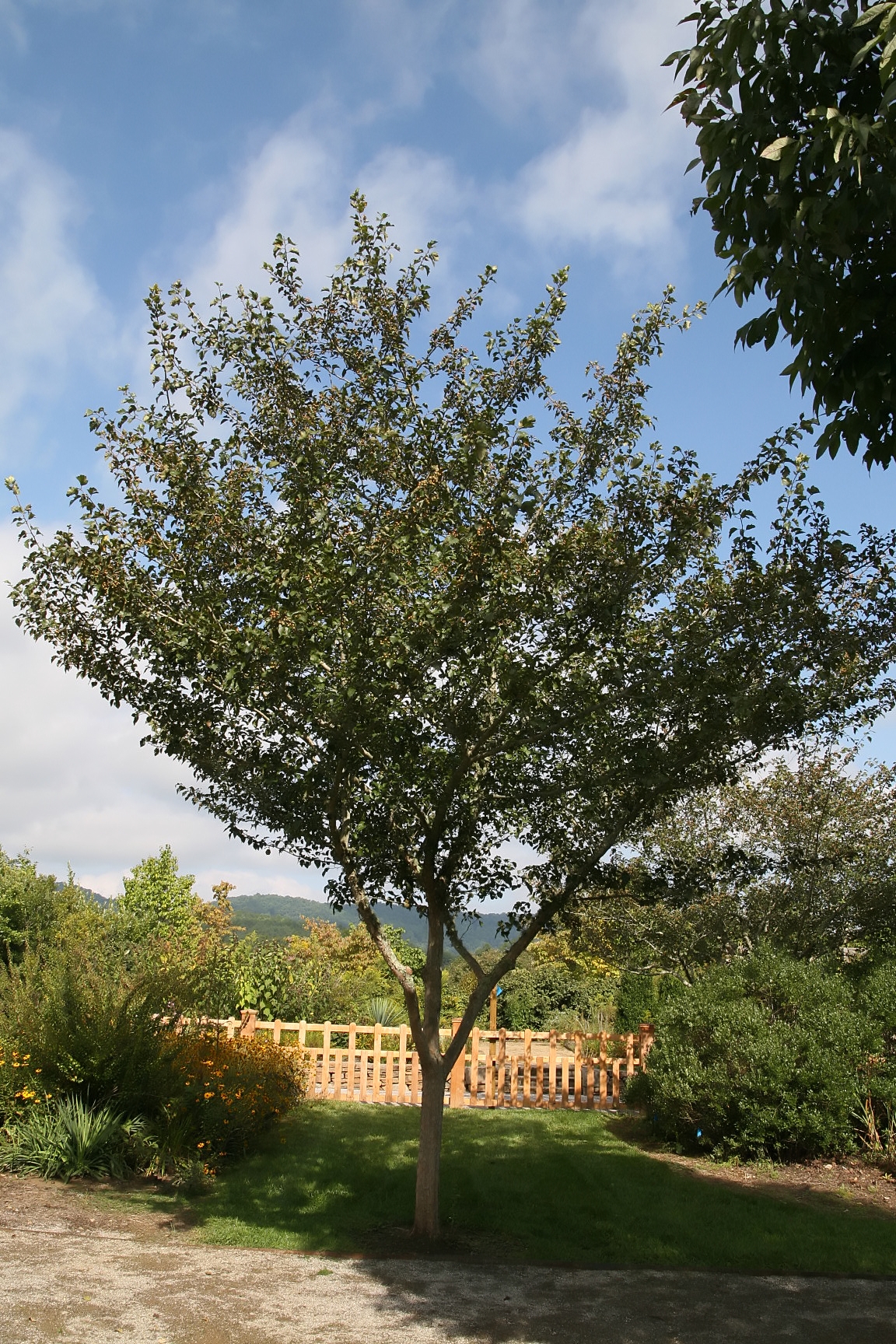
In the wild, green hawthorn grows as an understory or edge tree in bottomland hardwood forests, swamp margins, prairie borders and old pastures, usually on moist to wet, fertile soils. It typically reaches 20 to 35 feet tall with a dense, rounded crown of spreading branches, though old trees in good sites can approach 50 feet. The trunk is often fluted and may carry occasional thin thorns up to an inch and a half long, though many individuals — and especially the widely sold ‘Winter King’ selection — are nearly thornless.
For native-plant gardeners from the Gulf Coast up through the Ohio Valley and the Mid-Atlantic, green hawthorn offers a rare combination: a small flowering tree tough enough for wet clay or urban pollution, attractive enough for a front yard, and valuable enough to wildlife to anchor a habitat planting. Its red fruit persists into winter, feeding birds when little else is available, and its flowers and foliage support a long list of native bees, butterflies and moths.
Identification
Green hawthorn is a thicket-forming small tree or large shrub with a straight, often fluted trunk and a dense, rounded crown of horizontally spreading branches. Mature height runs 20 to 35 feet, occasionally to 50 feet on the best sites, with a spread nearly as wide as the tree is tall. Like most hawthorns it can be slow to key out in the field, but its glossy, largely unlobed leaves and relative lack of thorns set it apart from many of its relatives.
Bark & Stems
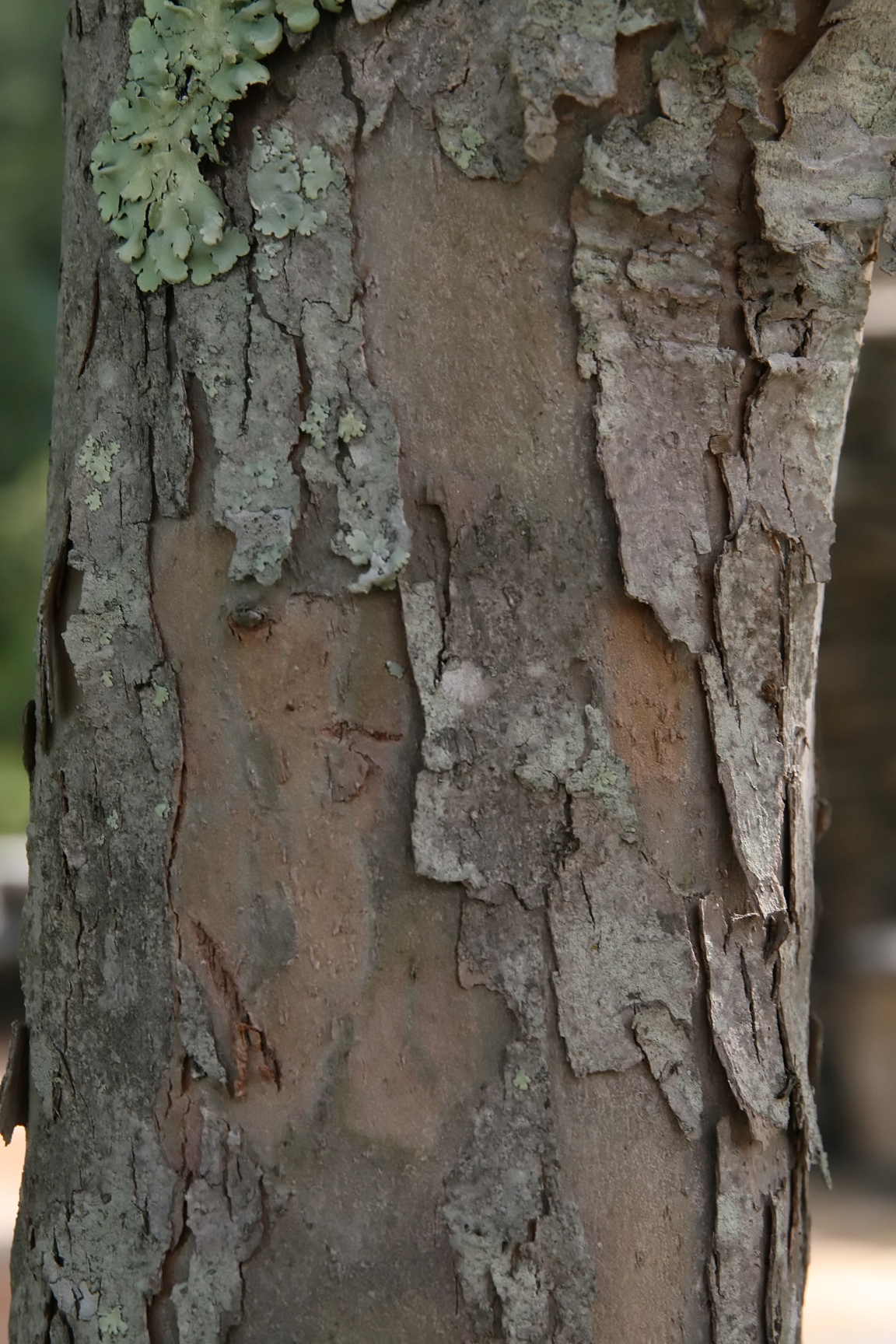
Young bark is gray-brown and fairly smooth; with age it exfoliates in thin, curling plates that reveal lighter orange-brown to silvery patches underneath, giving older trunks a mottled, scaly look similar to that of a sycamore in miniature. Twigs are slender and reddish-brown. Thorns, when present, are thin and straight, up to about 1.5 inches long, scattered along the twigs and smaller branches; many trees — and nearly all ‘Winter King’ specimens — carry few or none.
Leaves
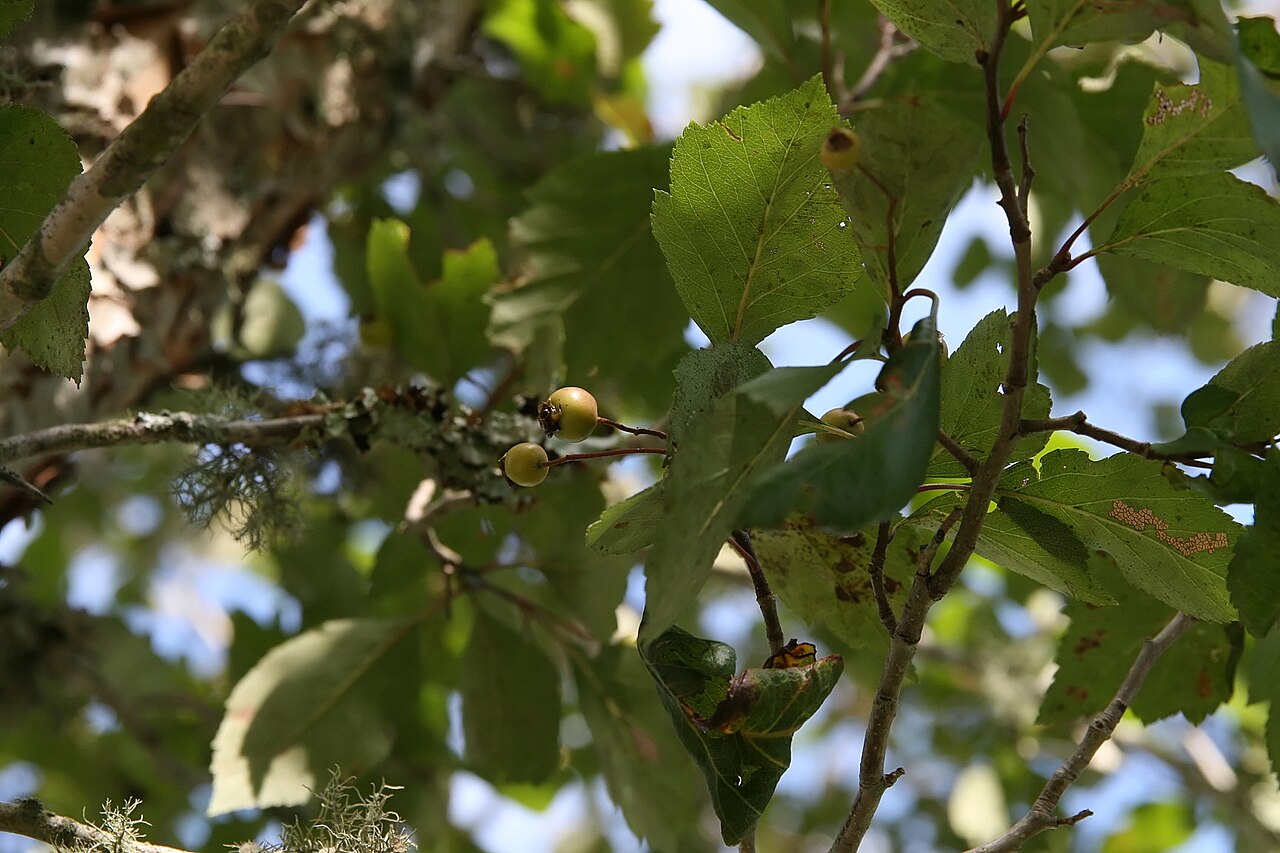
Leaves are simple, alternate, and ovate to elliptic, 1.5 to 3 inches long, with a glossy, dark yellow-green upper surface and finely toothed margins. Unlike many hawthorns, the leaves are usually unlobed or only shallowly lobed, which makes green hawthorn easier to tell apart from similar species in the field. Fall color is a real asset: foliage turns shades of purple, red and orange before dropping, often later in the season than other native trees.
Flowers & Fruit
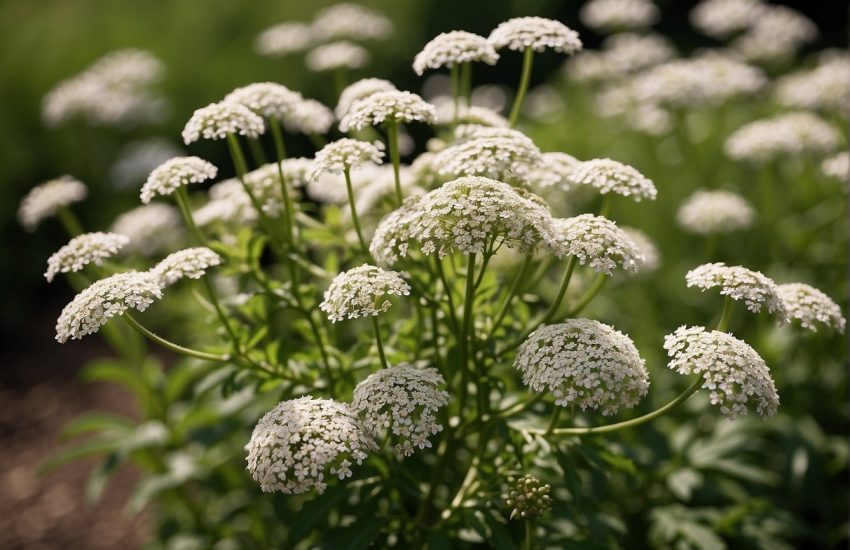
In March and April, green hawthorn produces flat-topped clusters of small, five-petaled white flowers about half an inch across. Like other hawthorns, the blooms have a faintly unpleasant scent that draws flies and beetles as well as bees. Flowers give way to abundant clusters of small pome fruits (haws), roughly a quarter to a third of an inch across, that ripen bright red to orange-red in fall and typically persist on the branches well into winter, long after the leaves have dropped.
Quick Facts
| Scientific Name | Crataegus viridis |
| Family | Rosaceae (Rose) |
| Plant Type | Deciduous small tree / large shrub |
| Mature Height | 20–35 ft (to 50 ft on good sites) |
| Mature Spread | 20–35 ft, broad and rounded |
| Growth Rate | Moderate |
| Sun Exposure | Full Sun to Part Shade |
| Water Needs | Average to high; tolerates occasional flooding |
| Soil Type | Sandy loam to clay; adaptable |
| Soil pH | Acidic to neutral (medium CaCO3 tolerance) |
| Bloom Time | March – April |
| Flower Color | White |
| Fall Color | Purple, red and orange |
| Fruit | Bright red to orange-red pomes (haws), persisting into winter |
| Deer Resistant | High |
| USDA Hardiness Zones | 5–9 |
Native Range
Green hawthorn is native to the southeastern and south-central United States, ranging from Delaware and Maryland south through the Carolinas, Georgia and northern Florida, west across the Gulf states to eastern Texas and Oklahoma, and north through the Mississippi and Ohio valleys into Illinois, Indiana, Kentucky and Pennsylvania. It is absent as a native plant from the Northeast, the upper Midwest and the West, where it is occasionally planted as an ornamental, especially in the popular ‘Winter King’ form, but does not occur naturally.
Across this range, green hawthorn is most often found on moist, fertile sites: bottomland hardwood forests, stream terraces, pond and swamp margins, and the edges of wet prairies and pastures. It tolerates periodic flooding better than most hawthorns, which makes it a useful small tree for low spots that are too wet for many other flowering trees, while still performing well in ordinary garden soil once established.
Because it hybridizes readily with other hawthorns and shares habitat with dozens of regional Crataegus species and varieties, botanists continue to debate the exact boundaries of some populations. Gardeners working from local nursery stock of confirmed species origin, rather than wild-collected material, avoid most of this uncertainty.
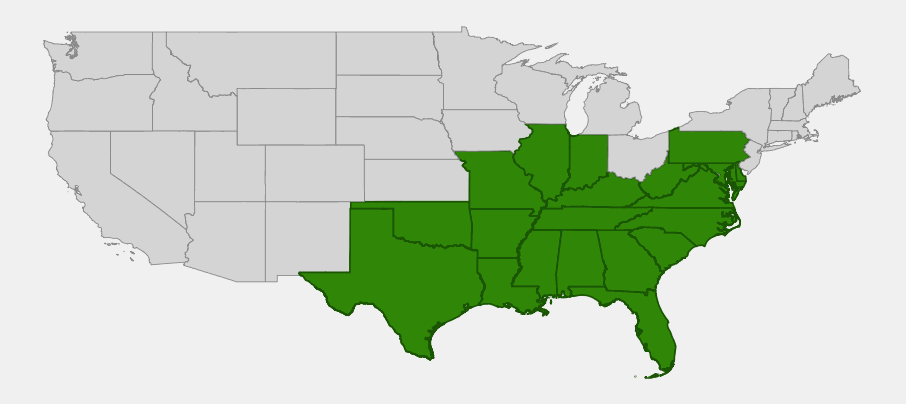
📋 Regional plant lists featuring Green Hawthorn: Georgia, Alabama & Mississippi · Arkansas, Louisiana, Eastern Oklahoma & Eastern Texas · Kentucky & Tennessee · Ohio & Indiana · Illinois, Iowa & Missouri · Maryland, Virginia & West Virginia · North Carolina & South Carolina · Delaware, Southern New Jersey & Long Island · New York, Pennsylvania & Northern New Jersey
Growing & Care Guide
Green hawthorn is an easygoing small tree that performs well across a wide range of garden conditions, which is part of why the ‘Winter King’ selection has become one of the most commonly planted native flowering trees in the Southeast and Mid-Atlantic.
Light
Plant in full sun for the densest flowering and best fall color, though green hawthorn also tolerates light shade, particularly at the woodland edge where it naturally occurs — often alongside Flowering Dogwood and American Holly. Trees in too much shade become leggier and bloom less heavily.
Soil & Water
Green hawthorn is adaptable to sandy, loamy or clay soils and tolerates both occasional flooding and short dry spells once established, though it performs best with consistently average to moist conditions. It has only a medium tolerance for highly alkaline soils, so very chalky or limestone-derived soils may cause some leaf chlorosis. Mulch to conserve moisture and keep lawn mowers and trimmers away from the base, since bark wounds invite borers.
Planting Tips
Plant balled-and-burlapped or container stock in fall or early spring. Give the tree room for its full 20- to 35-foot spread, and avoid planting directly over septic lines or near foundations, since roots follow available moisture. Thornless ‘Winter King’ stock is widely available and is the best choice for areas near walkways, patios or play spaces.
Pruning & Maintenance
Prune in late winter while dormant to remove crossing, damaged or overly low branches and to maintain a single leader if a more tree-like form is wanted. Green hawthorn tolerates pruning well and can even be trained as a clipped hedge. Watch for cedar-hawthorn rust where eastern redcedar grows nearby — green hawthorn is more resistant than most hawthorns but not immune — along with occasional fire blight, leaf spot, powdery mildew and borers.
Landscape Uses
Green hawthorn’s small size, four-season interest and wildlife value make it useful in many settings:
- Specimen flowering tree for front yards and small lots
- Wet-site planting for low spots, rain gardens and pond edges
- Wildlife garden anchor — persistent winter fruit feeds birds when little else is available
- Street tree in thornless ‘Winter King’ form, tolerant of urban pollution
- Informal hedge or screen when planted in groups and lightly pruned
- Naturalized bottomland or prairie-edge restoration plantings
Wildlife & Ecological Value
Few small native trees deliver as much wildlife value across as many seasons as green hawthorn, which is part of why it remains a favorite recommendation for backyard habitat plantings throughout its range.
For Pollinators
The spring flower clusters draw a wide range of native bees along with honeybees, flies and beetles. Hawthorns in general serve as larval host plants for a number of moths and several hairstreak butterflies, including king’s hairstreak, gray hairstreak, banded hairstreak, red-banded hairstreak and soapberry hairstreak.
For Birds
The small red fruits ripen in fall and typically hang on the branches well into winter, making green hawthorn an important late-season food source for American robins, cedar waxwings, northern mockingbirds, eastern bluebirds and many other fruit-eating birds, especially after other wild fruit has been stripped. The dense, often thorny branching also provides excellent nesting cover and protection from predators.
For Mammals
Fallen fruit is readily eaten by raccoons, opossums, foxes and other small mammals, which help disperse the seeds. Deer rarely browse green hawthorn heavily, making it one of the more reliable flowering trees in areas with high deer pressure.
Ecosystem Role
As a shrubby, thicket-forming small tree, green hawthorn adds structural complexity to forest edges, wet meadows and old-field succession, creating cover that larger canopy trees cannot provide. Its tolerance of periodic flooding also makes it a useful stabilizer along stream terraces and pond margins, where its roots help hold soil during high water.
Cultural & Historical Uses
Like other North American hawthorns, green hawthorn’s hard, dense wood was historically used by rural communities for tool handles, mallets and fence posts, prized for its strength even in small diameters. The sharp thorns found on some individuals were occasionally used by early settlers as makeshift pins or fasteners, a practical use shared across many hawthorn species.
The fruit, though edible in small amounts, has a dry, mealy texture and mild flavor that made it a minor food rather than a staple; it was sometimes gathered to supplement other wild fruits or made into jelly where more palatable fruits were scarce. Historically, the persistence of hawthorn fruit through the winter made the trees a familiar sight along fence rows and field edges, where birds dispersed the seeds into thickets that early farmers often left in place as informal hedgerows and windbreaks.
Today, green hawthorn’s primary cultural role is ornamental and ecological rather than utilitarian. The widely planted ‘Winter King’ selection, introduced from a parent tree discovered in Ohio in the mid-20th century, has made green hawthorn a familiar sight in parks, median strips and residential landscapes well beyond its original wild range.
Frequently Asked Questions
Is green hawthorn the same as ‘Winter King’ hawthorn?
‘Winter King’ is a specific cultivated selection of green hawthorn (Crataegus viridis), chosen for its largely thornless branches, silvery bark, heavy fruit set and strong fall color. It is the same species as the wild tree, just a named form propagated for the nursery trade.
Can you eat green hawthorn fruit?
The small red haws are technically edible and were occasionally used in jellies, but they are dry, mealy and not very flavorful compared to cultivated fruit. Most gardeners leave them for the birds, which rely on them heavily in late winter.
Does green hawthorn have thorns?
Some wild trees carry thin thorns up to about 1.5 inches long, but many individuals have few or none, and the popular ‘Winter King’ cultivar is nearly thornless. If thorns are a concern near walkways, choose nursery stock specifically labeled ‘Winter King.’
How fast does green hawthorn grow?
Green hawthorn has a moderate growth rate, typically adding around a foot per year under good conditions. It reaches a modest mature size for a flowering tree, usually 20 to 35 feet, which makes it well suited to smaller yards.
Will green hawthorn grow in a wet spot that floods occasionally?
Yes. Green hawthorn tolerates periodic flooding better than most hawthorns and many other small flowering trees, reflecting its native habitat in bottomlands and swamp margins. It is a good choice for low areas that stay wet after heavy rain but are not permanently inundated.

Looking for a nursery that carries Green Hawthorn?
Browse our native plant nursery directory: AL, AR · DE, FL, GA · IL, IN, KS · KY, LA, MD, MS, MO · NC, OK · PA, SC, TN, TX, VA · WV