American Smoke Tree (Cotinus obovatus)
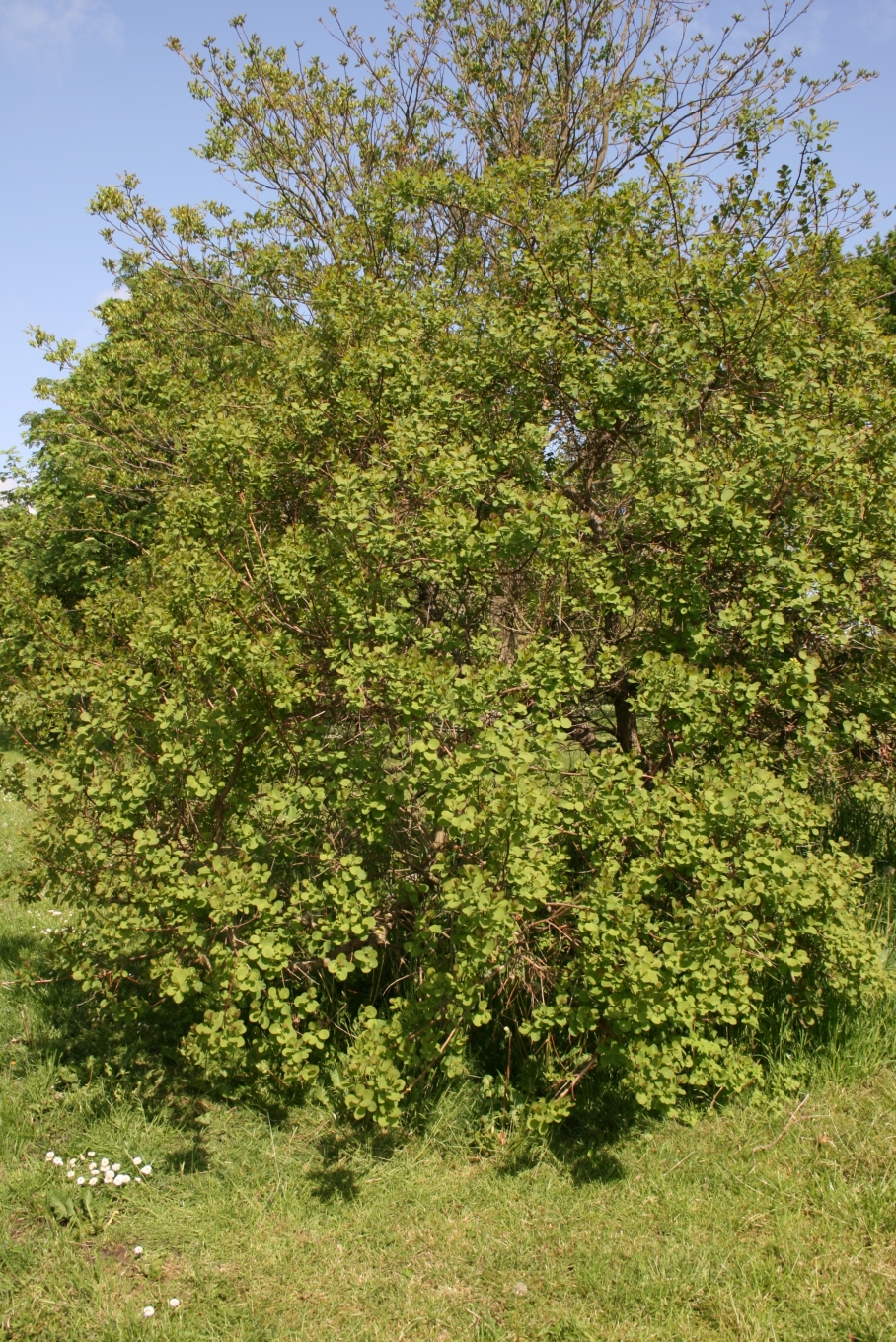
Cotinus obovatus, the American Smoke Tree, is one of the great under-planted native trees of the South — a small, tough, slow-growing tree that few nurseries carry and even fewer gardeners recognize, yet it produces some of the most reliable fall color of any native plant east of the Rockies. Also called chittamwood, yellowwood, or American smokewood, it belongs to the cashew family (Anacardiaceae) and is a close cousin of the Eurasian smoke bush (Cotinus coggygria) that is far more common in gardens.
In the wild, American smoke tree is genuinely rare, restricted to scattered limestone glades, rocky bluffs and dry calcareous outcrops across a handful of southern and south-central states. It rarely forms stands; instead it turns up as isolated trees or small clumps clinging to thin, rocky soil where taller competitors can’t get a foothold. That toughness — tolerance of shallow, alkaline, drought-prone ground — is exactly what makes it valuable in difficult garden sites.
The tree earns its common name from the airy, smoke-like puffs of pinkish seed-bearing hairs (pedicels) that persist on female trees after the small spring flowers fade, giving the whole canopy a hazy, cloud-like look through summer. Combine that with brilliant orange-to-scarlet fall color, attractive flaking bark, and a compact mature size, and it is hard to understand why American smoke tree isn’t planted more often.
Identification
American smoke tree is usually seen as a large, rounded, multi-stemmed shrub or small single-trunked tree, typically 20 to 30 feet tall with an equal spread, though old specimens on good sites can reach 35 feet. It has an open, somewhat irregular branching habit that becomes more tree-like and tidy with age and pruning.
Bark & Stems
Young twigs are slender and reddish-brown. As the tree matures, the bark becomes gray to grayish-brown and breaks into thin, irregular scaly plates that flake away to reveal lighter inner bark — an attractive winter feature on older trunks. The wood itself is bright yellow-orange just under the bark, which is where the old common name “yellowwood” comes from; it was once a source of yellow dye.
Leaves
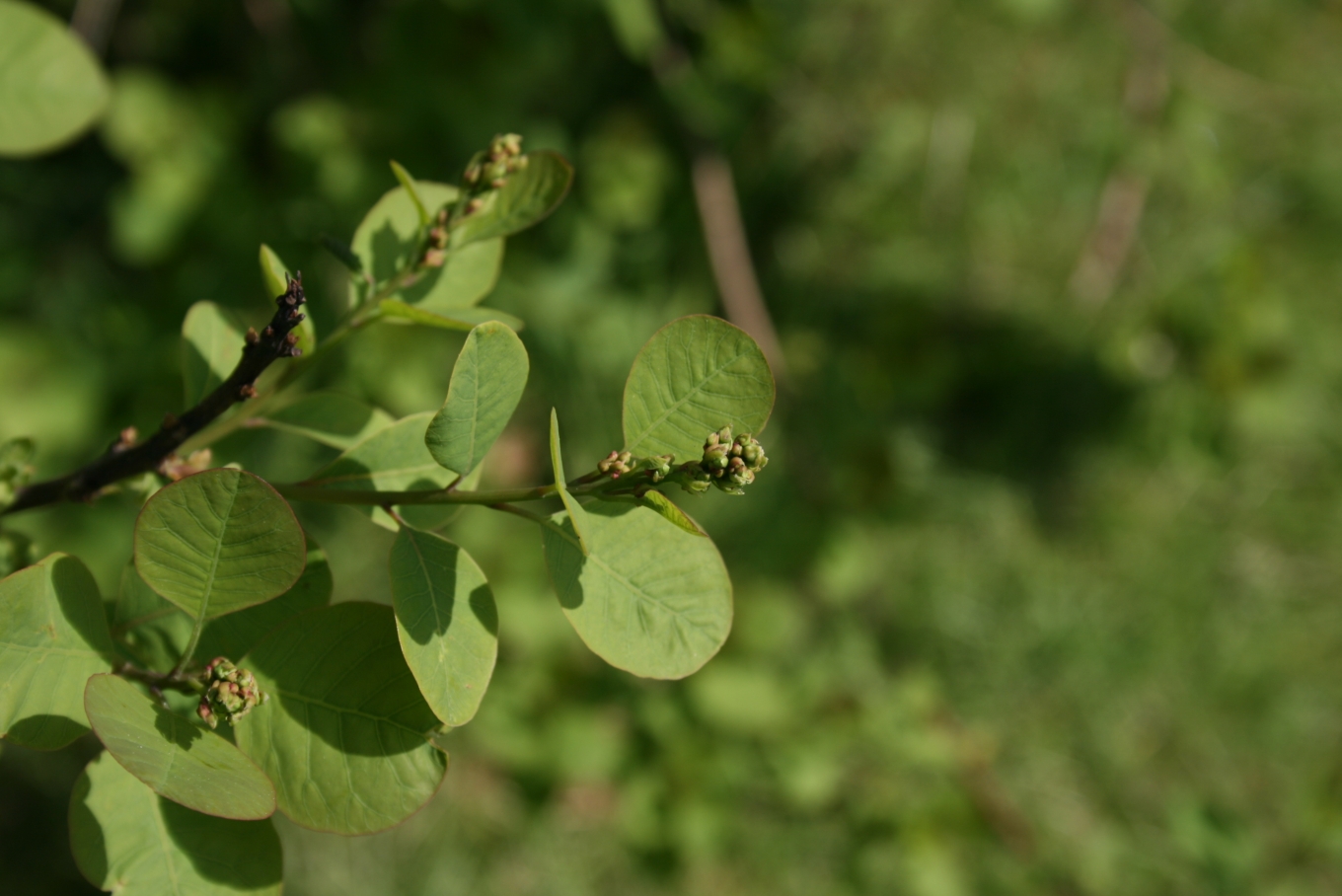
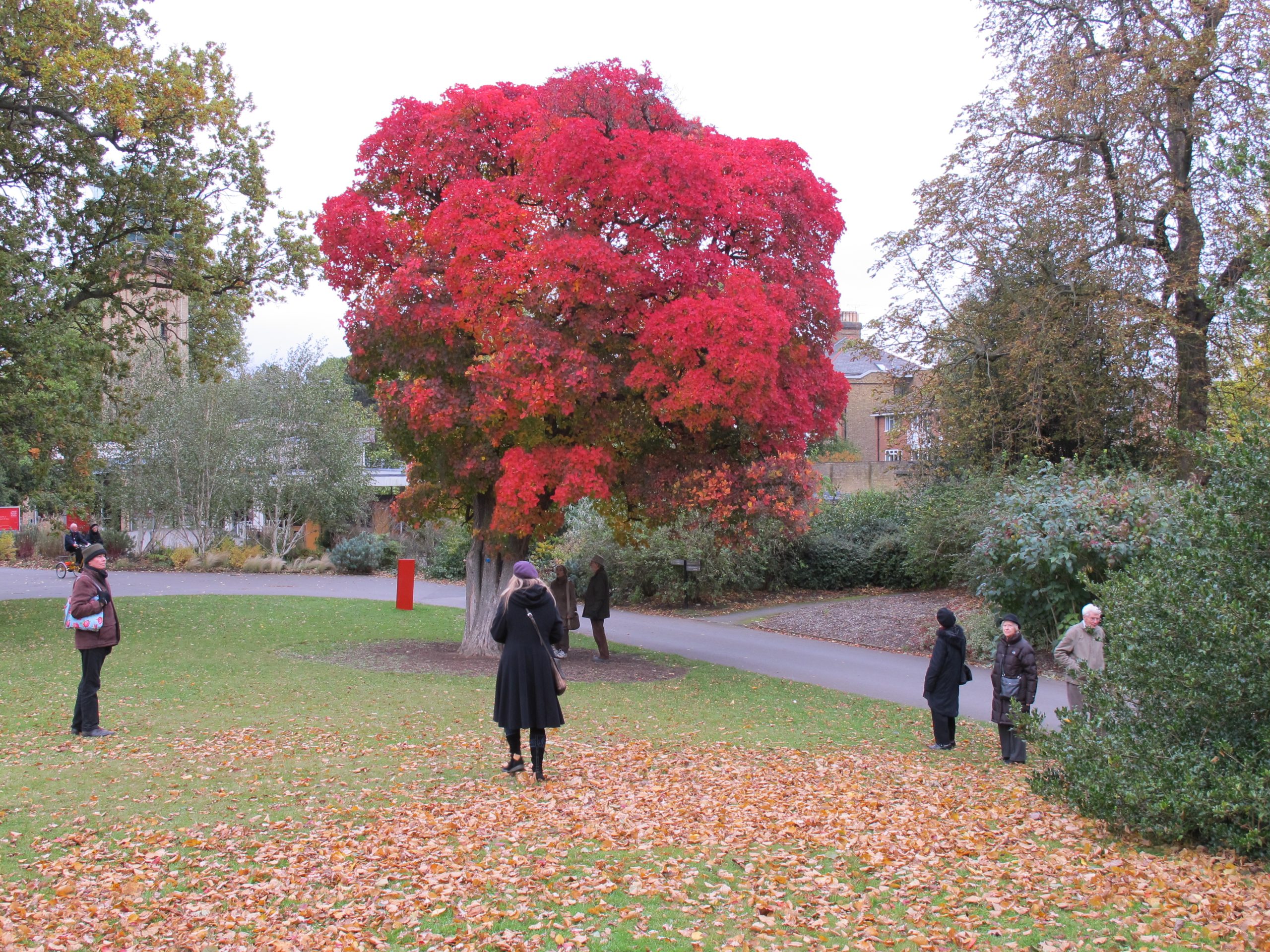
Leaves are simple, alternate, and obovate (egg-shaped with the broad end outward) to nearly round, 3 to 5 inches long, with smooth margins and a distinctly bluish-green cast on top and a paler, slightly glaucous underside. Crushed leaves and twigs have a faint, somewhat unpleasant resinous odor, a family trait shared with sumacs and poison ivy. Fall color is the tree’s signature feature: foliage turns shades of yellow, orange, scarlet and reddish-purple, often several colors on the same tree at once, rivaling sugar maple for intensity.
Flowers & Fruit
American smoke tree is functionally dioecious — individual trees are mostly male or mostly female, though some produce a few flowers of both types. Tiny yellowish-green flowers appear in loose, airy, branched clusters (panicles) 6 to 10 inches long in mid to late spring, before or as the leaves expand. Most flowers in each cluster are sterile; after bloom, the slender flower stalks (pedicels) on female trees elongate and become covered in fine pinkish-purple hairs, creating the billowy, smoke-like plumes that persist through summer. The actual fruit is a small, dry, kidney-shaped drupe about ¼ inch long, produced in modest numbers tucked among the smoky plumes.
Quick Facts
| Scientific Name | Cotinus obovatus |
| Family | Anacardiaceae (Cashew/Sumac) |
| Plant Type | Deciduous Small Tree / Large Shrub |
| Mature Height | 20–30 ft (occasionally to 35 ft) |
| Mature Spread | 15–25 ft |
| Growth Rate | Slow |
| Sun Exposure | Full Sun to Part Shade |
| Water Needs | Low once established; excellent drought tolerance |
| Soil Type | Rocky, shallow, well-drained; tolerates poor limestone soils |
| Soil pH | Neutral to alkaline (tolerates 6.0–8.0) |
| Bloom Time | April – May |
| Flower Color | Yellowish-green, with pink-purple smoky plumes after bloom |
| Fall Color | Yellow, orange, scarlet and reddish-purple |
| Fruit | Small dry drupes, inconspicuous, on female trees |
| Deer Resistant | Yes |
| USDA Hardiness Zones | 4–8 |
Native Range
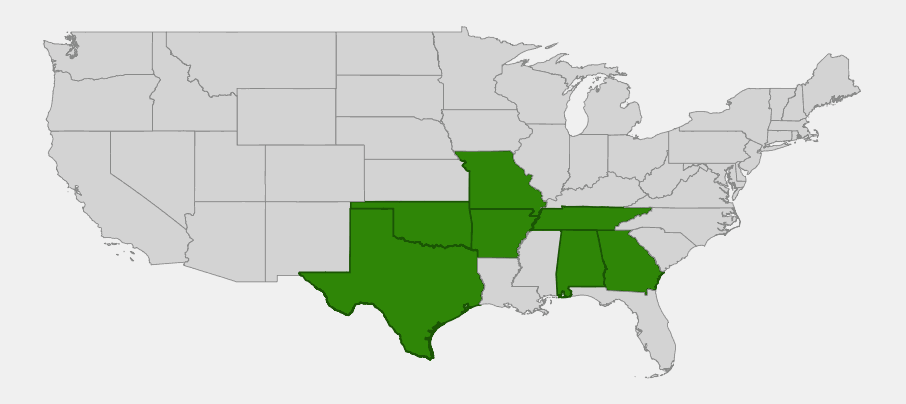
American smoke tree has one of the most fragmented native ranges of any eastern North American tree. It occurs in scattered, often disjunct populations across Missouri, Arkansas, Oklahoma, Tennessee, Alabama, Georgia and the Edwards Plateau of central Texas. Within each state it is typically rare, limited to a handful of counties where the right exposed limestone habitat exists, rather than spread broadly across the landscape.
Its signature habitat is dry, rocky limestone glades, bluffs and outcrops — places with thin, alkaline soil, intense summer heat, and little competing vegetation. Classic sites include the limestone glades of the Ozark Plateau in Missouri and Arkansas, the Arbuckle Mountains of south-central Oklahoma, the Ridge and Valley and Highland Rim limestone bluffs of Tennessee and Alabama, and the Edwards Plateau’s limestone canyons in the Texas Hill Country. These are harsh, exposed sites with shallow soil that bakes in summer and drains quickly after rain — conditions most trees cannot tolerate.
Because it is restricted to such a narrow, specialized habitat, American smoke tree is uncommon to rare throughout its range and is tracked as a species of conservation concern in several states. It is not legally protected nationwide, but check state natural heritage programs before collecting seed or plant material from wild populations, and favor nursery-propagated stock for garden use.
📋 Regional plant lists featuring American Smoke Tree: Georgia, Alabama & Mississippi · Arkansas, Louisiana, Eastern Oklahoma & Eastern Texas · Kentucky & Tennessee · Illinois, Iowa & Missouri
Growing & Care Guide
American smoke tree is one of the most forgiving native trees for hot, dry, rocky sites where little else thrives. Its biggest requirement in cultivation is good drainage — give it that, and it asks for almost nothing else.
Light
Plant it in full sun for the densest form and the most vivid fall color. It also tolerates part shade, especially in the hottest parts of its range, but trees grown in shade become leggier and more open, and fall color is noticeably less intense. In the garden, a spot with at least six hours of direct sun gives the best results.
Soil & Water
This is fundamentally a limestone-glade tree, so it wants lean, rocky, fast-draining, neutral-to-alkaline soil rather than rich, moist garden loam. It tolerates poor, shallow and even clay soils as long as drainage is adequate, and it is remarkably drought tolerant once established — a real asset on slopes, rock gardens and other sites that go dry in summer. The one thing it will not tolerate is wet feet; soggy or poorly drained soil leads to root problems. Water regularly through the first one to two growing seasons to establish roots, then back off; established trees need supplemental water only in extended drought.
Planting Tips
Plant container-grown trees in fall or early spring. Because the species naturally grows in thin, rocky soil, there is rarely a need to amend garden soil with organic matter before planting — in fact, overly rich, loose soil can encourage weak, floppy growth. Choose the sunniest, best-drained spot available, such as a slope, berm or rocky bed, and avoid low areas that collect water. Stake young trees only if the planting site is windy, and remove the stakes within a year.
Pruning & Maintenance
American smoke tree needs very little pruning. Remove dead, crossing or damaged branches in late winter while the tree is dormant. Many gardeners allow it to develop its natural multi-stemmed, rounded shrub form; to train it as a single-trunked small tree, select a leader early and remove competing stems over the first few years. It is slow-growing, so avoid heavy pruning that sets growth back further. The tree has few serious pest or disease problems, though verticillium wilt can occasionally affect it, as it does the related smoke bush.
Propagation
Propagation from seed is slow and often erratic; seed has a hard coat and benefits from scarification followed by cold stratification over winter before spring sowing. Softwood cuttings taken in early summer can root with rooting hormone and bottom heat, though success rates vary. Because of this, and because the species is uncommon in the wild, buy nursery-propagated plants rather than attempting to collect from native populations.
Landscape Uses
- Rock gardens and rocky slopes, where its drought tolerance and lean-soil preference are assets rather than limitations
- Fall color specimen planted where its orange-to-scarlet display can be seen from a distance
- Xeriscaping and low-water landscapes in the South and lower Midwest
- Limestone and alkaline-soil gardens alongside Eastern Redbud and fragrant sumac
- Small-space or street tree where its modest mature size fits under power lines
- Winter interest plantings, thanks to its flaking, scaly bark
Wildlife & Ecological Value
American smoke tree’s wildlife role is modest compared to many native trees, but it contributes real value in the harsh glade habitats where it grows, and in gardens that recreate those conditions.
For Pollinators
The small spring flower clusters, though individually inconspicuous, are produced in quantity and attract a range of native bees and other small pollinating insects during a period when few other plants are blooming on exposed, rocky glades.
For Birds
Small songbirds use the dense branching structure for cover and nesting sites, particularly valuable on open glades where tall woody cover is otherwise scarce. The dry fruit is eaten occasionally by birds, though it is not a major food source compared to fleshier native fruits.
For Mammals
Deer generally avoid browsing the foliage, which is part of why the species is considered deer resistant — a practical benefit for gardeners as much as an ecological note. Small mammals use the tree’s cover on open glade habitat in the wild.
Ecosystem Role
On the limestone glades where it is native, American smoke tree is one of relatively few woody plants able to establish in thin, rocky, drought-prone soil, so it plays an outsized structural role in these rare plant communities, providing shade pockets and woody structure amid low groundcover and exposed rock. Glade ecosystems themselves are globally uncommon and support many specialized plants and animals, making conservation of remaining smoke tree populations part of a broader glade conservation effort.
Cultural & Historical Uses
The old common name “yellowwood” refers to the tree’s bright yellow-orange heartwood, which was historically used as a source of natural dye in the rural South, particularly before the widespread availability of synthetic dyes. The wood was boiled to extract a yellow-orange pigment used for coloring homespun cloth and other textiles, a practice recorded among Appalachian and Ozark settlers.
Because of its rarity and slow growth, American smoke tree was never an important timber species, and its wood has little commercial history beyond small-scale dye production and occasional use in turnery or small woodworking projects. Its main modern significance is horticultural: botanists and arboretum collectors have long valued it for its exceptional and reliable fall color, and specimens are grown at arboreta well outside its native range, including in the United Kingdom, where its autumn display is particularly celebrated.
Today, interest in American smoke tree centers on native-plant gardening and habitat restoration in the South and lower Midwest, where it is increasingly recognized as a durable, low-maintenance choice for the difficult rocky, alkaline sites that frustrate many other trees.
Frequently Asked Questions
Is American smoke tree the same as the smoke bush sold at garden centers?
No. The purple-leaved “smoke bush” commonly sold in nurseries is usually Cotinus coggygria, a Eurasian species, or a hybrid between it and American smoke tree. True American smoke tree (Cotinus obovatus) is a US native, grows larger, has blue-green rather than purple foliage, and is valued mainly for fall color rather than summer leaf color.
Why is American smoke tree hard to find at nurseries?
It is slow-growing and propagates with some difficulty from both seed and cuttings, which makes it less profitable for growers than fast-rooting ornamentals. Specialty native-plant nurseries, particularly in its native region, are the most reliable source.
Does American smoke tree need alkaline soil?
It is naturally found on limestone and tolerates alkaline soil very well, but it also grows successfully in neutral and even somewhat acidic garden soils as long as drainage is good. Good drainage matters more than exact pH for garden success.
How big does American smoke tree get?
Most garden specimens reach 20 to 30 feet tall with a similar spread over many years, since it is a slow grower. It stays far more compact than a typical shade tree, making it a good fit for smaller landscapes.
Is American smoke tree endangered?
It is not federally listed, but because its glade habitat is naturally rare and fragmented, several states where it occurs track it as a plant of conservation concern. Buying nursery-propagated stock rather than wild-collected plants helps protect remaining populations.

Looking for a nursery that carries American Smoke Tree?
Browse our native plant nursery directory: Alabama & Arkansas · Georgia · Missouri · Oklahoma · Tennessee & Texas