
Loblolly Bay (Gordonia lasianthus)
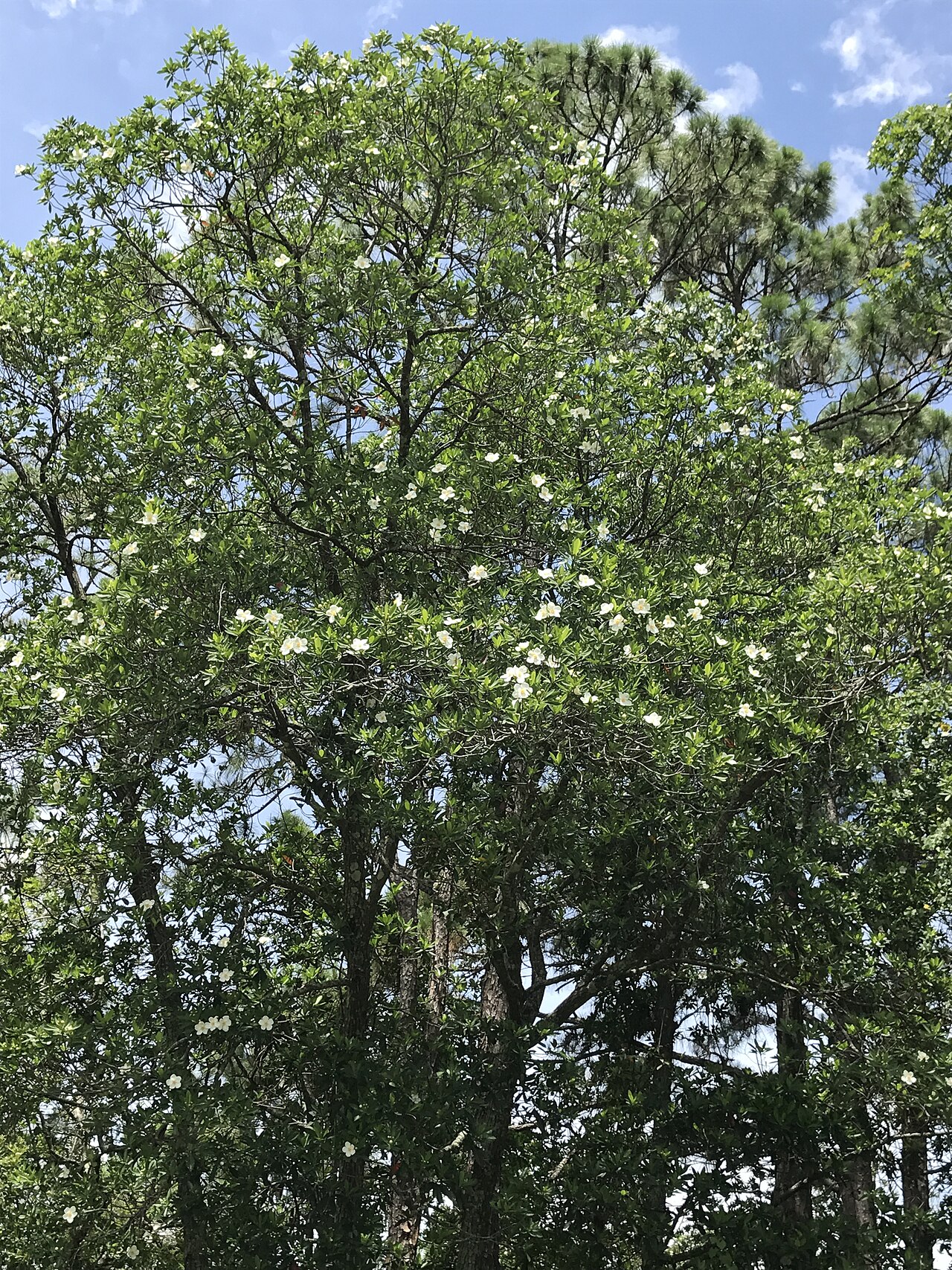
Gordonia lasianthus, commonly called Loblolly Bay, is a tall evergreen tree of the Southeastern Coastal Plain, prized for its glossy foliage and large, camellia-like white flowers that open through the heat of summer. A member of the tea family (Theaceae), it shares that family’s handsome foliage and showy blooms, but in the wild it is a tree of wet, acidic ground — pocosins, bay swamps, and the margins of cypress ponds — rather than a garden ornamental in the usual sense. The name “bay” refers to its leathery, bay-like leaves, not to any relation to true laurels.
In good sites Loblolly Bay grows as a straight-trunked tree 40 to 60 feet tall, occasionally taller, with a narrow, rounded crown of dark, leathery leaves that stay on the tree through winter. From June into August it produces a long succession of fragrant white flowers, each one lasting only a day or two but replaced by new buds for weeks on end, so a mature tree is rarely without a few blossoms through midsummer. Few native Southeastern trees flower this heavily this late in the season, which makes Loblolly Bay a genuinely useful source of nectar when many spring bloomers have finished.
Because it demands constantly wet, peaty, acidic soil, Loblolly Bay is not a plant for the average home landscape. It belongs in restoration plantings, pond margins, and the lowest, wettest corners of a native plant garden where few other trees will thrive — sites where its combination of evergreen structure and summer flowers has no real substitute among Southeastern natives.
Identification
Loblolly Bay is most often seen as a single-trunked tree with a fairly narrow, upright crown, though it can form a large shrub on poorer sites or where repeatedly top-killed by fire. Trunk diameter on older trees commonly reaches 1 to 2 feet. The tree is evergreen, holding its leaves year-round, which combined with its height makes it a conspicuous dark-green component of bay swamps and pocosins even in winter.
Bark
Young bark is smooth and gray-brown, but with age it becomes thick, deeply furrowed, and reddish-brown to gray, breaking into long, flat-topped ridges somewhat reminiscent of a pine. The furrowed, fire-blackened trunks of old Loblolly Bays are a familiar sight at the edges of pocosins that have burned in recent decades.
Leaves
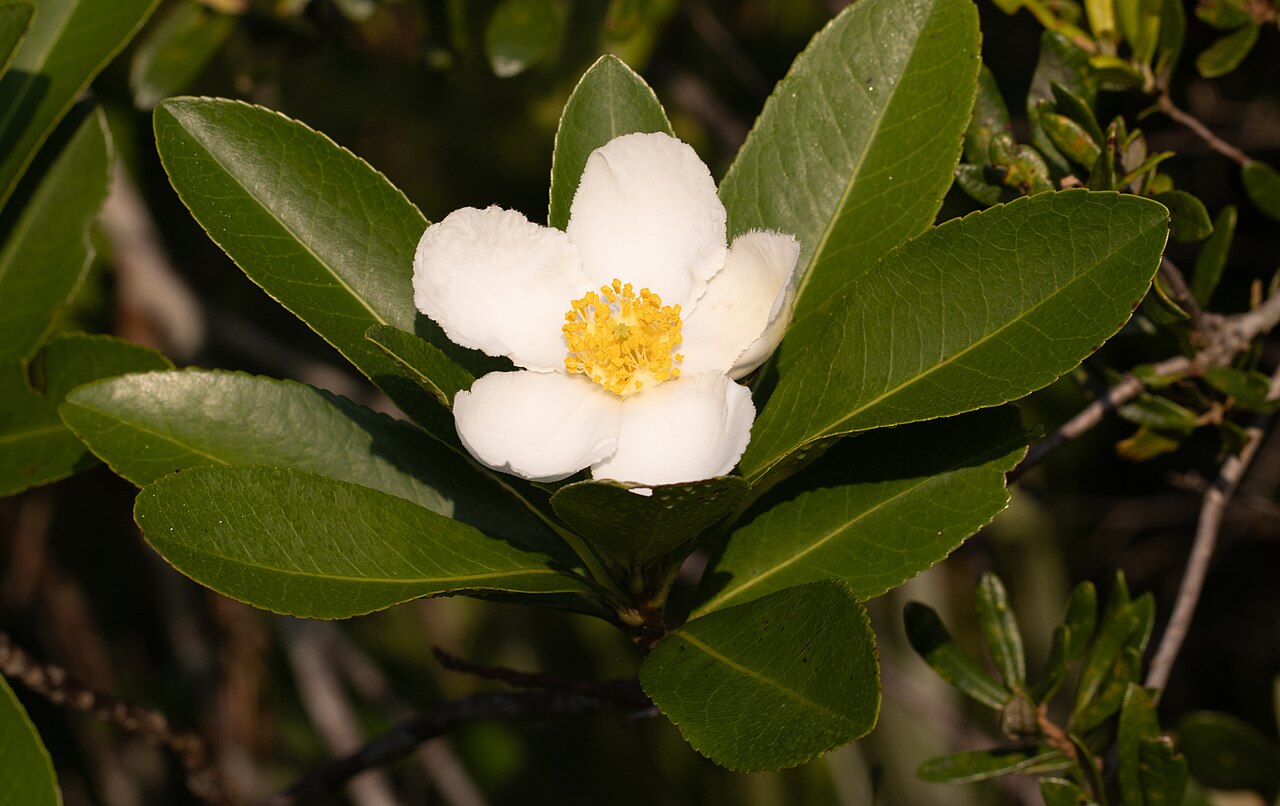
Leaves are alternate, leathery, and elliptic to oblong, 3 to 5 inches long, glossy dark green above and paler beneath, with finely toothed margins. Individual leaves persist for roughly a year; as they near the end of their life a scattering of them turns bright red before dropping, so an otherwise solid-green crown is usually flecked with a few crimson leaves at any given time — a useful field mark even from a distance. Crushed leaves have no strong scent, which helps distinguish the tree from true bays (Persea species) growing in the same wet woods.
Flowers & Fruit
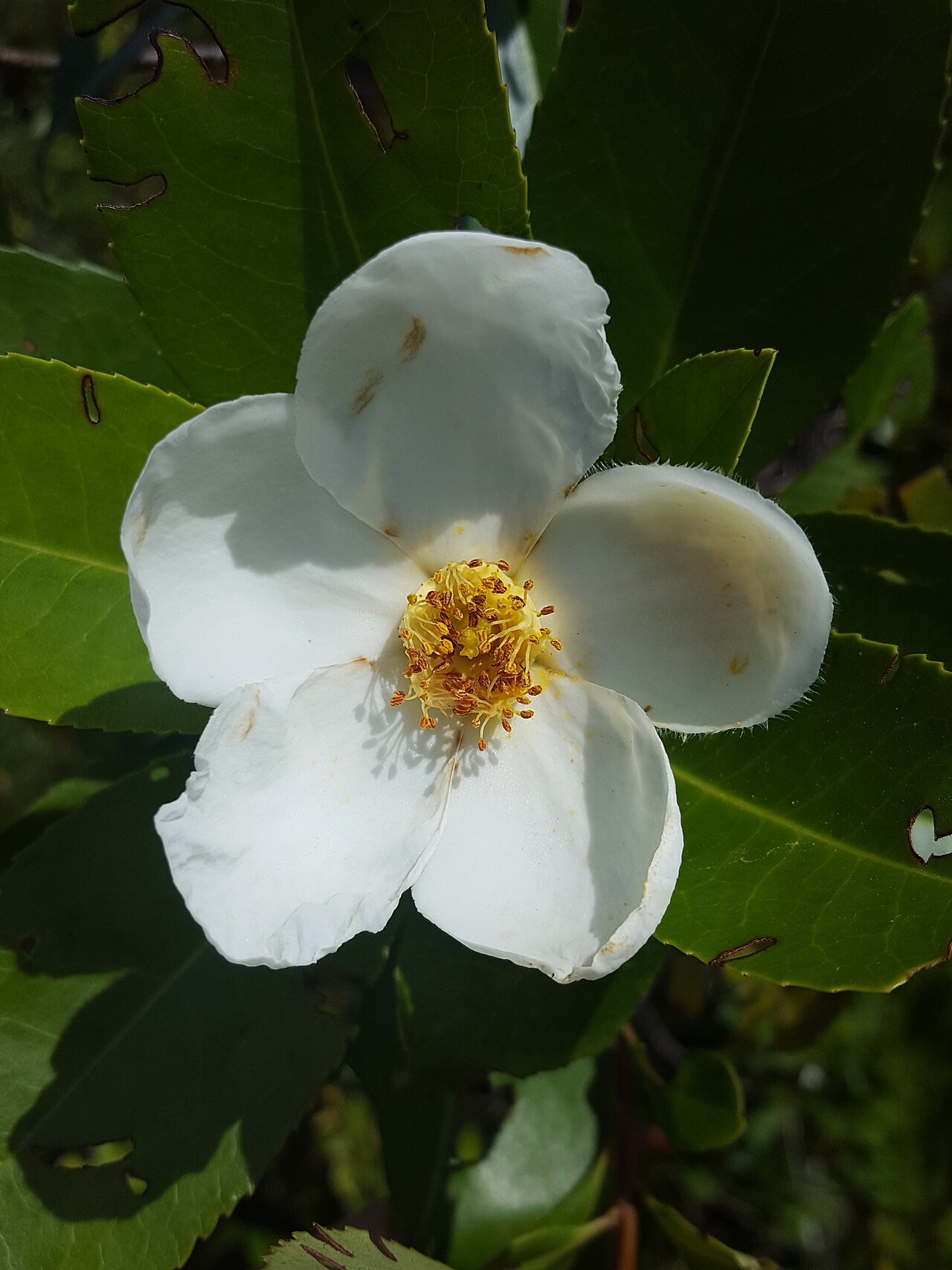
The flowers are the tree’s signature feature: solitary, cup-shaped, 2 to 3 inches across, with five crinkled white petals surrounding a dense boss of yellow-orange stamens, carried on long stalks from the leaf axils near the branch tips. They open from June through August, each bloom lasting only a day or two, but the tree keeps producing new buds over many weeks, so flowering is extended rather than a single flush. The fragrance is mild and sweet, and the flowers are heavily worked by bees — loblolly bay honey is a distinct, prized product in parts of the Southeast. The fruit is a woody, five-chambered capsule about ¾ inch long that ripens in fall and splits open to release small winged seeds.
Quick Facts
| Scientific Name | Gordonia lasianthus |
| Family | Theaceae (Tea) |
| Plant Type | Evergreen Tree |
| Mature Height | 40–60 ft |
| Trunk Diameter | 1–2 ft |
| Growth Rate | Slow to Moderate |
| Sun Exposure | Full Sun to Part Shade |
| Water Needs | High (constantly wet soil) |
| Soil Type | Wet, peaty or sandy; poorly drained |
| Soil pH | 4.5–6.0 (strongly to moderately acidic) |
| Bloom Time | June – August |
| Flower Color | White |
| Fall Color | Evergreen; scattered leaves turn red year-round |
| Fruit | Woody 5-valved capsule |
| Deer Resistant | Generally yes |
| USDA Hardiness Zones | 7–9 |
Native Range
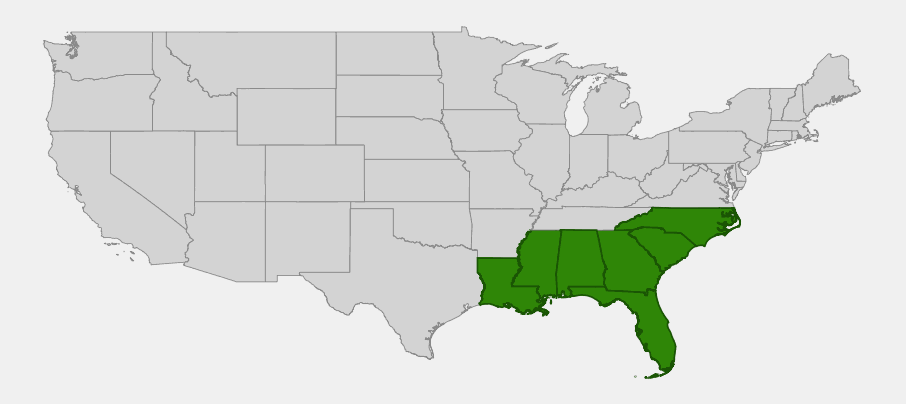
Loblolly Bay is native to the Atlantic and Gulf Coastal Plains of the southeastern United States, from North Carolina south through South Carolina, Georgia, and Florida, and west along the Gulf into Alabama, Mississippi, and Louisiana. It is most abundant in Florida and the Carolinas; populations in Mississippi and Louisiana sit near the western edge of the species’ range and are more scattered. It is not native farther north or west than this coastal belt, and plants offered outside the Southeast are garden specimens, not naturalized populations.
Within this range, Loblolly Bay is a characteristic tree of pocosins, bay swamps, and the swampy margins of ponds and slow streams — the same acidic, saturated, sandy-peaty soils favored by Sweetbay Magnolia (Magnolia virginiana), Swamp Bay (Persea palustris), and Fetterbush (Lyonia lucida). It often grows alongside Slash Pine (Pinus elliottii) on the drier fringes of these wetlands, which is why it appears in the background of so many longleaf and slash pine flatwoods photographs, its white summer flowers visible above the pine understory.
📋 Regional plant lists featuring Loblolly Bay: North Carolina & South Carolina · Georgia, Alabama & Mississippi · Arkansas, Louisiana, Eastern Oklahoma & Eastern Texas
Growing & Care Guide
Loblolly Bay is not a plant for ordinary garden conditions — it is built for permanently wet, acidic ground, and it struggles anywhere that soil dries out between rains. Where that condition can be met, though, it is a tough, low-maintenance evergreen that asks for very little once established.
Light
Full sun produces the densest crown and the most flowers, but Loblolly Bay also tolerates partial shade, especially as a young tree establishing beneath taller pines. In deep shade it grows thin and flowers sparsely.
Soil & Water
This is the species’ defining requirement: constantly moist to wet, strongly acidic soil, whether sandy, peaty, or a mix of both. It is at home with its roots in standing water for extended periods and will not thrive, and may eventually fail, on soil that dries out for long stretches in summer. It has no tolerance for alkaline or neutral soils. Pond and stream margins, the low end of a rain garden, or a constructed bog bed are the kinds of sites that suit it.
Planting Tips
Plant container-grown stock in fall or early spring, choosing the wettest, most acidic spot available — the edge of a pond, a drainage swale, or a low area that collects runoff. Mulch with pine straw or bark to help hold moisture and maintain soil acidity. Because nursery availability is limited, order well ahead from a native plant specialist rather than expecting to find it at a general garden center.
Pruning & Maintenance
Pruning needs are minimal: remove dead wood and any damaged branches after flowering. The tree naturally sheds a scattering of older leaves throughout the year, which is normal rather than a sign of stress. Loblolly Bay has no major pest or disease problems when grown in appropriately wet soil; most decline in cultivation traces back to soil that is simply too dry.
Landscape Uses
Loblolly Bay fits a narrow but valuable niche:
- Wetland and pond-margin plantings where few other evergreen trees will grow
- Bog garden or rain garden centerpiece in the wettest zone
- Restoration plantings in degraded pocosins and bay swamps
- Pollinator gardens as a source of abundant midsummer nectar
- Screening or specimen tree on consistently saturated ground
Fire Ecology
In its native pocosins and wet flatwoods, Loblolly Bay is adapted to a landscape shaped by periodic fire, though the tree itself is only moderately fire-tolerant. Thin-barked young trees are readily top-killed by fire, but mature trees with thick, furrowed bark often survive low-intensity burns, and top-killed trees frequently resprout from the root crown. Because pocosins can burn severely during drought, fire history strongly influences the age structure of Loblolly Bay stands, favoring a mix of fire-scarred veterans and younger resprouts.
Wildlife & Ecological Value
Loblolly Bay’s long midsummer bloom period makes it one of the more valuable native nectar trees of the Southeastern wetlands, flowering at a time when many spring-blooming trees and shrubs have finished for the year.
For Pollinators
Honeybees and native bees work the flowers heavily through June, July, and August. Loblolly bay honey is recognized as a distinct regional honey in parts of Florida and the Carolinas, produced where bee colonies have ready access to extensive stands of the tree in pocosins and bay swamps.
For Birds & Other Wildlife
The dense evergreen canopy of mature Loblolly Bay provides year-round cover and nesting structure in wetland forests that otherwise lose much of their canopy cover in winter. Seed-eating birds take advantage of the capsules once they split open in fall, though the tree is valued more for structure and nectar than for a heavy fruit crop.
Ecosystem Role
As one of the few large evergreen trees adapted to permanently saturated, acidic wetland soils, Loblolly Bay helps define the pocosin and bay swamp plant community, growing alongside Sweetbay Magnolia and Swamp Bay to form the characteristic “bay forest” canopy of these habitats. These wetland forests buffer adjacent uplands from flooding, filter runoff, and support wildlife communities distinct from the surrounding pine flatwoods.
Cultural & Historical Uses
Loblolly Bay has a modest but specific history of use in the Southeast. Its wood, though not commercially important, has occasionally been cut for lumber and tool handles where it could be found. The tree’s main historical significance is as a honey plant: beekeepers in Florida and the Coastal Plain have long placed hives near pocosins and bay swamps to take advantage of its extended midsummer bloom, and loblolly bay honey remains a recognized, locally distinctive product in parts of its range today.
The name “loblolly,” shared with loblolly pine, is an old Southern term for a mudhole or mire, a fitting reference to the wet, boggy ground this tree calls home. No part of the plant has a documented history of medicinal or food use, and none should be assumed safe to eat.
Frequently Asked Questions
Can I grow Loblolly Bay in a normal garden bed?
Not successfully in most cases. Loblolly Bay needs constantly wet, acidic soil and declines where the ground dries out between rains. It belongs in a pond margin, bog garden, or other consistently saturated, low-lying spot rather than a typical border or lawn setting.
Is Loblolly Bay the same as loblolly pine?
No. They share the word “loblolly,” an old term for a mudhole, because both grow in wet ground, but they are unrelated: loblolly pine (Pinus taeda) is a conifer, while Loblolly Bay (Gordonia lasianthus) is a broadleaf evergreen in the tea family.
Why does my Loblolly Bay drop leaves even though it’s evergreen?
This is normal. As an evergreen, the tree continuously sheds its oldest leaves — usually a scattering of leaves that turn red before falling — while retaining the rest of its foliage year-round. It does not go bare the way a deciduous tree does.
How long does Loblolly Bay bloom?
Individual flowers last only a day or two, but a healthy tree keeps producing new buds from June into August, so flowering appears continuous through much of the summer rather than occurring in one short flush.
Is Loblolly Bay easy to find at nurseries?
It is uncommon in the general nursery trade because of its specific wet-soil requirements. Native plant specialists in Florida, Georgia, and the Carolinas are the most reliable sources; expect to special-order it rather than finding it at a typical garden center.

Looking for a nursery that carries Loblolly Bay?
Browse our native plant nursery directory: Florida & Georgia · South Carolina · North Carolina · Alabama · Mississippi & Louisiana