
Texas Palmetto (Sabal mexicana)
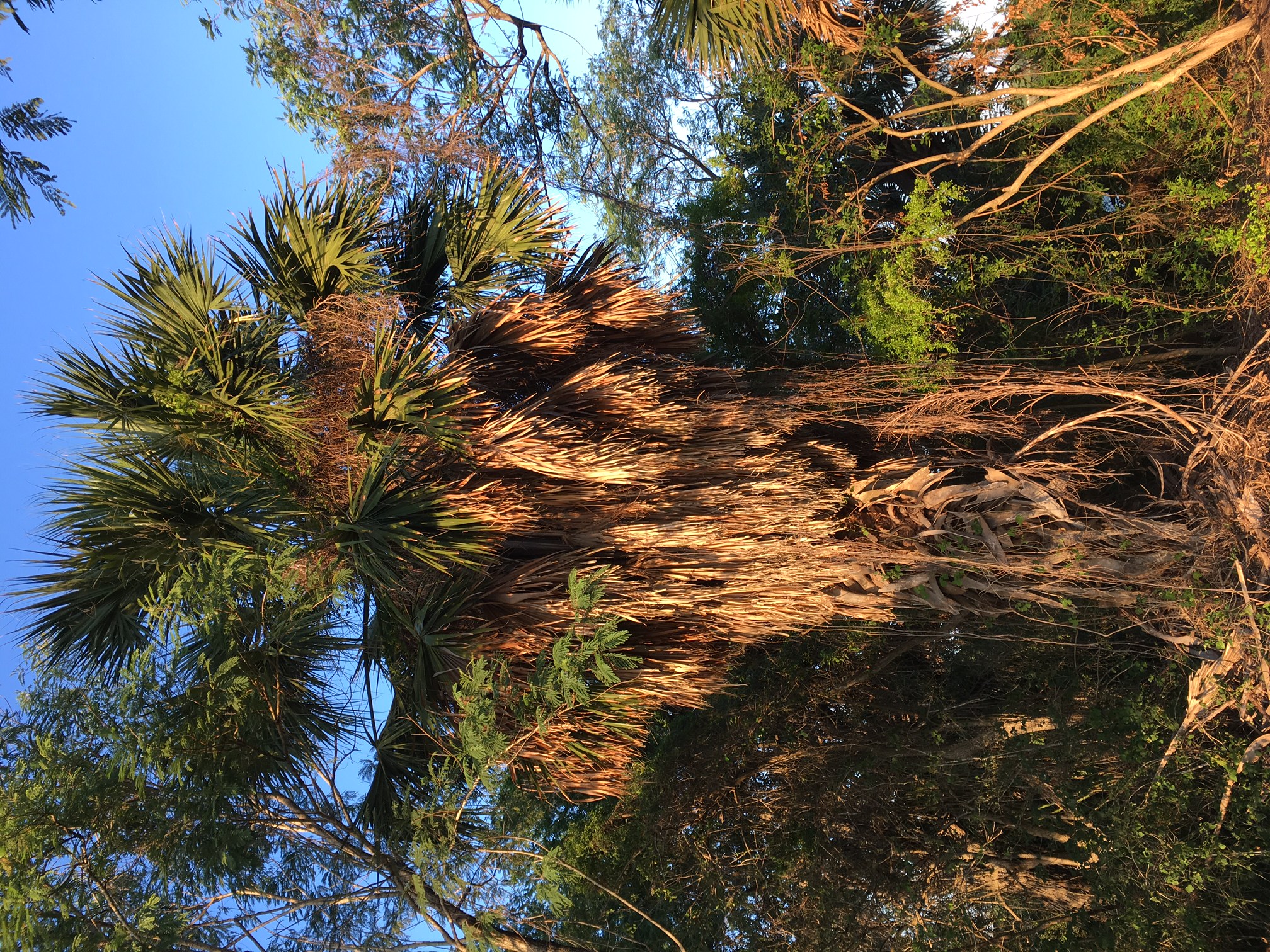
Sabal mexicana, commonly called the Texas Palmetto or Rio Grande Palmetto (also sold as Mexican Palmetto or Texas Sabal Palm), is one of only a handful of palm species native to the continental United States — and the only true fan palm native to Texas. This stately, slow-growing tree once formed dense “sabal forests” (locally called palmares) along the lower Rio Grande, a habitat type that has nearly vanished under agriculture and development. Today, fewer than a handful of protected remnants remain, making every Texas Palmetto planted in a native garden a small act of habitat restoration.
In the wild, Texas Palmetto grows along the floodplain of the lower Rio Grande in the four southernmost counties of Texas — Cameron, Hidalgo, Starr, and Willacy — and continues south into the Mexican states of Tamaulipas, Veracruz, and beyond. It reaches 30 to 50 feet tall with a thick, often leaning trunk, topped by a dense crown of stiff, fan-shaped (costapalmate) leaves. Unlike its more commonly planted Florida relative, Cabbage Palm (Sabal palmetto), the Texas Palmetto is adapted to the brushy, semi-arid subtropical thorn-scrub (Tamaulipan biotic province) rather than coastal pine flatwoods, and it tolerates both periodic flooding along the river and long dry spells between floods.
Texas Palmetto is an excellent, low-maintenance landscape palm for South Texas gardens, especially where a native, cold-hardy, wildlife-friendly alternative to non-native ornamental palms is wanted. It is slow to establish but extremely long-lived, and its fruit is an important late-season food source for Rio Grande Valley wildlife, including the endangered ocelot, which uses dense palmetto stands for cover.
Identification
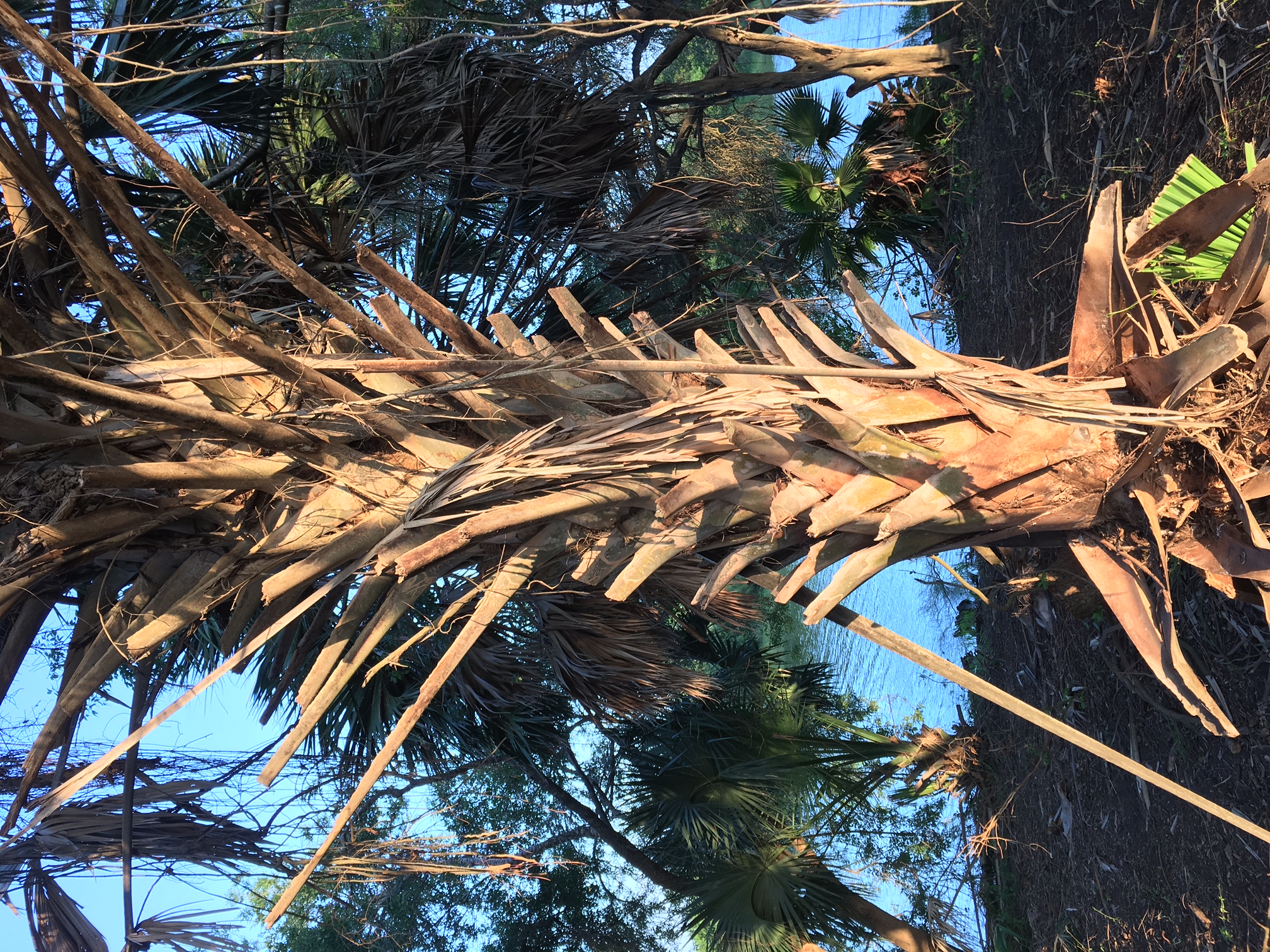
Texas Palmetto is a solitary-trunked fan palm, usually 30–50 ft (9–15 m) tall in cultivation, with old-growth wild specimens occasionally reaching 50–60 ft. The trunk is stout, 12–18 in (30–46 cm) in diameter, gray-brown, and often leans or curves with age. Young and unmaintained trees carry a thick “skirt” of dead, drooping fronds and retained leaf-base “boots” that are not shed on their own; these must be removed by hand (or burn off naturally) to reveal the smooth trunk beneath.
Trunk & Boots
The persistent leaf bases, or “boots,” form a crosshatched, woven-looking pattern around the upper trunk of young and unmaintained palms. Over years to decades these boots eventually weather and fall away, exposing a trunk ringed with old leaf-scar lines — a feature shared with other Sabal species but distinct from feather palms. In habitat, the boots and the hanging dead-frond skirt provide shelter for roosting bats, tree-dwelling lizards, and nesting birds.
Leaves
Leaves are costapalmate (fan-shaped but with the blade folded along a short continuation of the leaf stalk, giving a slightly drooping, three-dimensional form) rather than flat, 4–6 ft (1.2–1.8 m) across, divided roughly halfway into 40–60 stiff, pointed segments that often split further at their tips into two narrower points. Leaf color is a deep yellow-green, paler than the blue-green of many ornamental palms. Leaf stalks (petioles) are unarmed — without the marginal teeth or spines found on some other palms — and are 3–5 ft long, widening into a fibrous network at the base.
Flowers & Fruit
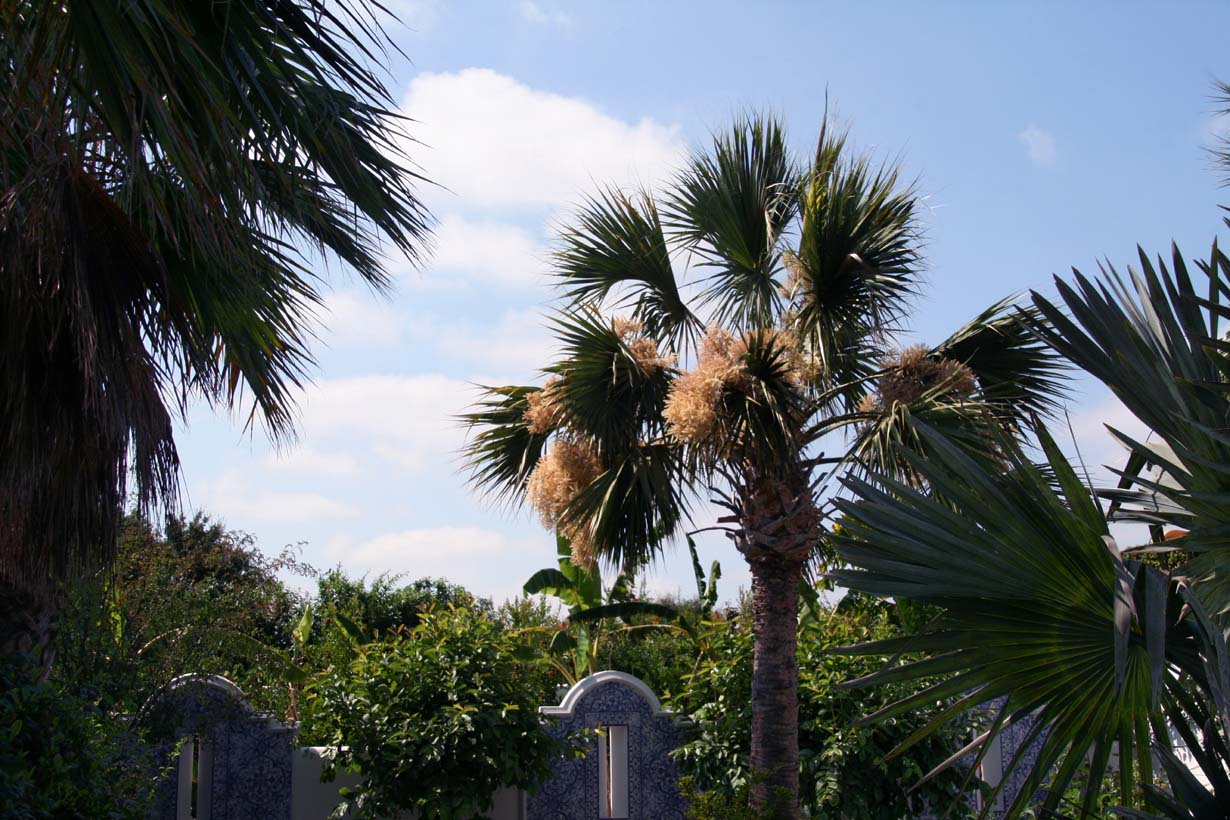
Mature palms produce large, arching flower stalks (inflorescences) up to 6–8 ft long that emerge from among the leaves in late spring to summer, bearing thousands of small, fragrant, creamy-white flowers in branched clusters. Flowers are perfect (containing both male and female parts) and are visited heavily by bees and other insects. Fruit follows in fall: round to oval, 1/2 to 3/4 inch (1.3–2 cm) black drupes borne in heavy, hanging clusters, each containing a single hard seed surrounded by thin, sweetish, date-like flesh.
Quick Facts
| Scientific Name | Sabal mexicana |
| Family | Arecaceae (Palm) |
| Plant Type | Evergreen Fan Palm |
| Mature Height | 30–50 ft (9–15 m) |
| Mature Spread | 10–15 ft (crown) |
| Growth Rate | Slow |
| Sun Exposure | Full Sun to Part Shade |
| Water Needs | Average; tolerates periodic flooding and drought once established |
| Soil Type | Clay, loam or sand; tolerates heavy, poorly drained soil |
| Soil pH | 6.0–8.0 (adaptable, tolerates alkaline soil) |
| Bloom Time | Late spring – summer |
| Flower Color | Creamy white |
| Fall Color | Evergreen (no fall color change) |
| Fruit | Black drupes, 1/2–3/4 in, in hanging clusters |
| Deer Resistant | Yes |
| USDA Hardiness Zones | 9a–11 (tolerates brief dips into the low 20s°F once established) |
Native Range
Texas Palmetto is native only to the far southern tip of Texas and adjacent northeastern Mexico — it is not native anywhere else in the United States. Within Texas, confirmed wild populations are restricted to the floodplain of the lower Rio Grande in Cameron, Hidalgo, Starr, and Willacy counties, part of the Tamaulipan thornscrub ecoregion. From there its range continues south through the Mexican states of Tamaulipas, Nuevo León, San Luis Potosí, Veracruz, and into parts of Central America, where related forms have sometimes been described as separate species.
Historically, dense stands of Texas Palmetto — known locally as sabal or palmetto forests — lined many miles of the Rio Grande floodplain, forming a distinctive subtropical riparian woodland found nowhere else in the country. Clearing for agriculture, flood control, and urban development eliminated the vast majority of this habitat during the 20th century; the Audubon Sabal Palm Sanctuary near Brownsville protects one of the last significant native stands. Because its true native range is so narrow, Texas Palmetto planted elsewhere in Texas (it is now a popular and widely sold landscape palm as far north as San Antonio and Houston) should be understood as a cultivated planting, not a sign the species is native to those areas.
Where it does grow wild, Texas Palmetto occupies low floodplain terraces and resaca (old river channel) margins that flood periodically, rooting in rich alluvial clay and loam alongside Texas Ebony, Anacua, and Mexican Ash.
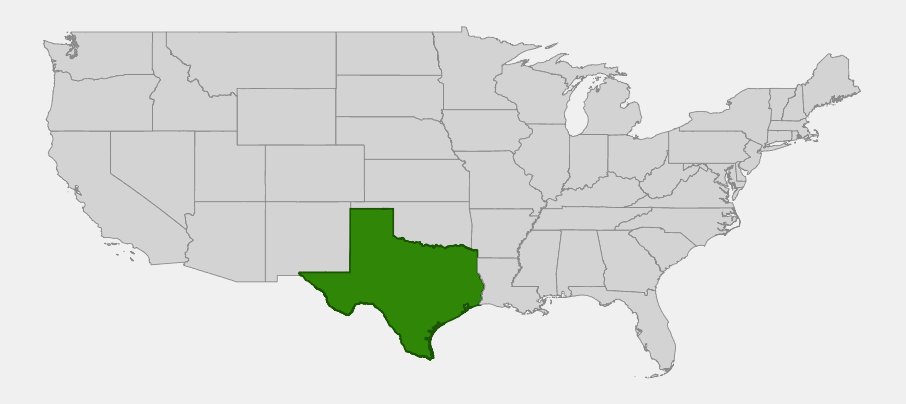
📋 Texas Palmetto’s native range is too narrow to fall within any of Plant Native’s regional plant lists; it is not included in the Arkansas, Louisiana, Eastern Oklahoma, and Eastern Texas list, which covers eastern Texas rather than the Rio Grande Valley.
Growing & Care Guide
Texas Palmetto is tough and low-maintenance once established, tolerating heat, periodic flooding, brief drought, and the heavy clay soils common across South Texas. Its main limiting factor outside its native range is cold: hard freezes below the low 20s°F can damage or kill the growing bud, which is why it thrives mainly in zones 9a and warmer.
Light
Plant in full sun for the fastest growth and fullest crown. Texas Palmetto also tolerates part shade, especially while young, but growth slows considerably and the crown becomes more open and lopsided as the palm leans toward available light.
Soil & Water
This palm is remarkably adaptable, growing in sand, loam, or heavy clay, and tolerating both occasional flooding and extended dry spells once its root system is established. Young palms benefit from regular watering during their first two to three years; after that, established plants need supplemental water only during prolonged drought. Good drainage is not essential — in the wild it grows on floodplain soils that are wet for days at a time.
Planting Tips
Transplant balled-and-burlapped or container specimens in spring or early summer so roots establish before winter. Texas Palmetto is notoriously slow to show new growth after transplanting — be patient, as a newly moved palm may sit for a year or more before pushing new fronds. Space specimens at least 10–12 ft apart to allow the crown to fill out, and keep the trunk base free of turf competition for the first few seasons.
Pruning & Maintenance
Remove only fully dead, brown fronds; green or yellowing fronds still feed the palm and should be left in place. Over-pruning (cutting live fronds for a “hurricane cut” look) stresses the palm and is not recommended. The shaggy skirt of dead fronds and retained leaf-base boots are natural, not a sign of poor health, and many gardeners leave them in place for wildlife value and a more naturalistic look; they can also be trimmed away over several years for a cleaner, smooth-trunk appearance.
Landscape Uses
Texas Palmetto’s native status, drought tolerance once established, and striking form make it valuable for several landscape roles:
- Specimen or focal-point tree in South Texas native and xeriscape gardens
- Street or avenue planting where a cold-hardy, native fan palm is wanted
- Riparian restoration along resacas and floodplain margins within its native range
- Wildlife garden anchor — fruit and dense fronds support birds and mammals
- Screening when planted in groups, especially with the frond skirt retained
Wildlife & Ecological Value
Where it still grows in dense native stands along the lower Rio Grande, Texas Palmetto anchors one of the rarest habitat types in the United States, and its ecological value is disproportionate to its small native footprint.
For Birds
The heavy fall clusters of black fruit are eaten by a wide range of resident and migratory birds, including Great Kiskadees, Altamira Orioles, Green Jays, and various thrushes, which pass through the Rio Grande Valley on migration. The dense crown and retained frond skirt provide secure nesting and roosting sites, and cavity-nesting birds use old trunks in long-undisturbed stands.
For Mammals
Fruit is consumed by raccoons, opossums, and coyotes, which help disperse the seeds. Perhaps most notably, the dense, low cover created by mature, unmaintained palmetto stands with their full frond skirts provides important daytime shelter for the endangered ocelot in the few protected sabal forest remnants of the lower Rio Grande Valley, making stand structure (not just species presence) ecologically significant.
For Pollinators
The large, fragrant summer flower clusters attract abundant native bees and other insects at a time when fewer other woody plants are blooming in South Texas, making Texas Palmetto a useful late-season nectar source in regional pollinator gardens.
Ecosystem Role
Historically, Texas Palmetto formed the structural backbone of a unique subtropical riparian forest type found nowhere else in the United States. Because so little of this habitat remains, every mature stand retains outsized importance for the species that depend on it, and restoring palmetto cover along the river corridor is a stated goal of several regional conservation programs.
Cultural & Historical Uses
Indigenous peoples and early settlers along the lower Rio Grande used Texas Palmetto’s tough, fan-shaped leaves for thatching roofs, weaving baskets and mats, and making brooms, while the fibrous leaf bases were sometimes used for cordage. The trunk’s durable wood was occasionally used for fence posts and rustic construction in areas where lumber was scarce.
The sweet, date-like flesh of the ripe fruit was eaten by local peoples and is still foraged occasionally today, though the fruit is thin-fleshed and mostly seed, making it a minor food resource rather than a staple. The large, nearly round seeds have also been collected and strung as beads.
In the 20th century, as the native sabal forests of the Rio Grande were cleared for farmland, Texas Palmetto shifted from a wild resource to a prized ornamental, and it is now the signature native palm of South Texas landscaping — planted from Brownsville to San Antonio as a hardy, low-maintenance alternative to non-native palm species.
Frequently Asked Questions
Is Texas Palmetto the same plant as Sabal texana?
Yes. Sabal texana is an older scientific name once used for Rio Grande Valley populations; botanists now treat it as the same species as Sabal mexicana, which ranges from South Texas through much of eastern Mexico.
Is Texas Palmetto native to all of Texas?
No. Its only confirmed wild populations are in the four southernmost counties along the lower Rio Grande — Cameron, Hidalgo, Starr, and Willacy. It is widely planted as an ornamental much farther north in Texas, but those plantings are cultivated, not native stands.
How fast does Texas Palmetto grow?
Slowly. It can take a decade or more of establishment before a young palm begins forming visible trunk, and transplanted specimens may show little new growth for a year or two while roots reestablish. Patience is essential with this species.
Can Texas Palmetto survive a hard freeze?
Established plants tolerate brief dips into the low 20s°F with only frond damage, but prolonged hard freezes can kill the bud and the whole palm. This limits reliable outdoor survival to USDA zones 9a and warmer.
Do I need to remove the dead frond skirt?
No — the skirt of dead fronds and leaf-base boots is natural and not a sign of disease. Many native-plant gardeners leave it in place for its wildlife value and rustic look, though it can be pruned away gradually for a cleaner, smooth-trunk appearance if preferred.

Looking for a nursery that carries Texas Palmetto?
Browse our native plant nursery directory: Texas and surrounding states