Black Raspberry (Rubus occidentalis)
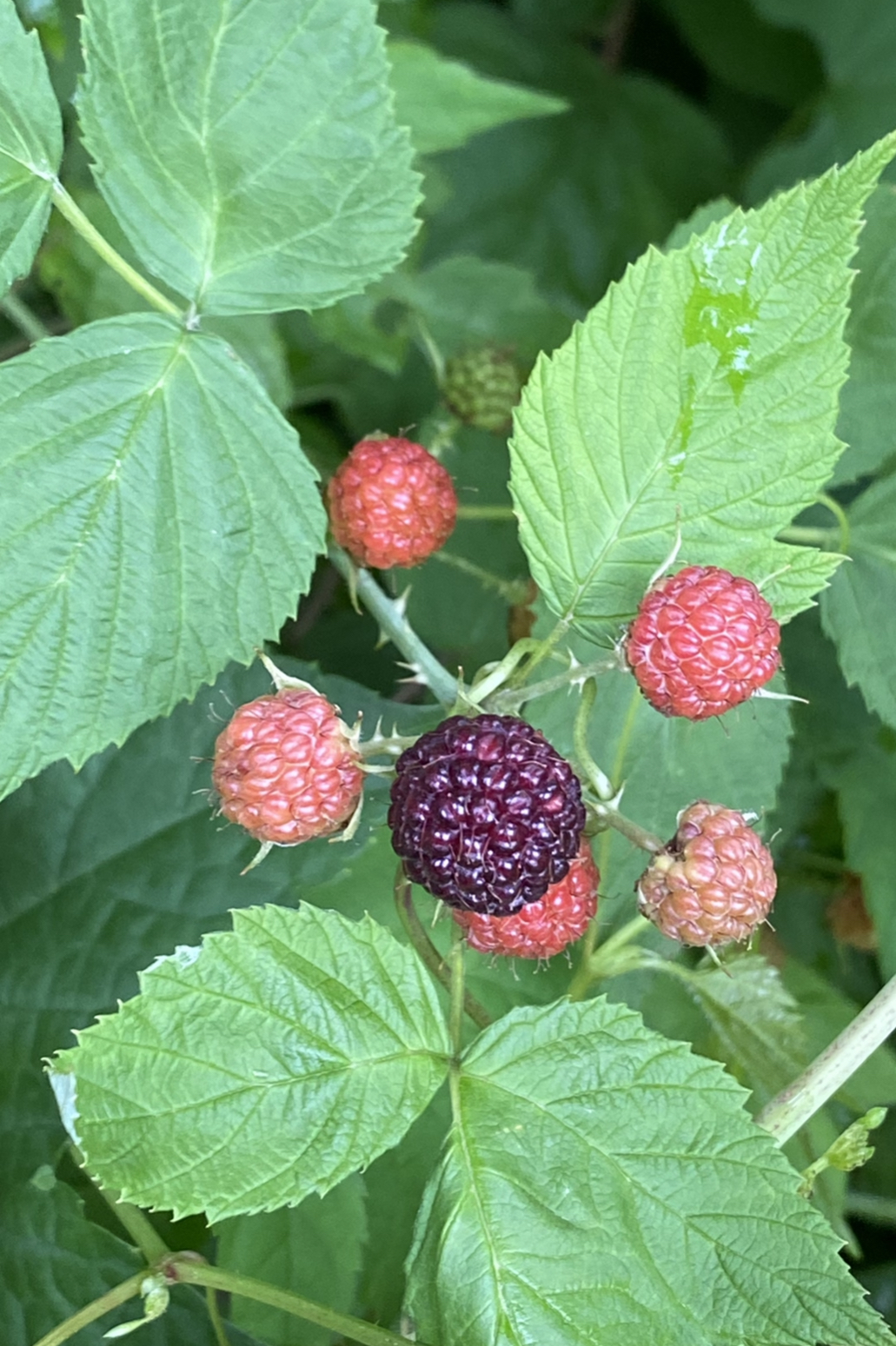
Rubus occidentalis, commonly known as Black Raspberry or Blackcap, is a native bramble found across much of the eastern and central United States, prized by foragers and gardeners alike for its intensely flavored summer fruit. Unlike many of its thicket-forming bramble relatives, Black Raspberry has a distinctive growth habit: long, arching canes covered in a pale, waxy “bloom” that roots at the tip wherever it touches soil, forming loose, tangled colonies rather than dense impenetrable hedges.
Black Raspberry thrives in disturbed, sunny edge habitats — old fields, fencerows, forest margins, roadsides, and recently cleared ground — making it one of the first fruiting shrubs to colonize open sites after disturbance. This pioneer habit means it is often one of the most abundant native fruits available to early-successional wildlife, and it has long been a favorite of human foragers for the same reason: it shows up reliably along field edges and trail margins across its wide native range.
In the garden, Black Raspberry is an easy, productive native fruiting shrub for a sunny edge or informal hedgerow, requiring little more than full sun and occasional pruning. It is also the wild ancestor of most purple and black raspberry cultivars sold for home fruit production, so a wild-type planting offers genuine native-plant value alongside a familiar, delicious harvest.
Identification
Black Raspberry is a deciduous, clump-forming bramble reaching 3 to 6 ft tall, with long, arching canes that can reach 6 to 10 ft in length and often bend over to root at the tip, a habit called “tip-layering” that lets a single plant spread into a loose patch over a few seasons.
Canes & Stems
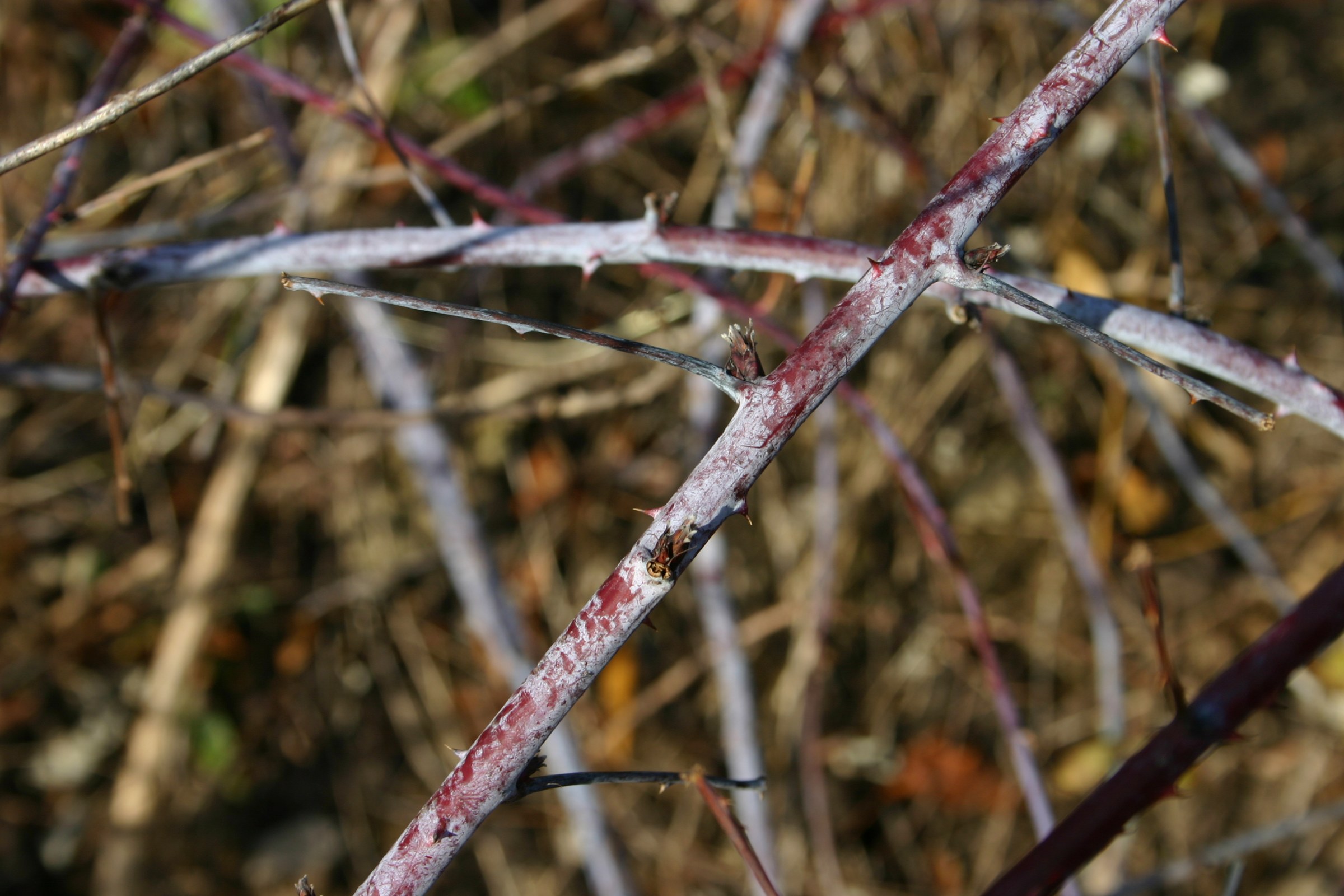
First-year canes are round in cross-section (not angled, as in many blackberries), covered in a whitish, powdery bloom that rubs off easily, and armed with scattered, curved, broad-based thorns. This pale waxy coating is one of the most reliable field marks separating Black Raspberry from true blackberries, whose canes are typically green to reddish without the heavy bloom. In winter, the bare canes stand out clearly as pale, arching, thorny whips.
Leaves
Leaves are palmately compound with three (occasionally five) toothed, pointed leaflets, dark green above and distinctly whitish or silvery-felted beneath — another useful identification feature, since the undersides appear almost white when the leaf flips in a breeze. Leaflets are 2–4 in long, with the terminal leaflet somewhat larger than the two lateral ones.
Flowers & Fruit
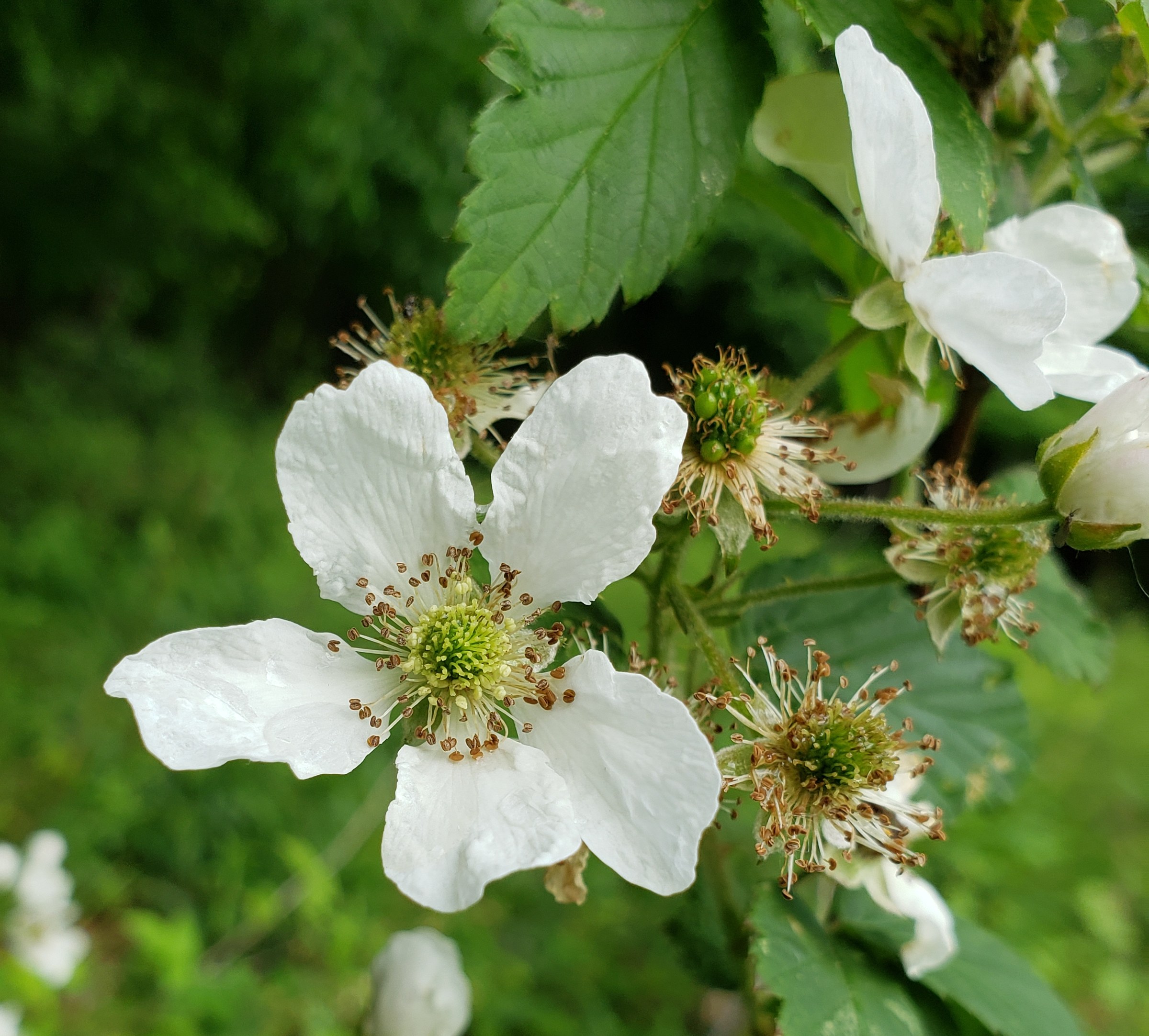
Flowers appear in late spring in small clusters at the ends of side branches, each with five narrow white petals that are shorter than the sepals, giving the flower a somewhat open, star-like look rather than a full round blossom. Fruit ripens over several weeks in early-to-mid summer, passing from green to red to a deep, glossy purple-black at full ripeness. Unlike blackberries, the ripe fruit separates cleanly from its white, cone-shaped receptacle when picked, leaving the fruit hollow — the classic “raspberry” structure, distinguishing it immediately from blackberries, which pull away with the receptacle still inside.
Quick Facts
| Scientific Name | Rubus occidentalis |
| Family | Rosaceae (Rose) |
| Plant Type | Deciduous Bramble / Subshrub |
| Mature Height | 3–6 ft (canes arching to 6–10 ft long) |
| Mature Spread | Spreads by tip-layering; patch can widen several feet per year |
| Growth Rate | Fast |
| Sun Exposure | Full Sun to Part Sun |
| Water Needs | Average; appreciates consistent moisture during fruiting |
| Soil Type | Well-drained loam or sandy loam; adaptable |
| Soil pH | 5.5–7.0 (slightly acidic to neutral) |
| Bloom Time | Late spring (May–June) |
| Flower Color | White |
| Fall Color | Yellowish, not showy |
| Fruit | Purple-black aggregate “berries,” early-mid summer |
| Deer Resistant | No (deer browse canes and foliage) |
| USDA Hardiness Zones | 3–8 |
Native Range
Black Raspberry is native across a broad swath of eastern and central North America, from southern Quebec, Ontario and New England west through the Great Lakes states and upper Midwest to the Dakotas, Nebraska, and eastern Kansas, and south through the Ohio Valley and central Appalachians to the mountains of northern Georgia and Alabama. Its western edge trails off into the eastern plains, with a further outlying presence in eastern Colorado; it is not native to the Gulf Coast, peninsular Florida, or west of the Great Plains.
Black Raspberry is a classic early-successional species, favoring the full sun and loose, disturbed soil of forest edges, fencerows, old fields, roadside thickets, and recently logged or cleared ground. It does not persist well in closed-canopy forest interiors, where it is gradually shaded out as woody succession proceeds, but it readily recolonizes new openings from seed carried in by birds.
Because it is so often found along the same forest-edge and old-field habitats as other brambles, Black Raspberry frequently grows intermixed with blackberries (Rubus spp.) and occasionally hybridizes with Red Raspberry (Rubus idaeus) where their ranges overlap, producing intermediate “purple raspberry” forms.
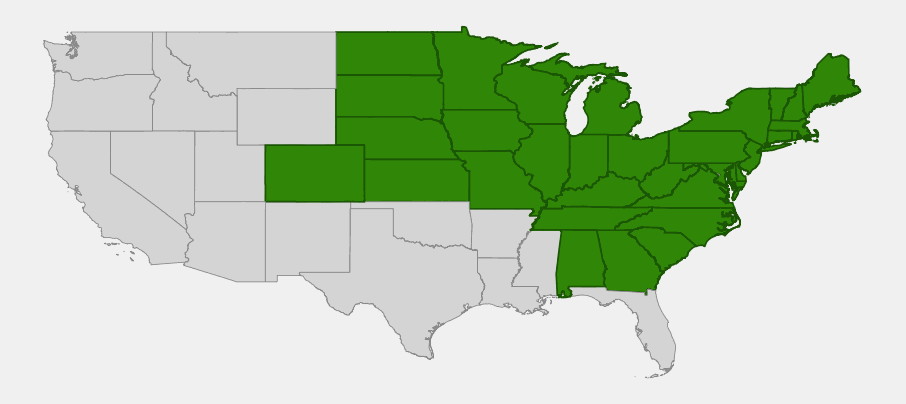
📋 Regional plant lists featuring Black Raspberry: New Hampshire, Maine & Vermont, Connecticut, Massachusetts & Rhode Island, New York, Pennsylvania & Northern New Jersey, Delaware, Southern New Jersey & Long Island, Maryland, Virginia & West Virginia, North Carolina & South Carolina, Georgia, Alabama & Mississippi, Kentucky & Tennessee, Ohio & Indiana, Illinois, Iowa & Missouri, Michigan, Wisconsin & Eastern Minnesota, North Dakota, South Dakota & Western Minnesota, and Nebraska, Kansas & Eastern Colorado
Growing & Care Guide
Black Raspberry is one of the easiest native fruiting shrubs to grow, asking for little beyond full sun, reasonably well-drained soil, and room to spread. Its biggest management challenge is not keeping it alive but keeping its enthusiastic tip-layering habit contained to where you want it.
Light
Full sun produces the heaviest fruit crops and sturdiest canes. Black Raspberry tolerates part sun, especially at a woodland edge, but fruiting and vigor both decline as shade increases, consistent with its wild role as an edge and clearing specialist rather than a forest-interior plant.
Soil & Water
Well-drained, moderately fertile loam suits it best, though it is adaptable to a range of soils as long as drainage is adequate — like most brambles, it dislikes “wet feet” and is prone to root rot in soggy ground. Consistent moisture during flowering and fruit development improves berry size and yield; established plants tolerate short dry spells but perform best without prolonged drought stress.
Planting Tips
Plant bare-root or container stock in early spring, spacing plants 3–4 ft apart to allow for cane spread, or farther apart if naturalizing a hedgerow. Because canes root readily wherever their tips touch soil, Black Raspberry is easy to propagate — simply pin an arching cane tip to the ground in late summer and it will root and can be separated the following spring.
Pruning & Maintenance
Black Raspberry fruits on second-year canes (floricanes); after a cane finishes fruiting, cut it to the ground, since it will not fruit again. In late winter, thin out crowded first-year canes to improve air circulation and fruit quality, and tip-prune young canes in summer to encourage branching. Without some control, tip-layering can turn a single plant into a sprawling thicket within a few seasons — contain the patch by cutting off cane tips before they root where they are not wanted.
Landscape Uses
Black Raspberry fits naturally into several native-garden roles:
- Informal fruiting hedgerow along a property line or sunny edge
- Wildlife and pollinator garden — flowers and fruit both support wildlife
- Erosion control on sunny slopes and banks, where tip-layering helps stabilize soil
- Edible native landscaping for home fruit production
- Naturalized old-field or meadow-edge restoration plantings
Wildlife & Ecological Value
As one of the earliest-ripening native brambles across much of its range, Black Raspberry provides a critical early-summer food pulse for a wide range of wildlife, often before most other fruiting shrubs have produced ripe fruit.
For Birds
Catbirds, Cedar Waxwings, Brown Thrashers, Eastern Towhees, and many other songbirds eat the fruit heavily during its short ripening window, and in turn disperse the seeds widely into new disturbed sites. The tangled, thorny cane structure also provides secure nesting cover for ground- and shrub-nesting birds.
For Mammals
White-tailed Deer and Eastern Cottontail browse the canes and foliage, while Black Bears, Raccoons, and Red Foxes all consume the ripe fruit. Small mammals use the dense cane thickets for cover from predators, particularly in open old-field habitat where few other hiding places exist.
For Pollinators
The late-spring flowers are a significant nectar and pollen source for native bees, including bumblebees and mining bees, as well as honeybees, at a time of year when competing bloom can still be limited in early-successional habitats.
Ecosystem Role
Black Raspberry’s role as an early colonizer of disturbed ground makes it ecologically important well beyond its modest size: it helps stabilize bare soil after disturbance, provides an early food resource that supports wildlife populations through the vulnerable post-disturbance period, and gradually gives way to longer-lived woody species as succession proceeds — a normal and valuable part of the eastern forest-edge life cycle rather than something to manage against.
Cultural & Historical Uses
Indigenous peoples across Black Raspberry’s range ate the fruit fresh and dried it for winter storage, and used the roots and leaves in various traditional preparations. The fruit’s intense flavor and anthocyanin-rich dark color have long made it a favorite base for jams, syrups, and homemade wine wherever it grows wild.
Black Raspberry holds particular historical importance in American pomology: it was domesticated and selectively bred far earlier and more extensively in North America than the European red raspberry, giving rise to most “black raspberry” and many “purple raspberry” cultivars grown commercially today, distinguishing it from the primarily Old World ancestry of common garden red raspberries.
Historically, Black Raspberry juice was also used as a food dye — including, reportedly, by the U.S. Department of Agriculture as an ink for stamping meat grades in the early 20th century — thanks to its deep, stable purple-black pigment.
Frequently Asked Questions
What’s the difference between Black Raspberry and blackberry?
Black Raspberry canes are round (not angled) and covered in a pale, waxy bloom, and the ripe fruit pulls free of its white receptacle, leaving the berry hollow inside. Blackberries have angled canes without the heavy bloom, and the receptacle stays inside the fruit when picked.
Is Black Raspberry the same as black raspberry you buy in stores?
Commercial black raspberries are cultivated selections of this same species, bred for larger fruit size and more uniform ripening, but they share the same wild ancestry and growth habits as native plants.
How do I stop Black Raspberry from spreading too much?
Cut back arching canes before their tips touch the ground and root, since tip-layering is the main way a single plant expands into a larger patch. Routine removal of spent (second-year) canes after fruiting also helps keep a planting tidy.
Does Black Raspberry need a pollinator plant to fruit?
No — it is self-fertile and does not require a second variety or species nearby to produce fruit, though cross-pollination by visiting bees can improve fruit set.
Can Black Raspberry grow in shade?
It tolerates light shade but fruits poorly there. As a forest-edge and old-field pioneer species, it performs best with at least several hours of direct sun daily.

Looking for a nursery that carries Black Raspberry?
Browse our native plant nursery directory: ME/MA/MD/KY/MI/MN/MO · NH/NY/NJ/NC/OH/ND/NE · VT/RI/PA/VA/SC/TN/SD · CT/DE/GA/CO · WV/WI · AL · IN/IL/IA/KS