
Three-Toothed Cinquefoil (Sibbaldiopsis tridentata)
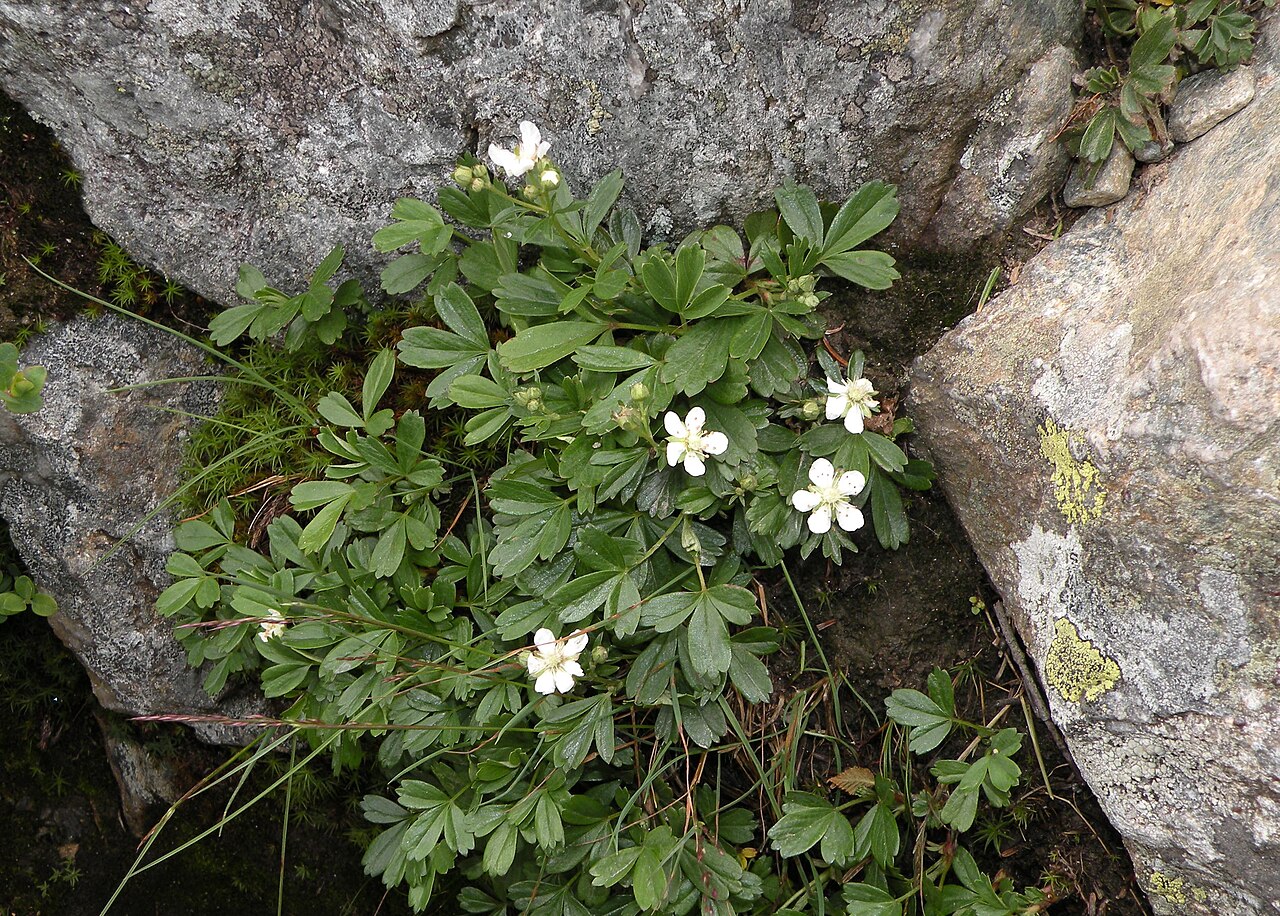
Sibbaldiopsis tridentata, the Three-Toothed Cinquefoil, is a low, mat-forming evergreen subshrub of rocky, exposed ground, best known for carpeting alpine summits and sea cliffs with small, glossy, three-lobed leaves and clusters of tiny white flowers. Also called shrubby fivefingers or wineleaf, it earns the “wineleaf” nickname from the deep burgundy color its foliage takes on through fall and winter.
This is a plant built for hard places. In the wild it roots directly into cracks and ledges on wind-scoured mountain summits, rocky barrens, and gravelly coastal headlands, forming tight, woody-based mats rarely more than a few inches tall. Despite that toughness, it blooms generously through much of the summer, and its combination of evergreen texture, durability, and long bloom has made it a favorite for rock gardens and crevice plantings well beyond its wild range.
Three-toothed cinquefoil is common and often locally abundant across Canada, New England, and the upper Great Lakes, but becomes progressively rarer and more restricted to high elevations as its range reaches south into the Appalachians, where isolated populations persist on a handful of exposed, cold-adapted summits in Virginia, West Virginia, North Carolina, Tennessee, and Georgia — remnants of a much colder climate that retreated north after the last ice age.
Identification
Three-toothed cinquefoil grows as a low, spreading, woody-based subshrub, typically just 2 to 6 inches tall but capable of spreading into mats a foot or more across over time. Its lower stems are genuinely woody, which is why some botanists classify it as a dwarf shrub rather than an herbaceous perennial, while its upper growth is soft and leafy.
Leaves
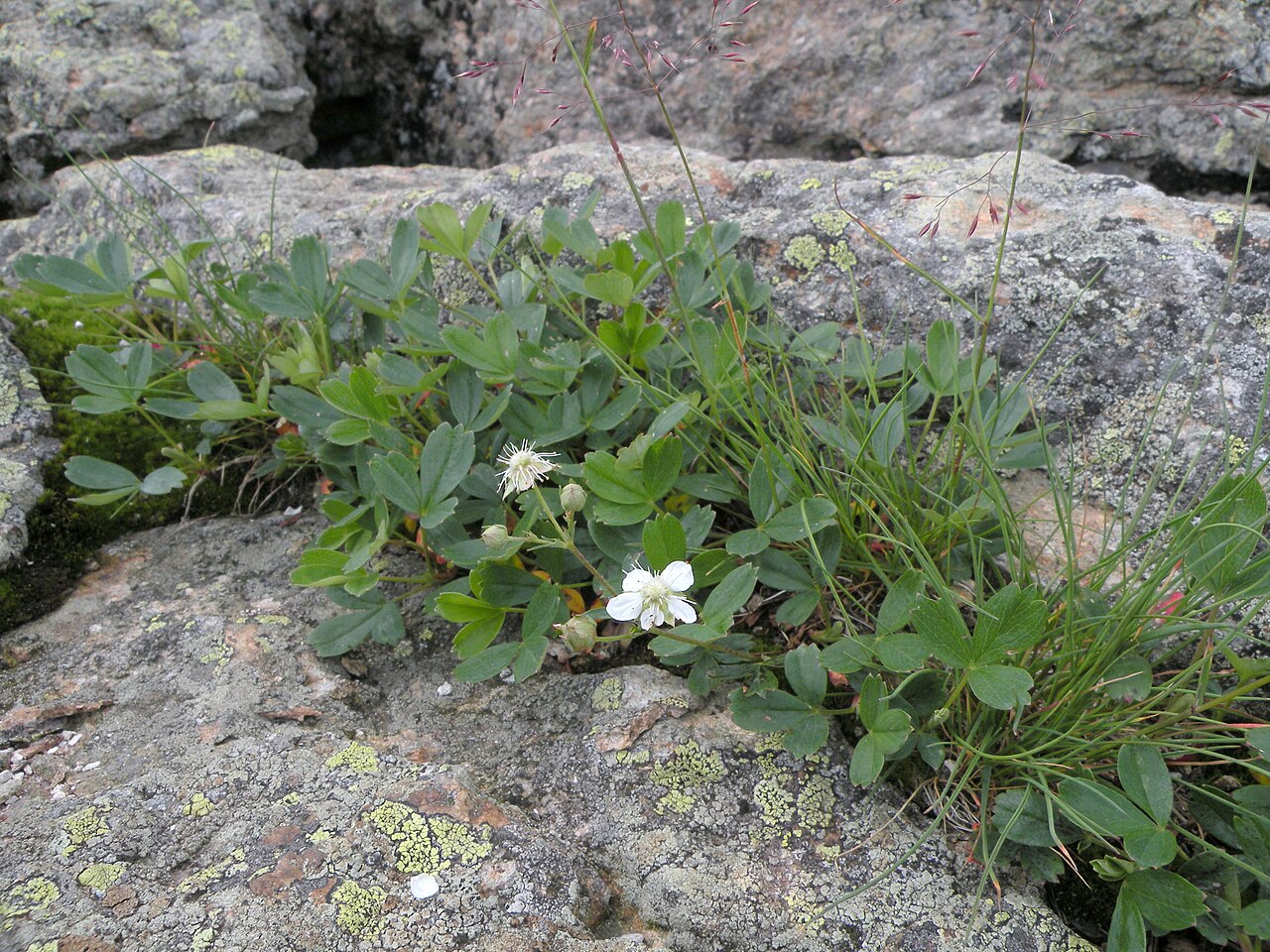
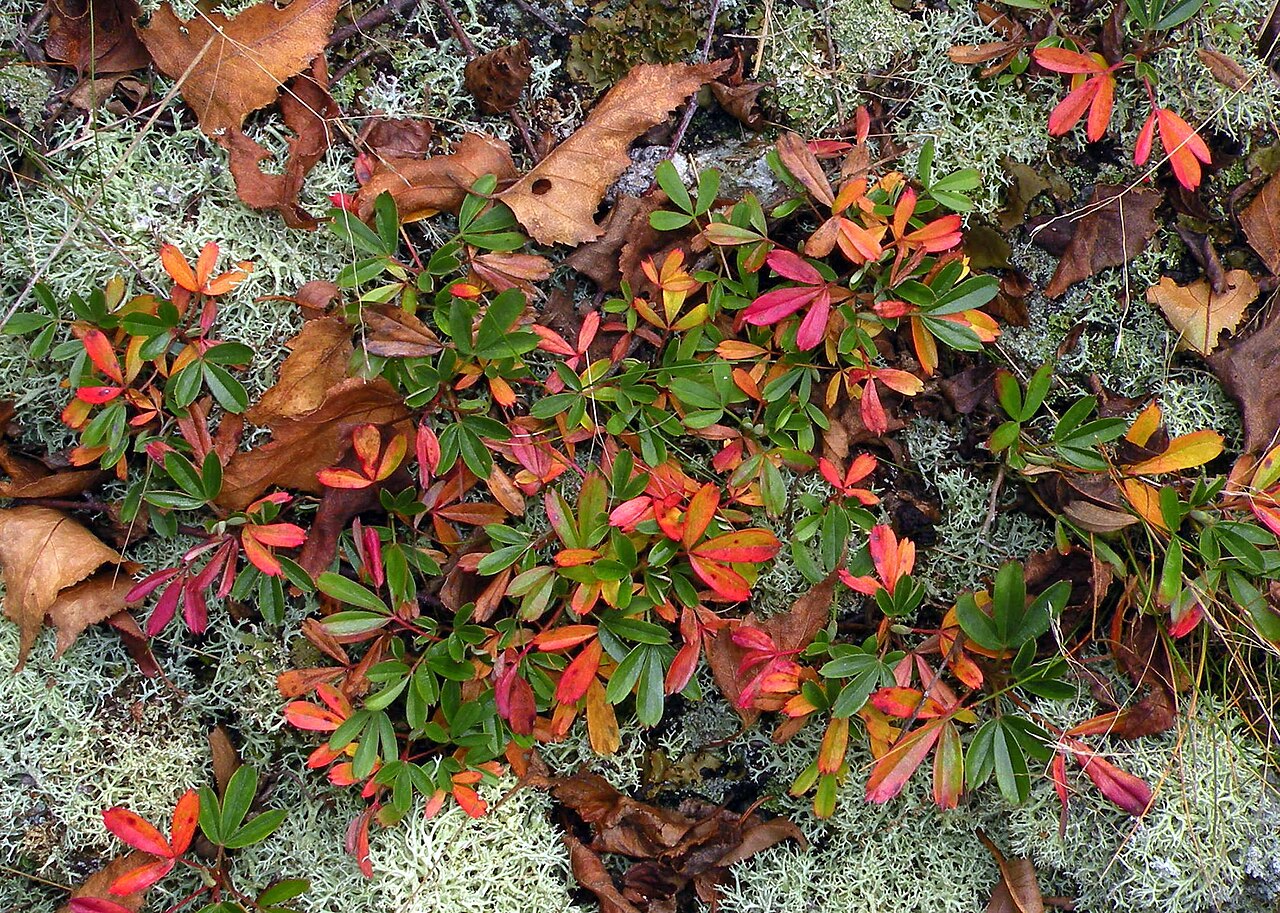
The leaves are the easiest identification feature: each is divided into three narrow, leathery, glossy dark-green leaflets, and every leaflet ends in three blunt teeth at its tip — the source of both the Latin species name tridentata (“three-toothed”) and the common name. The foliage is evergreen, though in cold, exposed sites it often turns a deep wine-red to bronze in fall and winter before greening up again in spring, giving the plant its “wineleaf” nickname.
Flowers
Flowers are small, about ½ inch across, with five rounded white petals surrounding a cluster of yellow stamens, borne in loose, open clusters above the foliage on slender stalks. Bloom runs from roughly June through August depending on elevation and latitude, and established plants flower generously for weeks at a time.
Fruit & Roots
After flowering, each blossom leaves behind a small cluster of dry, single-seeded achenes, inconspicuous and not ornamentally significant. Below ground, the plant anchors itself with a tough, woody taproot and spreading root system well suited to gripping thin soil in rock crevices — the same trait that makes it difficult to dig and transplant from the wild, and a good reason to always buy nursery-propagated plants.
Quick Facts
| Scientific Name | Sibbaldiopsis tridentata (syn. Potentilla tridentata, Sibbaldia tridentata) |
| Family | Rosaceae (Rose) |
| Plant Type | Evergreen, mat-forming dwarf subshrub |
| Mature Height | 2–6 in |
| Mature Spread | 12–18 in, slowly spreading |
| Growth Rate | Slow |
| Sun Exposure | Full Sun to Part Shade |
| Water Needs | Low; excellent drought tolerance once established |
| Soil Type | Thin, rocky, sandy or gravelly; very well-drained |
| Soil pH | Acidic to neutral (4.5–6.5) |
| Bloom Time | June – August |
| Flower Color | White |
| Fall Color | Foliage turns wine-red to bronze; evergreen |
| Fruit | Tiny dry achenes, not ornamental |
| Deer Resistant | Yes |
| USDA Hardiness Zones | 2–6 (struggles with heat and humidity farther south) |
Native Range
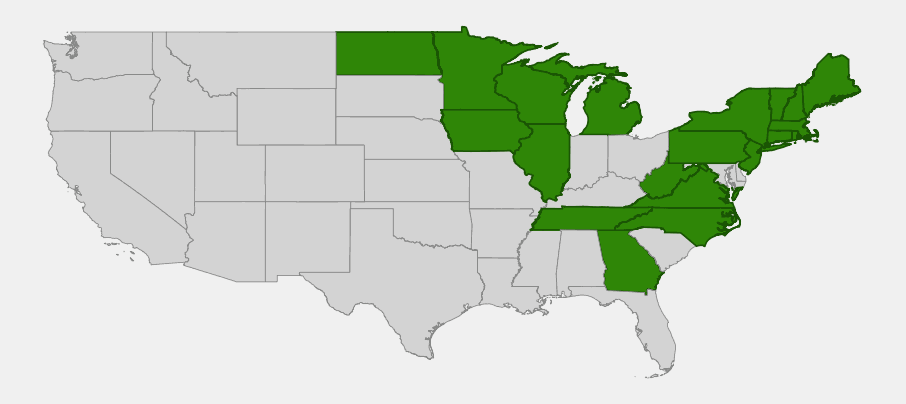
Three-toothed cinquefoil is primarily a plant of arctic and boreal North America, common across most of Canada, the Northeast, and the upper Great Lakes. In the United States its core range covers New England, New York, Pennsylvania, New Jersey, the Great Lakes states of Michigan, Wisconsin, and Minnesota, and it reaches west to the edge of its range in North Dakota, Iowa, and Illinois.
South of this core range, the species occurs only as scattered, disjunct populations confined to high elevations in the Appalachian Mountains — summits and rocky balds in West Virginia, Virginia, North Carolina, Tennessee, and Georgia — where it persists as a cold-climate relict, occupying progressively higher ground the farther south it grows. These southern mountain populations are small, isolated, and considered rare or vulnerable in several states.
Across its range, three-toothed cinquefoil favors open, sterile, rocky or sandy ground with little competition: exposed summits, alpine and subalpine barrens, granite ledges, sea cliffs and headlands, sand plains, and old quarries or roadcuts. It handles wind, cold, thin soil, and drought far better than it handles shade or competition from taller vegetation.
📋 Regional plant lists featuring Three-Toothed Cinquefoil: New Hampshire, Maine & Vermont · Connecticut, Massachusetts & Rhode Island · New York, Pennsylvania & Northern New Jersey · Maryland, Virginia & West Virginia · North Carolina & South Carolina · Georgia, Alabama & Mississippi · Kentucky & Tennessee · Illinois, Iowa & Missouri · Michigan, Wisconsin & Eastern Minnesota · North Dakota, South Dakota & Western Minnesota
Growing & Care Guide
Three-toothed cinquefoil is an excellent choice for the one garden situation most plants struggle with: thin, rocky, well-drained soil in full exposure. Give it the lean, open conditions it has in the wild and it needs almost nothing from the gardener.
Light
Full sun produces the tightest growth and best flowering and fall color. The plant tolerates part shade, especially in warmer parts of its range, but becomes looser and blooms less in heavier shade.
Soil & Water
This is a plant for lean, fast-draining soil — sandy, gravelly, or rocky ground suits it far better than rich garden loam, which tends to encourage rot and floppy growth. Established plants are extremely drought tolerant and resent soggy or heavy clay soils. Good drainage matters more than fertility; skip the amendments and supplemental feeding.
Planting Tips
Plant in spring or early fall into a crevice, raised bed, rock garden, or gravel path setting with sharp drainage. Space plants 12 to 18 inches apart to allow mats to fill in over several seasons. Because wild plants are slow-growing and difficult to transplant successfully from their rocky anchorage, always start with nursery-propagated stock rather than wild-collected material.
Pruning & Maintenance
Essentially none needed. Established mats can be lightly trimmed to tidy their shape or control spread, but this is rarely necessary. The plant is naturally long-lived and pest-free, and its woody base makes it more resilient to winter damage than purely herbaceous rock-garden perennials.
Propagation
Division of established mats in spring is the most reliable method for the home gardener, since seed germination can be slow and uneven. Small rooted sections taken from the mat’s edge, with some of the woody base attached, transplant readily into gritty, well-drained potting mix.
Landscape Uses
- Rock gardens and crevice gardens, where its small scale and toughness are hard to beat
- Green roofs and gravel gardens with minimal irrigation
- Alpine and native plant collections focused on cold-hardy, high-elevation species
- Edging for sunny, well-drained beds and pathways
- Erosion control on thin, rocky, or sandy slopes within its hardiness range
Wildlife & Ecological Value
Though small and often overlooked, three-toothed cinquefoil contributes real value in the harsh, low-competition habitats where it grows.
For Pollinators
The small white flowers are visited by a range of native bees, including specialist and generalist species, as well as butterflies and other flying insects, making the plant a useful nectar source on exposed summits and barrens where blooming plants can be scarce.
For Birds & Mammals
The dense, low mats provide ground-level shelter for small wildlife in otherwise exposed, windswept terrain, and the plant’s persistence on thin alpine soils helps stabilize ground used by nesting birds adapted to open, rocky habitats.
Ecosystem Role
As one of relatively few plants able to root directly into bare rock and thin, nutrient-poor soil, three-toothed cinquefoil is an early colonizer and soil stabilizer on exposed summits, cliffs, and barrens, helping hold a foothold of vegetation in places few other plants can establish. Its isolated southern Appalachian populations are also valuable indicators of the cooler climate that prevailed across the region thousands of years ago.
Cultural & Historical Uses
Three-toothed cinquefoil has no major documented tradition of food, fiber, or medicinal use among Indigenous peoples or early settlers, likely reflecting both its small size and its remote, difficult-to-reach alpine and coastal habitats. Unlike some of its showier relatives in the rose family, it appears mainly in historical botanical and exploration records rather than in ethnobotanical ones.
Its more recent history is horticultural rather than practical: as rock gardening grew popular in the 20th century, three-toothed cinquefoil became valued as a tough, reliable, evergreen mat plant for crevice and alpine garden collections, prized by specialist growers for its ability to thrive in conditions that defeat most garden plants.
The species also carries scientific interest as a glacial relict — its isolated southern Appalachian mountaintop populations are studied as living evidence of the colder climate and more southerly plant ranges that prevailed during the last ice age, before boreal species retreated north as the climate warmed.
Frequently Asked Questions
Why does three-toothed cinquefoil grow on mountaintops in Georgia and Tennessee, so far from its main range?
These southern populations are glacial relicts — remnants of a much colder climate that covered a far larger range during the last ice age. As the climate warmed and boreal species retreated north, a few populations survived by moving upslope to cold, exposed mountain summits that still mimic the conditions the plant needs, leaving small, isolated colonies stranded hundreds of miles south of the main range.
Is three-toothed cinquefoil really a shrub?
Technically, yes — its lower stems are woody, which is why some botanists treat it as a dwarf subshrub rather than a true herbaceous perennial, even though it looks and behaves like a low groundcover in the garden.
Can I grow it outside its native hardiness range?
It performs best in zones 2 through 6 and struggles with heat and humidity farther south or in low-elevation warm climates, which is also why its few wild southern populations are confined to cool, high-elevation summits rather than lowland sites.
Does it stay green all winter?
It is evergreen, but the leaves commonly turn wine-red to bronze in cold, exposed sites through fall and winter, greening back up with new growth in spring — a color change that gave rise to its “wineleaf” nickname.
Is it safe to collect from the wild?
No — wild plants are slow-growing, difficult to transplant successfully because of their deep anchoring roots, and several southern populations are rare or vulnerable. Always buy nursery-propagated plants instead of collecting from wild sites.

Looking for a nursery that carries Three-Toothed Cinquefoil?
Browse our native plant nursery directory: CT & GA · IL & IA · ME, MA, MI & MN · NH, NJ, NY, NC & ND · PA, RI, TN, VT & VA · WV & WI