
Iodine Bush (Allenrolfea occidentalis)
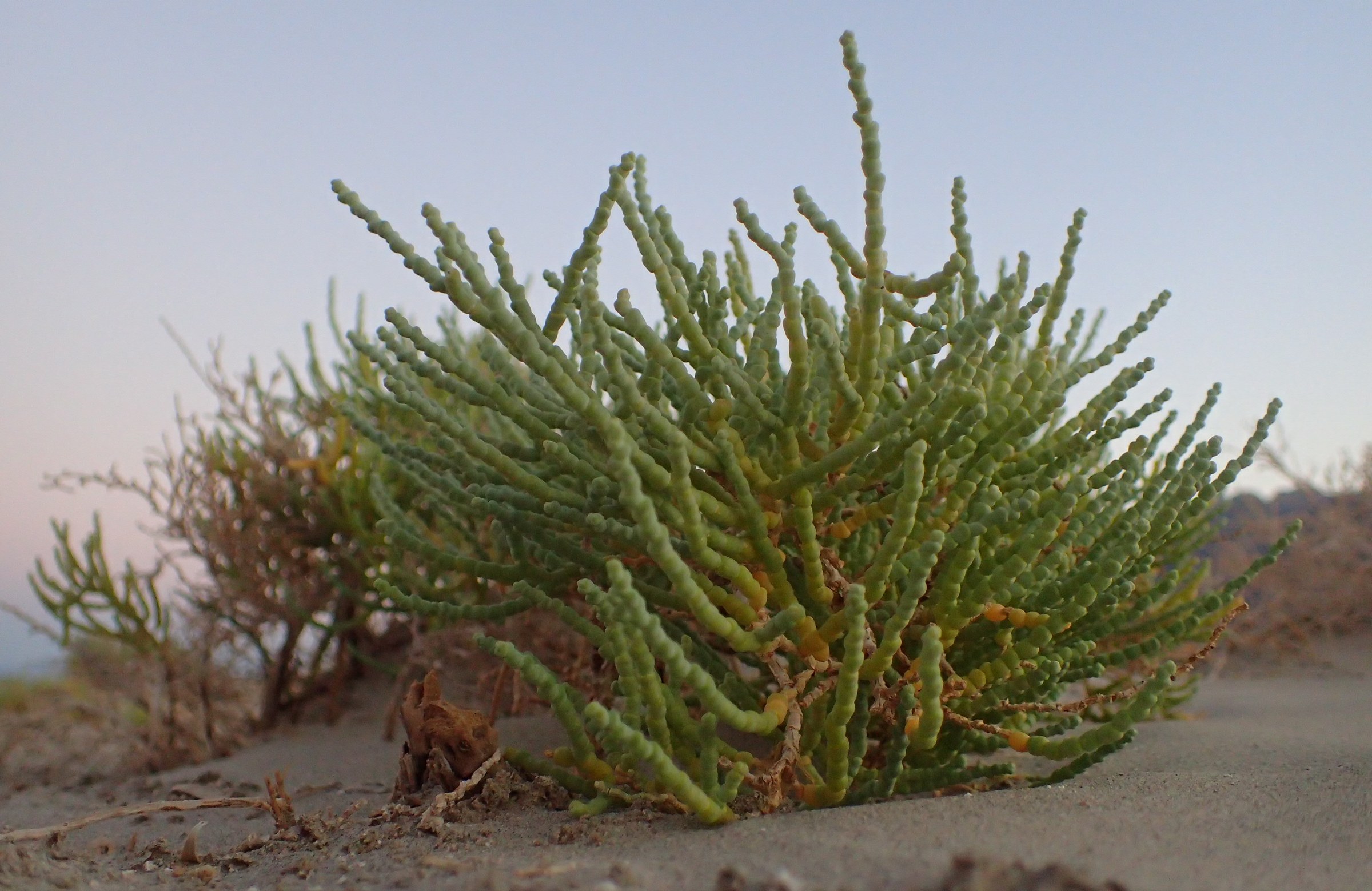
Allenrolfea occidentalis, commonly known as Iodine Bush or Iodinebush, is a low, leafless-looking succulent shrub that thrives where almost nothing else will grow: the cracked, salt-crusted floors of desert playas and alkali sinks across the American Southwest. Its jointed, bead-like green stems give it an almost otherworldly appearance, and its common name comes from the reddish-brown, iodine-colored tint the stems can take on, especially as they age or dry. This is not a plant for the ordinary home garden, but for anyone restoring a saline wetland, an alkali flat, or a desert wash with extreme soil chemistry, Iodine Bush is often the only native woody species equal to the task.
Botanically, Iodine Bush belongs to the Amaranthaceae (which now includes the old goosefoot family, Chenopodiaceae) and is one of the most salt-tolerant shrubs native to North America. It is a true halophyte, meaning it is physiologically adapted to grow in soils so saline that most plants cannot survive there at all. Rather than true leaves, the plant photosynthesizes through its fleshy, segmented stems, which appear as strings of small green beads threaded along the branches. This succulence allows the plant to dilute the salts it absorbs and store water through long dry periods.
Iodine Bush typically grows 2 to 6 feet tall, forming rounded, bushy mounds on the margins of dry lakebeds, desert washes, and alkaline flats from California’s Death Valley to the Great Basin and south into the Sonoran and Chihuahuan Deserts. It is a keystone species of the alkali sink plant community, often forming nearly pure stands in conditions too harsh for competing vegetation, and it plays an outsized ecological role in these specialized desert wetland habitats.
Identification
Iodine Bush is immediately recognizable once you know what to look for, even though it lacks the conventional leaves, flowers, and fall color that make most shrubs easy to identify at a glance.
Stems
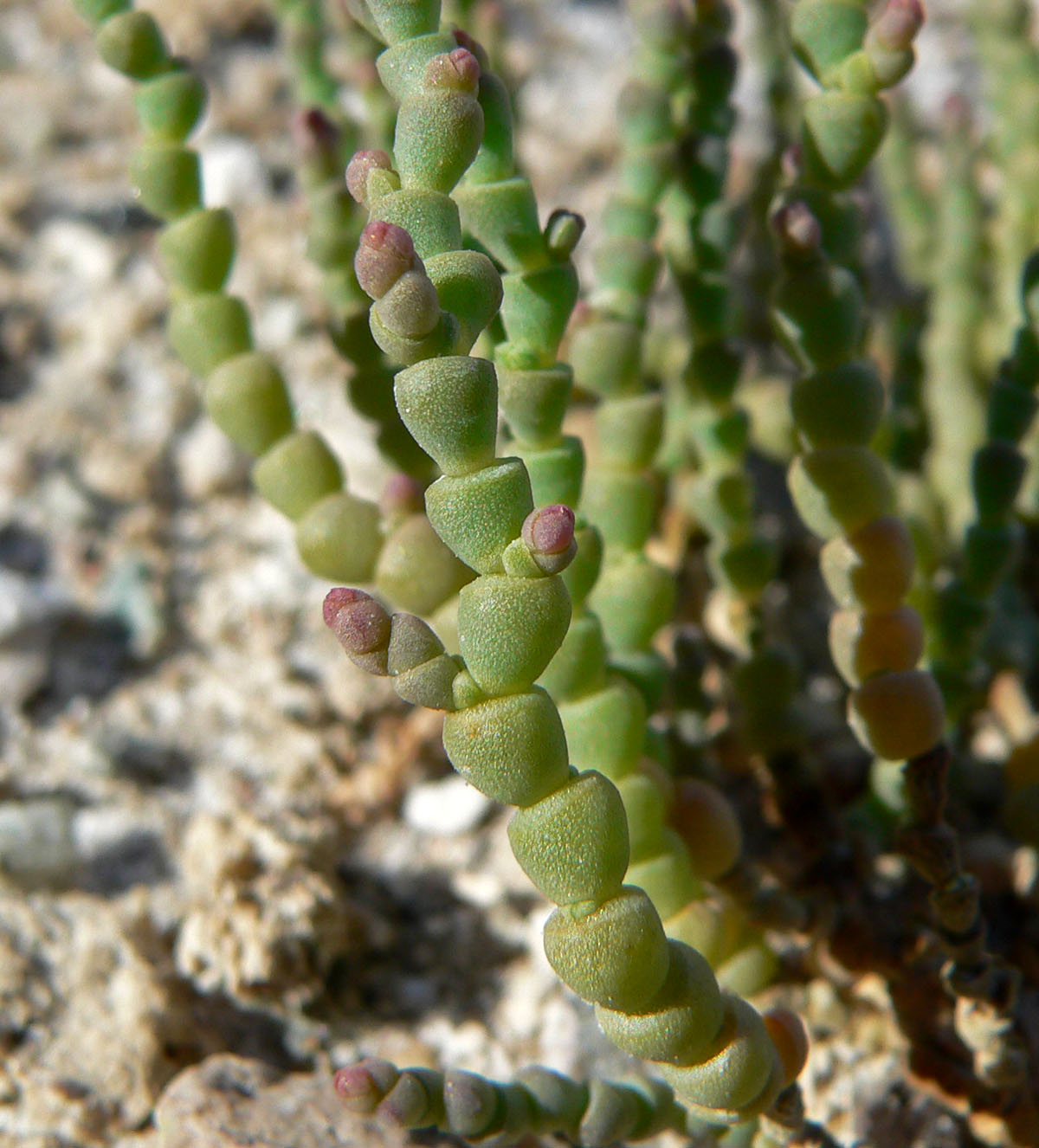
The defining feature of Iodine Bush is its fleshy, jointed stems, which are divided into short, bead-like or barrel-shaped segments at each node. Young stems are bright green to yellow-green and distinctly succulent, resembling a woody version of pickleweed (a close relative in the same family). Older stems turn woody, grayish-brown, and rigid at the base, while the actively growing stem tips remain green and succulent. The overall branching pattern is dense and intricate, giving the shrub a rounded, almost coral-like silhouette.
Leaves
True leaves are reduced to tiny, inconspicuous scales pressed against the stem segments, barely visible without close inspection. Essentially all photosynthesis happens in the green, fleshy stem tissue itself, an adaptation shared with other succulent halophytes such as pickleweeds (Salicornia and Arthrocnemum).
Flowers & Fruit
Flowers are minute and easy to overlook, embedded in small notches along the fleshy stem segments rather than held on obvious stalks. They lack petals and are wind-pollinated, as is typical of the amaranth and goosefoot family. Bloom occurs in late summer, and the resulting fruit is a tiny, dry, single-seeded utricle that remains hidden within the stem tissue until it dries and splits open. Because the reproductive structures are so inconspicuous, most people never notice that Iodine Bush flowers at all.
Quick Facts
| Scientific Name | Allenrolfea occidentalis |
| Family | Amaranthaceae (Goosefoot) |
| Plant Type | Succulent Shrub |
| Mature Height | 2–6 ft (0.6–1.8 m) |
| Mature Spread | 3–6 ft (0.9–1.8 m) |
| Growth Rate | Slow |
| Sun Exposure | Full Sun |
| Water Needs | Low to seasonally wet (tolerates both drought and standing saline water) |
| Soil Type | Saline, alkaline clay or sand; alkali flats and playas |
| Soil pH | 7.5–9.5 (alkaline) |
| Bloom Time | Late summer |
| Flower Color | Inconspicuous, greenish |
| Fall Color | None (stems redden slightly with age or stress) |
| Fruit | Tiny dry utricle embedded in the stem tissue |
| Deer Resistant | Yes |
| USDA Hardiness Zones | 7–10 |
Native Range
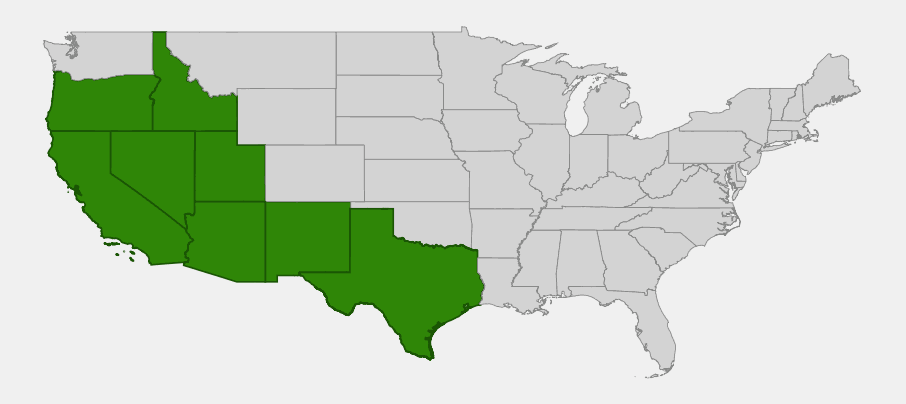
Iodine Bush is native to the arid interior of the western United States, centered on the Great Basin and extending into the Mojave, Sonoran, and northern Chihuahuan Deserts. It is common and often dominant in California’s desert valleys, including Death Valley and the Owens and Salton basins, and across much of Nevada, Utah, Arizona, New Mexico, and western Texas. Smaller, more localized native populations occur in southeastern Oregon and southern Idaho, where the species reaches the northern edge of its range on the margins of Great Basin playas. BONAP county-level mapping confirms these as true native occurrences rather than naturalized outliers.
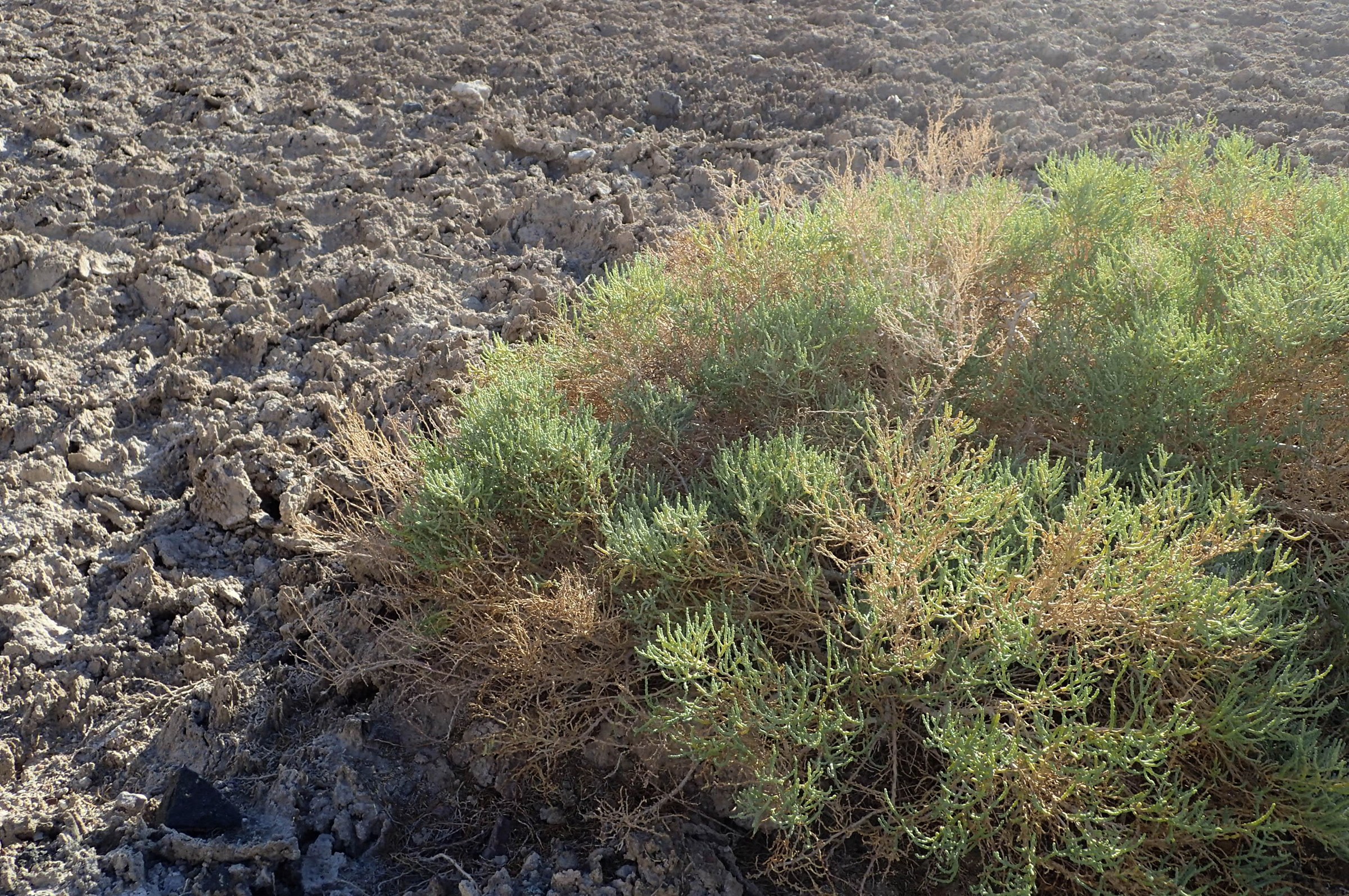
The species is tightly restricted to one specialized habitat type: alkali sinks and saline flats, usually at the lowest point of closed desert drainage basins where salts accumulate as water evaporates. These sites flood briefly after winter rains or snowmelt, then dry into cracked, white-crusted playas for most of the year. Iodine Bush is frequently the only woody plant able to colonize the most saline portions of these basins, forming a distinct vegetation zone immediately above the bare salt pan and below the surrounding desert scrub.
Because Iodine Bush is a near-obligate indicator of alkali sink habitat, it is not naturally found outside the Intermountain West and warm deserts, and it is not considered native or recommended for planting in regions without comparably saline, seasonally wet soils. Gardeners outside its native range should not attempt to naturalize this species; its value lies specifically in restoring degraded playas and alkaline wetlands within its historic range.
📋 Regional plant lists featuring Iodine Bush: none of PlantNative’s current regional lists cover its native range; see the full native plant directory.
Growing & Care Guide
Iodine Bush is not a conventional landscape plant, and most home gardeners will never need to grow it. Its true value is in habitat restoration: stabilizing and revegetating alkali sinks, saline wetland margins, and desert playas where ordinary native shrubs cannot establish. For restoration practitioners and desert gardeners working with genuinely saline soils, however, it is an indispensable, low-maintenance species.
Light
Iodine Bush requires full sun. It grows in wide-open, treeless alkali flats with no natural shade, and it will not perform well in a shaded or sheltered planting.
Soil & Water
This is the one native shrub that genuinely prefers saline, alkaline soil, and it will not thrive in ordinary garden loam. It is adapted to seasonally flooded, slow-draining clay or fine sand with high salt content, cycling between brief winter saturation and long summer drought. Established plants tolerate extreme drought once their deep roots reach residual soil moisture, but they also tolerate standing water for short periods after storms. Do not amend the soil or attempt to “improve” drainage or reduce salinity — doing so removes the very conditions the species needs to outcompete other vegetation.
Planting Tips
Iodine Bush is propagated primarily from seed collected in late summer or by salvaging and transplanting rooted stem segments from established stands, and it is rarely available from conventional nurseries. Restoration plantings are best done in fall or winter so that seedlings can take advantage of natural rainfall and cooler temperatures before summer heat arrives. Because the species is so narrowly adapted, it should only be planted on sites with naturally saline, alkaline soils and a documented history of supporting alkali sink vegetation.
Pruning & Maintenance
Once established, Iodine Bush needs essentially no maintenance. It does not require fertilizing, irrigation beyond natural precipitation, or regular pruning. Old, woody growth at the base can be left in place; it provides structure and wildlife cover.
Landscape Uses
Iodine Bush’s uses are narrow but important:
- Alkali sink and playa restoration where few other natives can establish
- Saline wetland buffer plantings around desert lakes and terminal basins
- Erosion control on exposed, salt-crusted desert soils
- Interpretive desert gardens illustrating extreme halophyte adaptation
Wildlife & Ecological Value
Iodine Bush anchors one of the harshest and most specialized plant communities in North America, and its ecological role is outsized relative to its modest appearance.
For Pollinators
Because its flowers are wind-pollinated and nectarless, Iodine Bush offers little direct floral reward to bees or butterflies. Its ecological value to pollinators is indirect: it stabilizes alkali sink soils and provides structure that supports the handful of specialized insects adapted to saline desert habitats.
For Birds
Dense stands of Iodine Bush provide cover and nesting habitat for desert birds in otherwise open, exposed terrain, including Sage Sparrows and other species that favor low shrub cover at the edges of playas. Shorebirds and waterfowl using adjacent alkaline wetlands rely on the surrounding Iodine Bush zone for concealment and resting cover between feeding bouts.
For Mammals
Small mammals such as kangaroo rats and other desert rodents shelter within and beneath the dense branching structure, and the shrub’s seeds contribute modestly to the diets of seed-eating desert wildlife. Pronghorn and other large herbivores occasionally browse the succulent stem tips, particularly in drought years when little else is available.
Ecosystem Role
Iodine Bush is a foundation species of the alkali sink plant community, one of the rarest and most threatened wetland habitat types in the arid West due to groundwater pumping, agricultural conversion, and urban development around desert basins. By tolerating salinity levels lethal to most plants, it stabilizes playa margins against wind erosion, moderates the harsh microclimate at ground level, and creates the structural foundation that allows a small community of other halophytes and salt-tolerant wildlife to persist in an otherwise barren landscape.
Cultural & Historical Uses
Indigenous peoples of the Great Basin, including Numic-speaking groups such as the Shoshone and Paiute, lived in close proximity to the alkali sinks where Iodine Bush grows and made limited use of the plant and its surrounding habitat. Archaeological evidence from sites such as Danger Cave in Utah indicates that small-seeded desert plants, including halophytes of the alkali flats, were gathered and processed for food during the early Holocene, reflecting the deep antiquity of desert foraging economies in the region.
More broadly, alkali sink habitats like those Iodine Bush defines were often avoided as permanent settlement sites due to their harsh, salt-crusted conditions, but they were valued as seasonal resource areas where waterfowl, salt, and specialized plant foods could be gathered when basins held water. The plant itself, being woody, salt-laden, and of little direct food or fiber value, was not a primary resource in the way that pinyon pine, mesquite, or riparian willows were, but its presence reliably signaled the alkaline wetland habitats that desert peoples knew to approach with specific ecological knowledge.
Today, Iodine Bush is primarily significant as an indicator species and a restoration tool. Land managers and botanists use its presence to delineate the boundaries of alkali sink wetlands for conservation planning, and ecologists studying desert halophytes continue to examine its salt-tolerance mechanisms as a model for understanding plant adaptation to extreme saline environments.
Frequently Asked Questions
Why is it called Iodine Bush?
The common name refers to the reddish-brown, iodine-like color that the fleshy stems can develop, especially on older growth or under drought and salt stress. It is not related to actual iodine content or any medicinal use of the plant.
Can I grow Iodine Bush in a regular garden?
Generally no. Iodine Bush requires genuinely saline, alkaline soil that floods briefly and then dries completely, conditions found naturally only in desert alkali sinks and playas. In ordinary garden soil it will not thrive and has no ornamental advantage over better-adapted desert natives.
Does Iodine Bush have leaves?
Not in the conventional sense. Its leaves are reduced to tiny scales, and the fleshy, jointed stem segments perform photosynthesis instead — an adaptation it shares with pickleweeds and other succulent halophytes in the same plant family.
Is Iodine Bush edible?
No current source documents Iodine Bush itself as a reliable food plant, and it should not be eaten. Archaeological evidence shows some small-seeded alkali-flat plants were historically processed for food by desert peoples, but this reflects regional foraging history, not a safe modern use of this particular species.
Is Iodine Bush threatened or endangered?
It is not federally listed, but NatureServe ranks the alkali sink shrubland plant community it defines as globally vulnerable due to groundwater depletion and conversion of desert basins to agriculture and development. Protecting remaining Iodine Bush stands helps conserve one of the rarest wetland habitat types in the arid West.

Looking for a nursery that carries native plants for an alkaline or desert restoration site?
Browse our native plant nursery directory: California · Nevada & New Mexico · Utah & Texas · Arizona · Oregon · Idaho