White Snakeroot (Ageratina altissima)
⚠ Toxic plant: Every part of white snakeroot contains the toxin tremetol. Livestock, horses, goats and sheep that graze on it become poisoned, and historically people were poisoned in turn by drinking milk or eating meat from affected cattle — a 19th-century illness known as “milk sickness” that killed thousands of early Midwestern settlers, including Abraham Lincoln’s mother, Nancy Hanks Lincoln. Keep this plant out of pastures and hay fields, and do not let livestock or horses browse it.
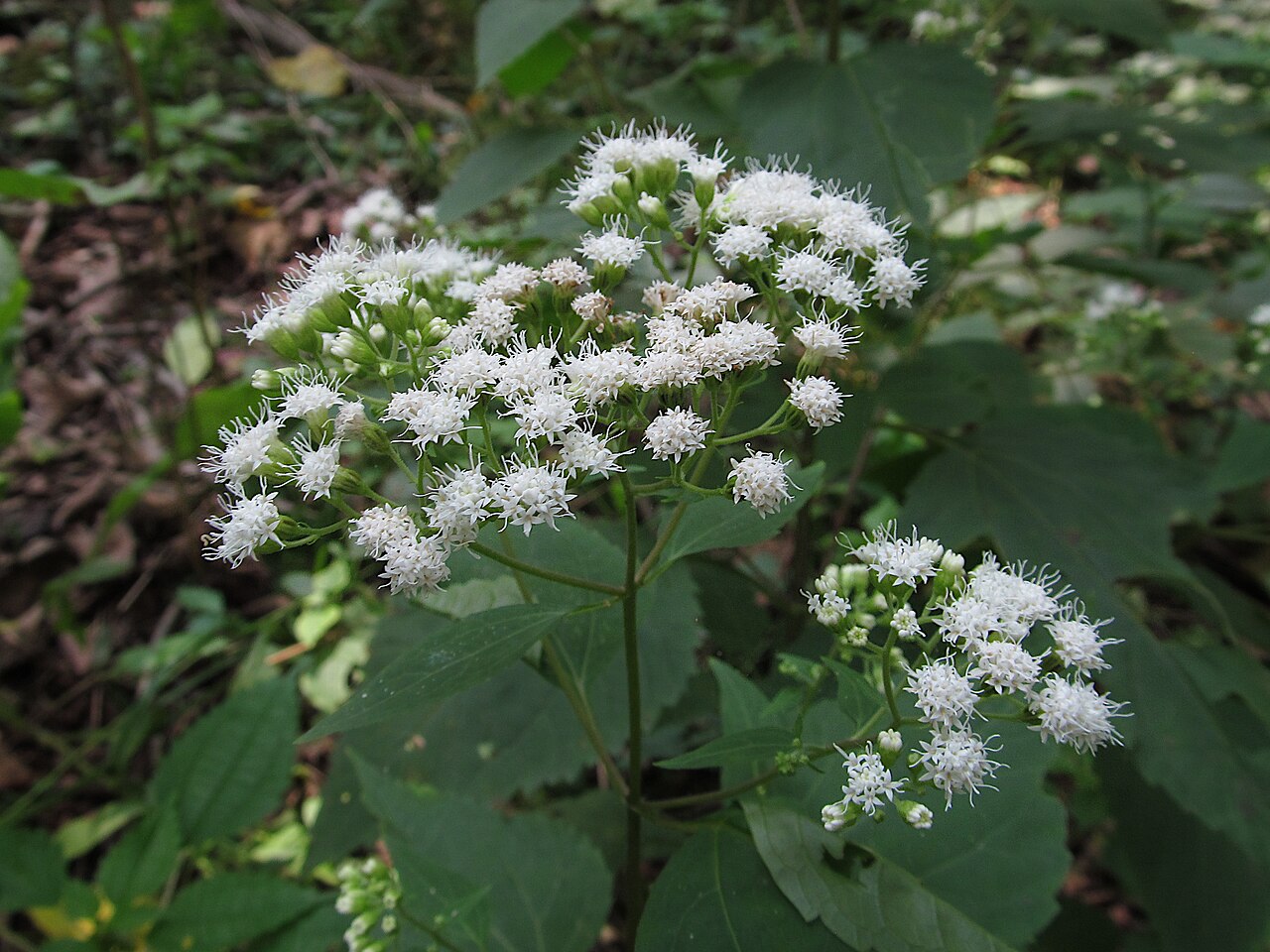
Ageratina altissima (formerly classified as Eupatorium rugosum), commonly called White Snakeroot, is a late-season woodland wildflower native across the central and eastern United States. From midsummer into fall it tops out in flat-topped clusters of small, fluffy white flowers that light up shaded forest edges and clearings just as most other woodland bloomers are finishing for the year. The plant forms upright, leafy clumps 1 to 4 feet tall with dark green, sharply toothed, opposite leaves, and it spreads steadily by rhizome to form loose colonies in rich, shaded soil.
White snakeroot is one of the most reliable native plants for deep shade. It asks for almost nothing — some leaf litter, a bit of moisture, and protection from the hottest afternoon sun — and it rewards that modest care with months of foliage interest followed by a long, late bloom that pollinators depend on heavily in early fall. Because the plant is toxic to livestock and, historically, to people through tainted milk, it earned a grim reputation on the 19th-century frontier, but in a home landscape kept away from grazing animals it is simply a tough, useful, late-blooming native for the shade garden.
Gardeners value white snakeroot for filling the “nothing blooms here” gap under trees in September and October. It self-sows readily and spreads by rhizome, so it is best used in naturalized woodland plantings, slope plantings under trees, or informal borders where a drift of white, late-season bloom is welcome rather than a tightly controlled bed. Pair it with other shade natives and let it find its own space.
Identification
White snakeroot grows as an upright or slightly arching clump-forming perennial, typically 1 to 4 feet tall, occasionally reaching 5 feet in rich soil with good light. Stems are smooth, often purplish near the base, and branch in the upper half of the plant. The overall look in bloom is a rounded, airy mass of small white flower clusters held well above the foliage.
Stems
Stems are smooth (glabrous) to lightly hairy, round in cross-section, and green to purple-tinged, especially lower on the plant. They are hollow to pithy and branch repeatedly in the upper third of the plant where the flower clusters form. Each pair of leaves sits at a 90-degree angle to the pair above and below it, a trait called decussate leaf arrangement that is a useful field mark.
Leaves
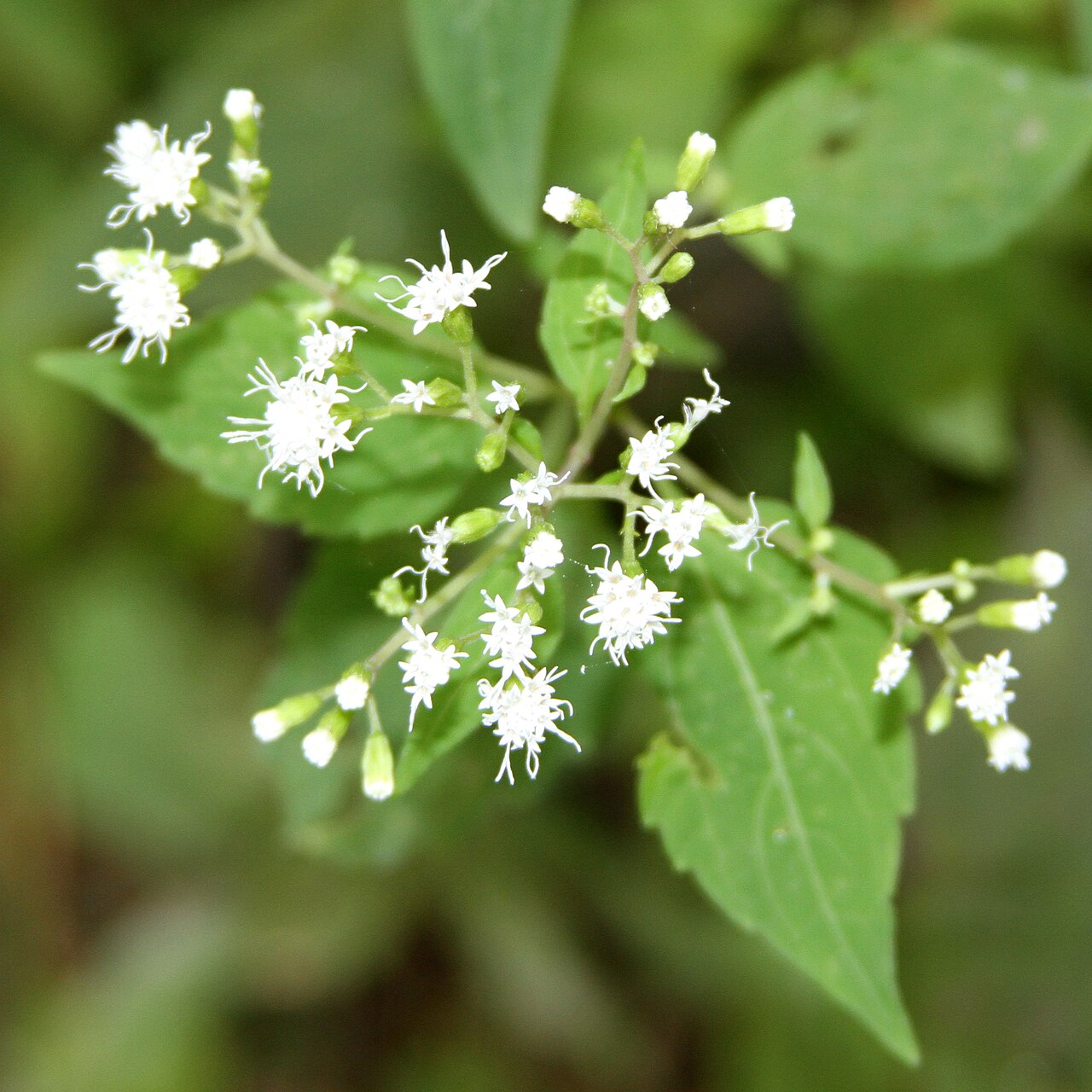
Leaves are opposite, broadly oval to heart-shaped at the base, 3 to 6 inches long, with long leaf stalks (petioles) and sharply, coarsely toothed margins. The leaf surface is thin but noticeably veined, dark green above and paler below. Crushed foliage has a faint, not unpleasant, weedy-green scent. The leaves closely resemble several other native woodland asters, which is why confirming the flat-topped white flower clusters and opposite, decussate leaf pattern together is the safest way to identify the plant in the field.
Flowers & Fruit
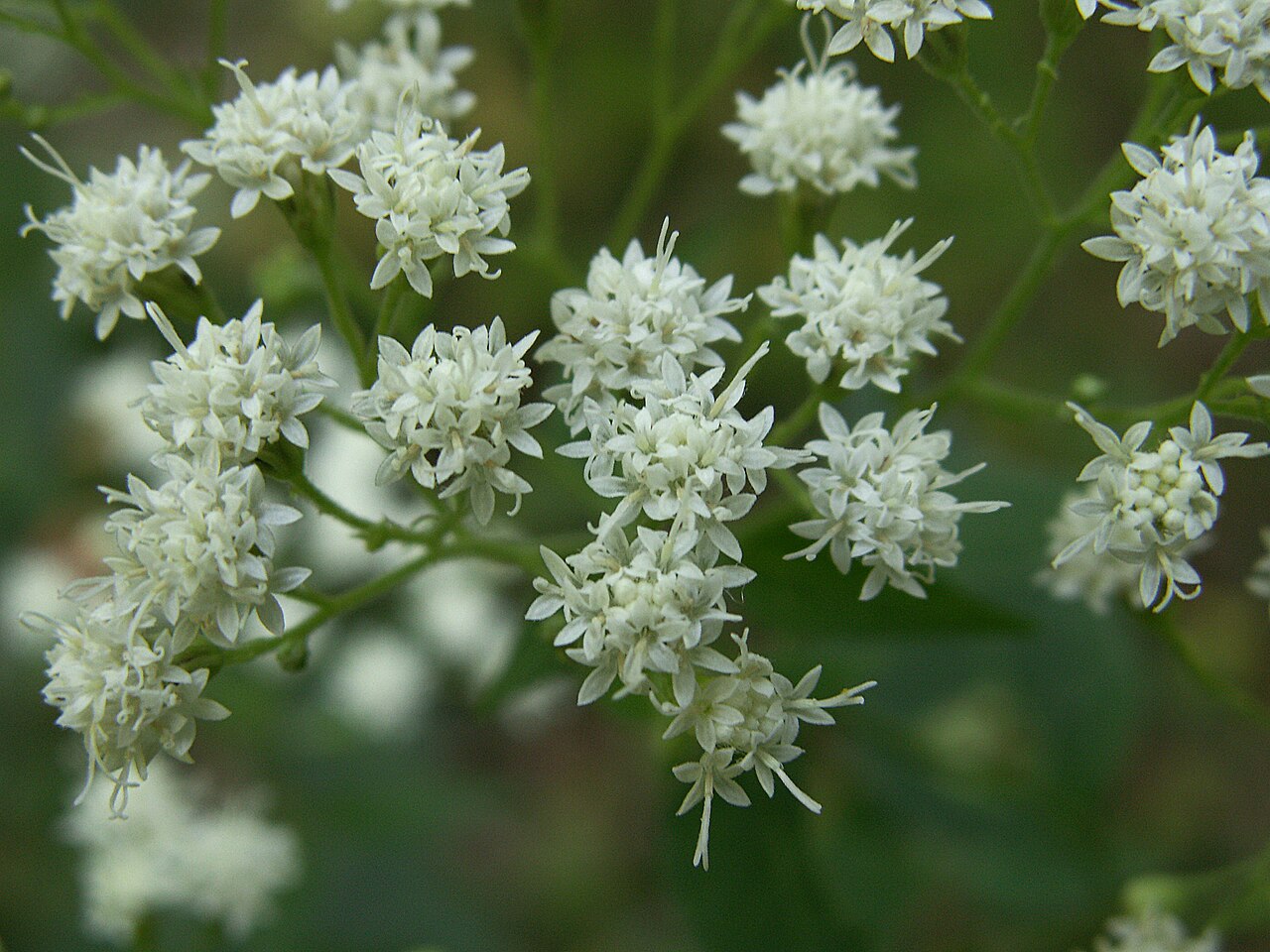
From midsummer through fall (roughly July into October, peaking in September), the plant produces flat-topped to slightly rounded clusters (corymbs) of small flower heads, each head made up of 15 to 30 tiny tubular white florets with no true petals — the “fluffy” look comes from the protruding styles. Clusters measure 2 to 6 inches across and appear at the ends of the upper branches, creating a billowy white mass that covers the whole plant at peak bloom. After flowering, each floret produces a small, dark, ribbed achene topped with a tuft of white hairs (a pappus), and the seed heads turn a soft tan or gray, catching the wind to disperse.
Quick Facts
| Scientific Name | Ageratina altissima (syn. Eupatorium rugosum) |
| Family | Asteraceae (Aster/Daisy) |
| Plant Type | Herbaceous perennial wildflower |
| Mature Height | 1–4 ft (occasionally to 5 ft) |
| Mature Spread | 2–3 ft, forming colonies by rhizome |
| Growth Rate | Moderate to fast; self-sows and spreads |
| Sun Exposure | Part Shade to Full Shade |
| Water Needs | Average to moist |
| Soil Type | Rich, moist woodland soil; tolerates clay and loam |
| Soil pH | 5.5–7.5 (slightly acidic to neutral) |
| Bloom Time | Late July – October |
| Flower Color | White |
| Fall Color | Foliage fades yellow-green; flowers persist into fall |
| Fruit | Tiny wind-borne achenes with white pappus |
| Deer Resistant | Yes (toxic foliage deters browsing) |
| USDA Hardiness Zones | 3–8 |
Native Range
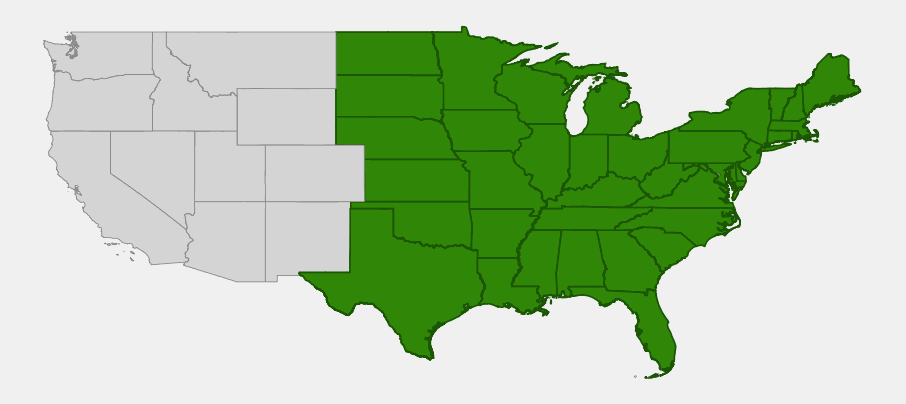
White snakeroot is native across nearly the entire central and eastern United States, from the Gulf Coast and Florida panhandle north through the Great Lakes states and New England, and west through the Great Plains into the eastern Dakotas, Nebraska, Kansas, and central Texas. It is one of the most widespread native woodland wildflowers in the country, essentially absent only from the arid and montane West — it is not native to Washington, Oregon, California, Idaho, Nevada, Utah, Arizona, New Mexico, Colorado, Wyoming, or Montana.
Across this huge range the plant is consistently a woodland and forest-edge species. Expect to find it in the understory of deciduous and mixed forests, along shaded stream banks, in moist ravines, at the edges of woodlots and hedgerows, and in disturbed shady ground such as old homesites and woodland paths. It tolerates a wide range of soils as long as some shade and reasonable moisture are present, which is part of why it has such an enormous native range.
Because it spreads readily by both rhizome and wind-blown seed, white snakeroot can look “weedy” in disturbed shady sites and is sometimes mistaken for an introduced plant — it is not. It is a true native that happens to be very good at colonizing shaded ground, including the kind of partially disturbed woodland edges found in many suburban and rural landscapes.
📋 Regional plant lists featuring White Snakeroot: New Hampshire, Maine & Vermont · Connecticut, Massachusetts & Rhode Island · New York, Pennsylvania & Northern New Jersey · Delaware, Southern New Jersey & Long Island · Maryland, Virginia & West Virginia · North & South Carolina · Georgia, Alabama & Mississippi · Arkansas, Louisiana, Eastern Oklahoma & Eastern Texas · Kentucky & Tennessee · Ohio & Indiana · Illinois, Iowa & Missouri · Michigan, Wisconsin & Eastern Minnesota · North Dakota, South Dakota & Western Minnesota · Nebraska, Kansas & Eastern Colorado
Growing & Care Guide
White snakeroot is about as easy-going as native wildflowers get, provided it has the one thing it truly needs: shade. Once established it needs almost no attention and will reliably fill a dim, difficult corner of the yard with months of foliage followed by a long late-season bloom.
Light
Part shade to full shade is ideal. The plant tolerates a few hours of morning sun, especially with consistent soil moisture, but hot afternoon sun in the South tends to scorch the leaves and stress the plant. In deep shade it grows taller and leggier, reaching for light; in brighter part shade it stays more compact and flowers more heavily.
Soil & Water
Rich, humusy, well-drained woodland soil suits it best, but white snakeroot is notably adaptable and will grow in average garden soil, clay, or rocky ground as long as some moisture is available. Water during extended dry spells in the first year; established plants handle brief drought but look their best with consistent moisture through the growing season.
Planting Tips
Set out container plants in spring or fall, spacing them 18 to 24 inches apart to allow for spread by rhizome. White snakeroot self-sows freely, so expect volunteer seedlings nearby within a season or two — a useful trait for naturalizing a woodland bed, but one to watch in small, tidy gardens. Mulch with leaf litter to mimic its native forest-floor habitat and suppress competing weeds while plants establish.
Pruning & Maintenance
Little maintenance is required. Cut plants back in late fall or early spring after the seed heads have fed birds and insects through the winter. Deadhead before seed sets if you want to limit self-sowing in a formal bed; otherwise let it be, since the late bloom and seed heads are valuable to wildlife. Divide congested clumps every few years in spring to control spread and share divisions elsewhere in the shade garden.
Landscape Uses
White snakeroot earns its keep in several shady garden situations:
- Woodland gardens — a reliable, late-blooming layer under trees
- Naturalized slopes and banks shaded by canopy trees
- Shady borders where a drift of white fall bloom is welcome
- Pollinator gardens — a critical late nectar source for fall-flying insects
- Restoration plantings in disturbed woodland edges
Keep it away from pastures, paddocks, hay fields, and any area grazed by livestock or horses, and do not plant it where foraging animals or curious grazers could browse it.
Wildlife & Ecological Value
Late bloom is white snakeroot’s biggest ecological gift: it flowers from midsummer well into October, exactly when most other native nectar sources have finished for the year, making it an important late-season resource across its enormous range.
For Pollinators
The flat-topped flower clusters attract a wide range of bees, wasps, flies, and especially butterflies and moths, which rely on the nectar to fuel fall migration and winter preparation. It is a larval host plant for several moth species, including the clymene moth and the hitched dart moth, and supports numerous small leaf-mining and gall-forming insects that in turn feed birds.
For Birds
Though the foliage is toxic and avoided by browsing mammals, the fluffy seed heads that follow the flowers provide small seeds favored by native sparrows, juncos, and finches through late fall and into winter. The dense clump structure also offers cover for ground-feeding birds in the forest understory.
For Mammals
Deer, rabbits, and other herbivores reliably avoid white snakeroot because of its toxicity, which makes it one of the most dependably deer-resistant native wildflowers for shaded gardens in areas with heavy browsing pressure.
Ecosystem Role
As a common, rhizome-spreading understory forb, white snakeroot helps stabilize shaded forest-floor soil, fills gaps left by disturbance, and provides structural diversity in the herbaceous layer beneath the forest canopy. Its late bloom time fills a critical seasonal niche in the pollinator calendar across its range.
Cultural & Historical Uses
White snakeroot holds a significant, if grim, place in American history. In the early 19th century, as settlers from the East moved into the wooded Midwest and Upper South, cattle grazing on white snakeroot passed the plant’s toxin, tremetol, into their milk and meat. Thousands of settlers died from the resulting illness, which came to be called “milk sickness” once its connection to the land was understood. The condition is traditionally linked to the 1818 death of Nancy Hanks Lincoln, mother of Abraham Lincoln, in Indiana.
It took decades for European American settlers to identify the cause. Dr. Anna Pierce Hobbs Bixby is traditionally credited with tracing milk sickness to white snakeroot in the 1830s in the Ozarks, reportedly after learning of the plant’s danger from a Shawnee woman. Once livestock were kept away from the plant and land was cleared of it near pastures, the disease faded from memory through the later 19th century as settlement patterns shifted and farming practices changed.
Beyond this history, white snakeroot has no record of safe traditional food or medicinal use by Indigenous peoples or settlers — unlike many native wildflowers, its toxicity made it a plant to avoid rather than use. Today it survives mainly as a reminder of how closely frontier life depended on recognizing which native plants were safe to have near livestock, and as a genuinely useful, low-maintenance native for the modern shade garden, kept well away from grazing animals.
Frequently Asked Questions
Is white snakeroot safe to plant in my yard?
Yes, as an ornamental in a garden setting away from livestock, horses, and grazing animals. The toxicity concern is specifically about cattle, horses, goats, and sheep grazing on the foliage, and about people historically being poisoned through contaminated milk or meat. It poses no special risk simply growing in a home landscape, though as with any toxic plant it is wise to keep small children and pets from eating the foliage.
Will white snakeroot take over my garden?
It spreads by rhizome and self-sows readily, so it can form sizable colonies over a few seasons in favorable shaded conditions. This makes it excellent for naturalizing a woodland area but something to manage — by deadheading or dividing — in a small, formal bed.
Why is it called “snakeroot”?
The common name comes from an old folk belief that the root could treat snakebite, a use with no scientific support. The plant itself is toxic, not medicinal, and should not be used for any home remedy.
Does white snakeroot attract pollinators?
Yes, heavily. Its late bloom time, from midsummer into October, makes it one of the more important native nectar sources for bees, wasps, flies, butterflies and moths preparing for migration or winter in its range.
Is white snakeroot the same as boneset or other white-flowered asters?
No, though it is often confused with relatives like boneset (Eupatorium perfoliatum) and white heath aster. White snakeroot has opposite, broadly oval, long-stalked leaves and flat-topped clusters of small white flowers with no petals; checking the opposite, decussate leaf arrangement together with the flower shape is the most reliable way to confirm identification.

Looking for a nursery that carries White Snakeroot?
Browse our native plant nursery directory: Alabama & Arkansas · Connecticut, Delaware, Florida & Georgia · Illinois, Indiana, Iowa & Kansas · Kentucky, Louisiana, Maine, Maryland, Massachusetts, Michigan, Minnesota, Mississippi & Missouri · Nebraska, New Hampshire, New Jersey, New York, North Carolina, North Dakota, Ohio & Oklahoma · Pennsylvania, Rhode Island, South Carolina, South Dakota, Tennessee, Texas, Vermont & Virginia · West Virginia & Wisconsin