
Littleleaf Mountain Mahogany (Cercocarpus intricatus)
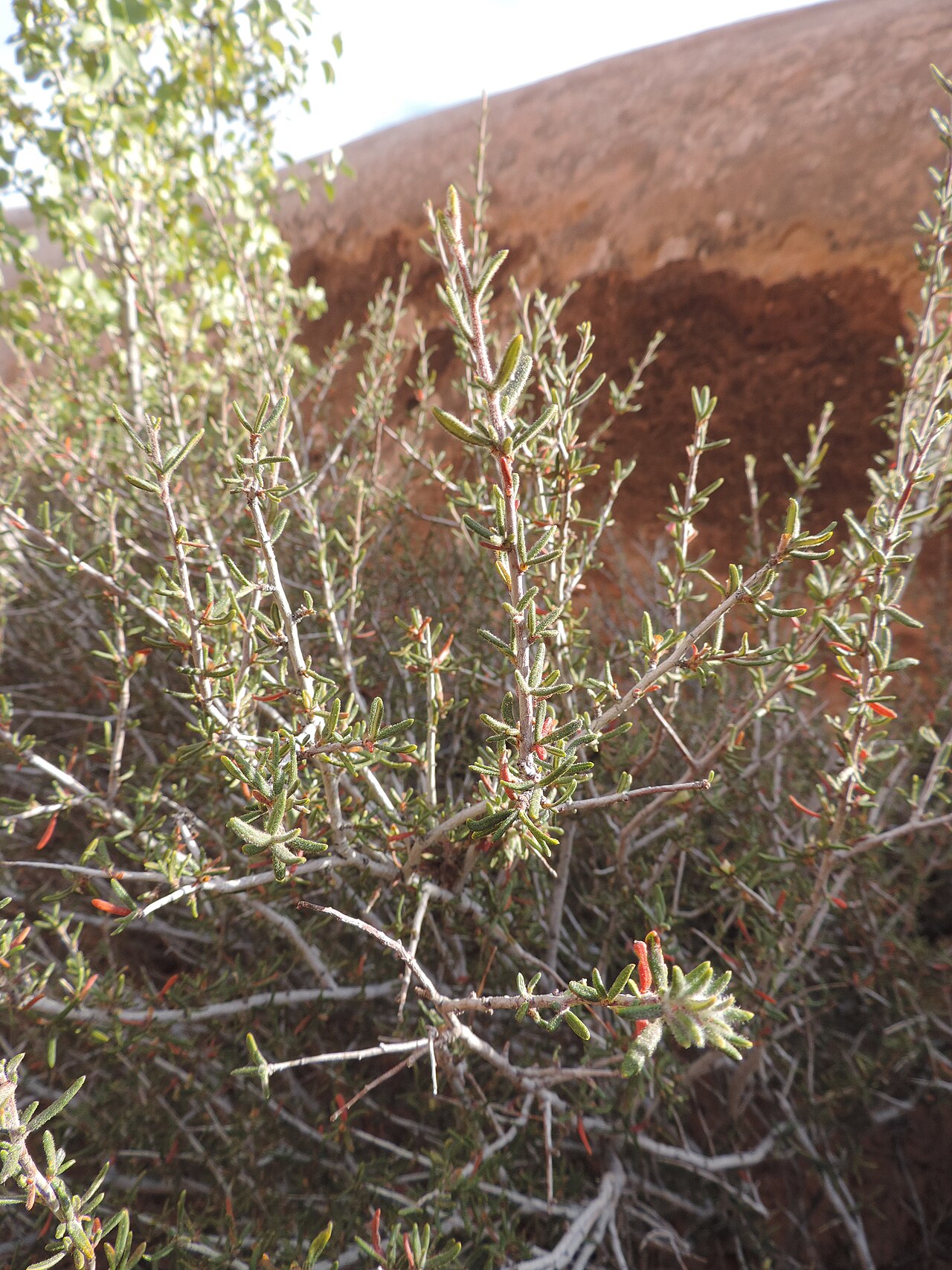
Cercocarpus intricatus, known as Littleleaf Mountain Mahogany (also called desert mahogany or dwarf mountain mahogany), is a tough, slow-growing evergreen shrub of the rose family found on the driest, rockiest ground of the Mojave Desert, Colorado Plateau, and Great Basin. It is one of the most drought-adapted native shrubs in the Southwest, thriving where little else can get a foothold: thin desert soils over limestone and sandstone, exposed canyon rims, and wind-scoured mesa edges.
The plant’s name describes it well — “intricate” refers to its dense, intertwined tangle of short, rigid, gray-barked branches, and “littleleaf” to the tiny, needle-like evergreen leaves that cling to the twigs year-round. Unlike its larger relative curl-leaf mountain mahogany (Cercocarpus ledifolius, of which this species is sometimes treated as a variety), littleleaf mountain mahogany rarely exceeds head height, growing instead as a dense, rounded, thicket-forming shrub.
For gardeners and land managers in the Interior West, littleleaf mountain mahogany is an exceptional choice for extremely dry, rocky sites where few other woody plants survive. It asks for almost nothing once established, provides valuable winter browse for deer and bighorn sheep, and its long, feathery, silvery seed plumes add a distinctive ornamental touch to high-desert and xeriscape plantings.
Identification
Littleleaf mountain mahogany is a thickly branched, rounded evergreen shrub typically one to three meters (three to ten feet) tall, though it is often shorter and more compact on the harshest sites. The many short, rigid branches interlace densely, giving the whole plant an intricate, twiggy architecture that is often easier to recognize from a distance than any single leaf or flower.
Bark & Stems
Twigs are numerous, short, and gray, with a somewhat stiff, almost thorn-like appearance even though the plant is unarmed. Older stems develop gray to grayish-brown bark. The dense branching pattern, rather than any single trunk, is the shrub’s most recognizable identification feature in the field.
Leaves
Leaves are evergreen, widely spaced along the twigs, and tiny — about a centimeter long or less. Each leaf is narrow, thick, and leathery, with the margins rolled under (revolute), an adaptation that reduces water loss in the plant’s hot, dry habitat. The upper leaf surface is dull gray-green, matching the overall silvery-gray cast of the whole shrub.
Flowers
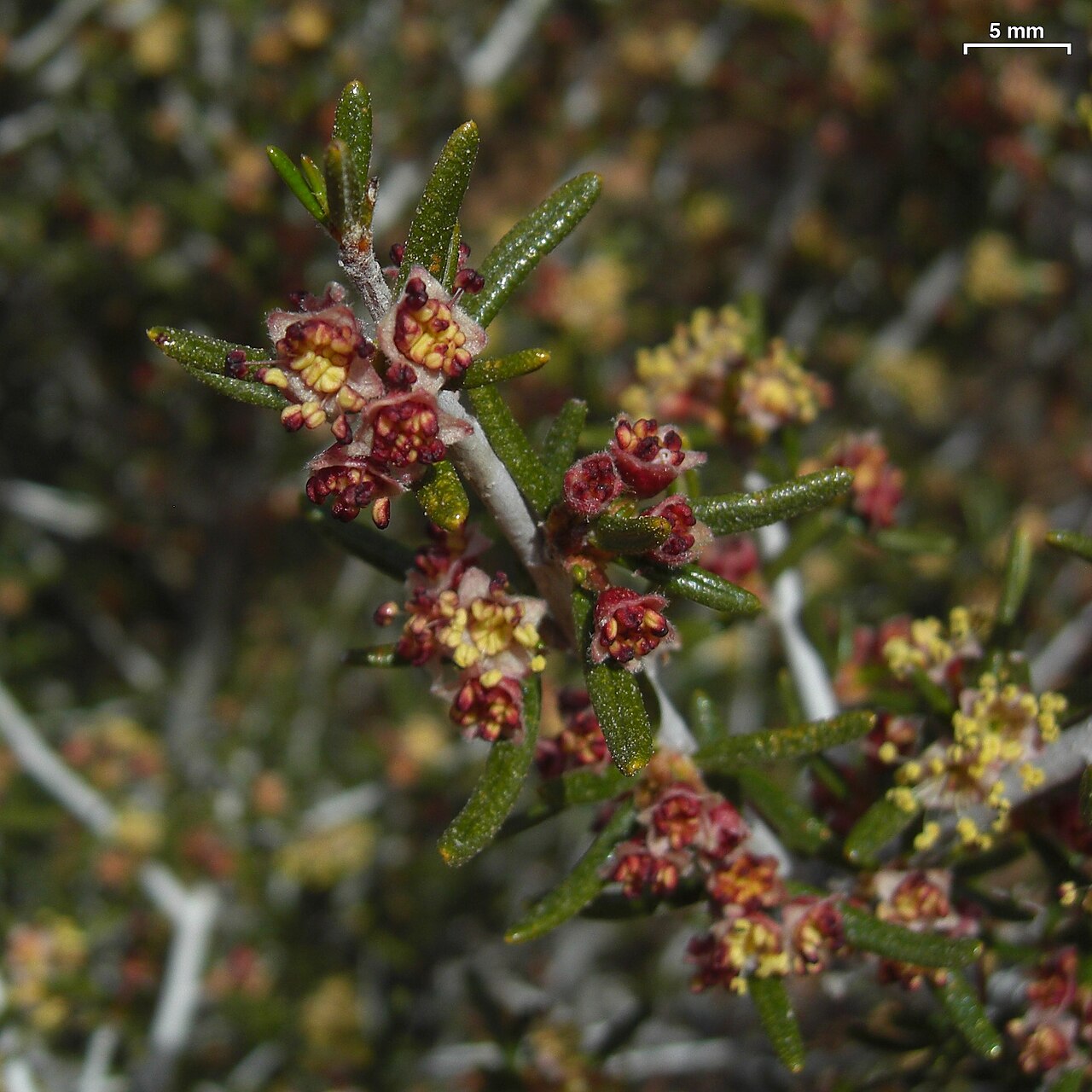
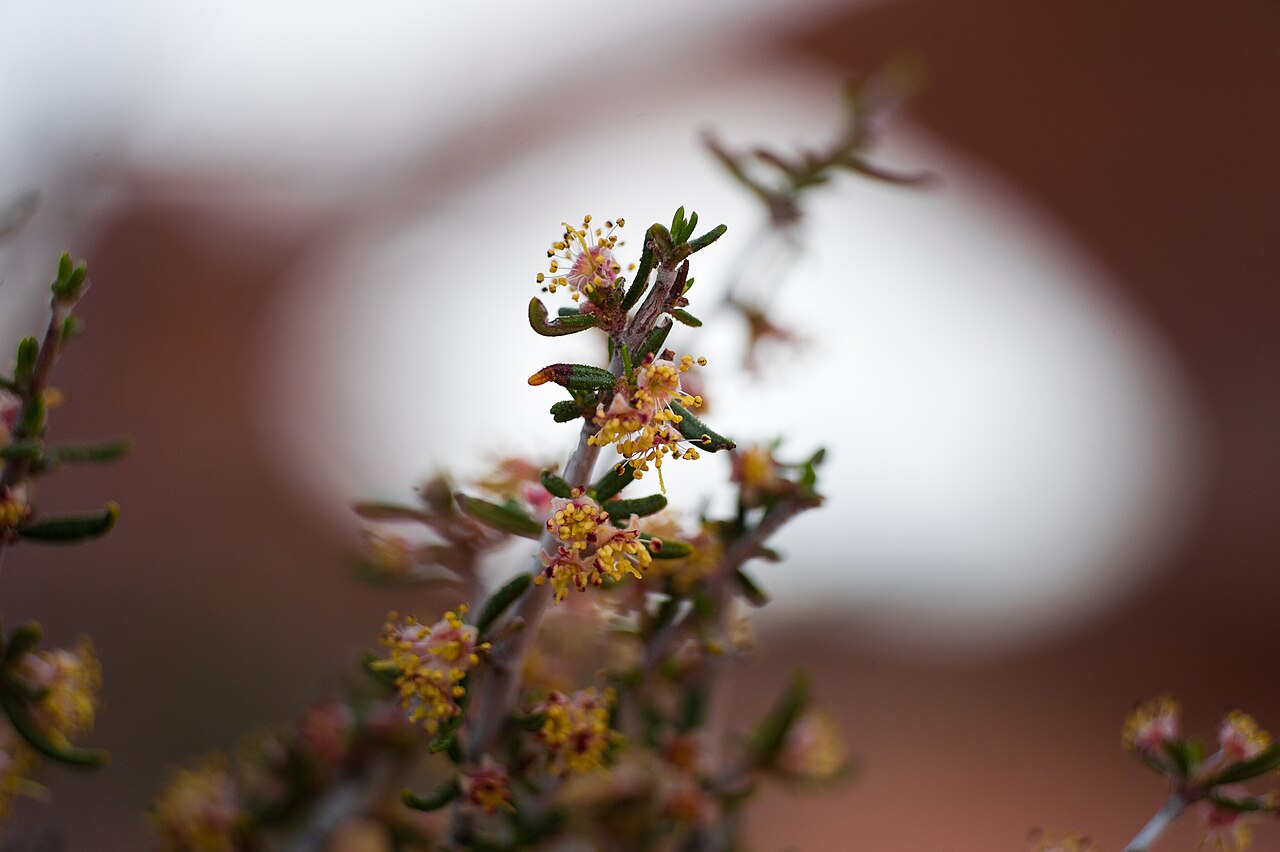
Flowers are inconspicuous and petal-less, appearing in small clusters of two or three at the branch tips in spring. Each tiny flower is little more than a cup a few millimeters wide, holding several protruding stamens and a single pistil; there is no showy corolla to speak of, and the bloom is easy to overlook entirely.
Fruit & Seeds
What the flowers lack in show, the fruit makes up for. Each flower develops into a single-seeded achene tipped with a long, feathery, spirally twisted style that can reach two inches. In fruit, a branch tip covered in these silvery, curling plumes gives the whole shrub a soft, almost smoky appearance, especially when backlit — one of the best identification clues for the genus as a whole.
Quick Facts
| Scientific Name | Cercocarpus intricatus |
| Family | Rosaceae (Rose) |
| Plant Type | Evergreen shrub |
| Mature Height | 3–10 ft |
| Mature Spread | 3–8 ft, dense and rounded |
| Growth Rate | Very slow |
| Sun Exposure | Full sun |
| Water Needs | Very low once established |
| Soil Type | Thin, rocky, well-drained; limestone or sandstone derived |
| Soil pH | Neutral to alkaline |
| Bloom Time | Spring |
| Flower Color | Greenish-yellow, inconspicuous |
| Fall Color | None; evergreen |
| Fruit | Achene with long, feathery, twisted silvery plume |
| Deer Resistant | No; valuable winter browse for deer and bighorn sheep |
| USDA Hardiness Zones | 5–8 |
Native Range
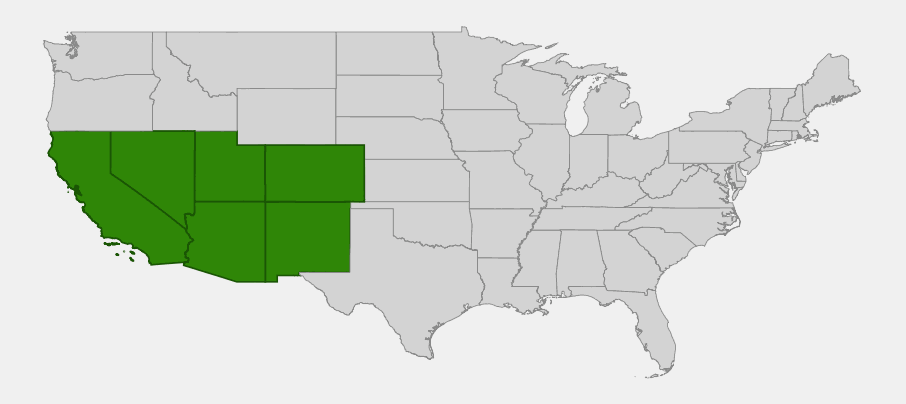
Littleleaf mountain mahogany is native to the desert and canyon country of the southwestern United States, centered on the Colorado Plateau and the eastern Mojave Desert. Its range runs from southeastern California east through southern Nevada and Utah, into western Colorado and Arizona, with a limited presence in western New Mexico.
Across this range it grows on some of the driest, rockiest sites available: canyon rims and slickrock benches, pinyon-juniper woodland, desert mountain slopes, and plateau country between roughly 4,000 and 9,000 feet elevation. It is frequently found rooted directly in cracks and pockets of exposed sandstone or limestone, where almost no soil has developed, and it often grows alongside pinyon pine, Utah juniper, and other drought-hardened shrubs of the high desert.
The species is slow-growing and long-lived, and because it occupies such marginal, erosion-prone terrain, established plants are best left undisturbed; the species does not transplant or recover from damage quickly given how slowly it grows in the wild.
📋 Regional plant lists featuring Littleleaf Mountain Mahogany: Utah & Western Colorado · Arizona & New Mexico
Growing & Care Guide
Littleleaf mountain mahogany is built for neglect in the best possible sense: it is one of the most drought-tolerant native shrubs available for high-desert and rock-garden plantings, but it rewards patience rather than active care.
Light
This shrub needs full, unobstructed sun. It is a plant of open, exposed desert and canyon terrain and performs poorly in shade or even partial shade, where growth becomes sparse and weak.
Soil & Water
Plant it in thin, rocky, fast-draining soil — sandy or gravelly ground derived from sandstone or limestone suits it best, and it tolerates alkaline conditions without issue. Water sparingly; established plants need essentially no supplemental irrigation beyond natural rainfall in most of their range. Occasional deep watering during the first year or two after planting helps young shrubs establish a deep root system, but overwatering or planting in heavy, moisture-retentive soil is the most common cause of failure.
Planting Tips
Because it is extremely slow-growing, start with the largest container stock available and be patient — a shrub that will eventually be head-high may take many years to get there. Choose a site with excellent drainage, such as a rock garden, slope, or raised bed, and avoid low spots where water collects. Fall planting, timed to let roots establish over the cool season before summer heat, generally works better than spring planting in hot desert climates.
Pruning & Maintenance
Prune minimally, if at all. The dense, tangled branching is natural and part of the plant’s character; heavy shaping removes the very structure that makes it distinctive and the shrub recovers very slowly from hard pruning given its slow growth rate.
Propagation
Propagation from seed is slow and often difficult, as the hard seed coat and the extended cold-stratification many individuals require can make germination unpredictable. Most nursery stock is grown from seed collected locally and given a cold-moist stratification period over winter before spring sowing.
Landscape Uses
Littleleaf mountain mahogany is a specialist plant for specific garden situations:
- Xeriscape and rock gardens in the Interior West, where its toughness and textured form shine
- Slope and erosion-prone rocky sites too dry and thin-soiled for most other shrubs
- Wildlife habitat plantings that provide winter browse for deer and bighorn sheep
- Native desert and high-plateau restoration projects within its natural range
- Specimen or accent shrub valued for its silvery, feather-plumed seed heads
Wildlife & Ecological Value
In the sparse, resource-limited canyon and desert habitats where it grows, littleleaf mountain mahogany is a disproportionately important source of year-round forage and cover for wildlife.
For Mammals
Mule deer and desert bighorn sheep browse the evergreen foliage heavily, especially in winter when more palatable forage is scarce; in many desert ranges it is considered a key winter browse species. Small mammals use the dense, tangled branches for cover from predators and weather.
For Birds
The dense, twiggy growth form provides nesting and roosting cover for small birds in otherwise open, exposed terrain, while the evergreen foliage offers rare year-round shelter in the harsh desert landscape.
For Pollinators
Although the small, petal-less flowers are not showy, they are visited by a range of small native bees and other insects that are adapted to the sparse floral resources of the high desert.
Ecosystem Role
As a long-lived, slow-growing shrub rooted directly in rock, littleleaf mountain mahogany helps stabilize thin desert soils on slopes and canyon rims where erosion risk is otherwise high. Its deep, extensive root system allows it to access moisture unavailable to shallower-rooted plants, letting it persist for decades on sites too harsh for most other woody species, and giving it an outsized structural role in these sparse plant communities.
Cultural & Historical Uses
The Navajo have traditionally used the deep-red bark from the plant’s taproot to produce a reddish-brown dye for coloring handspun wool yarns, a practice documented among weavers in the Four Corners region. The extremely hard, dense wood characteristic of the genus Cercocarpus — the name itself comes from Greek words meaning “tailed fruit” — has also seen limited traditional use for tool handles and similar small items where a very hard, heavy wood was wanted.
Because the shrub grows so slowly and occupies fragile desert terrain, it has not been harvested commercially at any scale, and its greatest cultural significance today is ecological and aesthetic: a signature plant of the slickrock canyon country prized by hikers and naturalists for its gnarled, sculptural form and its silvery, feather-tailed seed heads.
Among Southwestern native-plant gardeners, the species has gained a following in recent decades as rock-garden and xeriscape plantings have grown more popular, valued precisely for the toughness and distinctive form that made it so well suited to its original desert habitat.
Frequently Asked Questions
Is littleleaf mountain mahogany the same plant as desert mahogany?
“Desert mahogany” is sometimes used as another common name for this species, though “littleleaf mountain mahogany” is the name recognized by the USDA PLANTS database and is used more consistently in field guides.
How fast does littleleaf mountain mahogany grow?
Very slowly. In its harsh, rocky native habitat, growth of just a few inches per year is typical, and even with supplemental water in cultivation it remains one of the slower-growing native shrubs.
Can I grow littleleaf mountain mahogany outside the desert Southwest?
It can be grown in other arid, well-drained climates with similar winter cold tolerance, but it struggles in humid regions or heavy, poorly drained soils where root rot becomes a risk.
Do deer eat littleleaf mountain mahogany?
Yes, heavily. It is an important winter browse plant for mule deer and bighorn sheep across much of its range, which also means it is not a good choice where deer pressure on young plants is a concern.
Why does it have feathery, silvery seed heads?
The long, twisted, hairy style attached to each seed acts like a tiny parachute, catching wind currents to help the seed disperse away from the parent plant — a common adaptation among many members of the rose family’s Cercocarpus group.

Looking for a nursery that carries Littleleaf Mountain Mahogany?
Browse our native plant nursery directory: California · Arizona · Colorado · Nevada & New Mexico · Utah