
Panamint Cryptantha (Cryptantha angustifolia)
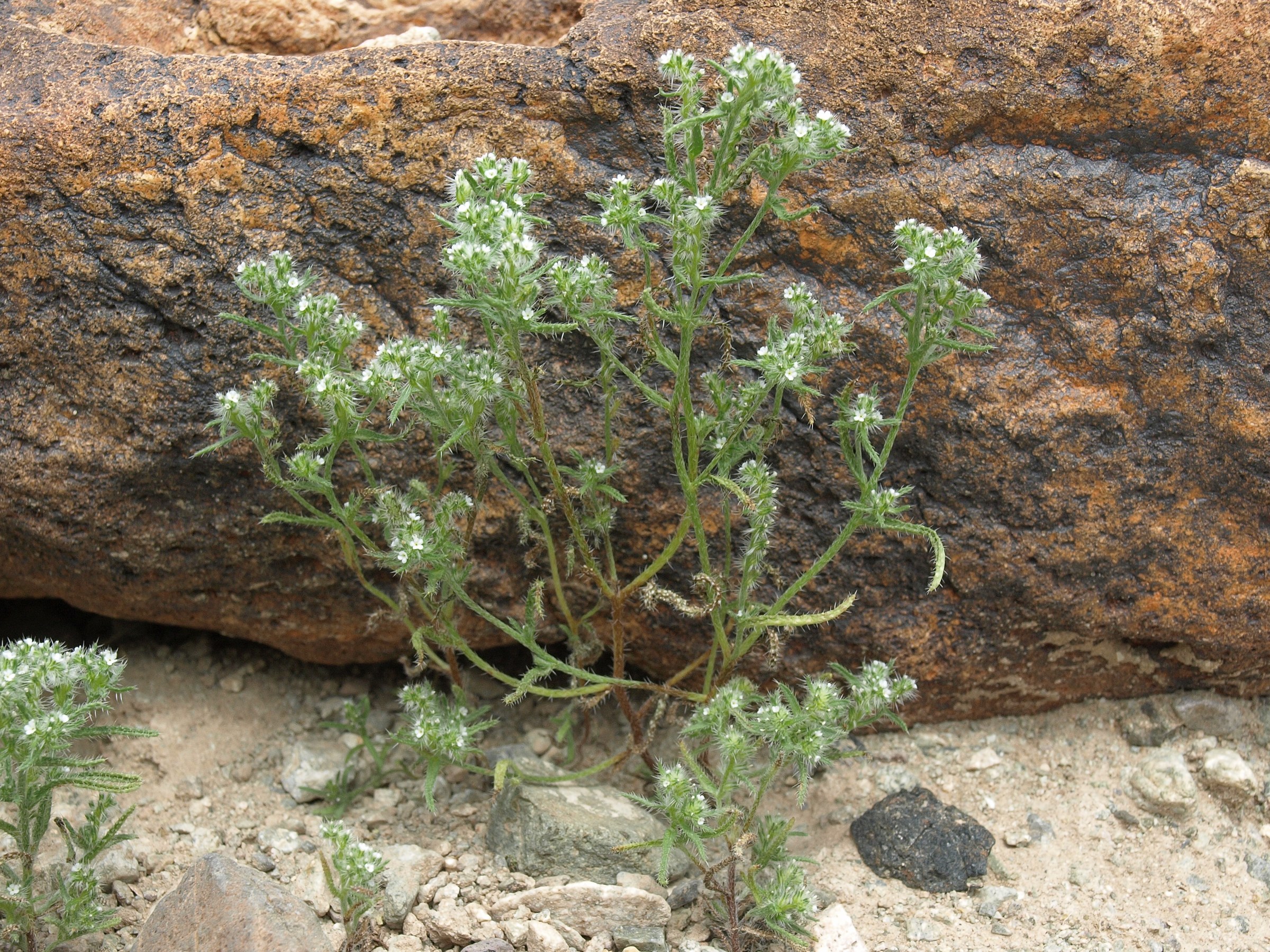
Cryptantha angustifolia, commonly known as Panamint cryptantha or narrowleaf cryptantha, is a small, bristly-haired annual wildflower of the hot deserts of the American Southwest. It belongs to the borage family (Boraginaceae), the same family as forget-me-nots, and its genus name comes from the Greek for “hidden flower” — a fitting label for a plant whose tiny white blooms are easy to overlook until a whole hillside of them opens after a good winter rain. Some botanists now place this species in the segregate genus Johnstonella, so it may also appear in references as Johnstonella angustifolia.
Panamint cryptantha grows low and much-branched, usually just 2 to 12 inches tall, with slender stems that spread outward before curving upright. Every part of the plant above ground — stems, narrow leaves, and the sepals that cup each flower — is covered in stiff, bristly hairs that give the whole plant a grayish, sandpapery texture. The minute white flowers, each barely an eighth of an inch across, cluster along coiled, scorpion-tail-shaped flowering branches that are typical of the borage family.
This is strictly a desert annual, not a garden perennial, and it completes its life cycle in a single season: germinating with cool-season rains, flowering from late winter into late spring, then setting seed and dying back before the summer heat arrives. For desert and xeriscape gardeners in the Southwest, it is less a planted ornamental and more a welcome self-sowing wildflower that fills bare, sunny ground between cacti and shrubs with a haze of tiny white blooms, feeding small native bees and other insects along the way.
Identification
Panamint cryptantha is easiest to identify by its small size, its bristly-hairy, grayish-green appearance, and its coiled flower clusters. It is an annual forb with no woody tissue, dying completely to the ground (and to seed) each year.
Stems
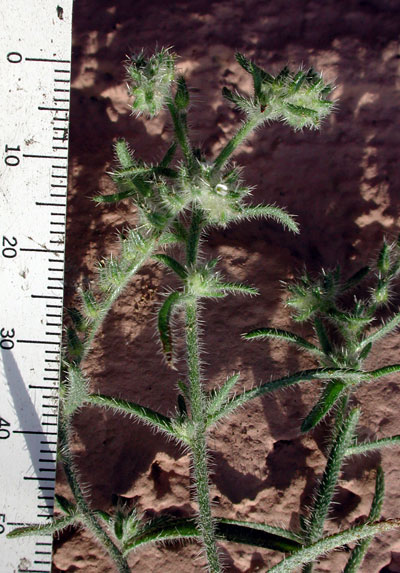
Stems are slender, 2 to 12 inches long, and much-branched from the base and again above, so a single plant often looks like a loose, rounded tuft. Young stems spread out horizontally before the tips turn upward (ascending) or stay low and curving (decumbent). Like the rest of the plant, the stems are covered in stiff, straight, closely appressed hairs mixed with coarser spreading bristles, each hair attached at a small swollen base.
Leaves
The leaves are narrow and linear to narrowly oblong, about ⅜ to 1½ inches long, stalkless (sessile), and arranged alternately along the stems. They are most crowded near the base of the plant and become smaller and more scattered toward the flowering tips. Like the stems, the leaf surfaces are rough and bristly-hairy to the touch, which is the source of the Spanish common name peluda, meaning “hairy.”
Flowers & Fruit
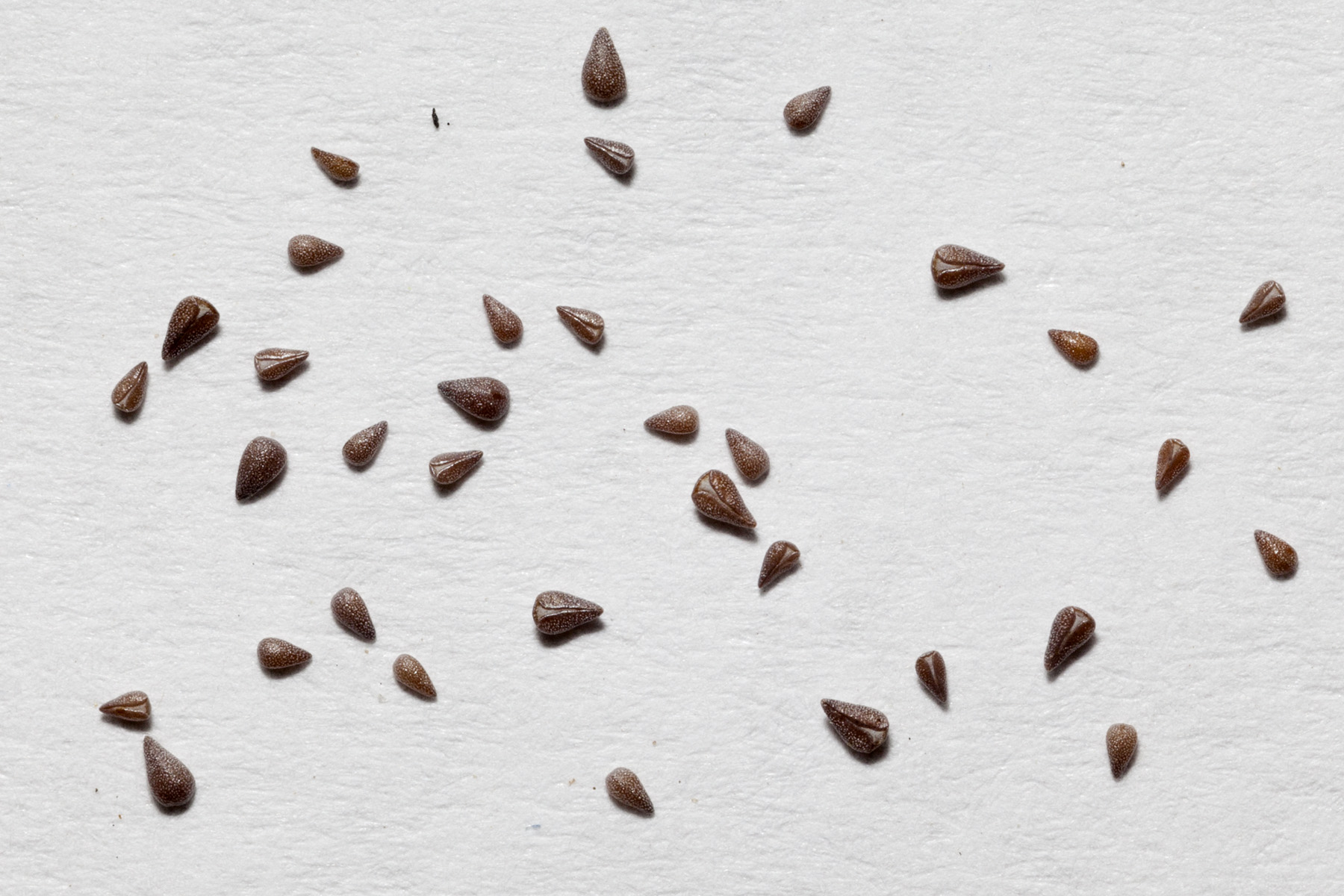
Flowers are tiny, about ⅛ inch across, white with a small yellow throat, and funnel-shaped, widening gradually from a narrow base. They are borne along coiled, one-sided flowering branches (scorpioid cymes) that uncoil gradually as buds open in succession, a hallmark of the borage family. The narrow, hairy, lance-shaped sepals (calyx lobes) are often as conspicuous as the flowers themselves. Each flower produces a small dry fruit that splits into four tiny nutlets; characteristically for this species, one nutlet is noticeably larger than the other three. The seeds are tear-drop shaped, brown, and finely textured.
Quick Facts
| Scientific Name | Cryptantha angustifolia (syn. Johnstonella angustifolia) |
| Family | Boraginaceae (Borage) |
| Plant Type | Annual forb/wildflower |
| Mature Height | 2–12 in (5–30 cm) |
| Mature Spread | 6–12 in, loosely spreading |
| Growth Rate | Fast (completes life cycle in one season) |
| Sun Exposure | Full sun |
| Water Needs | Low; relies on winter/spring rainfall |
| Soil Type | Sandy to gravelly, well-drained |
| Soil pH | Neutral to alkaline |
| Bloom Time | February – June (January–June in California) |
| Flower Color | White with a yellow throat |
| Fall Color | None (dies back after seed-set in late spring) |
| Fruit | Dry nutlets, 4 per flower, one larger than the rest |
| Deer Resistant | Yes (bristly foliage is unpalatable) |
| USDA Hardiness Zones | 8–11 (grown as a self-sowing annual) |
Native Range
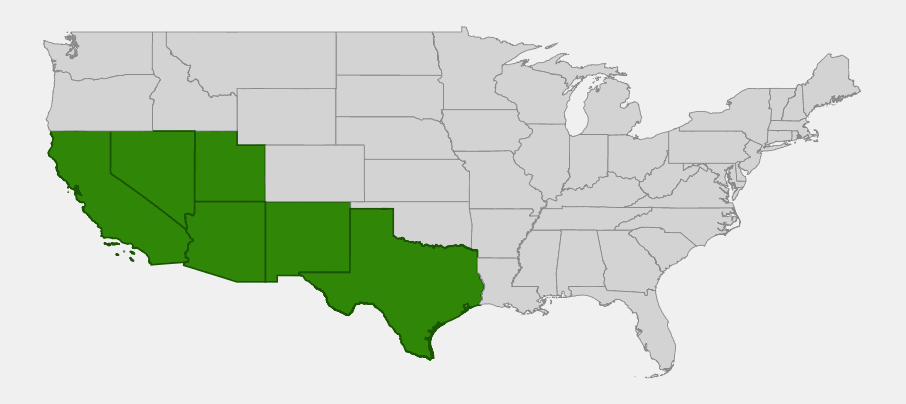
Panamint cryptantha is native to the hot deserts of the southwestern United States, where it has its greatest concentration in Arizona, California and Nevada, with smaller populations extending into New Mexico, Utah and western Texas. It is a true lowland desert annual, found mostly below about 5,200 feet in elevation across the Mojave, Sonoran and Chihuahuan desert regions.
Typical habitat is open, sandy to gravelly desert flats, washes, bajadas and rocky slopes within creosote bush scrub and other desert shrub communities. It often grows in the open spaces between widely spaced shrubs, taking advantage of bare mineral soil, and is one of the first wildflowers to bloom after adequate winter rain, frequently appearing alongside other small desert annuals such as fiddlenecks (Amsinckia) and combseeds (Pectocarya).
Because it is an annual that germinates opportunistically with rainfall, Panamint cryptantha’s visible abundance varies enormously from year to year: in a wet winter it can carpet desert flats in a haze of tiny white flowers, while in a dry year very few plants may appear at all. It is not considered rare or of conservation concern anywhere in its range.
📋 Regional plant lists featuring Panamint Cryptantha: Arizona & New Mexico · Utah & Western Colorado
Growing & Care Guide
Panamint cryptantha is not a plant most gardeners deliberately plant and tend; it is better thought of as a desert wildflower that establishes itself readily from seed in appropriate conditions and then reseeds on its own each year. For desert native-plant gardeners, the “growing” effort mostly involves creating the right bare, sunny, well-drained ground and then letting the species move in from blown or scattered seed.
Light
Full sun is essential. Panamint cryptantha is adapted to open, unshaded desert ground and will not persist in shaded areas or dense groundcover.
Soil & Water
It thrives in lean, fast-draining sandy or gravelly soils with little organic matter — the same conditions found on desert flats and washes. It needs no supplemental irrigation once established in a suitable desert garden, relying entirely on cool-season rainfall to germinate and grow; in fact, summer watering or rich garden soil tends to favor weedier competitors over this small native annual.
Planting Tips
Scatter seed over bare, undisturbed mineral soil in fall, just ahead of the winter rainy season, and avoid deep burial — these tiny seeds germinate best on or very near the soil surface. Keep the seeded area free of mulch and dense companion planting so seedlings have open ground to establish in. Once a population is established in a desert garden bed, it typically self-sows and returns in varying numbers each year depending on rainfall.
Landscape Uses
- Desert wildflower gardens as a low, early-blooming filler among cacti and shrubs
- Naturalistic desert restoration plantings on disturbed sandy or gravelly ground
- Pollinator gardens, where the tiny flowers support small native bees
- Rock garden and bajada-style plantings that mimic natural desert flats
Wildlife & Ecological Value
Though individually inconspicuous, Panamint cryptantha contributes to desert plant communities as one of the many small annual wildflowers that bloom in sequence after winter rains, supporting pollinators and seed-eating wildlife during the desert’s brief flush of spring growth.
For Pollinators
The small white flowers are visited by native bees and other small flying insects seeking nectar and pollen during the early desert bloom season, when few other flowers are yet open.
For Birds & Mammals
The abundant small seeds are a food source for seed-eating birds and small mammals that forage on the desert floor, part of the broader web of desert annuals that provide forage in years of good rainfall.
Ecosystem Role
As a fast-cycling winter annual, Panamint cryptantha helps fill the gaps between perennial desert shrubs with temporary ground cover, contributing leaf litter and organic matter to otherwise sparse desert soils and supporting the boom-and-bust rhythm of desert annual communities that follows the region’s unpredictable rainfall.
Cultural & Historical Uses
Panamint cryptantha has no significant recorded history of use by Indigenous peoples or settlers, likely because of its small size, bristly texture and the abundance of larger, more useful desert plants nearby. Its Spanish folk name, peluda (“hairy one”), reflects how the plant was recognized and described by Spanish-speaking residents of the Southwest, but it was not a food, fiber or medicinal plant of note.
The genus Cryptantha as a whole, along with its close relatives, is collectively known to botanists and desert naturalists as “cat’s-eyes” or “popcorn flowers,” names that reflect the small, bright white flowers scattered like popped kernels across desert ground after rain. Panamint cryptantha’s main modern significance is as an indicator species: its appearance in large numbers signals a good wildflower year, and desert naturalists and photographers watch for it, along with other small annuals, each spring.
Frequently Asked Questions
Is Panamint cryptantha the same as narrowleaf cryptantha?
Yes. “Panamint cryptantha” is the USDA’s accepted common name for Cryptantha angustifolia, but the plant is also widely called narrowleaf cryptantha, a translation of its species name angustifolia (“narrow-leaved”), as well as narrow-leaf popcorn flower.
Can I grow Panamint cryptantha outside the desert Southwest?
It is adapted specifically to hot, dry, low-elevation desert conditions and cool-season rainfall patterns, so it is not well suited to humid or cold-winter climates outside its native range. It is best grown only within or very near its native desert region.
Does Panamint cryptantha need to be watered in summer?
No. As a winter-spring annual, it germinates, flowers, sets seed and dies back entirely before summer heat arrives, and does not need or benefit from summer irrigation.
Is Panamint cryptantha edible or medicinal?
There is no documented food or medicinal use for this species. Its chief value is ecological, as an early nectar source for small pollinators and a seed source for desert wildlife.
Why do Panamint cryptantha populations vary so much from year to year?
As a true desert annual, it germinates in response to adequate cool-season rain. In wet winters, dense stands can appear across desert flats; in dry years, very few seeds germinate, and the species may be almost invisible until conditions improve again.

Looking for a nursery that carries Panamint Cryptantha?
Browse our native plant nursery directory: Arizona · California · Nevada & New Mexico · Utah & Texas