
Florida Strangler Fig (Ficus aurea)
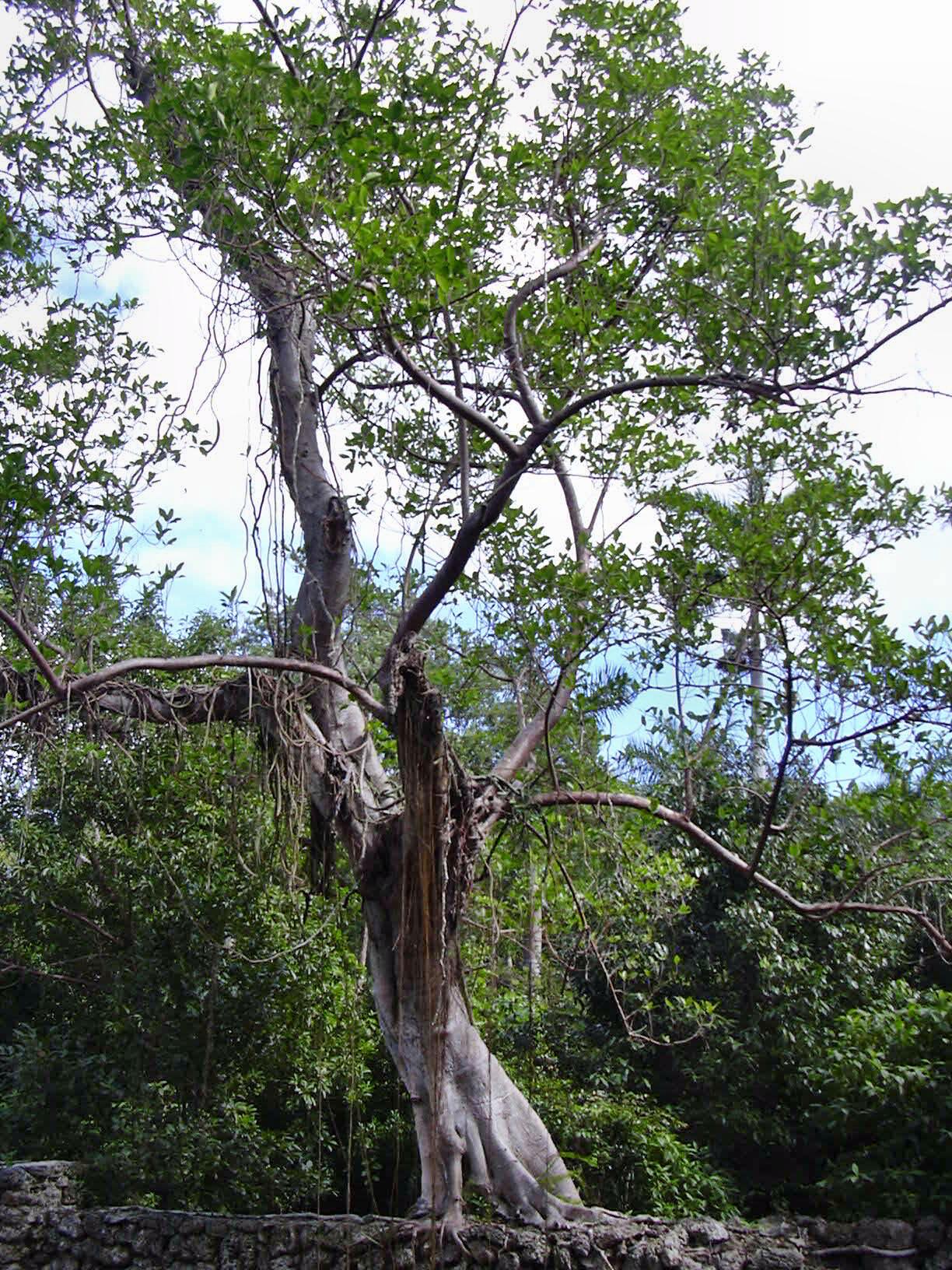
Ficus aurea, the Florida Strangler Fig, is one of the most distinctive native trees of South Florida’s hammocks and coastal woodlands. It begins life as an epiphyte — a sticky seed, usually dropped by a bird or raccoon that has eaten the fig fruit, germinates high in the crotch of a host tree such as a cabbage palm or live oak. From there it sends long, wiry roots downward along the host’s trunk, eventually reaching the soil and thickening into a woody lattice that encases the host completely. Over decades the host tree dies and rots away, leaving the strangler fig standing as a broad, free-standing tree with a distinctive hollow, basket-like trunk.
Despite the dramatic name, the strangler fig does not actively choke its host — it simply out-competes it for light and, eventually, growing space, while also weighing it down and intercepting water and nutrients. The result is one of the great spectacles of Florida’s hardwood hammocks: huge, broad-crowned fig trees with massive buttressed, fused-root trunks, often 40 to 60 feet tall and wider than they are tall, draped with additional aerial roots still descending from the branches above.
For South Florida landscapes with the room for it, Florida strangler fig is an excellent native shade tree with outstanding wildlife value — its fruit feeds dozens of bird species nearly year-round. It is not a plant for small yards or anywhere near a foundation, septic field, pool, or sidewalk, since its aggressive, wide-ranging roots will seek out and exploit any crack or seam in masonry, pipes, and pavement as they grow.
Identification
Florida strangler fig is evergreen to nearly so, with a broad, rounded crown and a short, massive trunk made of fused, root-like strands where it once enveloped a host tree. Free-standing (non-strangling) individuals that establish directly in the ground develop a more conventional single trunk with heavy buttressing at the base. Mature trees commonly reach 40 to 60 feet, occasionally taller in old hammocks, with a crown spread that can exceed the height.
Bark, Trunk & Roots
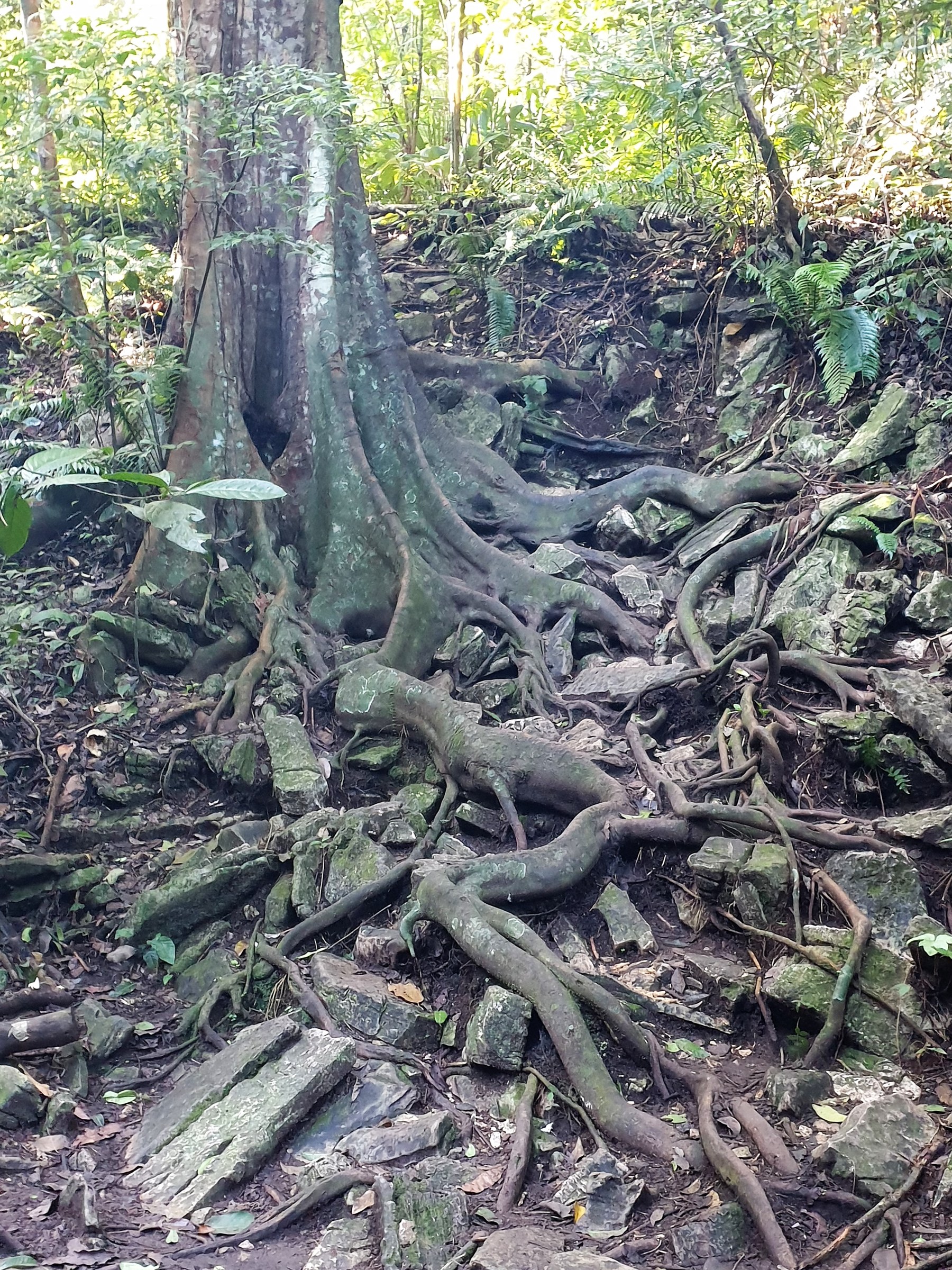
The bark is smooth and pale gray on young growth, becoming furrowed and gray-brown with age. The signature feature is the root system: aerial roots drop from the branches, thicken, and fuse together into a column or open, cage-like lattice around the original host trunk. These roots are tough, woody, and relentless — they will travel many feet along the soil surface and underground in search of moisture, and they readily invade septic lines, foundations, pool decks, and sidewalks. Keep this tree well away from any structure you want to keep intact.
Leaves
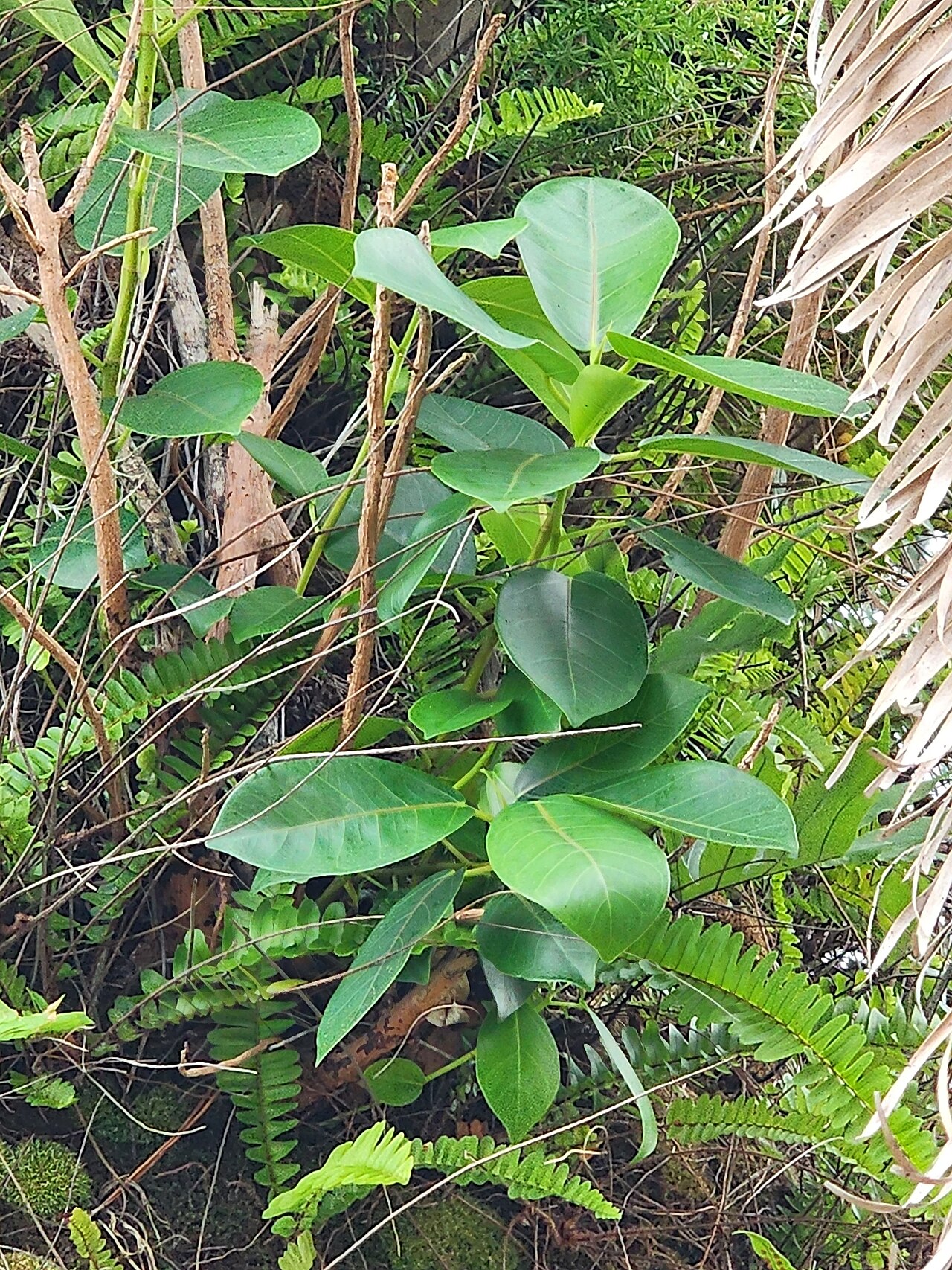
Leaves are simple, alternate, thick, and leathery, 2 to 5 inches long, oval to elliptic with a short point at the tip and a rounded base. They are glossy dark green above and paler, dull yellow-green beneath, with a conspicuous pale midrib. New leaves emerge wrapped in a thin, papery stipule that drops off as the leaf expands, leaving a faint ring scar around the twig — a reliable fig-family identification trait.
Flowers & Fruit
Like all figs, Ficus aurea does not produce visible flowers; instead it bears a syconium, a hollow, fleshy receptacle that holds hundreds of tiny flowers on its inner surface. These structures mature into the familiar “fig,” about ⅜ to ⅝ inch round, ripening from green to yellow, red, or purplish. Pollination depends entirely on a single, highly specialized fig wasp (Pegoscapus mexicanus) that enters the immature fig through a tiny pore to lay eggs, pollinating the internal flowers in the process — an obligate partnership that neither species can complete without the other. Fruiting occurs on and off throughout the year, with a heavier flush in spring, and a single large tree can produce enormous quantities of figs that draw wildlife from a wide area.
Quick Facts
| Scientific Name | Ficus aurea |
| Family | Moraceae (Fig/Mulberry) |
| Plant Type | Evergreen tree (hemiepiphyte/strangler) |
| Mature Height | 40–60 ft, occasionally more |
| Mature Spread | 20–60 ft, often wider than tall |
| Growth Rate | Fast |
| Sun Exposure | Full Sun to Part Shade |
| Water Needs | Average; tolerates both moist hammock soil and short dry spells once established |
| Soil Type | Sandy or limestone-based hammock soils; adaptable |
| Soil pH | Neutral to alkaline (tolerates oolitic limestone) |
| Bloom Time | Figs form year-round, heaviest in spring |
| Flower Color | Not showy (enclosed within the fig) |
| Fall Color | None (evergreen) |
| Fruit | Small yellow-to-red figs, ⅜–⅝ in |
| Deer Resistant | Mostly (too large for browsing pressure once established) |
| USDA Hardiness Zones | 10–11 |
Native Range
Florida strangler fig is native to the southern half of Florida, from roughly the central peninsula south through the Everglades and the Florida Keys, and it is especially common in the subtropical hammocks of Miami-Dade, Monroe, Collier, and the lower east and west coasts. Outside the United States its range continues through the Bahamas, Cuba and the wider Caribbean, and south through Mexico and Central America to Panama, but within the U.S. it occurs only in Florida — it is not native anywhere else in the country, and it is not reliably cold-hardy north of about zone 10.
In the wild it is a hallmark species of tropical hardwood hammocks, often beginning its life epiphytically in the crown of a cabbage palm, live oak, or gumbo-limbo, then sending roots to the ground to become free-standing. It also grows on limestone outcrops, around sinkholes, and along the edges of pinelands and mangrove transition zones, tolerating both the thin, rocky soils of the Miami Rock Ridge and the richer organic soils of hammock interiors.
Because it germinates readily wherever birds perch, strangler fig seedlings also turn up on buildings, walls, bridges, and utility poles throughout South Florida, where their invasive root growth can cause real structural damage if left unmanaged. This same vigor is a landscape asset in the right setting — a large, open yard or park space — and a serious liability in the wrong one.
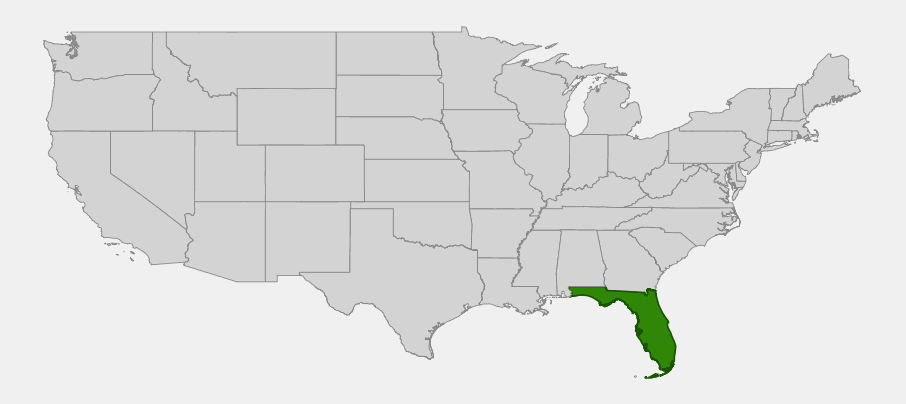
📋 Florida strangler fig’s native range sits south of the states covered by Plant Native’s current regional plant lists; no regional list applies yet.
Growing & Care Guide
Florida strangler fig is easy to grow in the right spot and nearly indestructible once established in South Florida’s warm, frost-free climate — the challenge is giving it enough room, and keeping it far enough from anything you don’t want its roots to reach.
Light
Give it full sun to part shade. Young trees establish readily in the dappled light of a hammock understory or in the crotch of a host tree, but open-grown, free-standing specimens develop the broadest, healthiest crowns in full sun.
Soil & Water
This fig tolerates nearly any well-drained soil found in South Florida, from thin oolitic limestone to deep sand to richer hammock loam, and it handles both periodic flooding and short dry spells well once its roots are established. Regular water speeds growth in young trees; mature trees are essentially self-sufficient on rainfall alone.
Planting Tips
Plant only where you have the space to let it reach a 40- to 60-foot spread — a park, large yard, or naturalized hammock restoration, not a residential foundation planting. Keep it at least 30 to 50 feet from septic fields, foundations, pools, seawalls, and paved surfaces; its roots are notorious for finding and exploiting any gap in masonry, pipe joints, or pavement seams. Container-grown nursery stock establishes quickly in warm weather.
Pruning & Maintenance
Mature trees need little pruning beyond removing deadwood and limbs that threaten structures or sightlines. Unwanted volunteer seedlings — which sprout readily from bird-dropped seed on walls, roofs, and other trees — should be removed while small, since a strangler fig allowed to establish on a building or valued tree becomes very difficult and expensive to remove later. Aerial roots reaching toward the ground from an established tree can be left to thicken into additional trunk support, or trimmed back if a tidier single-trunk form is wanted.
Propagation
Strangler fig grows easily from fresh seed (often via bird or mammal droppings in the wild) or from cuttings, which root readily in warm, humid conditions. Volunteer seedlings transplant well while young, before their root systems become extensive.
Landscape Uses
Given adequate space, strangler fig offers real landscape value:
- Specimen shade tree for large properties, parks, and golf courses
- Wildlife garden anchor — few native trees feed as many bird species
- Hammock restoration plantings in South Florida natural areas
- Living sculpture — the fused aerial-root trunk is a striking focal point on its own
- Not recommended near foundations, pools, septic systems, seawalls, or sidewalks
Wildlife & Ecological Value
Florida strangler fig is a keystone species in South Florida’s hammocks, supplying fruit through much of the year when many other natives are not fruiting.
For Birds
Figs are a critical food source for dozens of bird species, including the White-crowned Pigeon, whose South Florida population depends heavily on strangler fig and other native figs; also Northern Mockingbirds, Gray Catbirds, Red-bellied Woodpeckers, and many migrating warblers and thrushes that pass through in fall and spring when fig crops are heavy.
For Mammals
Raccoons, gray squirrels, and opossums regularly feed on the fallen and ripening figs, and in doing so disperse the seeds to new perches and crevices, continuing the species’ epiphytic life cycle.
For Pollinators
Strangler fig depends entirely on one tiny, specialized fig wasp species to pollinate its enclosed flowers — a relationship so precise that without this single wasp, the tree cannot produce viable seed. This obligate mutualism is one of the more remarkable pollination stories among Florida’s native trees.
Ecosystem Role
As it grows, a strangler fig gradually restructures its patch of hammock: its crown adds canopy height and habitat complexity, its hollow lattice trunk creates cavities and crevices used by cavity-nesting birds and arboreal wildlife, and its heavy, near-constant fruit production helps sustain fruit-eating animals through seasons when other food is scarce.
Cultural & Historical Uses
Florida’s indigenous peoples, including the Tequesta and later the Seminole, were familiar with strangler fig as a conspicuous and useful hammock tree, valuing its dense shade and the reliable food it brought in the form of birds and small game drawn to its fruit. Its milky latex sap, common to the fig family, saw occasional traditional use as a mild adhesive or in simple folk remedies for skin irritation, though it is not an edible or medicinal plant by modern standards and the sap can irritate skin and eyes.
In the 20th century, strangler fig became an icon of “old Florida” landscaping, prized for its dramatic, banyan-like form in parks, botanical gardens, and historic estates across South Florida. Its tendency to colonize masonry walls, bridges, and old structures has also made it a recurring character in local folklore about overgrown, reclaimed ruins — a visible reminder of how quickly subtropical vegetation can reclaim human structures in this climate.
Today the species remains widely planted in parks and large public landscapes for its shade and wildlife value, while homeowners are generally cautioned to admire it from a distance rather than plant it close to the house.
Frequently Asked Questions
Does the Florida strangler fig actually kill the tree it grows on?
Often, yes, eventually. It does not strangle its host in the literal sense, but by enveloping the trunk, shading out the host’s crown, and competing for root space and nutrients, it frequently outlives and outcompetes the host, which dies and decays, leaving the fig standing with a hollow, lattice-like base.
Is it safe to plant strangler fig near my house?
No. Its aggressive, wide-ranging root system is well known for cracking foundations, invading septic lines and pipes, and lifting pavement. Plant it only where it has 30 to 50 feet or more of clearance from any structure.
Can you eat the figs?
The small figs are edible to wildlife and are eaten by many bird and mammal species, but they are not a food crop for people — they are small, seedy, and not cultivated for human consumption. Leave them for the birds.
How is Florida strangler fig different from a true banyan tree?
“Banyan” is a common name most often applied to the Indian banyan (Ficus benghalensis), a related but non-native species planted ornamentally in Florida. Florida strangler fig is a distinct, Florida-native species with smaller leaves and figs, though both share the strangling, aerial-rooting growth habit typical of many tropical figs.
How fast does it grow, and how large will it get?
Strangler fig grows quickly in South Florida’s warm climate, and a tree with room to spread can reach 40 to 60 feet tall with an equal or greater crown spread within a few decades — so plan for its mature size from the start rather than trying to contain it later.

Looking for a nursery that carries Florida Strangler Fig?
Browse our native plant nursery directory: Florida