
American Dunegrass (Leymus mollis)
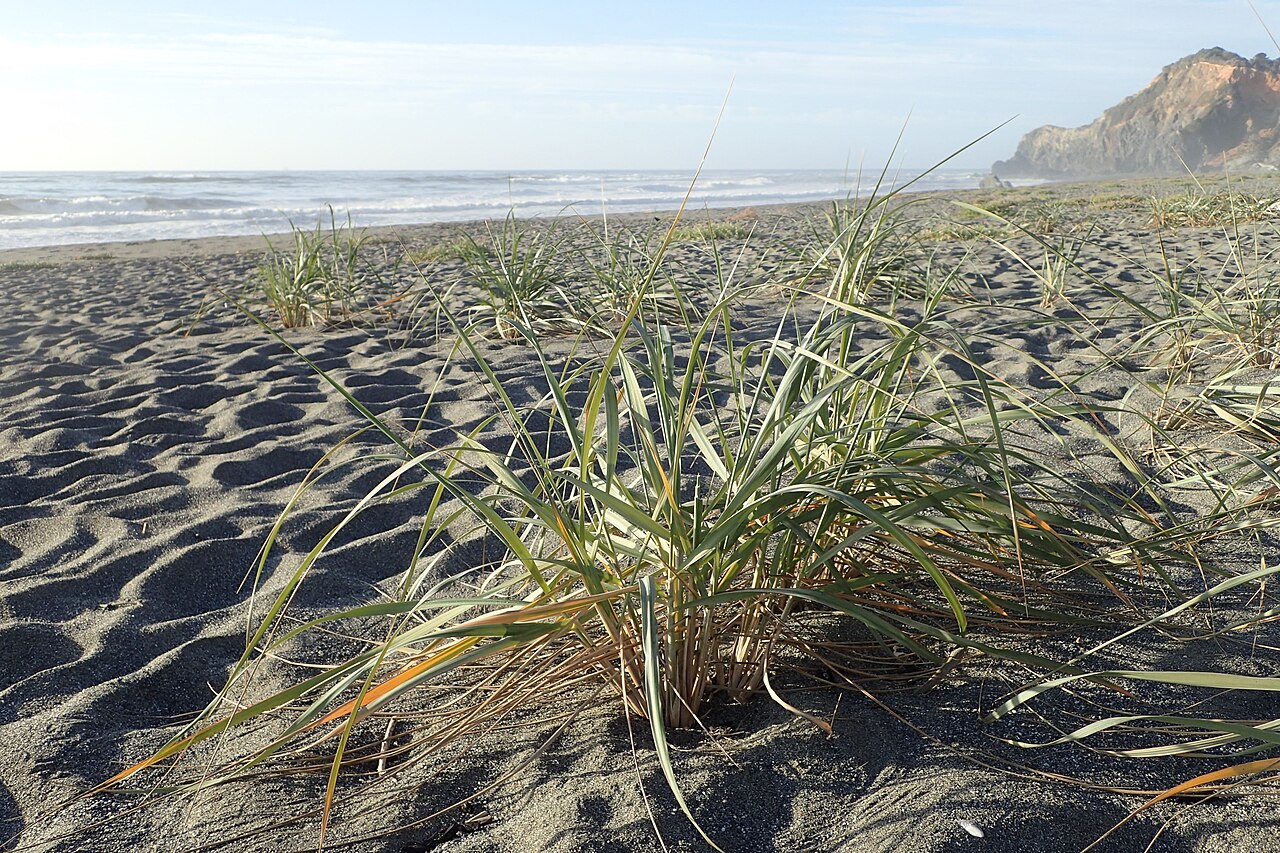
Leymus mollis (syn. Elymus mollis), known as American dunegrass and also called American dune wild-rye, sea lyme-grass, and strand-wheat, is a stout, rhizomatous perennial grass built for one of the toughest habitats in North America: the open, wind-raked foredune. Blue-green to gray-green in color, with broad leaf blades and tall, dense flowering spikes, it is immediately recognizable on the beaches and coastlines where it grows, standing well above the low, scattered vegetation typical of open sand.
Dunegrass is one of the first plants to colonize bare sand as a new dune begins to form, and it is arguably the single most important native plant for stabilizing foredunes along much of its range. Its large rhizomes spread through loose, shifting sand, knitting together a network of roots that the U.S. Fish and Wildlife Service and dune ecologists have called “the skeleton of the foredune.” Where dunegrass is lost, foredunes are far more vulnerable to blowout and storm erosion.
Beyond the Pacific and Atlantic coasts, dunegrass also occurs disjunctly along the shores of the Great Lakes, a reminder that its real requirement is not salt water but open, sandy, wind-exposed shoreline. In coastal and Great Lakes native landscaping alike, it is valued for erosion control, wildlife habitat, and its tough, handsome presence in a landscape where few other plants can compete.
Identification
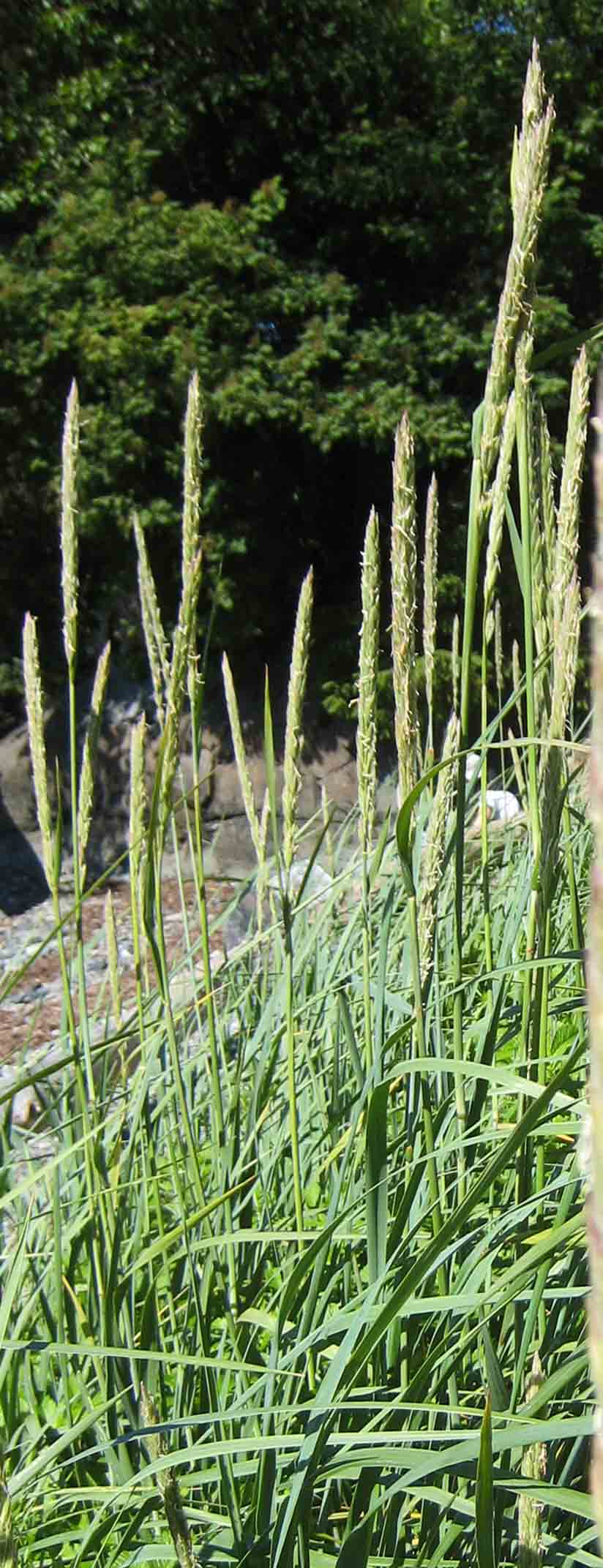
American dunegrass is a coarse, rhizomatous perennial grass with erect stems that can reach 2 to 5.5 feet (up to 1.7 m) tall. It spreads from thick, deep-running rhizomes that anchor it into loose, shifting sand and allow it to form sizable, loosely spaced colonies rather than tight bunches.
Leaves
The leaf blades are broad and flat, up to ½ to ¾ inch wide and sometimes nearly 3 feet long, with a stiff, blue-green to gray-green color that helps the plant stand out against duller beach vegetation. Leaves often curl or fold in dry, windy conditions, reducing water loss.
Flowers & Seed Heads
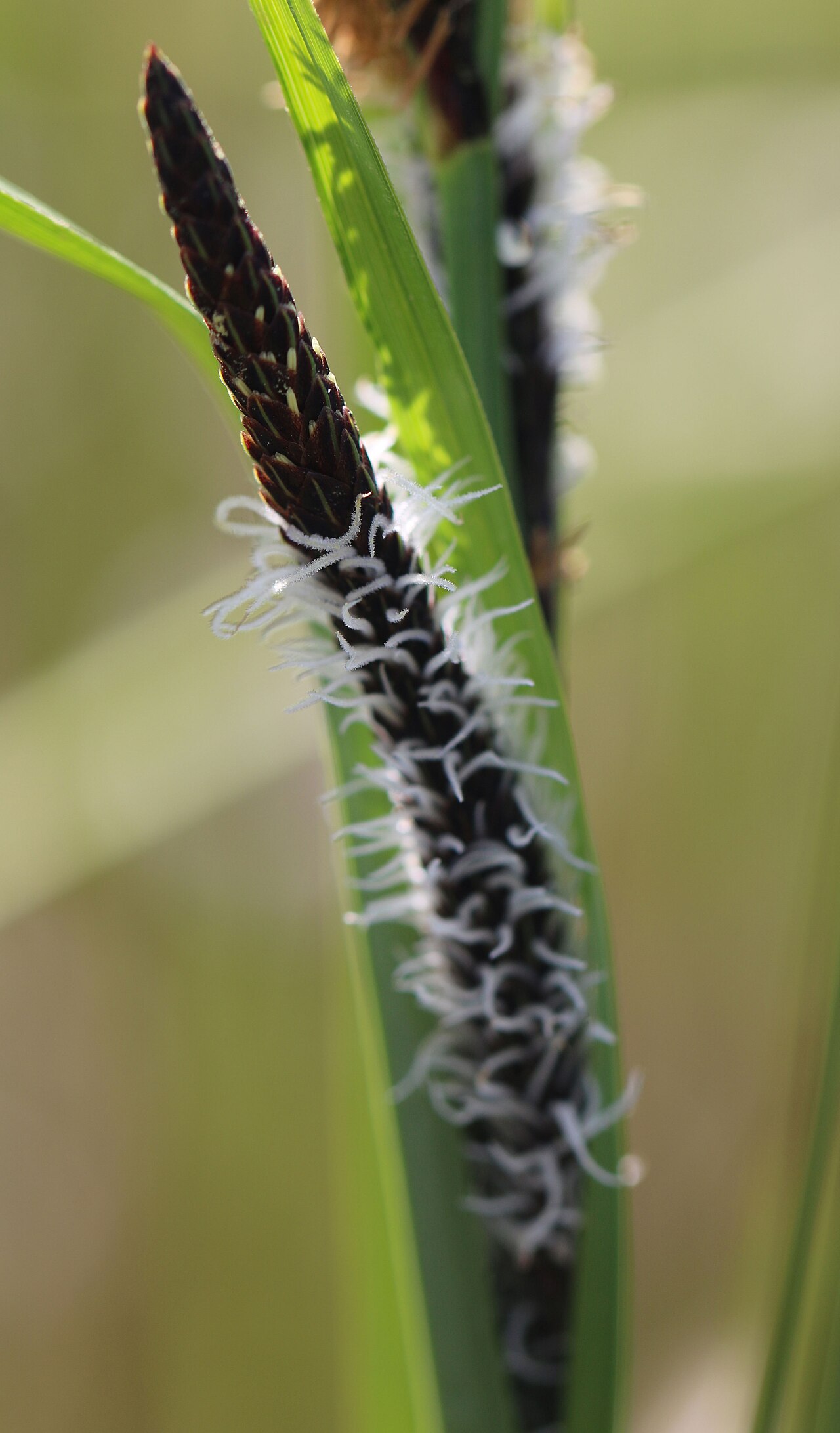
The flower spike is dense, erect, and bristled, up to about 13 inches long, with large spikelets each containing several florets and no awns. There are two subspecies: ssp. mollis, the larger and more widespread form found through most of the species’ temperate range, and ssp. villosissimus, a generally smaller, more densely hairy plant largely confined to arctic coastal habitats. The two can be hard to separate except by the type of hairs on the glumes and lemmas.
Quick Facts
| Scientific Name | Leymus mollis (syn. Elymus mollis) |
| Family | Poaceae (Grass) |
| Plant Type | Rhizomatous Perennial Grass |
| Mature Height | 2–5.5 ft (flowering stems) |
| Mature Spread | Spreading by rhizome; colonies of indefinite width |
| Growth Rate | Moderate to fast via rhizomes |
| Sun Exposure | Full Sun |
| Water Needs | Low; tolerates salt spray and drought |
| Soil Type | Loose sand; fast-draining |
| Soil pH | Neutral to slightly alkaline |
| Bloom Time | Summer |
| Flower Color | Blue-green, maturing to tan |
| Fall Color | Blades fade to tan/straw in late season |
| Fruit | Grain (caryopsis) within bristled spikelets |
| Deer Resistant | Generally yes |
| USDA Hardiness Zones | 3–9 |
Native Range
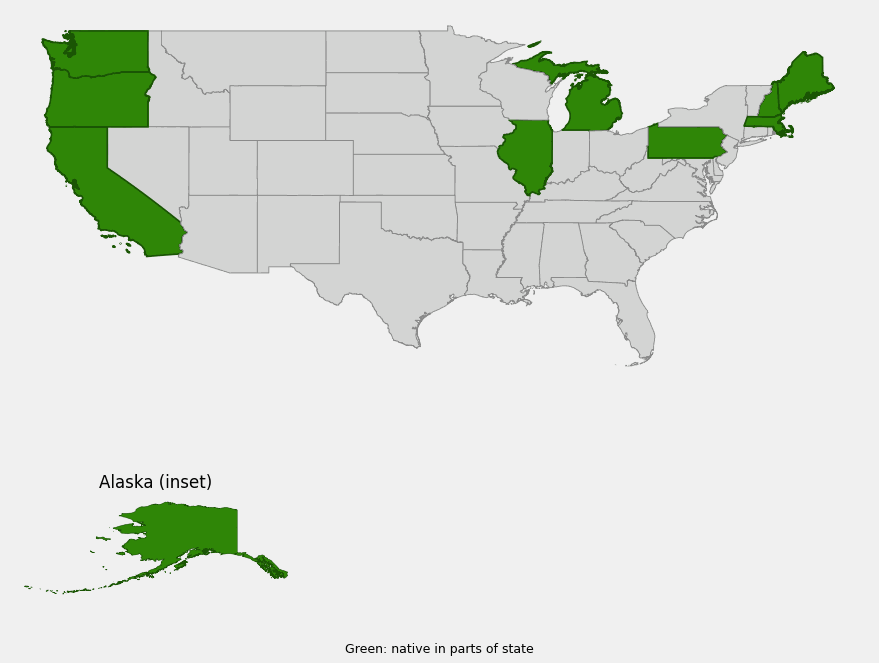
American dunegrass is native to coastal Alaska, Washington, Oregon, and California on the Pacific coast, and to coastal Maine, New Hampshire, and Massachusetts on the Atlantic coast. It also occurs natively along Great Lakes shoreline dunes in Illinois, Michigan, and Pennsylvania. Beyond the United States it ranges across coastal Canada, Greenland, Iceland, and parts of coastal Asia including Japan, China, Korea, and Russia.
It is a classic dune pioneer, usually the dominant grass on the foredune and embryo dunes closest to open water, and less often found further back on the backdune. It tolerates conditions that would kill most other plants: salt spray, salty, low-nutrient sand, little fresh water, occasional storm inundation, and constant abrasion by wind and blowing sand. On the Great Lakes, it fills the same ecological role on freshwater sand dunes that it does on ocean beaches. Common associates include beach pea (Lathyrus japonicus), yarrow, red fescue, and, on the Atlantic coast, American beachgrass (Ammophila breviligulata).
Although not rare or federally listed, dunegrass is vulnerable to coastal development, storm damage, and heavy recreational trampling, and in parts of the Pacific coast it has been displaced by the introduced European beachgrass (Ammophila arenaria), which forms denser mats that outcompete the native species. Protecting and replanting dunegrass is an active part of dune restoration work in many coastal states.
📋 Regional plant lists featuring American Dunegrass: Alaska · Western Oregon & Western Washington · New Hampshire, Maine & Vermont · Connecticut, Massachusetts & Rhode Island · Illinois, Iowa & Missouri · Michigan, Wisconsin & Eastern Minnesota · New York, Pennsylvania & Northern New Jersey
Growing & Care Guide
American dunegrass is not a plant for a conventional garden bed; it is a specialist for open, sunny, sandy sites, and it performs best when its tough, pioneering nature is put to work exactly where it is needed most.
Light
Full sun is essential. Dunegrass is adapted to the fully exposed conditions of an open beach or dune and does not perform well in shade or in sheltered garden settings.
Soil & Water
Loose, fast-draining sand is ideal; dunegrass is specifically adapted to low-nutrient, salty, sandy substrates and does not need or want rich garden soil. It is highly drought and salt tolerant once established, needing supplemental water only to get young plants rooted in during the first season.
Planting Tips
Plant container stock or rooted rhizome divisions in fall or early spring, spacing plants roughly 2 to 3 feet apart to let the rhizome network begin knitting the sand together. Dunegrass is most commonly planted as part of formal dune restoration and erosion-control projects, often alongside other native dune species, and many coastal jurisdictions have specific guidelines or permit requirements for planting on public dunes, so check locally before starting a restoration planting.
Pruning & Maintenance
Little maintenance is needed or appropriate; dunegrass is adapted to sand burial, wind abrasion, and occasional storm overwash, and intervention generally is not necessary. Avoid heavy foot traffic on planted areas, since trampling is one of the few things that reliably damages the stand.
Landscape Uses
Dunegrass has a narrow but important set of uses:
- Foredune and beach restoration, where its rhizomes stabilize loose sand
- Erosion control on coastal and Great Lakes shoreline sites
- Native dune habitat gardens in coastal communities
- Wildlife plantings supporting nesting birds and dune invertebrates
Wildlife & Ecological Value
Dunegrass does more ecological work than its modest flowers would suggest, underpinning the entire foredune community in many coastal and Great Lakes habitats.
For Birds
Dunegrass stands are among the most common plants found at arctic and subarctic nesting sites of the snow goose, and researchers believe geese favor the broader dune ecosystem that dunegrass helps create rather than the grass itself as forage. Dense dunegrass cover also provides nesting habitat and concealment for beach-nesting shorebirds elsewhere in its range.
For Mammals
The grass provides forage and cover for small mammals living in dune and coastal grassland habitat, and its extensive rhizome mats create burrowing structure that many dune-dwelling animals rely on.
Ecosystem Role
As one of the first plants to colonize bare sand, dunegrass is a foundational species in dune ecology. Its deep, extensive rhizome network stabilizes shifting sand and builds the structural backbone of the foredune, allowing other, less hardy dune plants to establish behind it. Where dunegrass is lost to development, trampling, or competition from introduced beachgrass, dune stability and the habitat it supports typically decline.
Cultural & Historical Uses
American dunegrass has a long history of practical use among Indigenous peoples of the Pacific coast and the Arctic, documented in ethnobotanical records as history, not as guidance for present-day use. The Makah, Nitinaht, and Quileute peoples of the Pacific Northwest used bundles of the plant’s thick roots to rub the body while bathing. Yupik peoples of Alaska used the long leaves to weave mats, baskets, bags, and ropes for hanging fish to dry, while the Hesquiat wove the leaves into handles for carrying sacks.
The Kwakwaka’wakw made baskets and hats from dunegrass leaves and traditionally used them to line boxes in which lupine roots were cooked; the Nitinaht used the stiff, pointed leaves for sewing and tying, and the Haisla and Hanaksiala lined pits used for preparing eulachon fish oil with the grass. The Quinault spread salal berries on beds of dunegrass leaves to dry them. In the Arctic, Inuit communities in Canada traditionally used dunegrass leaves to treat stomach ailments, wove the leaves into baskets, and used dried leaves as boot insulation against the cold.
More recently, dunegrass has drawn scientific interest for a very different reason: as a wild, salt- and drought-tolerant relative of wheat, it has been used in plant breeding research aimed at improving wheat’s resistance to disease and environmental stress, a modern echo of the resilience that has always suited it to life on the open dune.
Frequently Asked Questions
Why is American dunegrass important for beaches?
Its large, spreading rhizomes anchor loose sand and form a network that stabilizes the foredune, the first line of defense against coastal erosion. Without it, foredunes are far more vulnerable to blowouts during storms.
Can I plant American dunegrass in a regular garden?
It is really a specialist for open, sunny, sandy, low-nutrient sites like beaches and dunes, and it does not perform or look its best in ordinary garden soil. It is best used in coastal restoration and erosion-control plantings rather than general landscaping.
Is American dunegrass the same as beach grass (Ammophila)?
No. They are different genera that often grow in similar dune habitats and can look superficially alike, but American beachgrass (Ammophila breviligulata) is native to the Atlantic coast, while European beachgrass (Ammophila arenaria) is an introduced species on the Pacific coast that has displaced dunegrass in some areas.
Does American dunegrass grow away from the ocean?
Yes, in a limited way. It also occurs natively on freshwater sand dunes along the Great Lakes shoreline in states including Illinois, Michigan, and Pennsylvania, filling the same sand-stabilizing role there that it does on ocean beaches.
Is American dunegrass endangered?
No, it is not listed as rare or threatened, but its coastal habitat is sensitive to development, storm damage, heavy foot traffic, and competition from introduced beachgrass, so local populations can decline even though the species as a whole is secure.

Looking for a nursery that carries American Dunegrass?
Browse our native plant nursery directory: Alaska · Washington · Oregon · California · Maine, Massachusetts & Michigan · New Hampshire · Illinois · Pennsylvania