
Sand Phlox (Phlox bifida)
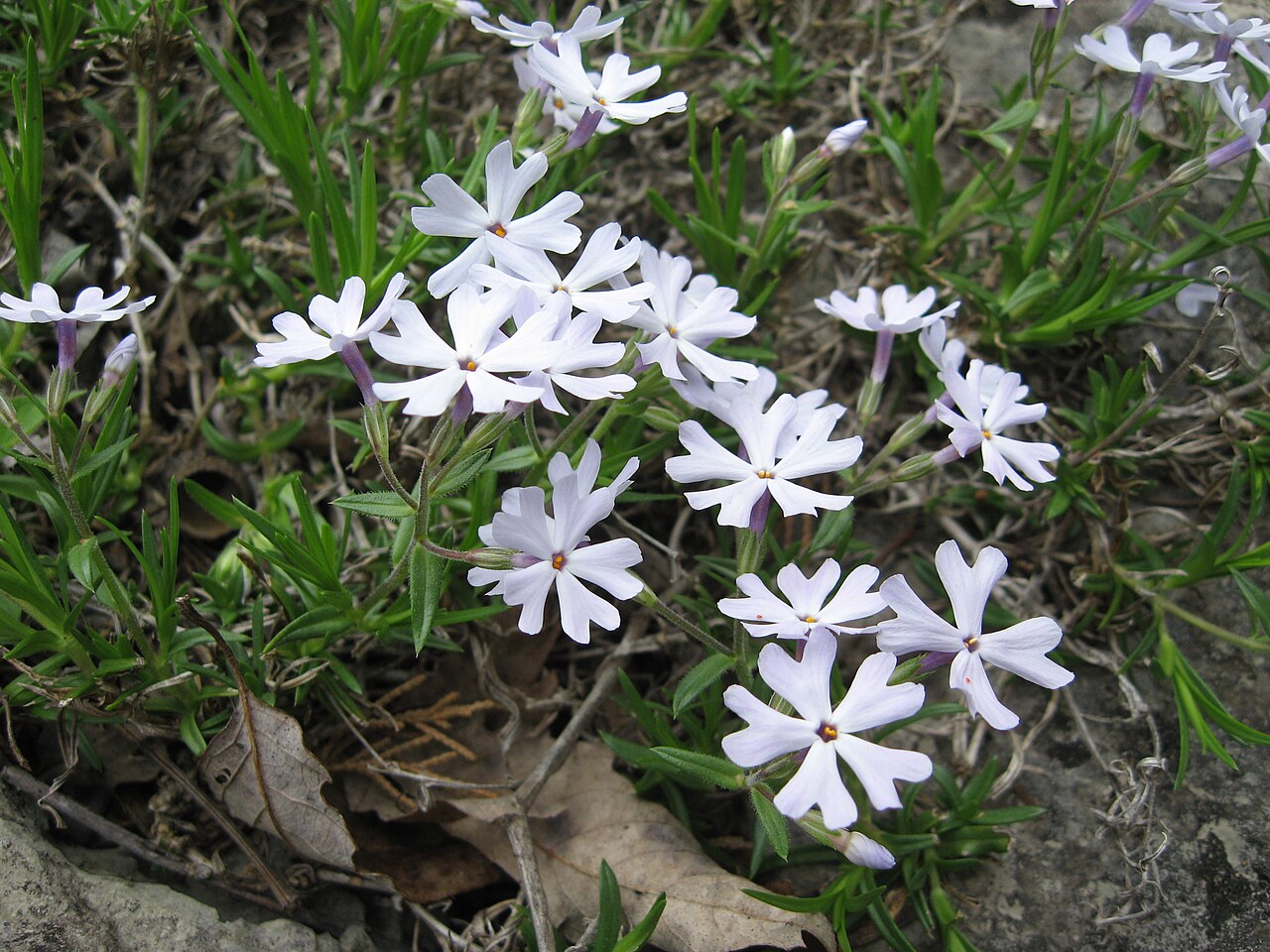
Phlox bifida, commonly called Sand Phlox or Cleft Phlox, is a low, mat-forming perennial of dry prairies, sandy open woods, and limestone glades across the central United States. It belongs to the phlox family, Polemoniaceae, and is easy to tell apart from other low phloxes by its flowers: each of the five petal lobes is split nearly to the middle by a narrow V-shaped notch, giving the flower a starry, almost pinwheel-like look rather than the rounded or faintly notched petals of Moss Phlox (Phlox subulata).
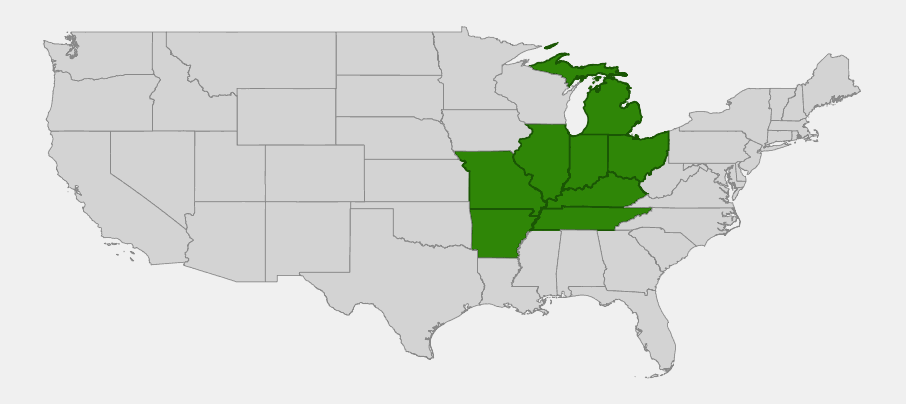
In the wild, Sand Phlox hugs the ground in dense, wiry tufts no more than 6 to 12 inches tall, built from short woody stems clothed in narrow, needle-like leaves. It roots into surprisingly lean, droughty sites — sand prairies, gravel hill prairies, eroded bluff tops, and bare limestone ledges — where taller, lusher plants cannot compete. Two recognized varieties divide its range: typical Sand Phlox grows on sandy ground from Michigan to Missouri and Arkansas, while the variety stellaria is restricted to limestone glades and cliff faces in Kentucky and Tennessee.
For gardeners, Sand Phlox is one of the best native choices for a hot, dry, sunny spot where little else will thrive — a gravel bed, a crevice garden, the top of a dry-laid wall, or the edge of a rock garden. It blooms early, in a flush of pale lavender to nearly white flowers in April and May, then holds its tidy evergreen-ish foliage mat through summer with almost no care.
Identification
Sand Phlox forms a low, spreading cushion or mat, usually 4 to 8 inches tall in flower and somewhat wider, built from short, wiry, often reclining stems that root where they touch the soil. Older plants develop a woody base (hence its classification as a subshrub rather than a true herbaceous perennial), with the current season’s growth staying soft and green above.
Leaves
Leaves are narrow, linear to awl-shaped, about 1 to 2 inches long and only a few millimeters wide, arranged in opposite pairs along the stem. They are stiff and somewhat needle-like, with a sharp point, and stay green through most of the growing season, giving the mat a fine, bristly texture even when not in bloom.
Flowers
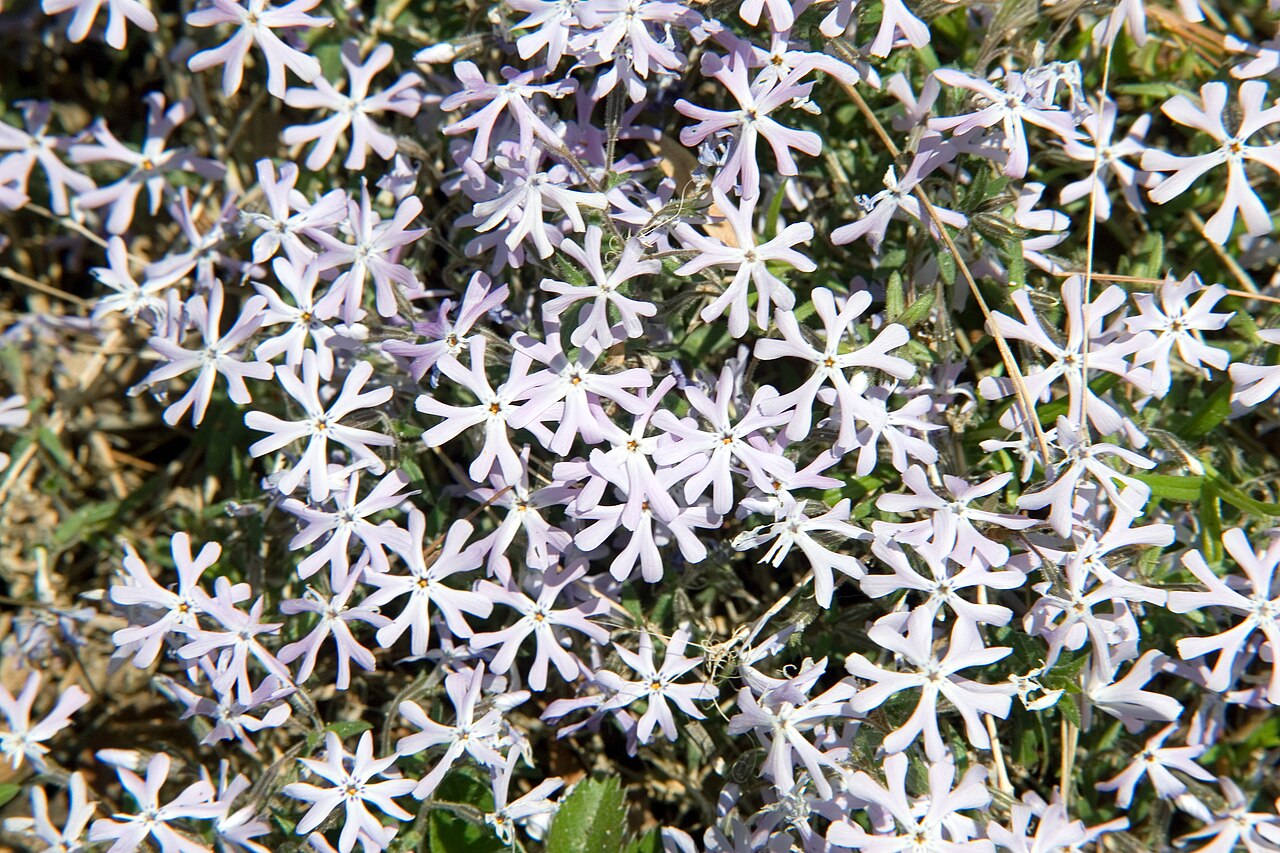
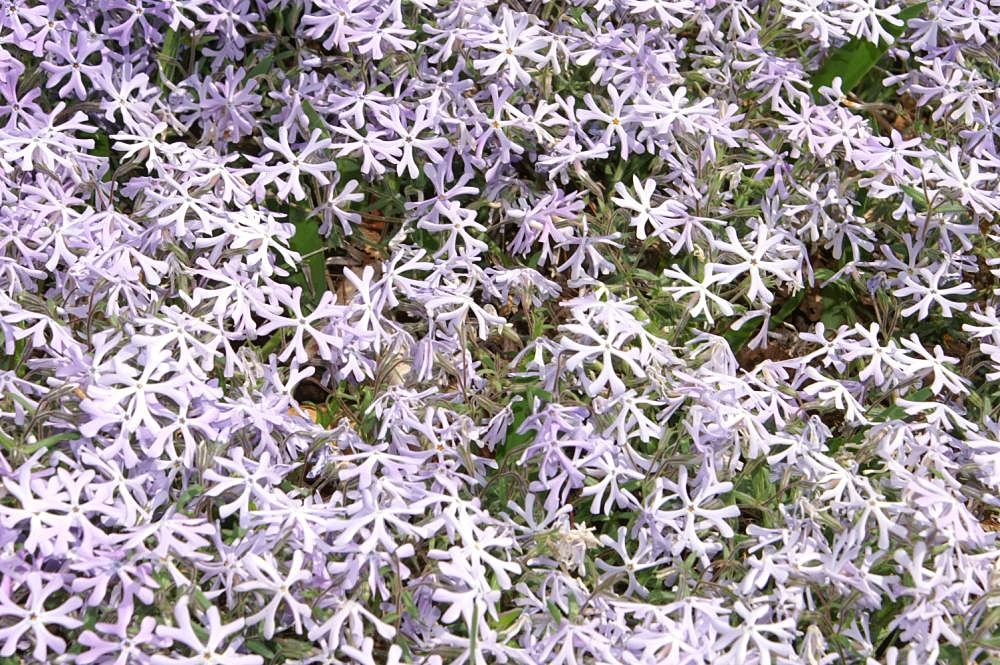
Flowers open in loose clusters of two to five at the stem tips from early to mid spring. Each flower is about ¾ to 1 inch across, with five petal lobes that flare out from a narrow corolla tube. The defining field mark is the deep notch at the tip of each lobe — cut roughly a third to half of the lobe’s length — which splits the petal into two narrow points. Color ranges from pale lavender-blue to nearly white, usually with a slightly darker throat. The effect of a well-grown mat in full bloom is a solid sheet of pale, starry flowers low to the ground.
Fruit & Seeds
After flowering, Sand Phlox sets small, dry, three-chambered capsules that split open at maturity to release a few seeds. The plant also spreads locally by stems that root as they creep along the ground, so an established patch slowly widens into a denser colony even without seedlings.
Quick Facts
| Scientific Name | Phlox bifida |
| Family | Polemoniaceae (Phlox) |
| Plant Type | Mat-forming perennial subshrub |
| Mature Height | 4–8 in |
| Mature Spread | 12–18 in, slowly widening |
| Growth Rate | Slow to moderate |
| Sun Exposure | Full Sun to Part Sun |
| Water Needs | Low; excellent drought tolerance once established |
| Soil Type | Sandy or rocky, sharply drained; tolerates limestone |
| Soil pH | Neutral to alkaline, tolerates acidic sand |
| Bloom Time | April – May |
| Flower Color | Pale lavender-blue to white |
| Fall Color | None notable; foliage stays green |
| Fruit | Small dry capsule, inconspicuous |
| Deer Resistant | Yes, generally avoided |
| USDA Hardiness Zones | 4–8 |
Native Range
Sand Phlox is native to the central United States, from southern Michigan and northern Illinois and Indiana south through Ohio to Missouri, Arkansas, Kentucky, and Tennessee. It is a plant of two distinct lean habitats: sandy or gravelly prairies and open sandy woods across the northern part of its range, and dry limestone glades, bluffs, and cliff ledges in the southern part, particularly in the Kentucky River Palisades region and similar cedar-glade country of Kentucky and Tennessee.
Across this range it is nowhere especially common and is considered rare or watch-listed in several states at the edges of its distribution, since the sand prairies and undisturbed glades it depends on have been reduced by development, fire suppression, and conversion to row-crop agriculture. Populations persist best where the underlying sand or rock keeps competing vegetation thin, such as sand dune remnants, hill prairies, and cliff tops too dry and shallow-soiled for trees to shade out.
Sand Phlox is sometimes grown as a garden perennial well outside this native range, including in parts of New England, where escaped or planted individuals have turned up along roadsides and forest edges; those occurrences are garden escapes, not part of the species’ native distribution.
📋 Regional plant lists featuring Sand Phlox: Illinois, Iowa & Missouri · Ohio & Indiana · Michigan, Wisconsin & Eastern Minnesota · Kentucky & Tennessee · Arkansas, Louisiana, Eastern Oklahoma & Eastern Texas
Growing & Care Guide
Sand Phlox is forgiving and low-maintenance once it has the one thing it truly demands: sharp drainage. Give it lean, gritty soil and full sun, and it needs almost nothing else.
Light
Full sun brings the heaviest bloom and keeps the mat tight and compact. Sand Phlox also tolerates light or part sun, especially in hotter climates, but plants grown in too much shade become loose and sparse and flower less.
Soil & Water
This is a plant for lean soil, not rich garden beds. Sandy, gravelly, or rocky soils with excellent drainage suit it best; heavy clay that stays wet, especially in winter, is the most common cause of failure. It tolerates both acidic sand and alkaline limestone soils, reflecting its two distinct habitat types in the wild. Water new plants through their first season to establish roots, then back off — established Sand Phlox is quite drought tolerant and resents soggy conditions far more than dry ones.
Planting Tips
Plant in spring or fall into a raised bed, gravel garden, rock garden, or the gritty soil at the top of a dry-laid wall. Amend heavy soil with coarse sand or fine gravel before planting rather than compost, which holds too much moisture. Space plants about 12 inches apart to allow the mat to fill in without excessive crowding. Sand Phlox resents being moved once established, so choose its permanent spot carefully.
Pruning & Maintenance
Little pruning is needed. Shearing the mat lightly after flowering can tidy its shape and occasionally encourages a light rebloom, but is optional. Remove dead stems in late winter if the planting looks ragged. Sand Phlox is not bothered by deer and has no serious pest or disease problems in a well-drained site; powdery mildew, common on taller garden phlox, is rarely an issue here because of the open, low growth habit and good air movement at ground level.
Propagation
The easiest method is division of an established clump in early spring or fall, since the trailing stems often have already rooted where they touch soil. Softwood cuttings taken in late spring root readily in sandy mix. Seed can be sown in fall for cold stratification over winter, but named selections and the straight regional ecotype are more reliably reproduced by division or cuttings.
Landscape Uses
Sand Phlox earns its keep in the toughest, driest corners of the garden:
- Rock gardens and crevice gardens, tucked between stones
- Gravel gardens and xeriscape plantings
- Dry-laid stone walls, trailing over the edge
- Front-of-border edging in sunny, well-drained beds
- Sand prairie or glade restoration plantings
- Container and trough gardens for alpine-style displays
Wildlife & Ecological Value
Though diminutive, Sand Phlox contributes real value to the early-season garden and to the lean prairie and glade communities it belongs to in the wild.
For Pollinators
The spring flowers are visited by a range of long-tongued insects able to reach nectar at the base of the narrow corolla tube, including butterflies, day-flying moths, and bee flies. Blooming as it does in early to mid spring, Sand Phlox provides nectar at a time when few other low-growing prairie or glade plants are yet in flower, making it valuable to early pollinators emerging from winter dormancy.
For Birds & Mammals
The dense, low mat offers minor cover for small insects and ground-level invertebrates that in turn support insect-eating birds, but Sand Phlox is not a significant food source for birds or mammals. Rabbits and deer generally leave it alone.
Ecosystem Role
In its native sand prairies and limestone glades, Sand Phlox is one of the low, mat-forming plants that stabilize thin, erosion-prone soil on slopes and bluff tops, helping hold sand and loose rock in place between the roots of bunchgrasses. Because it tolerates conditions too harsh for many other plants, it fills a niche in these open, sun-baked communities that would otherwise be bare ground.
Cultural & Historical Uses
Sand Phlox has no significant documented history of use by Indigenous peoples or early settlers as food or medicine; its small size and lack of notable chemical or nutritional properties kept it out of the ethnobotanical record that taller, more abundant prairie plants entered.
Its history is instead a horticultural one. Nineteenth- and twentieth-century rock garden and alpine plant enthusiasts prized Sand Phlox for the same qualities that make it useful today — its tolerance of lean, dry sites and its early, abundant bloom — and it appeared regularly in specialty nursery catalogs devoted to rock garden and alpine plants through the early twentieth century, alongside other low phloxes and sedums suited to the same conditions.
Today it remains mostly a plant for specialist gardeners: rock gardeners, prairie restorationists, and native-plant enthusiasts looking for a tough, early-blooming groundcover for difficult dry sites, rather than a mainstream nursery staple.
Frequently Asked Questions
What is the difference between Sand Phlox and Moss Phlox?
The easiest way to tell them apart is the petal tip. Sand Phlox has a deep notch cut well into each petal lobe, giving the flower a forked, starry look, while Moss Phlox (Phlox subulata) has petals that are rounded or only shallowly notched at the tip. Sand Phlox also tends to form a looser, more open mat than the denser moss-like cushions of Moss Phlox.
Does Sand Phlox need rich soil?
No — rich, moisture-retentive soil is the opposite of what this plant wants. Sand Phlox is adapted to lean, sharply drained sand or rocky soil and tends to decline, rot, or become floppy in fertile garden beds that stay damp. Lean and dry suits it far better than rich and moist.
Will Sand Phlox spread aggressively in the garden?
No. It spreads slowly by trailing stems that root where they touch soil, gradually widening a clump over several years, but it is not an aggressive spreader and will not overrun neighboring plants the way some groundcovers do.
Is Sand Phlox deer resistant?
Generally yes. Its narrow, somewhat bristly foliage is not a preferred browse for deer or rabbits, which makes it a reasonably safe choice in areas with heavy deer pressure, though no plant is completely deer-proof when food is scarce.
How is Sand Phlox different from Phlox bifida ssp. stellaria?
Phlox bifida ssp. stellaria is the limestone-glade variety found in Kentucky and Tennessee, distinguished by subtle differences in flower and hair characters from the sandier-soil typical variety found farther north and west. Both are part of the same species and are treated together here, since their garden needs — full sun and sharp drainage — are identical.

Looking for a nursery that carries Sand Phlox?
Browse our native plant nursery directory: Illinois & Indiana · Michigan, Missouri & Kentucky · Ohio · Arkansas · Tennessee