Beaked Yucca (Yucca rostrata)
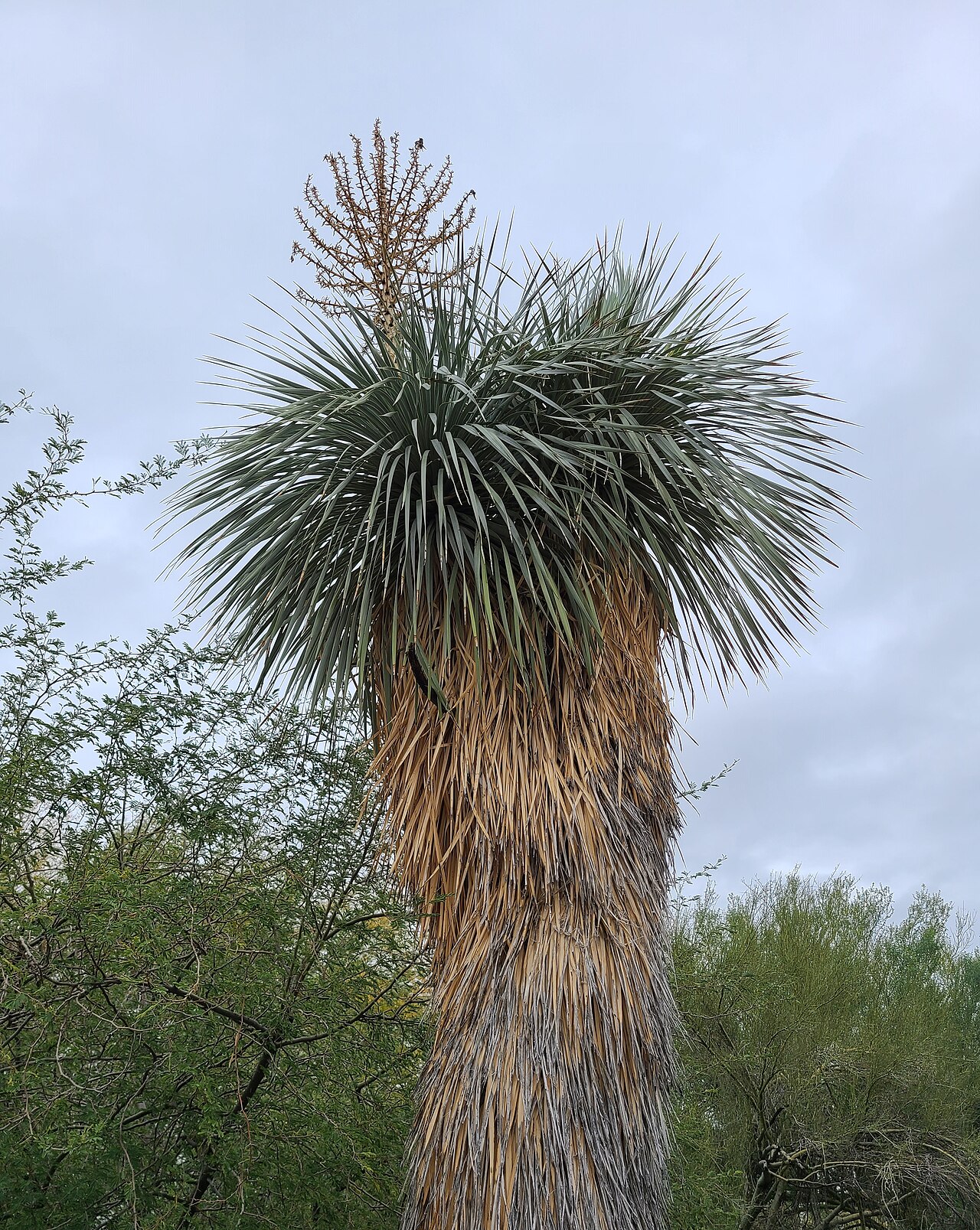
Yucca rostrata, the Beaked Yucca, is a slow-growing, tree-forming yucca prized for one of the most striking silhouettes in the genus: a tight, symmetrical globe of narrow, powder-blue leaves balanced atop a single straight trunk. In the wild it is a true regional specialist, found nowhere in the United States outside the Big Bend region of far West Texas, with the remainder of its range across the state line in the adjoining Chihuahuan Desert of Coahuila and Chihuahua, Mexico.
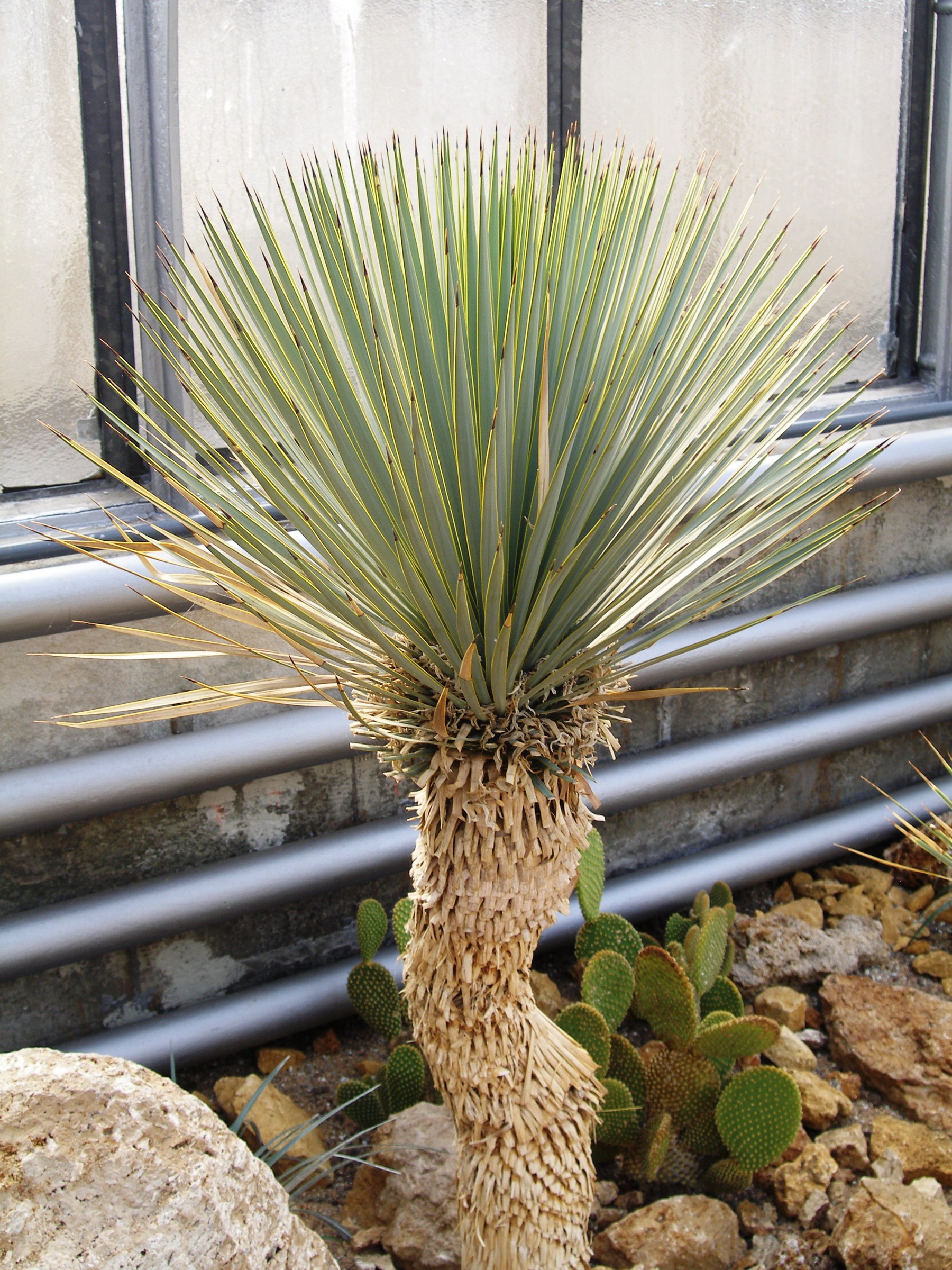
Where many yuccas sprawl or branch loosely, beaked yucca grows with real architectural discipline. Old leaves bend downward against the trunk as the plant ages, building up a dense, fibrous “skirt” or thatch that can be left in place for a wild, shaggy look or trimmed away to reveal a smooth, pale trunk — a choice that has made the species a favorite of desert landscape designers far beyond its native range.
Because its true native range is so limited — essentially the rocky slopes of the Big Bend country — beaked yucca is a genuine Texas native only in that corner of the state, even though it has become one of the most widely planted ornamental yuccas in arid and semi-arid gardens from Phoenix to the Mediterranean. Texas and New Mexico gardeners living within or near its native range get the added satisfaction of growing a true regional native; gardeners elsewhere are simply growing a tough, beautiful, drought-adapted exotic.
Identification
Beaked yucca develops as a single, unbranched or sparsely branched trunk topped by a dense, rounded crown of leaves. Mature plants in habitat and in cultivation can reach 10 to 15 feet tall, occasionally more, after many decades of slow growth.
Trunk
The trunk is slender for a tree yucca, usually 6 to 10 inches in diameter, and grows essentially straight with little taper. As lower leaves die, they fold down and persist along the trunk, building a thick, fibrous, light tan “petticoat” of dead leaf material. Growers either leave this thatch in place for a rustic look or trim it off, which reveals an attractive pale gray, finely checkered bark beneath.
Leaves
Leaves are thin, stiff and strap-like, up to about 24 inches long but rarely more than half an inch wide, tapering to a sharp point. Their most distinctive feature is color: a cool, silvery blue-gray to powder blue, finer and more uniformly colored than most other tree yuccas, which gives the whole crown a glaucous, almost metallic sheen. Leaf margins are smooth to finely toothed, without the coarse curling threads seen on some other yuccas.
Flowers
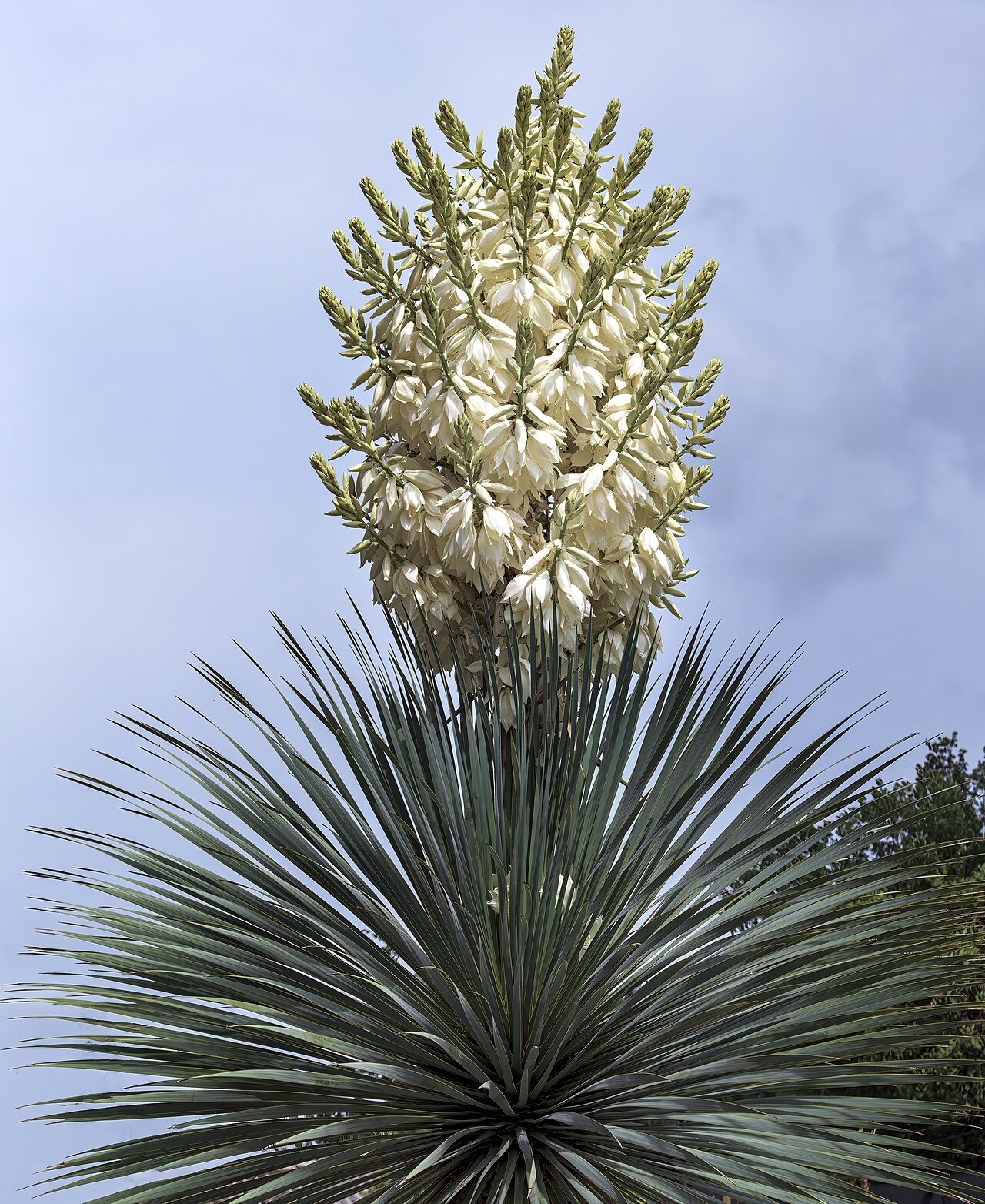
In late spring a tall, upright flower panicle rises 2 to 4 feet above the leaf crown, densely packed with white to cream, bell-shaped flowers, each about 2 inches across. The panicle is held well clear of the leaves on a stout stalk, making it one of the more conspicuous tree-yucca bloom displays.
Fruit & Seeds
Pollinated flowers mature into dry, upright, six-chambered capsules that split open to release flat black seeds. Spent flower stalks often persist on the plant for a season afterward, drying to a tan color above the blue-green crown.
Quick Facts
| Scientific Name | Yucca rostrata |
| Family | Asparagaceae (formerly Agavaceae) |
| Plant Type | Evergreen, single-trunked tree yucca |
| Mature Height | 10–15 ft (occasionally taller with age) |
| Mature Spread | 3–5 ft crown width |
| Growth Rate | Very slow (a few inches per year) |
| Sun Exposure | Full Sun |
| Water Needs | Low; excellent drought tolerance once established |
| Soil Type | Rocky or gravelly, limestone-influenced; sharply drained |
| Soil pH | Neutral to alkaline |
| Bloom Time | May – June |
| Flower Color | White to cream |
| Fall Color | None (evergreen) |
| Fruit | Dry, upright six-chambered seed capsule |
| Deer Resistant | Yes |
| USDA Hardiness Zones | 5–10 |
Native Range
In the United States, beaked yucca is native only to the Big Bend region of far West Texas — the rugged Trans-Pecos country along and near the Rio Grande, including the mountains and desert grasslands in and around Big Bend National Park. It does not occur natively anywhere else in Texas or in any other U.S. state; the many beaked yuccas planted in landscapes from Austin to Phoenix to the Carolinas are cultivated specimens well outside the species’ wild range.
South of the border, the species continues across a larger range through the states of Coahuila and Chihuahua, Mexico, where it grows in the same kind of rocky Chihuahuan Desert habitat found on the Texas side of the Big Bend. Across this range it favors steep, rocky limestone slopes, bajadas and desert grassland at moderate elevation, typically in arid (desert, “Bw”) to semi-arid (steppe, “Bs”) climates with hot summers, cold winter nights and very little annual rainfall.
Because it tolerates cold better than many desert yuccas — reliably down to USDA zone 5 — beaked yucca has become an extremely popular low-water ornamental well outside the Big Bend, grown as far afield as Denver, Salt Lake City and coastal gardens in the Mid-Atlantic, as well as in Mediterranean climates in Europe and Australia. All of that popularity is in cultivation; outside the Big Bend, the species is not a native plant and should be understood as a drought-tolerant exotic in the landscape rather than a regional native.
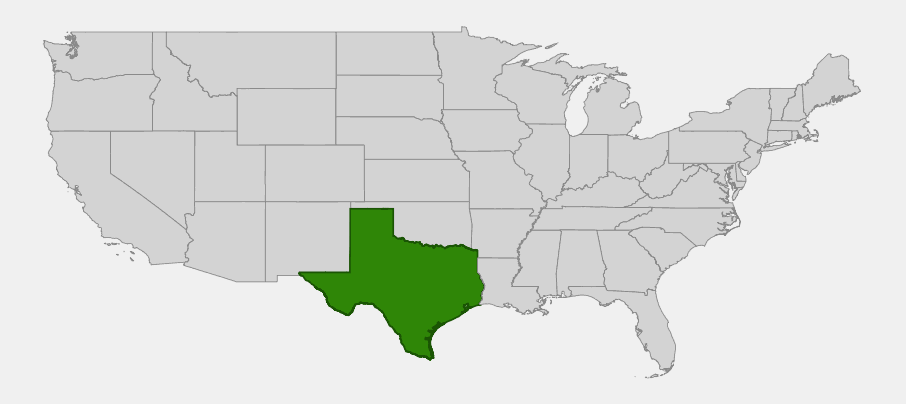
📋 Regional plant lists featuring Beaked Yucca: none — its U.S. native range is too narrow (Big Bend, Texas only) to fall within any of our multi-state regional lists.
Growing & Care Guide
Beaked yucca rewards patience with one of the most sculptural forms in the dryland garden. It asks for little beyond sun and drainage, but its very slow growth means the dramatic trunked specimens sold at nurseries represent many years of careful cultivation.
Light
Plant in full sun. This is an open desert-slope species adapted to intense light and heat, and it will etiolate, lean and flower poorly in shade. Reflected heat from walls, rock mulch or paving is tolerated well and can even improve winter cold hardiness by keeping the crown slightly warmer.
Soil & Water
Sharp drainage is essential; this is a desert-slope plant that rots quickly in heavy, wet, or poorly drained soil, especially in winter. Rocky, gravelly or sandy soils with a neutral to alkaline pH suit it best, and it is notably tolerant of limestone-derived soils. Water occasionally to establish a young plant, then let it dry thoroughly between waterings; established specimens need little or no supplemental irrigation outside of prolonged drought in hot climates.
Planting Tips
Plant container-grown specimens in spring, setting the crown slightly above grade on a slope or raised bed so water drains away rather than pooling at the base. Because beaked yucca is such a slow grower, buying the largest specimen your budget allows is a common strategy for gardeners who want trunk height sooner rather than decades later. Give it room away from walkways; mature leaf tips are sharp enough to injure passersby.
Pruning & Maintenance
Maintenance is mostly a matter of style rather than necessity. Leave the dead leaf thatch in place for a natural, shaggy look, or trim it off with sharp shears to expose the smooth trunk beneath — both are common and purely aesthetic choices. Remove the spent flower stalk after bloom if desired. The species has few pest or disease issues when grown in well-drained soil and needs no regular fertilizing.
Propagation
Beaked yucca is propagated almost entirely from seed, sown in a gritty, well-drained mix; germination is generally reliable but growth afterward is very slow, with seedlings taking years to develop a visible trunk. Because of this slow pace, named cultivars and larger specimens are typically nursery-grown over many years rather than quickly propagated from cuttings or divisions, which this species does not readily produce.
Landscape Uses
- Architectural specimen plant, used singly as a focal point in xeriscapes and courtyards
- Desert and rock gardens alongside agave, sotol and other Chihuahuan Desert natives
- Low-water landscaping in hot, dry climates well beyond its native range, thanks to strong cold hardiness
- Container and large-pot culture for patios, in climates mild enough to overwinter outdoors
- Big Bend native-plant gardens, where it is one of the signature species of the region’s rocky slopes
Wildlife & Ecological Value
Within its native Big Bend habitat, beaked yucca is a long-lived structural element of the Chihuahuan Desert plant community, providing food and shelter resources shared broadly among the region’s desert wildlife.
For Pollinators
Like other yuccas, beaked yucca depends on a specialized, obligate relationship with small yucca moths, which pollinate the flowers while laying their eggs in the developing ovary; moth larvae then consume a portion of the seeds. This tight partnership means a healthy local moth population is essential for the plant to set seed.
For Birds
The tall flower stalks attract nectar-feeding insects that in turn draw insect-eating birds, while the dense, spiny leaf crown offers secure nesting and roosting cover for small desert birds safe from most ground predators.
For Mammals
Javelina, deer and other desert mammals generally avoid browsing the stiff, sharp-tipped leaves, which is part of why the species is reliably deer resistant in gardens; this toughness is an adaptation to a harsh desert environment with significant browsing pressure on softer plants.
Ecosystem Role
As a long-lived, slow-growing perennial on rocky desert slopes, beaked yucca adds vertical structure and permanent cover in a landscape where many other plants are seasonal or low-growing, and its root system helps stabilize thin, rocky soils on steep terrain.
Cultural & Historical Uses
Yuccas across the Chihuahuan Desert held significant traditional importance for Indigenous peoples of the Big Bend region and northern Mexico, and tree-forming species like beaked yucca were valued for their tough, fibrous leaves, which were processed into cordage, coarse basketry and sandals. Roots of yuccas in this region, rich in natural saponins, were traditionally pounded in water to produce a sudsy liquid used for washing hair and cloth.
These are documented historical and ethnobotanical uses of yuccas in the Chihuahuan Desert region rather than a guide for modern use; the saponins that made yucca roots valuable as soap are not intended for consumption. Flowers and flower stalks of various native yuccas were sometimes gathered as a seasonal food after cooking by some regional groups, but this is a matter of historical record, not a present-day recommendation, and foraging for food should rely on current expert guidance rather than general yucca lore.
In the twentieth and twenty-first centuries, beaked yucca’s story has become primarily horticultural. Its slow growth, cold hardiness and striking blue-gray, globe-shaped crown made it a sought-after specimen plant well beyond the Chihuahuan Desert, and it is now a fixture of dryland landscaping from the American Southwest to Mediterranean Europe. Because mature, trunked specimens take many years to grow, always buy nursery-propagated plants from a reputable grower rather than wild-collected material; collecting from the wild damages the species’ already narrow native population in the Big Bend and is never appropriate.
Frequently Asked Questions
Is beaked yucca native to all of Texas?
No. In the United States it is native only to the Big Bend region of far West Texas. Beaked yuccas grown elsewhere in Texas, or anywhere else in the country, are cultivated ornamentals outside their natural range, not regional natives.
How cold-hardy is beaked yucca?
It is one of the hardiest trunk-forming yuccas, reliably surviving outdoors to USDA zone 5 and tolerating brief dips into the single digits Fahrenheit once established, which explains its popularity in gardens far north and east of its native desert range.
How fast does beaked yucca grow, and how tall does it get?
Growth is very slow, often just a few inches of trunk per year, which is why large, well-trunked specimens command high prices at nurseries. Given enough time, plants can reach 10 to 15 feet tall, occasionally more in ideal conditions.
Should I leave the dead leaves on the trunk or trim them off?
Either is fine and purely a matter of personal taste. Left alone, the dead leaves build up into a thick, shaggy thatch that many gardeners find attractive and that also adds some insulation to the trunk. Trimmed away, the smooth, pale, checkered bark beneath becomes a feature in its own right.
Is beaked yucca safe around pets and children?
The leaf tips are rigid and sharp enough to cause serious puncture injuries, so site it well away from paths, play areas and low traffic zones. As with other yuccas, plant parts contain saponins that can cause mild gastrointestinal upset if chewed or ingested in quantity, and the species is not used as a food plant in home landscapes.

Looking for a nursery that carries Beaked Yucca?
Browse our native plant nursery directory: Texas