New Mexico Yucca (Yucca harrimaniae var. neomexicana)
Yucca harrimaniae var. neomexicana, commonly called the New Mexico Yucca or New Mexico Spanish Bayonet, is a small, exceptionally cold-hardy yucca restricted to a narrow band of mesa and escarpment country where the high plains meet the southern Rocky Mountains. Botanists have long debated its standing: it was first described as its own species, Yucca neomexicana, and many wildflower guides and nurseries still sell it under that name, but the currently accepted treatment in the USDA PLANTS database and Flora of North America places it as a variety of the more widespread Yucca harrimaniae (Harriman’s yucca). The two are easy to tell apart by range and leaf width far more than by any single dramatic feature.
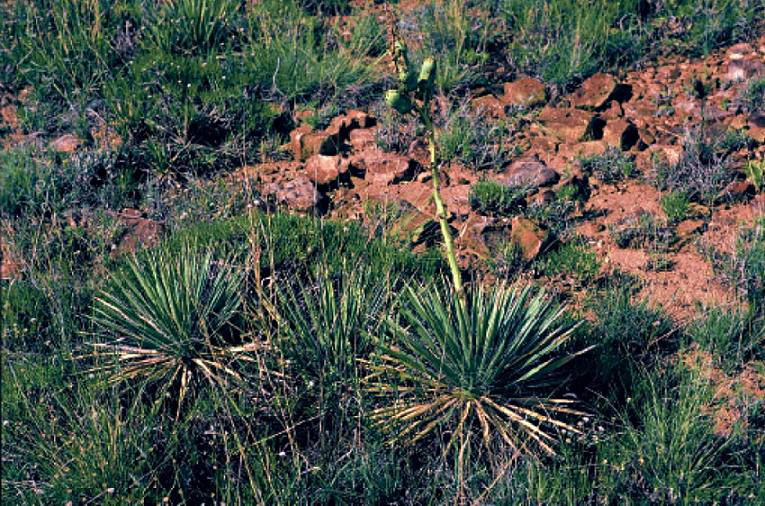
Unlike the tree-forming yuccas of the Southwest, this is a low, rosette-forming plant that rarely tops two feet in foliage, sending up a single flower stalk strung with nodding, cream-to-greenish bells heavily brushed with maroon or plum on the outside. It grows almost stemless or with only a very short, often buried stem, clustering slowly into small clumps on rocky outcrops where little else will take hold.
Because its known range is so small — a handful of counties where Colorado, New Mexico and the Oklahoma panhandle come together — New Mexico yucca is a genuine regional specialty rather than a plant you will find offered everywhere. It is an excellent choice for a xeric rock garden or gravel bed in its home region, prized for its tidy size, striking flowers and complete indifference to drought, wind and hard winters.
Identification
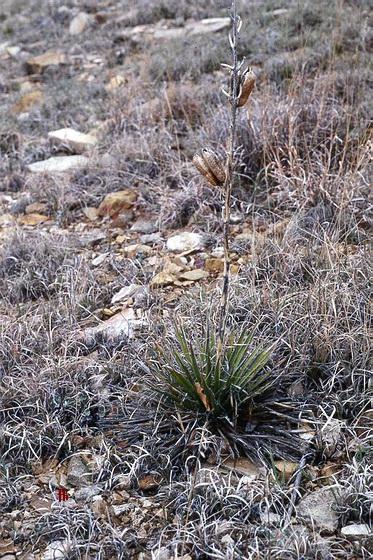
New Mexico yucca is a small, often solitary or loosely clustering rosette plant, usually acaulescent (stemless) or with a short stem largely hidden in the duff and soil at the base of the leaves. Established clumps may slowly produce a few offsets, but the plant never develops the tall woody trunk seen in tree yuccas.
Leaves
Leaves are stiff, narrow and sharply pointed, typically 8 to 18 inches long but only about ½ to 1 inch wide — noticeably narrower than the leaves of typical Harriman’s yucca further west. They are pale to blue-green, straight or slightly twisted, with yellowish, curling fibers (“threads”) peeling from the margins, a classic yucca trait. Each leaf ends in a stout, dangerously sharp spine.
Flowers
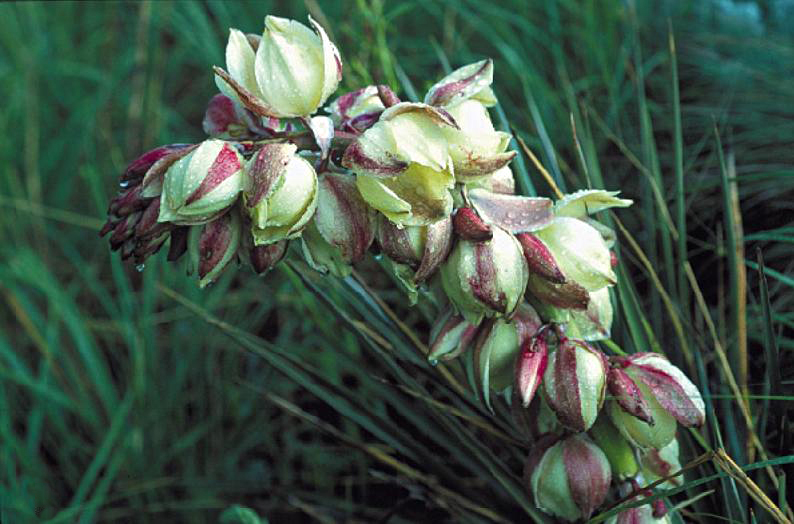
In late spring to early summer a single flower stalk rises 1½ to 5 feet above the rosette, carrying a loose, elongated raceme of nodding, bell-shaped flowers 1½ to 2 inches long. The petals are cream to pale greenish-white on the inside and heavily streaked or flushed with maroon, wine-red or purple-brown on the outside and at the base, giving the flower spike a two-toned, almost candy-striped look that is one of the best field marks for the variety.
Fruit & Seeds
Pollinated flowers develop into dry, upright, three-chambered seed capsules that split open at maturity to release flat, black seeds. The old flower stalks, capsules and papery bracts often persist through winter, standing dry and tan above the evergreen rosette.
Quick Facts
| Scientific Name | Yucca harrimaniae var. neomexicana (syn. Yucca neomexicana) |
| Family | Asparagaceae (formerly Agavaceae) |
| Plant Type | Evergreen, stemless to short-stemmed rosette perennial |
| Mature Height | Rosette 1–2 ft; flower stalk to 5 ft |
| Mature Spread | 1–3 ft, slowly clumping |
| Growth Rate | Slow |
| Sun Exposure | Full Sun |
| Water Needs | Low; excellent drought tolerance once established |
| Soil Type | Rocky, sandy or gravelly; sharply drained |
| Soil pH | Neutral to alkaline |
| Bloom Time | Late May – June |
| Flower Color | Cream to greenish-white, heavily streaked maroon |
| Fall Color | None (evergreen) |
| Fruit | Dry, upright three-chambered seed capsule |
| Deer Resistant | Yes |
| USDA Hardiness Zones | 4–8 |
Native Range
New Mexico yucca occupies one of the smallest ranges of any North American yucca: a cluster of counties where southeastern Colorado, the Oklahoma panhandle and northeastern New Mexico meet. Botanist David J. Ferguson, who has studied the plant closely, documents it from southwestern Baca and Las Animas counties in Colorado, the western tip of Cimarron County, Oklahoma, and Colfax and Union counties in New Mexico, with unconfirmed reports from a few neighboring counties. It is entirely a plant of the high plains and lava-capped mesa country near the Colorado state line, and is not found approaching the foothills of the nearby Sangre de Cristo Mountains.
Across this small range the plant is a specialist of exposed rock. It grows on escarpments, mesa rims and rocky outcrops, favoring dense, laminated sandstone and also tolerating basalt and other hard rock types. Elevations run roughly from 4,500 to 6,500 feet, in a semi-arid shortgrass prairie and juniper-breaks landscape with cold winters, hot summers and modest rainfall concentrated in late spring and summer thunderstorms.
Because the range is so narrow and tied to specific rock outcrops, New Mexico yucca should be considered a true regional native rather than planted outside its home area. Gardeners elsewhere in the Southwest who want a similar small rosette yucca are better served by Harriman’s yucca or other locally native species; New Mexico yucca is best reserved for gardens in or very near its own counties, where it reinforces the authentic local flora rather than blurring it.
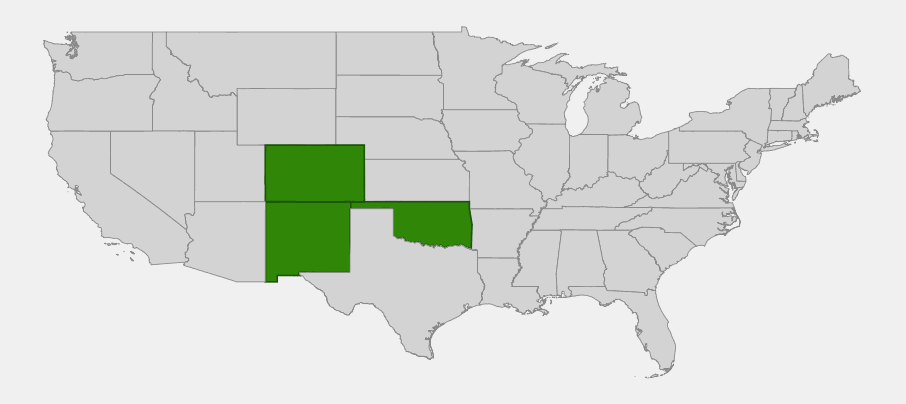
📋 Regional plant lists featuring New Mexico Yucca: Arizona & New Mexico · Nebraska, Kansas & Eastern Colorado
Growing & Care Guide
New Mexico yucca is tailor-made for a tough, sunny, well-drained spot where fussier plants struggle. Once its deep taproot is established, it asks for almost nothing and shrugs off the drought, wind and hard freezes typical of the high plains.
Light
Give it full sun. This is an open-plains plant adapted to intense summer sun and reflected heat off bare rock; it will stretch and flower poorly in shade and is prone to rot where overhung by trees or shrubs that hold moisture against the crown.
Soil & Water
Sharp drainage is the single most important requirement. Plant in rocky, sandy or gravelly soil, ideally amended with coarse grit if your native soil holds much clay. Water regularly the first year to establish the root system, then taper off; mature plants need no supplemental irrigation outside of extended drought and are easily killed by soggy soil, especially in winter. A neutral to alkaline pH suits it best.
Planting Tips
Set out container-grown plants in spring or fall, siting them where the crown sits slightly proud of grade so water sheds away from the base. Raised beds, berms and rock gardens all work well. Keep mulch away from direct contact with the leaf base, and allow 2 to 3 feet between plants so the leaf tips have room — they are sharp enough to catch skin and clothing.
Pruning & Maintenance
Little maintenance is needed beyond removing the spent flower stalk after seed drop if you prefer a tidier look, and trimming any leaves damaged by hail or frost. Wear thick gloves; the leaf tips are stiff enough to puncture skin. The plant has no significant pest or disease problems in a well-drained site.
Propagation
Propagate from ripe seed collected from dry capsules in late summer, sown shallowly in gritty mix; germination can be slow and uneven. Established clumps occasionally produce small offsets at the base that can be carefully separated with a sharp spade once they have their own roots, though seed-grown plants generally transplant with less setback.
Landscape Uses
- Xeric rock gardens and gravel beds, where its small scale fits tight spaces
- Front-of-border accent among other high-plains natives such as blue grama and winterfat
- Erosion control on dry, rocky slopes within its native counties
- Waterwise xeriscaping for gardeners who want a true regional native rather than a generic desert look
- Container culture in a gritty cactus mix, useful for gardeners outside its narrow native range who still want to display the plant responsibly
Wildlife & Ecological Value
Though small in stature, New Mexico yucca supports a tight web of specialized relationships typical of the genus, and its evergreen rosettes provide year-round structure on otherwise bare rock outcrops.
For Pollinators
Like all yuccas, this plant depends on a classic obligate partnership with small, white yucca moths in the genus Tegeticula. Female moths deliberately pack pollen onto the stigma while laying eggs inside the flower ovary, and in return their larvae feed on a portion of the developing seeds. Neither the yucca nor its moth can reproduce without the other, making every flowering stalk part of a tiny, self-contained ecosystem.
For Birds
The stiff, spine-tipped rosettes offer secure nesting and perching cover for ground-nesting and shrub-nesting birds of the shortgrass prairie, including various sparrows, that benefit from the physical protection the sharp leaves provide against predators.
For Mammals
Pronghorn, mule deer and small mammals generally avoid browsing the tough, fibrous leaves, which is part of why the plant is so reliably deer resistant in gardens. Rodents and other small animals sometimes shelter among the dense rosettes, and some desert wildlife feed on the capsules and seeds once they mature.
Ecosystem Role
As one of the few evergreen, structurally rigid plants on exposed sandstone and basalt outcrops, New Mexico yucca helps stabilize thin soils on rock rims and contributes year-round cover in a landscape otherwise dominated by seasonal grasses and low shrubs.
Cultural & Historical Uses
Yuccas across the Southwest held deep practical importance for Indigenous peoples of the region, and species in the Yucca harrimaniae group were no exception within their local range. The tough, fibrous leaves were historically processed into cordage, netting and coarse basketry, while the roots — rich in natural saponins — were pounded and used to make a sudsy soap or shampoo, a widespread use among yucca species across the Great Plains and Southwest.
Flower buds and the young, unopened flower stalks of various native yuccas were traditionally gathered as a seasonal food by some Southwestern tribes, typically boiled to reduce bitterness, while the fibrous leaves also had use in weaving mats and sandals. These are historical, documented uses of yuccas in the region rather than a recommendation for modern foraging; the saponins that make yucca root useful as soap are mildly irritating and not something to consume without specific traditional knowledge.
Today the plant’s story is mostly horticultural. Because it was long sold and described under the name Yucca neomexicana, rock-garden and native-plant enthusiasts in Colorado, New Mexico and the southern Rockies still often ask for it by that name, even as botanical treatments have folded it into Yucca harrimaniae as a variety. Specialist nurseries in the region continue to offer nursery-propagated plants, which is the only responsible way to acquire one — the species’ entire known range covers only a few counties, and digging wild plants is never appropriate.
Frequently Asked Questions
Is New Mexico yucca the same plant as Yucca neomexicana?
Yes. Yucca neomexicana was the original name given to this plant, and many growers and older references still use it. Current botanical treatment classifies it as Yucca harrimaniae var. neomexicana, a variety of the more widespread Harriman’s yucca, distinguished mainly by its narrower leaves and its separate range on the high plains near the Colorado-New Mexico-Oklahoma corner.
How big does New Mexico yucca get?
The evergreen rosette itself usually stays under 2 feet tall and wide. Only the flower stalk, which appears for a few weeks in late spring, rises taller — typically 2 to 5 feet — before drying and persisting through the following winter.
Can I grow New Mexico yucca outside its native range?
It can succeed in any climate with full sun, sharp drainage and cold-hardy conditions similar to its home range, and specialist growers do cultivate it well beyond its native counties. For wild-collected authenticity and habitat value, though, it is best treated as a true native only within or very near Baca, Las Animas, Cimarron, Colfax and Union counties; gardeners elsewhere get the same effect from a locally native yucca.
Is New Mexico yucca safe to have around pets and children?
The leaf tips are stiff and sharp enough to cause painful puncture wounds, so site it away from play areas and foot traffic. Like other yuccas, the plant contains saponins that can cause mild gastrointestinal upset if parts are chewed or eaten in quantity; it is not managed as a food plant in home landscapes.
Why do the flowers look two-toned?
The nodding, bell-shaped flowers are pale cream to greenish-white on the inner surface but heavily streaked and flushed with maroon or wine-red on the outside and at the base of each petal. This striking two-toned pattern is one of the easiest ways to recognize the variety in bloom, especially compared with the more uniformly pale flowers typical of nominate Harriman’s yucca farther west.

Looking for a nursery that carries New Mexico Yucca?
Browse our native plant nursery directory: Colorado · New Mexico & Oklahoma