Purple Prickly Pear (Opuntia macrocentra)
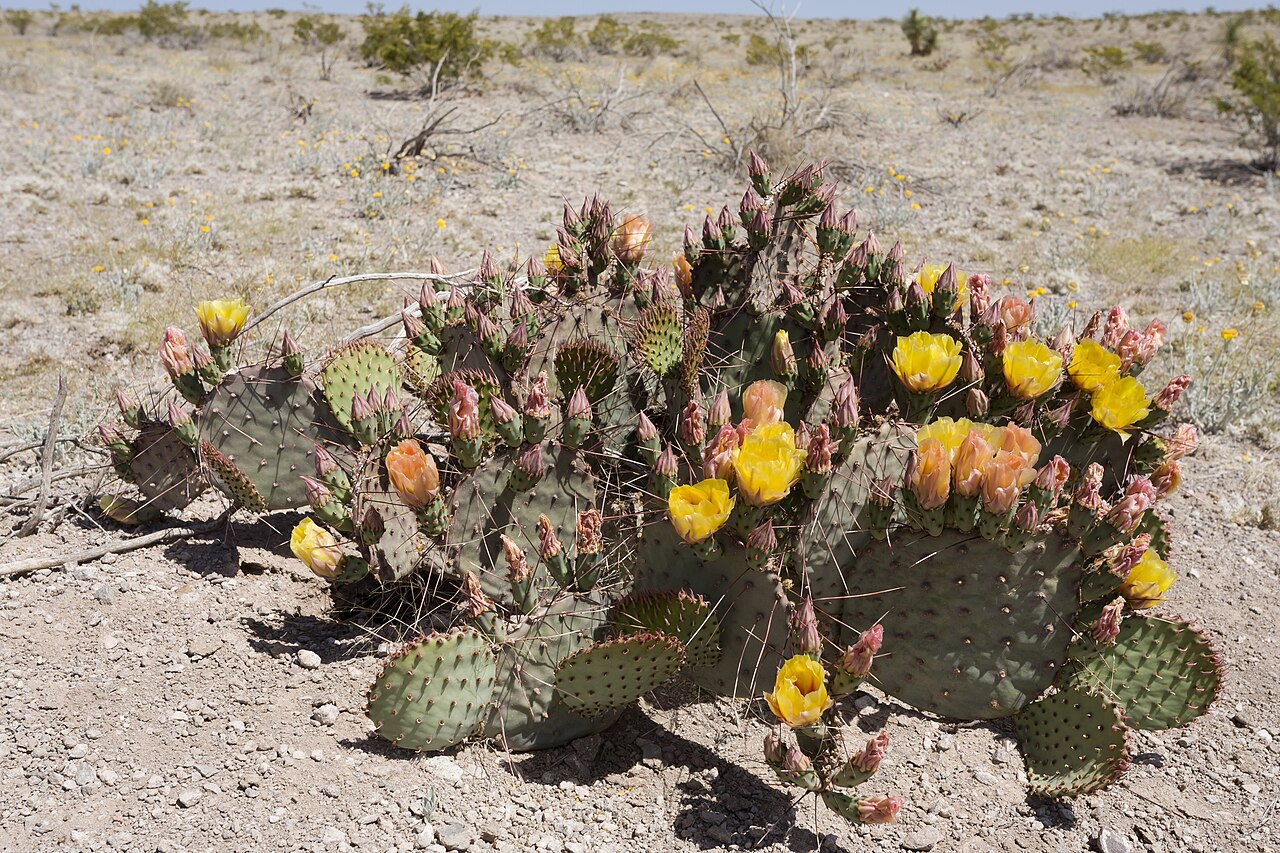
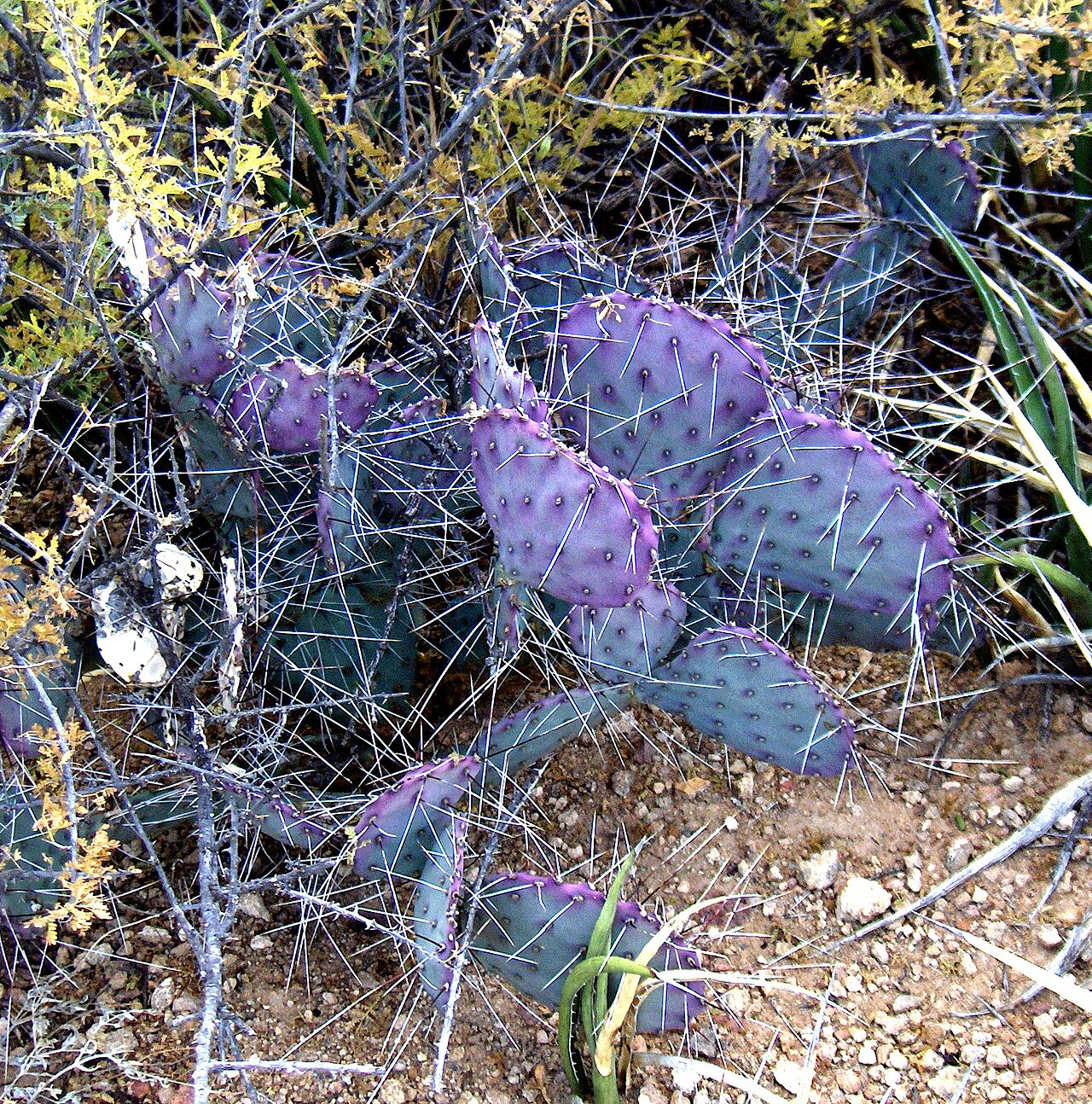
Opuntia macrocentra, commonly known as Purple Prickly Pear or black-spined prickly pear, is one of the most visually dramatic native cacti of the Chihuahuan Desert. Its blue-green pads flush a deep violet-purple under the stress of cold, drought, or intense sun, and contrast sharply with long, striking black to dark red-brown spines concentrated along the upper pad edges.
This low, sprawling cactus forms spreading clumps or mats, often just a foot or two tall but several feet across, in the rocky flats, bajadas, and limestone hillsides of the Trans-Pecos, southern New Mexico, and southeastern Arizona. In late spring it produces bright yellow to apricot flowers, frequently with a reddish-orange throat, that stand out beautifully against the purple pads.
Purple Prickly Pear is extremely drought tolerant and is prized in native and xeriscape gardens throughout its range for its year-round color — the purple pad tone intensifies in winter and during dry spells, giving the plant ornamental interest even when not in bloom.
Identification
Purple Prickly Pear grows as a low, sprawling to mounding shrub, typically 1 to 2 feet tall but spreading 3 to 6 feet or more as pads root along the ground, forming loose mats or thickets.
Pads
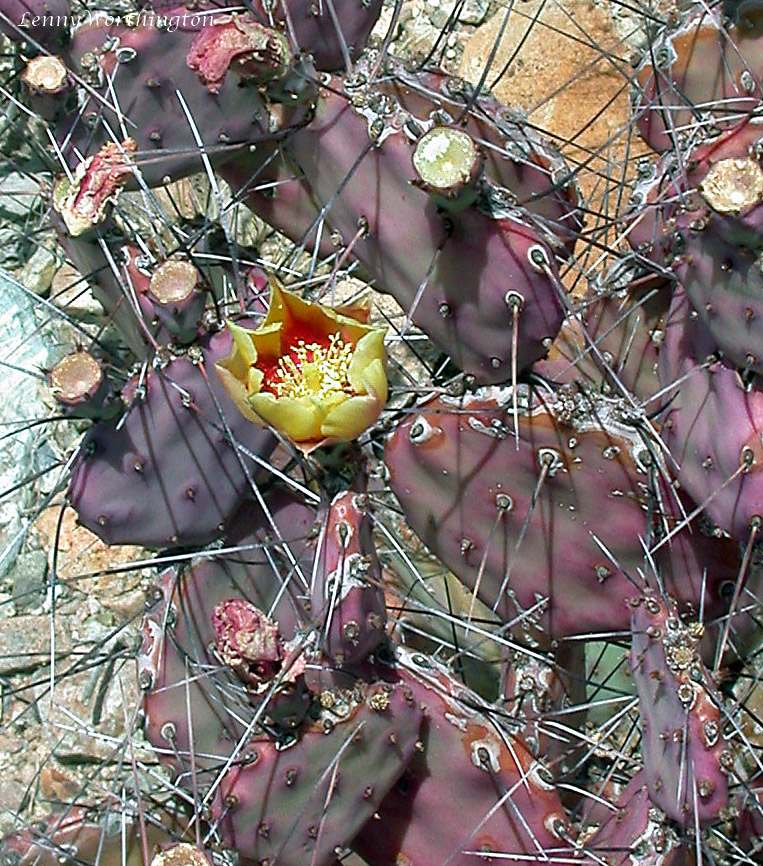
The flattened pads (cladodes) are 3 to 6 inches long, blue-gray to gray-green, turning a striking deep purple to maroon-violet under cold temperatures, drought stress, or intense sunlight, especially along the pad margins. Spines are concentrated mainly along the upper edge of each pad, typically 1 to 3 per areole, long (up to 3 inches), slender, and dark — black, deep red-brown, or blackish-purple — a key feature distinguishing this species from the more uniformly spined Tulip Prickly Pear. Lower areoles on the pad are often spineless or nearly so, bearing only small tufts of golden-brown glochids.
Flowers
Flowers open from the upper pad margins in late spring, each 2 to 3 inches across with numerous silky petals in clear yellow to apricot-orange, often with a reddish-orange base or throat that deepens toward the center. Blooms open in full sun and last only a day or two each, though a healthy clump flowers in succession for several weeks.
Fruit & Seeds
The fruit is a fleshy, egg-shaped berry about 1 to 1.5 inches long, reddish-purple when ripe in late summer, containing numerous hard, flattened seeds in juicy pulp.
Quick Facts
| Scientific Name | Opuntia macrocentra |
| Family | Cactaceae |
| Plant Type | Perennial Cactus (Prickly Pear) |
| Mature Height | 1–2 ft |
| Mature Spread | 3–6 ft |
| Growth Rate | Moderate |
| Sun Exposure | Full Sun |
| Water Needs | Very Low |
| Soil Type | Rocky, caliche or limestone gravel; very well-drained |
| Soil pH | 7.0–8.5 |
| Bloom Time | May – June |
| Flower Color | Yellow to apricot with reddish-orange throat |
| Fruit | Reddish-purple, fleshy, edible |
| Deer Resistant | Yes |
| USDA Hardiness Zones | 8–10 |
Native Range
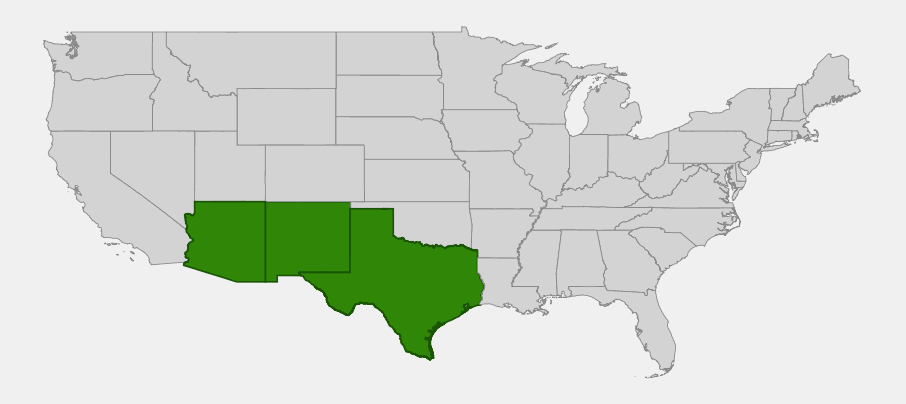
Purple Prickly Pear is native to the Chihuahuan Desert of the Trans-Pecos region of West Texas, southern and central New Mexico, and southeastern Arizona, extending south into the adjoining Mexican states of Chihuahua and Coahuila. GBIF specimen records show New Mexico and Texas as the core of its U.S. distribution, with a strong secondary presence in Arizona.
Within this range it grows on open, rocky flats, bajadas, and limestone or caliche hillsides in Chihuahuan Desert scrub, typically at elevations from about 2,000 to 5,500 feet, often alongside creosote bush, ocotillo, and other spiny desert shrubs.
Unlike the more widely ranging Tulip Prickly Pear, Purple Prickly Pear is a relatively narrow Chihuahuan Desert specialist and is not confirmed as native in California, Nevada, Utah, or Colorado.
📋 Regional plant lists featuring Purple Prickly Pear: South and West Texas · Arizona & New Mexico
Growing & Care Guide
Purple Prickly Pear is an easy, striking addition to a xeriscape or rock garden anywhere within its Chihuahuan Desert range, prized as much for its year-round purple color as for its flowers.
Light
Plant in full sun. Strong sun exposure, especially combined with cooler temperatures or dry conditions, intensifies the purple pigment in the pads; in shade the pads stay greener and the plant flowers less.
Soil & Water
Sharp drainage is essential — use a gritty mix of coarse sand, decomposed granite, or crushed limestone for containers, or plant directly in native caliche or rocky soil. Water deeply but infrequently during the growing season, letting soil dry completely between waterings, and withhold water almost entirely in winter. This species is highly drought tolerant once established and is one of the more rot-prone prickly pears if kept too wet.
Planting Tips
Propagate and plant from rooted pad cuttings set a few inches deep in well-drained soil during warm weather. Allow 3 to 6 feet of spread for mature clumps. Because the purple coloring intensifies with winter cold, this species is an excellent choice for adding cool-season landscape color in Chihuahuan Desert gardens.
Pruning & Maintenance
Remove individual pads with long tongs at a joint to control spread or shape; cut pads can be used for propagation. The species is largely pest-free when grown dry; watch for cochineal scale (white cottony patches) and hose off or treat promptly if seen.
Propagation
Propagation is easiest from pad cuttings: let a removed pad callus for several days to a week in a dry, shaded spot, then set the base shallowly in well-drained soil, where it roots within a few weeks during the growing season.
Landscape Uses
- Xeriscape color accents — purple pad tone provides year-round visual interest
- Rock gardens and gravel beds replicating Chihuahuan Desert terrain
- Erosion control on dry, rocky slopes
- Wildlife gardens — flowers and fruit support native pollinators and animals
Wildlife & Ecological Value
Purple Prickly Pear supports Chihuahuan Desert wildlife in much the same way as its relatives, through its flowers, fruit, and dense structural cover.
For Pollinators
The bright flowers attract native bees, including specialist cactus-pollen bees, as well as beetles and occasional hummingbirds investigating the reddish flower throats, providing an important nectar and pollen source during the late spring bloom period.
For Birds & Mammals
The ripe fruit is eaten by javelina, foxes, coyotes, and numerous birds, which disperse the seeds. Desert cottontails and jackrabbits browse the pads, particularly during drought, and the dense, low, spiny growth form offers cover for small reptiles and ground-nesting birds in open desert terrain.
Ecosystem Role
As a low, sprawling, mat-forming succulent, Purple Prickly Pear helps stabilize thin rocky and caliche soils on exposed Chihuahuan Desert slopes and flats, contributing structural diversity to plant communities where ground cover is naturally sparse.
Cultural & Historical Uses
Like other regional prickly pears, Purple Prickly Pear’s pads and fruit were used as food by Indigenous peoples of the Trans-Pecos and southern New Mexico borderlands, the young pads singed free of spines and cooked, the ripe fruit eaten fresh or dried. Its more scattered, lower-growing habit made it a secondary food source compared to larger-fruited prickly pears in the region.
Historically, the plant’s striking winter coloration made it a recognizable landmark species for travelers and ranchers across the Trans-Pecos and borderlands, and it continues to be referenced in regional common names such as black-spined prickly pear and purple-tinged prickly pear.
In modern horticulture, Purple Prickly Pear has become one of the most sought-after ornamental native cacti in the Southwest precisely for the dramatic violet coloring that intensifies through winter, giving xeriscape gardens cool-season color that few other native plants can match.
Frequently Asked Questions
Why do the pads turn purple?
The purple-violet pigment is a natural stress response triggered by cold temperatures, drought, and intense sunlight. It is a normal and even desirable trait in this species, not a sign of ill health, and the color typically deepens through the winter months.
How is Purple Prickly Pear different from Tulip Prickly Pear?
Purple Prickly Pear has smaller, more sprawling pads with long, dark (black to red-brown) spines concentrated mainly on the upper pad edge, and consistently develops deep purple coloring. Tulip Prickly Pear is larger-growing with straw-to-reddish spines distributed more evenly over the pad and a more variable, less consistently purple blush.
Is the fruit edible?
Yes, the ripe reddish-purple fruit is edible, with juicy pulp similar to other prickly pear fruit, though as with all prickly pears it should be handled with tongs and cleaned of glochids before eating.
How cold-hardy is this cactus?
It tolerates the winter lows typical of its native Chihuahuan Desert range (USDA zones 8–10) and in fact develops its best purple color after cold snaps, though it is less cold-hardy overall than Tulip Prickly Pear.
Will it spread aggressively in my garden?
Within its native range it spreads by rooting fallen pads into a slowly expanding mat, but it is not considered invasive there. Remove stray pads if you want to control its spread.

Looking for a nursery that carries Purple Prickly Pear?
Browse our native plant nursery directory: Texas · Arizona · New Mexico