Big Bend Penstemon (Penstemon havardii)
Penstemon havardii, commonly called Big Bend Penstemon (also Big Bend Beardtongue, Havard Penstemon, or Havard’s Beardtongue), is a striking perennial wildflower restricted in the United States to the Big Bend region of far southwest Texas. A member of the Plantaginaceae (plantain family, where penstemons now sit after being moved out of the old figwort family, Scrophulariaceae), it is prized by desert gardeners for its cardinal-red flower spikes, which rank among the showiest of any Chihuahuan Desert penstemon.
Big Bend Penstemon grows from a low rosette of large, elliptical, blue-green leaves that persists close to the ground, sending up tall, slender flowering stems each spring. From April through June those stems carry dangling, tubular, cardinal-red flowers that attract hummingbirds in large numbers — a trait shared with several of its showier Trans-Pecos relatives, but expressed here in an especially saturated, true red. Outside flowering season the low basal foliage keeps a tidy, unobtrusive profile in the garden.
Confined in the wild to the limestone slopes, canyons, and desert grasslands around Big Bend National Park and the adjacent Rio Grande borderlands, this species is a specialty plant for Trans-Pecos and Chihuahuan Desert gardens. It demands sharp drainage and resents wet feet, but where those conditions are met it is a dependable, long-blooming source of hummingbird nectar that is hard to match for sheer color intensity.
Identification
Big Bend Penstemon is a herbaceous perennial that spends most of the year as a low, ground-hugging rosette, becoming conspicuous only when its flowering stems rise each spring.
Leaves
The basal leaves are notably large and broadly elliptical for a penstemon, smooth-edged to faintly toothed, and a cool blue-green to gray-green color that itself has some ornamental value through the fall and winter when the plant is not in bloom. Stem leaves are smaller, reduced, and clasp the flowering stalks in opposite pairs as they ascend.
Flowers
Flowering stems rise well above the basal rosette, typically reaching 2 to 4 feet tall, and carry a loose, elongated spike of large, tubular, two-lipped flowers that hang or nod from the stem. The color is a vivid, true cardinal red — more saturated than the pink-reds of many related Texas penstemons — and the flowers are large enough and shaped precisely for pollination by hummingbird bills rather than bees. Bloom runs from April into June, among the longer flowering windows of the Trans-Pecos penstemons.
Similar Species
Big Bend Penstemon can be confused with other red-flowered Trans-Pecos penstemons such as Scarlet Bugler (Penstemon barbatus), which has narrower, more linear leaves and a more open, branching inflorescence, and Cardinal Penstemon (Penstemon cardinalis), which does not occur in the Big Bend region. The combination of unusually large, broad basal leaves with tall, simple flowering spikes of deep cardinal red is distinctive to Big Bend Penstemon within its native range.
Quick Facts
| Scientific Name | Penstemon havardii |
| Family | Plantaginaceae (Plantain, formerly Scrophulariaceae) |
| Plant Type | Herbaceous Perennial Wildflower |
| Mature Height | 2–4 ft (60–120 cm) in flower |
| Mature Spread | 1½–2 ft (45–60 cm) |
| Growth Rate | Moderate |
| Sun Exposure | Full Sun to Light Shade |
| Water Needs | Low (excellent drought tolerance) |
| Soil Type | Rocky, sandy to gravelly, limestone-based; sharp drainage essential |
| Soil pH | 6.5–8.0 (neutral to alkaline) |
| Bloom Time | April – June |
| Flower Color | Cardinal red |
| Fall Color | Not significant; basal rosette stays blue-green year-round |
| Fruit | Small two-chambered capsule |
| Deer Resistant | Yes, generally avoided by deer |
| USDA Hardiness Zones | 7–9 |
Native Range
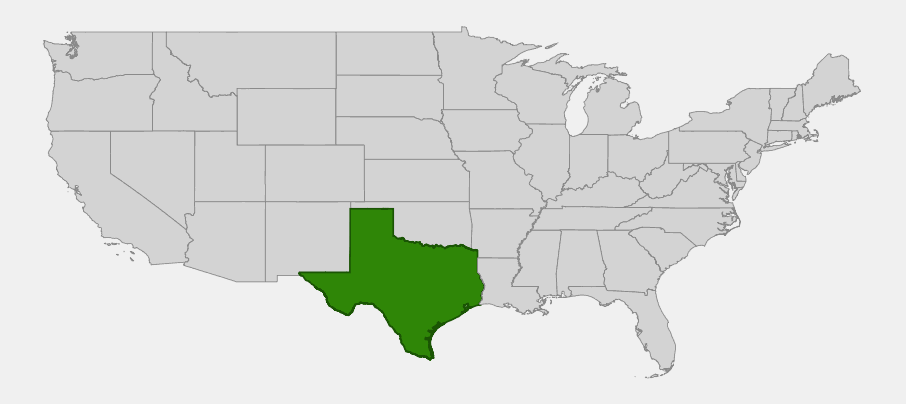
Big Bend Penstemon is found in the United States only in the Big Bend region of far southwest Texas — the rugged, mountainous stretch of the Trans-Pecos bordered by the great bend of the Rio Grande, centered on Brewster and Presidio counties and the area in and around Big Bend National Park. Its range continues south across the river into adjacent desert mountains of Chihuahua, Mexico, where the same limestone and volcanic geology continues.
Within this range the species grows on rocky limestone slopes, in desert canyons, and across Chihuahuan Desert grasslands and scrub, typically at middle elevations where thin, well-drained, mineral soils predominate. It is a plant of open, sun-exposed desert and semi-desert habitats rather than riparian corridors, tolerating intense heat and long dry spells as part of its normal growing conditions.
Because its native range is confined to this one corner of Texas, Big Bend Penstemon is not native anywhere else in the United States. It is sometimes offered by specialty and desert-adapted nurseries well outside the Trans-Pecos, but gardeners outside the Chihuahuan Desert region should recognize it as a regional specialty rather than a general-purpose native, best suited to hot, dry, well-drained gardens that mimic its home range.
📋 Regional plant lists featuring Big Bend Penstemon: South & West Texas
Growing & Care Guide
Big Bend Penstemon is a rewarding plant for hot, dry gardens, but it is uncompromising about drainage — meeting that one requirement is the key to success with this species.
Light
Plant in full sun across most of its hardiness range, but give it light, filtered afternoon shade in the hottest low-desert gardens, where intense reflected heat can stress the basal rosette. In the cooler high-desert conditions of its native Big Bend elevations, full sun all day is appropriate.
Soil & Water
Good drainage is essential. Big Bend Penstemon is adapted to thin, rocky, mineral soils over limestone and will not tolerate heavy clay or soil that stays wet, which quickly leads to crown and root rot. Raised beds, slopes, and soil amended generously with gravel or decomposed granite suit it well. Once established, water needs are low; this is a genuinely drought-tolerant desert perennial that should be watered sparingly, mimicking the sporadic rainfall pattern of the Chihuahuan Desert.
Planting Tips
Set out container-grown plants in fall or early spring to allow roots to establish before summer heat arrives. Space plants about 18 to 24 inches apart to give the basal rosette room to spread. A gravel mulch, rather than organic bark or compost, better matches the plant’s native desert conditions and helps keep the crown dry.
Propagation
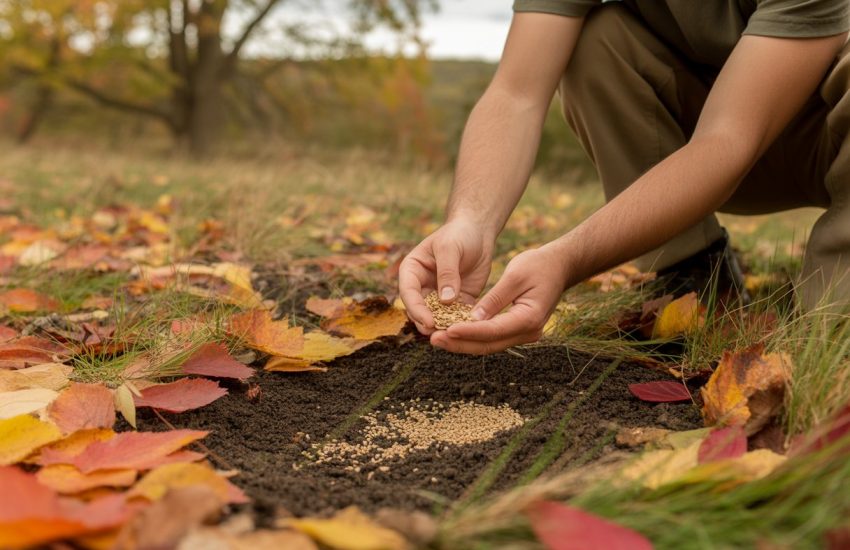
Big Bend Penstemon is most commonly propagated from seed. Allow flowering spikes to dry fully on the plant after bloom, then collect and sprinkle the seed where new plants are wanted, or sow in containers in fall for spring germination. Seed does not require extended cold stratification to germinate reliably.
Landscape Uses
This species fits best in gardens built around its need for heat, sun, and sharp drainage:
- Chihuahuan Desert and xeriscape gardens
- Rock gardens on slopes or raised limestone beds
- Hummingbird gardens, especially in Trans-Pecos Texas
- Gravel gardens with cacti, sotol, and agave companions
- Containers with fast-draining cactus or succulent mix
Wildlife & Ecological Value
Big Bend Penstemon plays an important role for pollinators in the Chihuahuan Desert, where reliable nectar sources can be scarce outside of brief wildflower flushes after rain.
For Hummingbirds
The tubular, nodding, cardinal-red flowers are a textbook hummingbird adaptation, and the species is heavily used by Black-chinned Hummingbirds and migrating species passing through the Big Bend region during its long April-to-June bloom window — a period that overlaps with major hummingbird migration and breeding activity in Trans-Pecos Texas.
For Pollinators
While its primary pollinators are hummingbirds, the flowers also provide nectar for long-tongued native bees able to access the tubular corolla, adding to the plant’s overall value in a desert pollinator garden.
Ecosystem Role
As one of relatively few large-flowered, hummingbird-pollinated perennials adapted to the harsh, rocky soils of the Big Bend region, Penstemon havardii fills a specialized ecological niche within the Chihuahuan Desert flora. Its persistence as a low rosette through drought, followed by a burst of flowering after seasonal rains, is typical of the boom-and-bust growth strategy that characterizes much of the desert plant community in this region.
Cultural & Historical Uses
Big Bend Penstemon does not carry a significant documented history of Indigenous or pioneer use; as a plant of remote, rugged desert mountains rather than areas of concentrated settlement, it has left little record in historical ethnobotanical sources, unlike some of the region’s more widely used desert plants such as sotol or agave.
Its modern significance is primarily horticultural and botanical. The species was named in honor of Valery Havard, a U.S. Army surgeon and botanist who collected extensively in the Trans-Pecos region of Texas in the late nineteenth century and documented much of the area’s then-poorly-known desert flora. Today it is grown by specialty and desert-adapted nurseries from Texas to Arizona as one of the showiest red-flowered penstemons available for low-water, hummingbird-friendly landscaping.
Interest in Big Bend Penstemon has grown alongside the broader popularity of Chihuahuan Desert native plant gardening, as water-conscious gardeners in the Southwest have sought out regionally appropriate alternatives to thirstier ornamental perennials.
Frequently Asked Questions
Is Big Bend Penstemon native to my part of Texas?
Only if you garden in or near the Big Bend / Trans-Pecos region of far southwest Texas, roughly centered on Brewster and Presidio counties. It is not native to any other part of Texas or the United States.
How tall does Big Bend Penstemon get?
Flowering stems typically reach 2 to 4 feet tall, rising from a low basal rosette of broad, blue-green leaves that stays under a foot tall outside the bloom season.
Does Big Bend Penstemon need a lot of water?
No. It is adapted to thin, rocky desert soils and has low water needs once established. Sharp drainage matters far more than irrigation — wet or heavy soil is the most common cause of failure with this species.
Will it attract hummingbirds?
Yes. The tubular cardinal-red flowers are strongly adapted to hummingbird pollination and bloom over an unusually long window from April into June, making it an excellent choice for a Trans-Pecos hummingbird garden.
Can I grow Big Bend Penstemon outside the desert Southwest?
It can be grown elsewhere with hot summers and sharp drainage, but it performs best where heat and dryness mimic its native Chihuahuan Desert conditions. In humid climates or heavy soils, it is prone to crown rot and is not a reliable choice.

Looking for a nursery that carries Big Bend Penstemon?
Browse our native plant nursery directory: Texas