Utah Agave (Agave utahensis)
Agave utahensis, commonly called Utah agave, is a small, fiercely armed succulent of the Mojave Desert and the canyon country where Utah, Nevada, Arizona, and California meet. Unlike the big landscape agaves sold at garden centers, this is a modest, rock-hugging plant — a tight rosette of toothy, gray-green leaves rarely more than a foot or two across, built to survive thin limestone soil, scorching sun, and winters cold enough to freeze water solid. It belongs to the Asparagaceae family, subfamily Agavoideae, and is one of the most cold-hardy agaves native to the United States.
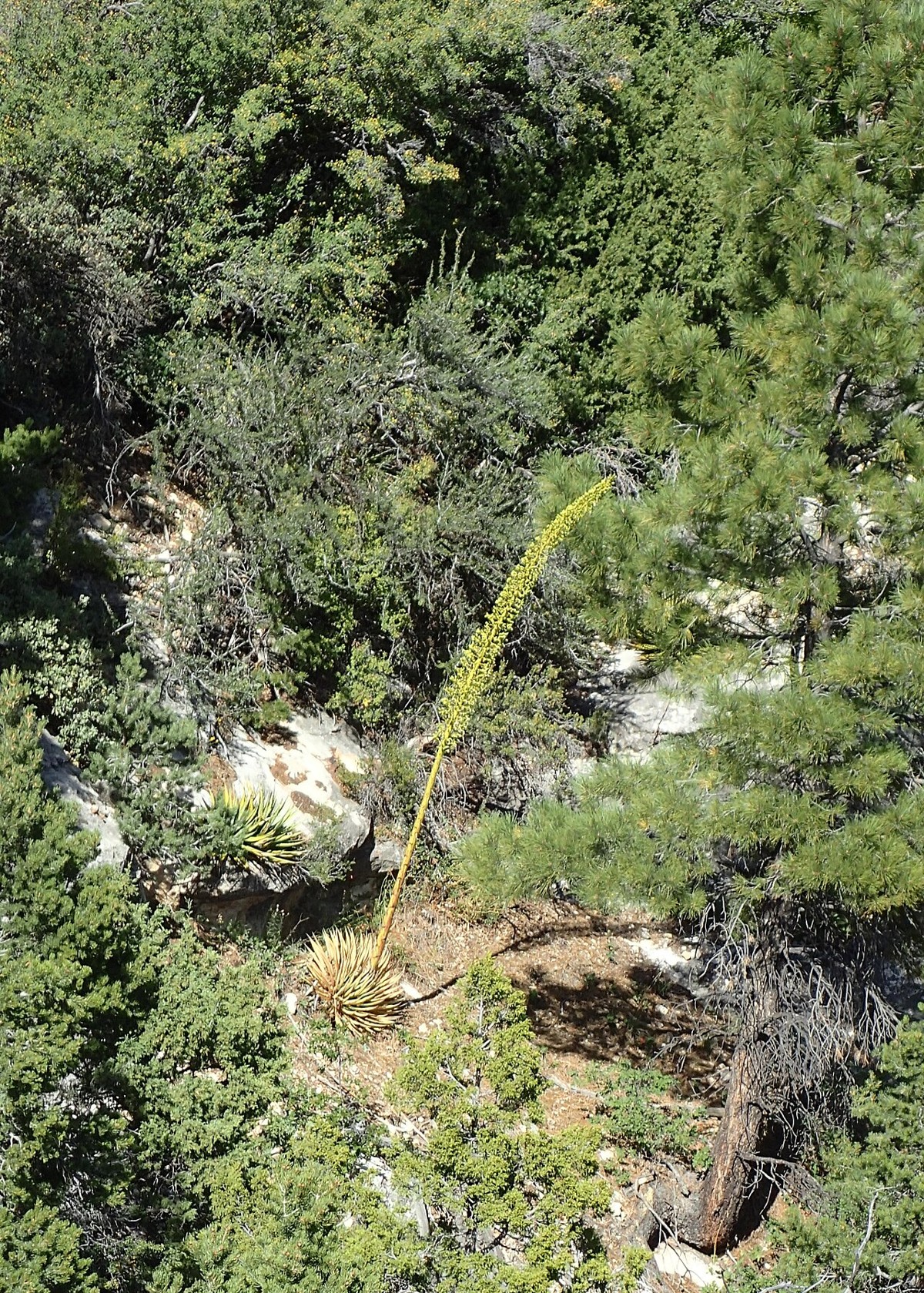
Most of the year a Utah agave looks like nothing more than a dense, spiky ball wedged into a crack in the rock. Then, usually after eight to twenty years of slow growth, a single rosette sends up a tall, asparagus-like stalk studded with greenish-yellow flowers — blooms once, sets seed, and dies, leaving its offsets to carry on. That boom-and-bust life cycle, combined with its preference for exposed limestone and volcanic outcrops, makes it a plant of very specific places rather than a generalist.
In the home landscape, Utah agave is a specialty plant for xeriscapes, rock gardens, and desert habitat plantings in its native range and nearby. It asks for almost nothing once established — no irrigation, no fertilizer, no pruning — but it rewards a careful match of soil drainage and sun exposure, and it should never be placed where people or pets brush against its needle-tipped leaves.
Identification
Utah agave forms a solitary or loosely clustering rosette of stiff, lance-shaped leaves, typically 6 to 14 inches long. Several named varieties exist across its range (var. utahensis, var. nevadensis, var. kaibabensis, and var. eborispina), differing mainly in leaf color, spine length, and degree of clustering, but all share the same basic rosette form and desert-limestone habitat.
Leaves
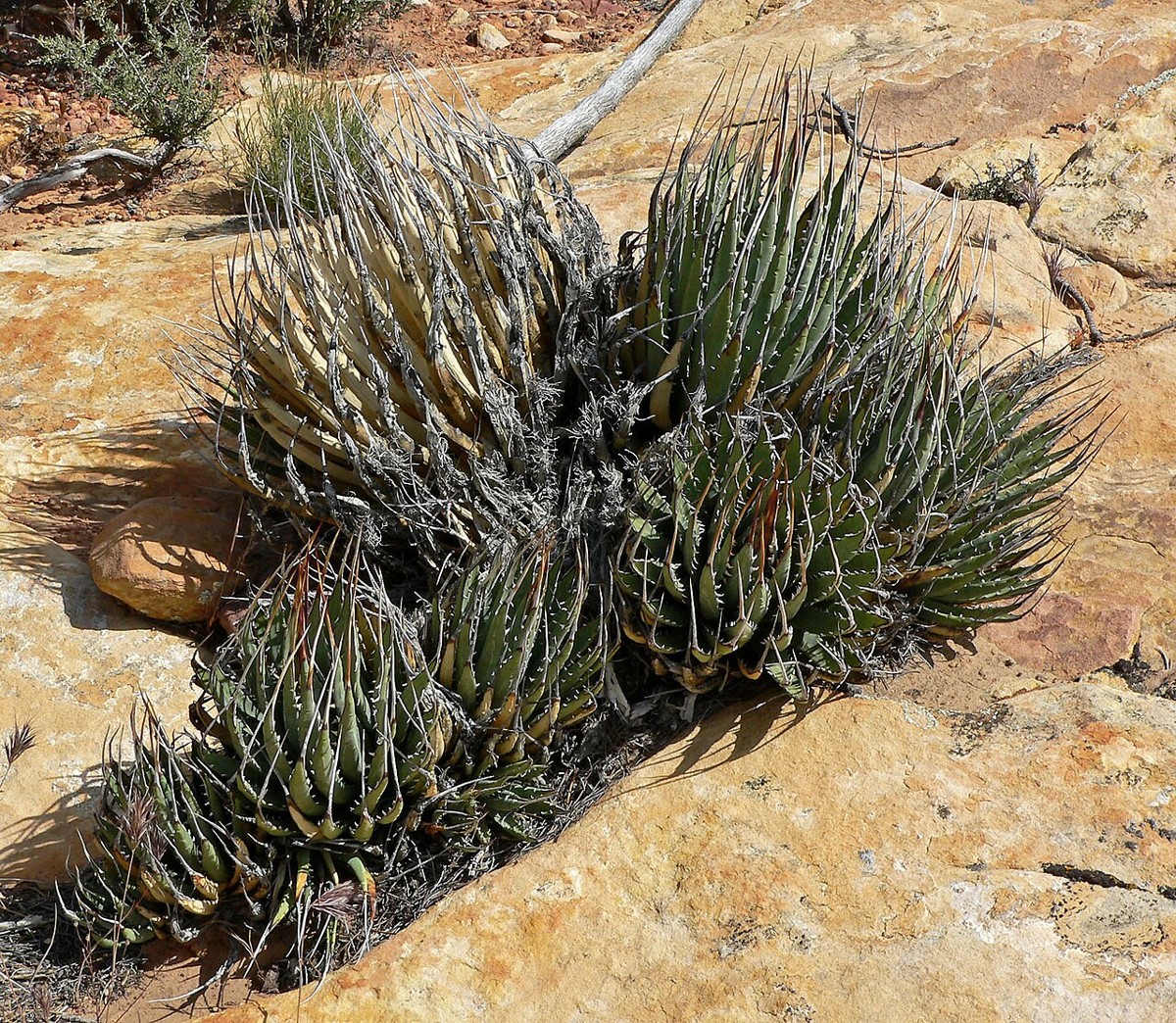
The leaves are gray-green to glaucous blue-green, rigid, and concave on the upper surface, narrowing to a sharp, dark terminal spine ½ to 1½ inches long. Leaf margins carry small, hooked, pale teeth spaced along their length — distinct from the broad, wavy teeth of larger landscape agaves. A single rosette generally measures 1 to 2 feet across and 8 to 20 inches tall, and over years a plant may offset from the base to form a loose clump of several rosettes.
Flowers
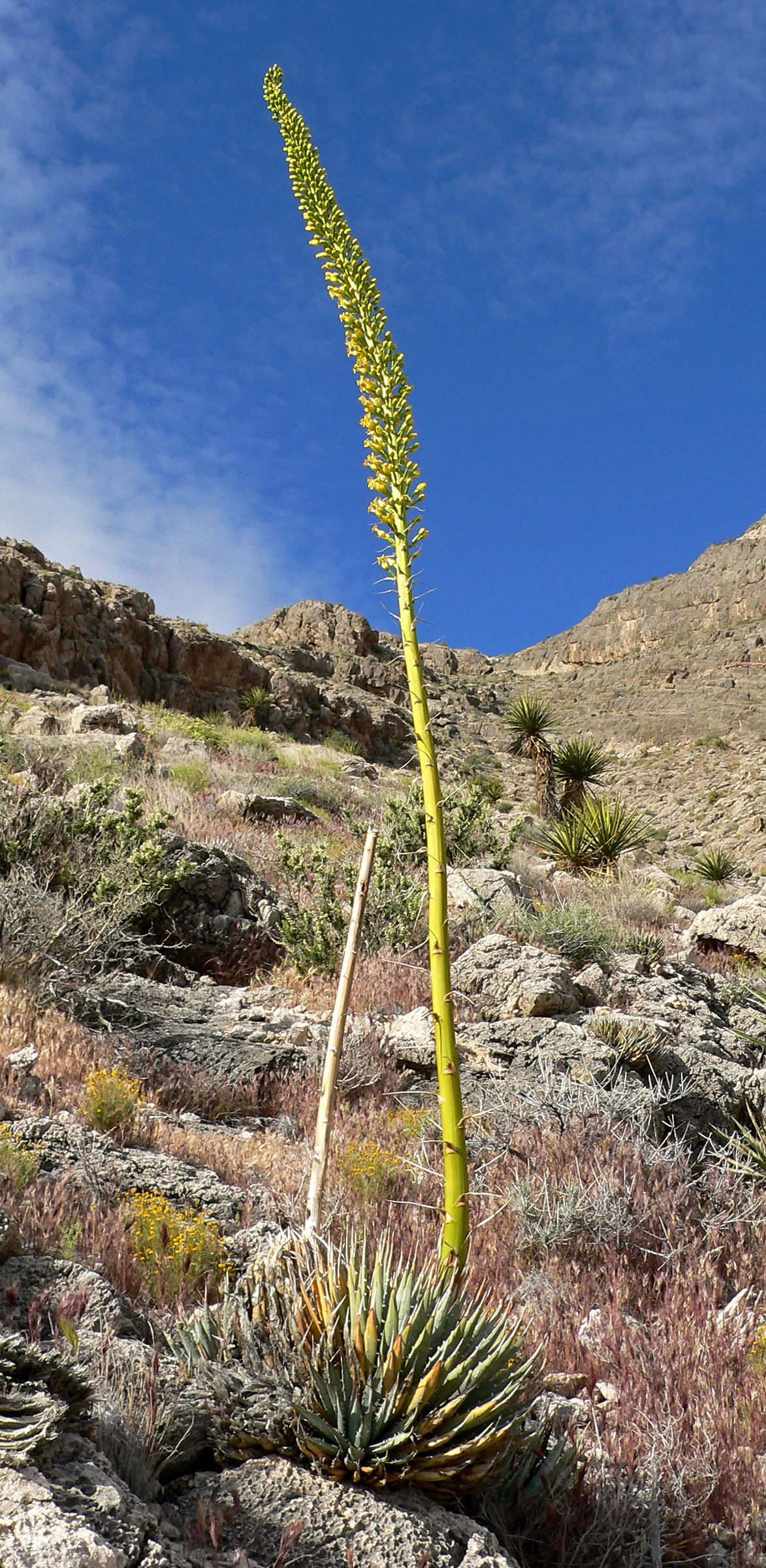
A mature rosette (commonly 8 to 20 years old, depending on growing conditions) sends up one flowering stalk 6 to 13 feet tall, slender and yellow-green, bearing a narrow, spike-like cluster of tubular, greenish-yellow flowers roughly 1 to 1½ inches long. Bloom time runs from April to June depending on elevation. As in all agaves, the rosette that flowers is monocarpic — it dies after setting seed — but surviving basal offsets allow the clump to persist indefinitely.
Fruit & Seeds
Following pollination, the plant produces oblong, three-chambered capsules about ¾ to 1¼ inches long that dry and split open to release flat, black, papery seeds. Seed set is often sparse in dry years, and most reproduction in the wild comes from basal offsets rather than seedlings.
Quick Facts
| Scientific Name | Agave utahensis |
| Family | Asparagaceae (Agavoideae) |
| Plant Type | Succulent Rosette (Cacti & Succulents) |
| Mature Height | Rosette 8–20 in; flower stalk 6–13 ft |
| Mature Spread | 1–2 ft per rosette; clumps wider with offsets |
| Growth Rate | Slow |
| Sun Exposure | Full Sun |
| Water Needs | Very Low once established |
| Soil Type | Rocky, gravelly or sandy; sharp drainage essential |
| Soil pH | 7.0–8.5 (neutral to alkaline, limestone-tolerant) |
| Bloom Time | April – June |
| Flower Color | Greenish-yellow |
| Fall Color | None (evergreen succulent) |
| Fruit | Dry, three-chambered seed capsules |
| Deer Resistant | Yes (spines deter browsing) |
| USDA Hardiness Zones | 6–10 |
Native Range
Utah agave is a plant of the Mojave Desert and adjoining canyon country, centered on the tri-state corner where Utah, Nevada, and Arizona meet, with an extension into the eastern Mojave of California. It grows from low desert basins near Las Vegas, Nevada, up to limestone cliffs and pinyon-juniper slopes along the North Rim of the Grand Canyon in Arizona at elevations approaching 8,000 feet — an unusually wide elevational span for an agave, and part of what makes it one of the hardiest cold-tolerant species in the genus.
Within this range it is a plant of specific rocky ground: limestone and volcanic outcrops, cliff ledges, talus slopes, and thin desert pavement where few other succulents compete. It is typically found rooted directly in rock crevices or shallow gravelly soil, rather than in the sandy flats favored by many other desert species. Associated vegetation includes blackbrush, Mojave yucca, Joshua tree, and various cacti at lower elevations, transitioning to pinyon pine and Utah juniper at its upper elevational limits.
County-level records confirm the species as native in southwestern Utah (Washington and Kane counties), southern Nevada (Clark and Nye counties), northwestern Arizona including the Grand Canyon region (Mohave and Coconino counties), and the eastern Mojave Desert of California (San Bernardino and Inyo counties). It is not native farther east, north, or at lower desert elevations outside this core Mojave-canyon region, despite being occasionally offered by nurseries well beyond its natural distribution.
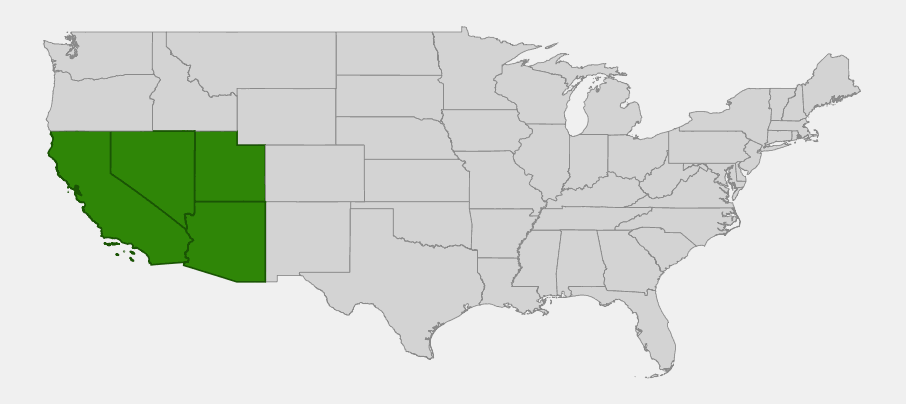
📋 Regional plant lists featuring Utah agave: California & Nevada · Arizona & New Mexico
Growing & Care Guide
Utah agave is best suited to desert and high-desert gardens that can offer it the same conditions it finds on a rocky Mojave hillside: full sun, sharp drainage, and minimal supplemental water. It is not a plant for average garden beds or regularly irrigated lawns, but in a rock garden, gravel bed, or xeriscape it is remarkably self-sufficient and long-lived.
Light
Give it full sun. In its native range it grows on open, south-facing rock faces with little shade, and plants grown in too much shade become etiolated and weak-spined. Some afternoon relief can help in the hottest low-desert gardens, but generally more sun produces a tighter, better-colored rosette.
Soil & Water
Drainage is the single most important factor. Plant in rocky, gravelly, or coarse sandy soil — raised beds, berms, or crevice gardens all work well — with a neutral to alkaline pH. Standing water or heavy clay will rot the roots quickly. Once established, Utah agave needs no supplemental irrigation in most of its native range beyond natural rainfall; occasional deep watering during extended summer drought in a garden setting is plenty. Avoid watering directly into the rosette, where moisture can pool among the leaf bases and promote rot.
Planting Tips
Plant in spring or fall, setting the base of the rosette slightly above grade on a mound of gravelly soil so water sheds away from the crown. Mulch with crushed rock or decomposed granite rather than organic mulch, which holds moisture against the base. Because of its sharp terminal spines and hooked leaf-margin teeth, site it away from walkways, play areas, and anywhere people or pets brush past; heavy gloves are essential when handling or planting it.
Pruning & Maintenance
Essentially none is needed. Remove dried lower leaves or a spent flower stalk after the rosette that produced it dies back, leaving any basal offsets undisturbed to continue the clump. No fertilizer is required, and over-fertilizing can produce soft, rot-prone growth.
Propagation
The easiest method is dividing rooted basal offsets (“pups”) from an established clump and potting them separately until they form their own root systems. Seed propagation is possible but slow, requiring warm temperatures, sharp drainage, and patience, since seedlings grow very slowly in their first years.
Landscape Uses
- Rock gardens and crevice gardens where its sculptural form and small footprint shine
- Xeriscaping in low- and high-desert climates needing zero supplemental irrigation
- Desert habitat restoration on rocky, disturbed slopes within its native range
- Barrier or security plantings thanks to its sharp spines
- Container culture in a gritty succulent mix for gardeners outside its hardiness range
Wildlife & Ecological Value
Though it is a small, slow-growing plant, Utah agave plays an outsized role for the desert wildlife that depends on its brief but abundant bloom.
For Pollinators
The tall flower stalks are a magnet for native bees and other insects, which work the greenish-yellow blossoms for nectar and pollen during the spring bloom window. In parts of its range, nectar-feeding bats migrating through the Southwest are also known to visit agave flowers, making desert agaves an important link in the seasonal food supply for these long-distance pollinators.
For Birds
Hummingbirds, including Costa’s and black-chinned hummingbirds, visit the flower spikes for nectar where Utah agave grows within their range, and the dried stalks left standing after bloom offer perches for small desert birds.
For Mammals
Rodents and other small mammals occasionally feed on the sugar-rich flower stalks and seed capsules, and the dense, spiny rosettes provide secure shelter from predators for small desert animals such as lizards and ground-nesting insects.
Ecosystem Role
By anchoring itself directly into bare rock and thin desert pavement, Utah agave helps stabilize otherwise unvegetated slopes and provides a foothold for soil development in an extremely harsh environment. Its periodic, synchronized blooms — tied to a years-long buildup of stored energy — provide a concentrated, reliable nectar source in a desert landscape where floral resources are often scarce and unpredictable.
Cultural & Historical Uses
Agaves were a crucial food and fiber resource for Indigenous peoples throughout the desert Southwest, and Utah agave was no exception within its range. Ancestral Puebloan and later Southern Paiute communities roasted the carbohydrate-rich stalk bases and immature flower stalks in large earthen roasting pits, a practice that converted the plant’s otherwise indigestible inulin-rich tissue into a sweet, edible food — remains of such roasting pits are still found archaeologically across the Southwest’s agave country.
The long leaf fibers were processed and twisted into cordage, nets, sandals, and mats, taking advantage of the exceptional strength of agave fiber. The sharp terminal spine, left attached to a strip of fiber, was sometimes used directly as a ready-made needle and thread.
Today, Utah agave is primarily of interest to native-plant gardeners, rock-garden enthusiasts, and succulent collectors rather than as a food or fiber source. It is not cultivated commercially for sugar or spirits the way larger agave species are, and its slow growth and modest size keep it a specialty plant rather than a commercial crop.
Frequently Asked Questions
Is Utah agave the same plant as the agave used to make tequila?
No. Tequila is made from Agave tequilana (blue agave), a cultivated Mexican species. Utah agave is a much smaller, cold-hardy wild species from the U.S. Mojave Desert and Grand Canyon region and is not used commercially for spirits or sweeteners.
Does Utah agave die after it flowers?
The individual rosette that produces the flower stalk dies after setting seed — this is normal for agaves, which are monocarpic. However, most Utah agave plants form clusters of several rosettes through basal offsets, so the clump as a whole survives even after one rosette blooms and dies.
Is Utah agave dangerous to touch?
Its leaves end in a sharp, rigid spine and carry small hooked teeth along the margins that can puncture skin and clothing. Some people also develop mild skin irritation from the sap. It should be planted away from walkways and handled with heavy gloves, but it is not toxic if simply brushed against.
How cold-hardy is Utah agave?
It is one of the most cold-tolerant agave species in cultivation, with high-elevation populations near the Grand Canyon’s North Rim surviving winter temperatures well below freezing. USDA zones 6–10 are generally suitable, provided drainage is excellent.
Can I grow Utah agave outside its native Mojave Desert range?
Yes, gardeners in other arid and semi-arid climates with sharp drainage and full sun can grow it successfully, and many succulent collectors do. It is not considered invasive. Just be sure the site mimics its native rocky, well-drained conditions, since poor drainage is the most common cause of failure.

Looking for a nursery that carries Utah agave?
Browse our native plant nursery directory: California · Nevada · Arizona · Utah