Foothill Beargrass (Nolina erumpens)
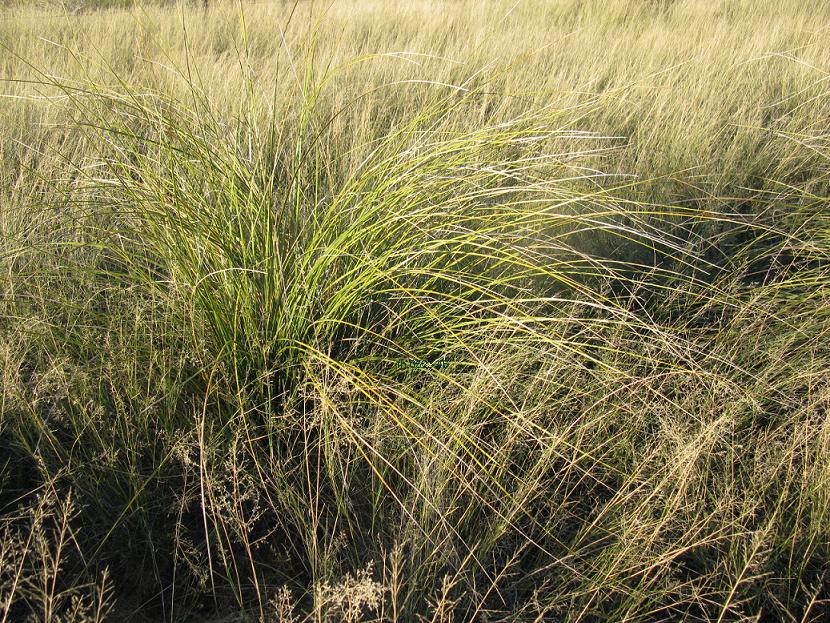
Nolina erumpens, commonly known as Foothill Beargrass (also called mesa sacahuista or sand beargrass), is a stemless, tuft-forming succulent of the desert grasslands and rocky foothills of the Trans-Pecos region of Texas and southern New Mexico. Its narrow, grooved, grasslike leaves form a dense tuft that blends so thoroughly into surrounding native grassland that the plant is easy to overlook until its club-shaped flower clusters appear.
Foothill Beargrass is smaller and finer-textured than many of its showier succulent relatives, more a textural grassland component than a dramatic specimen plant. That understated character is exactly what makes it useful in native landscaping: it reads as part of a natural desert grassland rather than as an imported accent, while still delivering the drought toughness gardeners expect from a true Chihuahuan Desert native.
In the wild it grows scattered among desert grasses and scrub on rocky slopes and mesas, often alongside sotol, lechuguilla and other Nolina species, where it is rarely common enough to dominate but reliably present across its Trans-Pecos and southern New Mexico range.
Identification
Foothill Beargrass is stemless, forming a wide tuft of leaves directly from a woody base with no visible trunk, distinguishing it from trunk-forming Nolina species found further south.
Leaves
Leaves are narrow (about ⅘ inch wide), longitudinally grooved, and grow 2 to 2.6 feet long in loose, arching tufts. Margins are sharp and finely serrated, with loose, hanging, filament-like fibers along the edges that give older leaves a slightly shaggy look.
Flowers
In late spring and early summer, club-shaped (clavate) flower clusters emerge, rarely rising much taller than the surrounding foliage. Each cluster carries numerous tiny, cream-colored flowers that attract a range of small insects, including ants, wasps and bees drawn to their modest nectar reward.
Fruit & Seeds
Flowers are followed by small, thin-walled, capsule-shaped fruits. Like other nolinas, the plant relies on both seed production and its persistent, long-lived rootstock to maintain its presence in desert grassland communities over time.
Quick Facts
| Scientific Name | Nolina erumpens |
| Family | Asparagaceae (Nolinoideae) |
| Plant Type | Evergreen, stemless succulent (cacti & succulents) |
| Mature Height | 2–2.6 ft |
| Mature Spread | 2–3 ft |
| Growth Rate | Slow |
| Sun Exposure | Full sun |
| Water Needs | Low |
| Soil Type | Rocky or sandy; well-drained |
| Soil pH | Neutral to alkaline |
| Bloom Time | Late spring – early summer |
| Flower Color | Cream |
| Fall Color | Evergreen (no change) |
| Fruit | Small, thin-walled capsule |
| Deer Resistant | Yes |
| USDA Hardiness Zones | 7–10 |
Native Range
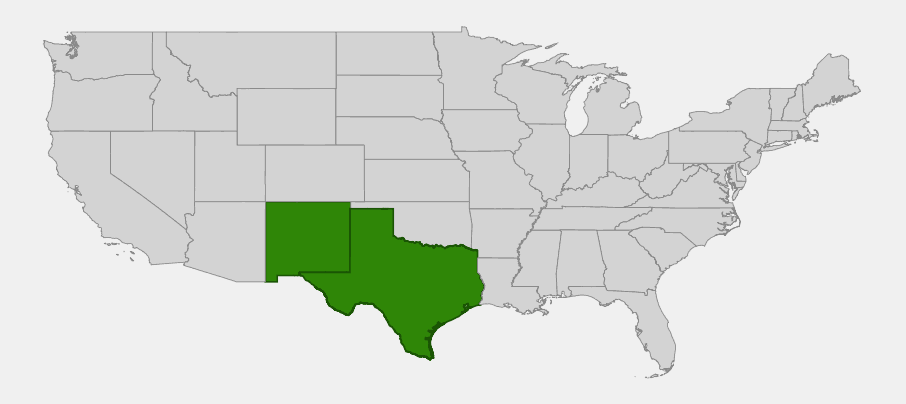
Foothill Beargrass is native to the Trans-Pecos region of far west Texas and extends west into southern New Mexico, with its range continuing south into adjacent northern Mexico (Chihuahua). It is a Chihuahuan Desert species, tied to the desert grassland and foothill habitats of this border region.
Within this range it grows on rocky slopes, mesas and desert grassland flats, typically scattered among native bunchgrasses rather than forming the dense colonies some other succulents do. Big Bend National Park, within its Trans-Pecos range, is one of the better-documented strongholds for the species.
Because its native range is narrowly limited to the Trans-Pecos and southern New Mexico, Foothill Beargrass should be treated as native only within that specific region; use elsewhere in Texas or the Southwest is ornamental rather than habitat restoration.
📋 Regional plant lists featuring Foothill Beargrass: South and West Texas · Arizona & New Mexico
Growing & Care Guide
Foothill Beargrass asks little beyond full sun and sharp drainage, making it a reliable, low-profile addition to desert grassland-style native plantings.
Light
Full sun matches its native open grassland and foothill habitat and produces the tightest, most compact tufts.
Soil & Water
Rocky or sandy, well-drained soils suit it best. Once established it is highly drought-tolerant and needs no supplemental irrigation across most of its native range; avoid heavy clay or poorly drained sites.
Planting Tips
Plant container-grown specimens in spring or fall, spacing clumps 2 to 3 feet apart if grouping several together to mimic its natural scattered distribution among grasses.
Pruning & Maintenance
Minimal care is needed — occasionally remove old, dried leaves from the base if a tidier appearance is wanted, though the plant looks natural left alone in a grassland-style planting.
Landscape Uses
- Desert grassland and prairie-style native plantings where a low, textural succulent is wanted
- Mixed Chihuahuan Desert beds with sotol and lechuguilla
- Rocky slopes and mesas needing erosion-resistant cover
- Low-water xeriscape in full-sun, well-drained sites
Because New Mexico plantings draw from a different regional nursery trade than Texas ones, gardeners on either side of the state line should confirm with local native-plant nurseries that stock reflects the Trans-Pecos / southern New Mexico ecotype rather than material collected further south in Mexico, which may be less reliably cold-hardy at the northern edge of its range.
Wildlife & Ecological Value
For Pollinators
The small, cream-colored flowers attract ants, wasps and bees during their late spring to early summer bloom, offering a modest but reliable nectar source within desert grassland communities.
Birds
Low, dense tufts provide ground-level cover for grassland and scrub birds foraging across the open desert grassland habitats where this species grows.
Mammals
The tough, fibrous, serrated leaves are generally avoided by browsing mammals, supporting the species’ good deer-resistance rating, while the clump base offers shelter for small desert mammals.
Ecosystem Role
As a long-lived, deep-rooted perennial scattered through Chihuahuan Desert grassland, Foothill Beargrass contributes to soil stability on rocky slopes and mesas and adds structural diversity to otherwise grass-dominated plant communities. Its evergreen tufts also provide a reliable source of green forage structure through the driest months, when many surrounding grasses have cured to tan, helping maintain habitat continuity for the small animals that shelter among its leaves year-round.
Cultural & Historical Uses
Like other nolinas of the Chihuahuan Desert region, Foothill Beargrass’s tough, fibrous leaves have a history of use by Indigenous and local communities for cordage and coarse weaving, a tradition shared broadly among desert succulents with similar leaf fiber. This is documented as regional ethnobotanical history rather than a present-day recommendation.
The species was first described from material collected in the Trans-Pecos and named erumpens (from the Latin for “bursting forth”), likely a reference to the way its flower clusters emerge abruptly from the tuft of leaves.
Today it remains a relatively obscure plant outside botanical and native-plant circles, more often encountered on a desert hike through its native grassland than in cultivation, though interest in native, low-water landscaping has slowly increased its presence in regional nurseries. Specialist succulent collectors also grow it in botanical garden collections and private succulent gardens well outside its native range, valuing it for its fine texture and genuine rarity in cultivation compared with more commonly offered nolinas.
Frequently Asked Questions
Is Foothill Beargrass the same as Texas Beargrass (Nolina texana)?
No — they are related but distinct species. Foothill Beargrass (Nolina erumpens) is restricted to the Trans-Pecos and southern New Mexico, while Texas Beargrass has a broader range across south-central Texas.
Does Foothill Beargrass form a trunk?
No. It is stemless throughout its life, forming a tuft of leaves directly from a woody base rather than developing a visible trunk.
Is it native to Arizona?
Not confirmed — its documented native range covers the Trans-Pecos of Texas and southern New Mexico, extending into adjacent Chihuahua, Mexico. It is not established as native to Arizona.
How drought-tolerant is it?
Very. As a true Chihuahuan Desert grassland species, it is adapted to long dry spells and needs no supplemental water once established in appropriate rocky or sandy, well-drained soil.
Why is it hard to find in nurseries?
Its low, grasslike profile makes it less showy than trunk-forming yuccas or bold agaves, so it has historically drawn less commercial nursery attention despite being a tough, useful native for desert grassland-style gardens.

Looking for a nursery that carries Foothill Beargrass?
Browse our native plant nursery directory: Texas · New Mexico