Mohr Oak (Quercus mohriana)
Quercus mohriana, commonly known as Mohr Oak (also called shin oak or scrub oak in parts of its range), is a tough, drought-hardy evergreen shrub or small tree native to the limestone hill country and canyonlands of west and central Texas, eastern New Mexico, and adjacent northern Mexico. Named for the nineteenth-century botanist Charles Mohr, this white-oak-group species is one of the defining woody plants of the Edwards Plateau, Trans-Pecos, and the limestone breaks of the Texas Panhandle, where it often forms dense, low thickets on thin, rocky soils that few other trees can tolerate.
Mohr Oak typically grows as a many-stemmed, rounded shrub 6 to 15 feet tall, though on deeper soils or protected sites it can develop into a small single-trunked tree reaching 20 to 25 feet. Its small, leathery, gray-green leaves are evergreen to semi-evergreen, holding on through most winters in the southern part of its range and giving the plant year-round structure in the landscape. The leaves and acorns are classic white oak in character — the acorn cups are shallow and the kernels relatively sweet and low in tannin compared to red oaks.
For gardeners and land managers working with thin, alkaline, rocky soils in the Southwest, Mohr Oak is an exceptionally reliable choice. It asks for almost nothing once established, tolerates extreme heat and extended drought, and provides dense cover, acorn mast, and thicket structure that few ornamental shrubs can match. It is an excellent foundation species for xeriscaping, wildlife plantings, and natural-area restoration on limestone soils.
Identification
Mohr Oak is most often encountered as a dense, rounded, multi-stemmed shrub, though scattered individuals growing in canyon bottoms or along drainages can take on a small single-trunked tree form. It frequently forms extensive thickets by root sprouting, especially after fire or browsing, creating the low, tangled “shinnery” that gives it one of its common names.
Bark & Stems
Young twigs are slender and covered in fine, gray pubescence, aging to smooth gray-brown. Mature bark is pale gray, finely scaly, and relatively thin — typical of the white oak group. Because the species sprouts readily from the root crown, older colonies often show stems of mixed ages growing from a shared root system rather than a single dominant trunk.
Leaves
Leaves are simple, alternate, and small for an oak — typically 1 to 2½ inches long, oblong to elliptic, with wavy, shallowly lobed or coarsely toothed margins tipped with small bristle-like points. The upper surface is a dull gray-green and somewhat leathery; the underside is paler and finely hairy, giving the foliage a soft gray cast from a distance. Leaves are evergreen to tardily deciduous, often persisting on the shrub until new growth pushes them off in spring.
Flowers
Like all oaks, Mohr Oak is wind-pollinated and monoecious. Male flowers hang in slender, pale yellow-green catkins in spring, appearing with or just before the new leaves; female flowers are tiny and inconspicuous, borne singly or in small clusters in the leaf axils.
Fruit & Seeds
Acorns are solitary or paired, ½ to ¾ inch long, with a shallow, saucer-shaped cup covering only the base of the nut and thin, closely appressed scales. Acorns mature in a single season (as in all white oaks) and drop in fall, germinating readily once on the ground. The kernels are comparatively sweet and are readily eaten by wildlife and historically gathered by Indigenous peoples of the region.
Quick Facts
| Scientific Name | Quercus mohriana |
| Family | Fagaceae (Beech/Oak) |
| Plant Type | Evergreen Shrub / Small Tree |
| Mature Height | 6–15 ft (shrub form); to 20–25 ft as a small tree |
| Mature Spread | 8–15 ft, often forming dense thickets by root-sprouting |
| Growth Rate | Slow |
| Sun Exposure | Full Sun to Partial Shade |
| Water Needs | Low (drought tolerant once established) |
| Soil Type | Shallow, rocky, well-drained; limestone or caliche |
| Soil pH | Neutral to alkaline (7.0–8.5) |
| Bloom Time | March – April |
| Flower Color | Pale yellow-green (catkins) |
| Fall Color | None notable (evergreen to semi-evergreen) |
| Fruit | Small acorns, ½–¾ in, shallow cup |
| Deer Resistant | No (browsed by deer; acorns heavily used by wildlife) |
| USDA Hardiness Zones | 6–9 |
Native Range
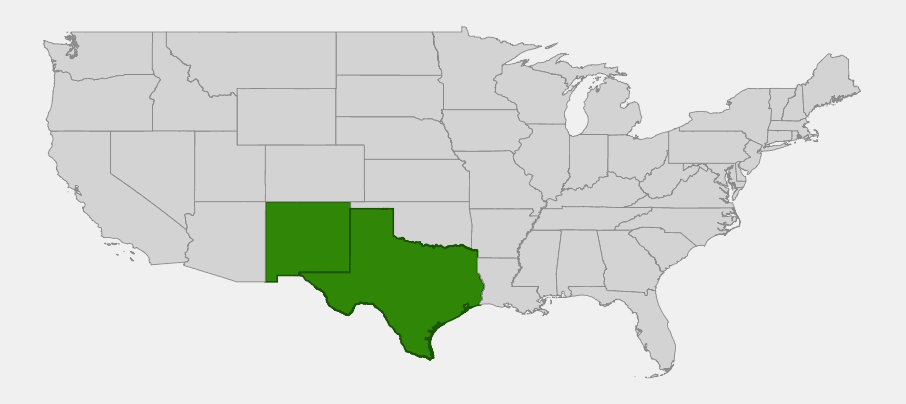
Mohr Oak is native to the limestone hill country, canyonlands, and rocky breaks of west, central, and south Texas, with its range extending northwest into the Texas Panhandle and adjacent eastern New Mexico, and south across the Rio Grande into Coahuila and Nuevo León, Mexico. It reaches its greatest abundance on the Edwards Plateau and in the canyons of the Trans-Pecos, where it is a dominant shrub on thin, rocky, alkaline soils.
Within this range, Mohr Oak occupies some of the harshest growing sites available to woody plants: shallow limestone benches, canyon rims, caliche flats, and rocky slopes where soil depth may be only a few inches over bedrock. It is highly drought tolerant and fire adapted, typically resprouting vigorously from its extensive root system after fire, browsing, or drought dieback, which allows it to persist and spread as dense thickets (“shinnery”) over long periods.
Because Mohr Oak is so closely tied to limestone and caliche substrates, it is largely absent from the sandy soils of east Texas and the deep alluvial soils of river valleys, even where those areas fall within its broader climatic range. Gardeners outside the limestone belts of west and central Texas and eastern New Mexico should not expect it to thrive without comparable alkaline, rocky conditions.
📋 Regional plant lists featuring Mohr Oak: South and West Texas · Arizona & New Mexico
Growing & Care Guide
Mohr Oak is built for tough, rocky, low-water sites and is a poor fit for rich, moist garden beds — give it the lean, well-drained conditions it evolved with and it will reward you with decades of low-maintenance structure.
Light
Plant in full sun to light, filtered shade. In its native canyons it often grows in full exposure on rocky rims but also tolerates the partial shade of larger trees along drainages.
Soil & Water
Mohr Oak demands sharp drainage and performs best in shallow, rocky, alkaline soils over limestone or caliche; it does poorly in heavy clay or acidic soils with standing moisture. Once established — generally after two to three growing seasons — it needs little to no supplemental irrigation and is among the most drought-tolerant native oaks in the Southwest.
Planting Tips
Set out container-grown plants in fall or early spring to allow root establishment before summer heat. Avoid amending planting holes with rich organic matter, which can hold excess moisture against the root crown on heavy sites; a wide, shallow hole matching the native soil works best. Space plants 8 to 12 feet apart if a continuous thicket or hedge effect is desired.
Pruning & Maintenance
Mohr Oak tolerates hard pruning and resprouts readily, making it suitable for shaping into a hedge or clearing to a single trunk if a small tree form is preferred. Remove dead wood after hard freezes, which can occasionally damage exposed growth at the northern edge of its range. Established plants need essentially no fertilization.
Propagation
Propagate from fresh acorns collected in fall and planted promptly, as white oak acorns germinate quickly and do not store well. Root sprouts can also be divided from established thickets, though acorn propagation produces a straighter root system.
Landscape Uses
- Xeriscaping on rocky, alkaline sites where few other woody plants thrive
- Wildlife hedgerows providing cover and acorn mast
- Erosion control on limestone slopes and canyon rims
- Screening and privacy hedges when planted in groups
- Restoration plantings on degraded rangeland in the Edwards Plateau and Trans-Pecos
- Low-water foundation plantings in regional native gardens
Wildlife & Ecological Value
For Birds
The dense, tangled growth form of Mohr Oak thickets provides excellent nesting cover and predator protection for scrub-adapted birds such as Bewick’s Wren, Black-crested Titmouse, and various sparrows. Scrub Jays and other corvids cache and disperse the acorns.
For Mammals
Acorns are an important fall and winter food source for white-tailed deer, javelina, fox squirrels, and numerous rodents. Deer also browse the foliage and twigs, particularly in winter when other forage is scarce, which can suppress the height of plants in heavily browsed areas.
For Pollinators
As a wind-pollinated species, Mohr Oak does not rely on insect pollinators, but its foliage hosts a range of native oak-specialist moth and butterfly larvae, which in turn support insectivorous birds during the breeding season.
Ecosystem Role
Mohr Oak is a foundational shrub of limestone and caliche plant communities across its range, stabilizing thin soils on slopes and canyon rims, buffering temperature and moisture extremes for understory plants, and providing structural diversity in landscapes otherwise dominated by grasses and low shrubs. Its ability to resprout after fire or drought makes it a resilient, long-persisting component of these rangeland ecosystems.
Cultural & Historical Uses
Mohr Oak is named for Charles Theodore Mohr (1824–1901), a German-American botanist and pharmacist who studied the flora of the southern United States extensively, though the species itself is most closely associated with the ranching and rangeland traditions of west and central Texas rather than any single documented Indigenous use. Its sweet, low-tannin acorns — typical of the white oak group — were gathered and eaten by Indigenous peoples across its range, as was common practice with white oaks generally.
On working ranches in the Edwards Plateau and Trans-Pecos, Mohr Oak thickets, often called “shinnery,” have long been regarded by livestock producers as both a resource and a management challenge: the dense thickets provide shelter and browse for livestock and wildlife but can also encroach on rangeland used for grazing, leading to periodic brush management on some properties.
The wood of Mohr Oak, given the shrub’s typically small stem diameter, has seen little commercial use, though locally it has been cut for fence posts and firewood where larger timber species are scarce on the rocky uplands where it grows.
Frequently Asked Questions
Is Mohr Oak a tree or a shrub?
Both, depending on the site. On thin, rocky soils it typically grows as a dense, multi-stemmed shrub 6 to 15 feet tall. On deeper soils, especially in canyon bottoms, it can develop into a small single-trunked tree up to 20 to 25 feet.
Will Mohr Oak grow in clay or sandy soil?
Not well. It is adapted to shallow, rocky, alkaline limestone and caliche soils and tends to struggle in heavy clay or acidic sandy soils, especially where drainage is poor.
How drought tolerant is Mohr Oak?
Extremely. Once established, it is one of the most drought-tolerant native oaks in the Southwest, reflecting its origin on exposed limestone sites that receive limited rainfall and hold little soil moisture.
Do deer eat Mohr Oak?
Yes. White-tailed deer browse the foliage and twigs, particularly in winter, and acorns are eaten by deer and many other wildlife species. It is not considered deer resistant.
Is Mohr Oak native outside of Texas and New Mexico?
Within the United States it is native only to Texas and New Mexico. Its range also extends south of the border into the Mexican states of Coahuila and Nuevo León. It is not native to Arizona, Oklahoma, or any states further east.

Looking for a nursery that carries Mohr Oak?
Browse our native plant nursery directory: Texas · New Mexico