Goldback Fern (Pentagramma triangularis)
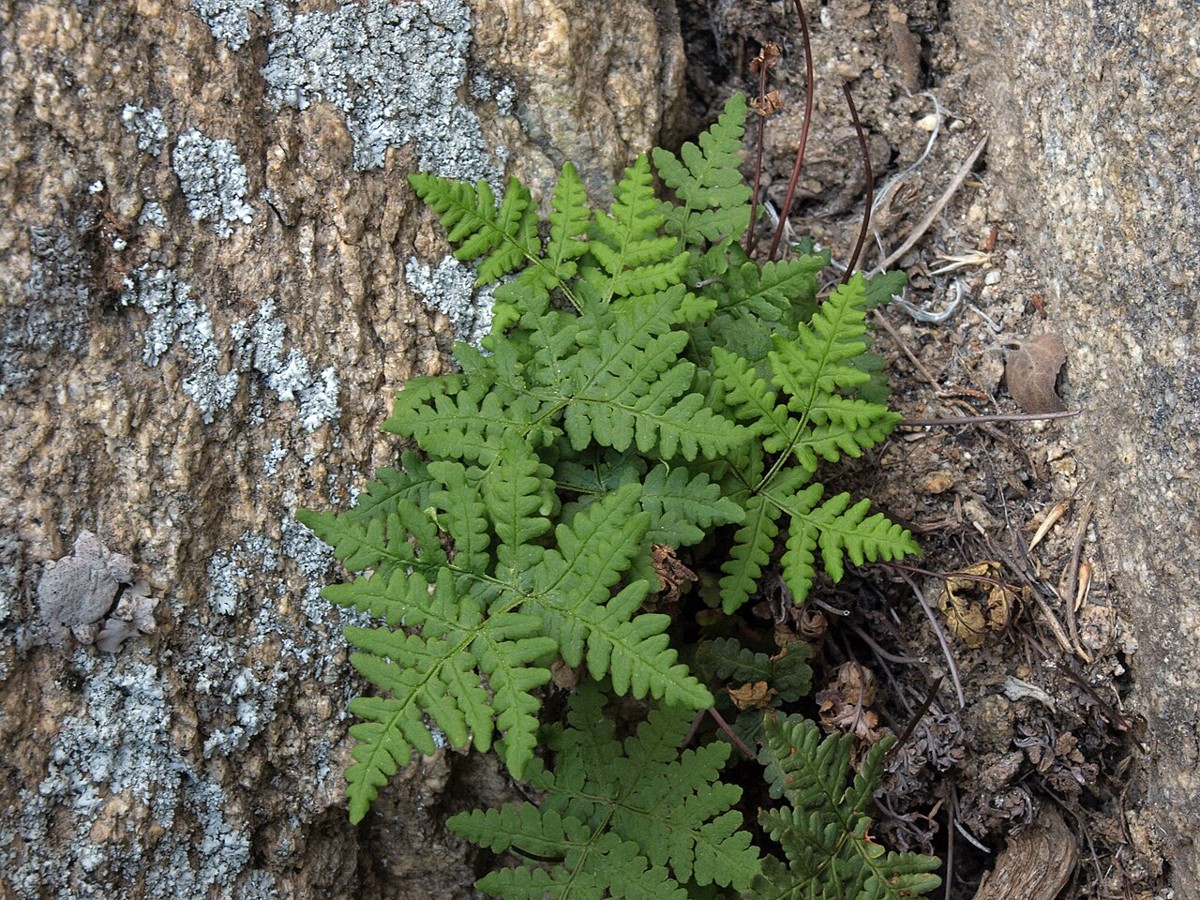
Pentagramma triangularis, commonly called Goldback fern, is a small, tough evergreen-to-drought-deciduous fern found tucked into rock crevices, shaded banks, and oak-woodland slopes across the West. Its common name comes from the fine yellow to golden-white powder (farina) that coats the underside of each frond — a feature so distinctive that gardeners and botanists alike can identify the species by turning a leaf over and checking for the telltale gold dust. It belongs to the Pteridaceae (brake fern family), a group well adapted to the dry, rocky habitats where many true ferns cannot survive.
Goldback fern is a diminutive plant, with triangular, finely divided fronds that rarely exceed 10 inches and often stay much shorter, rising in loose clusters from thin, wiry, dark brown to blackish stalks. It favors partially shaded rock outcrops, road cuts, canyon walls, and the dappled light beneath oaks and chaparral shrubs, often growing where almost nothing else can get a foothold. During the dry summer months the fronds curl, shrivel, and appear dead, only to unfurl again, green and fresh, with the return of fall and winter rains — a classic resurrection-fern strategy for surviving a Mediterranean climate.
Because it tolerates dry shade and thin, rocky soil better than almost any other native fern in the West, Goldback fern is a favorite for rock gardens, shaded slopes, and naturalistic plantings where gardeners want fern texture without the heavy watering most ferns demand. It spreads slowly by spores and short rhizomes, forming loose colonies over time rather than aggressive mats, and it asks for almost nothing once it is established in a spot that suits it.
Identification
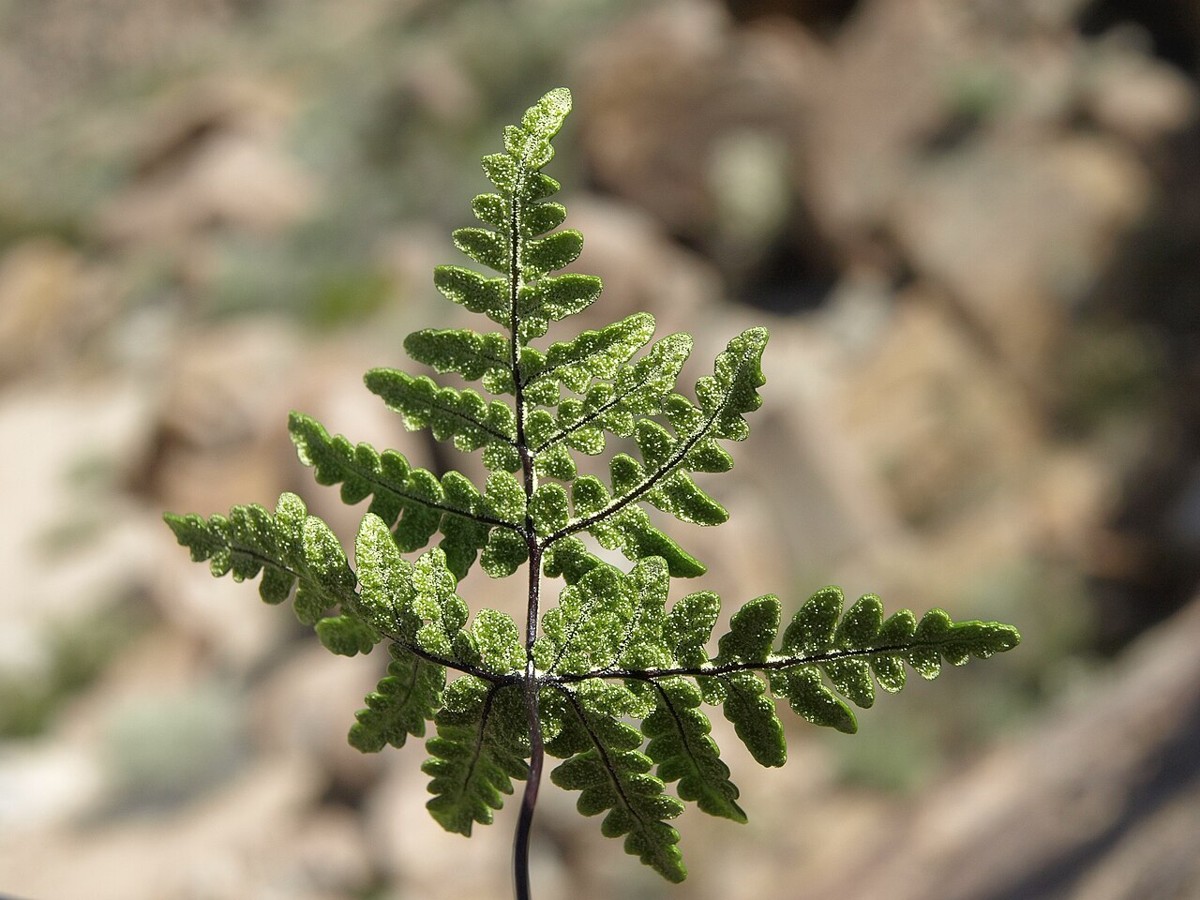
Goldback fern is most easily recognized by its small size, triangular frond outline, and — most reliably — the golden to pale-yellow (sometimes whitish) waxy powder coating the lower leaf surface. No other common western fern combines these three traits so consistently.
Fronds
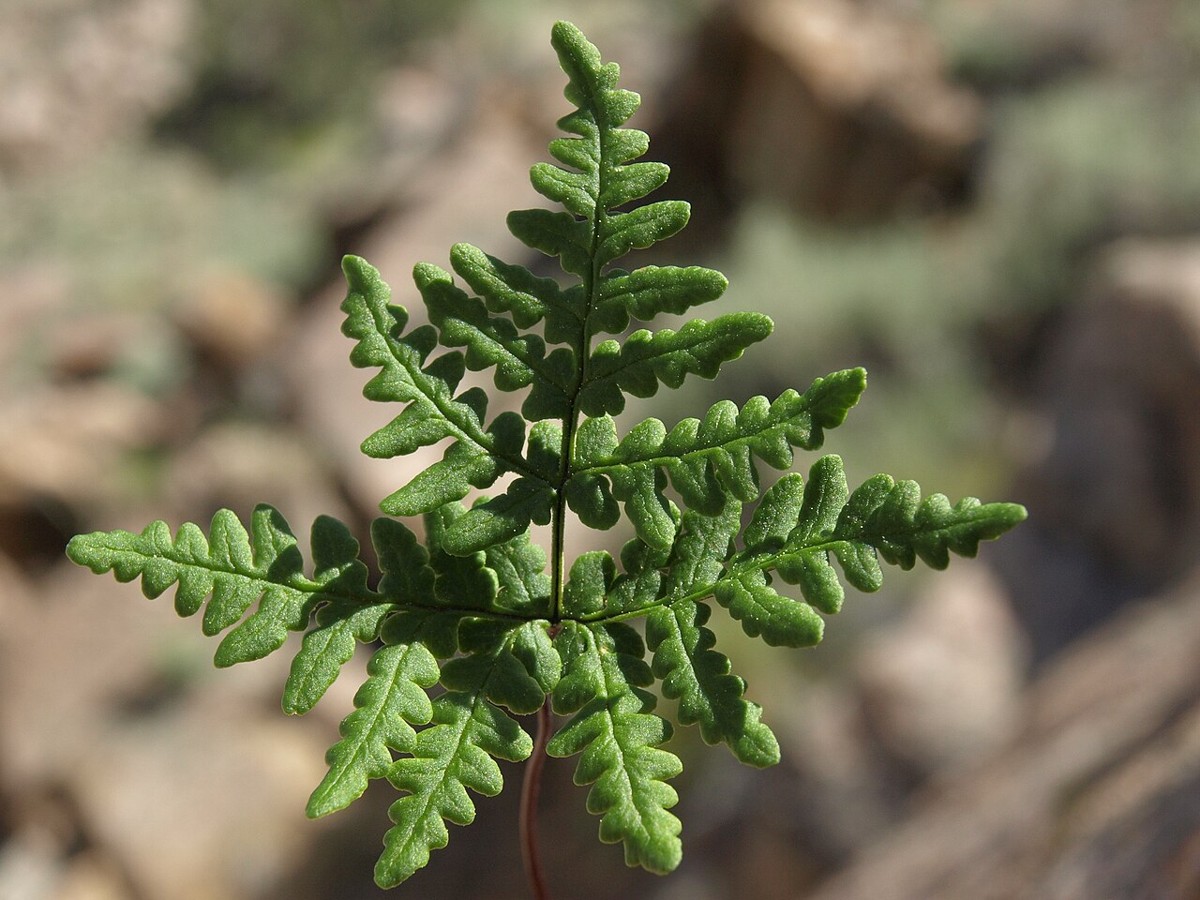
Fronds are triangular to broadly lance-triangular in outline, typically 1 to 5 inches long (occasionally to 8 inches in moist, sheltered sites), and are two to three times pinnately divided, giving each leaf a lacy, finely cut appearance. The upper surface is smooth and dull to slightly glossy green; texture is leathery rather than soft. Fronds arise in loose tufts rather than a single upright crown, and in dry years the whole clump may shrink to a cluster of curled, brittle-looking fronds that revive with moisture.
Farina (the “Gold Back”)
The defining field mark is on the underside of the blade: a layer of fine, powdery farina ranging from pale yellow to deep golden-orange, occasionally whitish in some populations and individuals. Rubbing a finger across the lower surface picks up the colored powder. This farina is a waxy secretion that helps the plant manage water loss and reflect excess light, an adaptation suited to the exposed, sun-flecked rock faces the species favors.
Stalks (Stipes) & Rhizome
The stipe (leaf stalk) is thin, wiry, and dark reddish-brown to nearly black, shiny, and usually longer than the blade itself. Fronds emerge in clusters from a short, creeping, scaly rhizome that branches slowly, which is why established plants form loose, spreading colonies rather than single clumps.
Spores
Like other brake ferns, Goldback fern reproduces by spores rather than flowers or seeds. Sporangia develop along the margins of the frond’s lower surface, hidden beneath the farina and the slightly curled leaf edge, and are released in late spring through summer.
Quick Facts
| Scientific Name | Pentagramma triangularis |
| Family | Pteridaceae (Brake Fern) |
| Plant Type | Perennial Fern |
| Mature Height | 4–10 in (10–25 cm) |
| Mature Spread | 6–12 in, slowly spreading by rhizomes |
| Growth Rate | Slow |
| Sun Exposure | Part Shade to Shade |
| Water Needs | Low once established; summer-dry tolerant |
| Soil Type | Rocky, thin, well-drained; tolerates poor soil |
| Soil pH | Neutral to slightly alkaline, tolerant of variation |
| Bloom Time | None (spore-bearing fern, not a flowering plant) |
| Flower Color | N/A |
| Fall Color | N/A — fronds often curl and go dormant in summer, refresh with fall rain |
| Fruit | None (reproduces by spores) |
| Deer Resistant | Yes |
| USDA Hardiness Zones | 7–10 |
Native Range
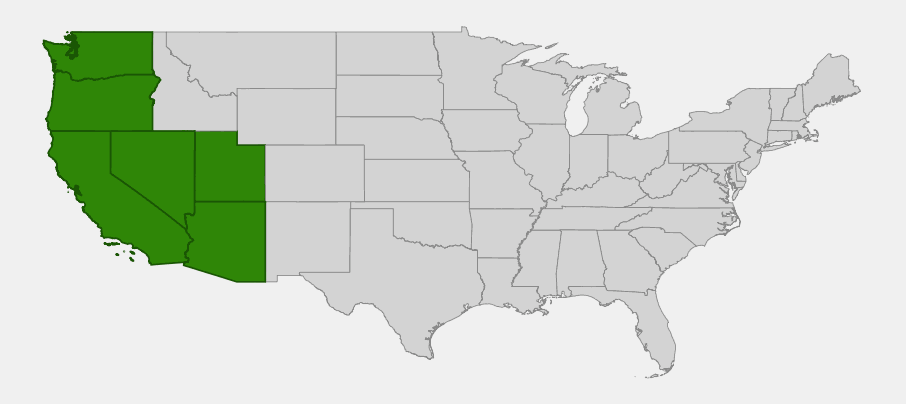
Goldback fern is native to the western United States, where it occurs across California and Nevada, through Oregon and the western two-thirds of Washington, and south and east into Arizona and the southwestern corner of Utah. It is one of the most common and widespread small ferns of California in particular, occurring from the coast to the lower mountains throughout most of the state.
Across this range the species tracks the Mediterranean and semi-arid climate pattern of winter rain and summer drought. In Washington and western Oregon it is largely confined to the moister, milder country west of the Cascade crest; county-level records also exist in east-central Washington near Lake Chelan and Kittitas County. It becomes more common southward, reaching its greatest abundance in California’s Coast Ranges, Sierra Nevada foothills, and southern California mountains, and continuing into drier, rockier habitat in Nevada, Arizona, and the Colorado Plateau edge of southwestern Utah.
Typical habitat includes shaded to partly sunny rock outcrops, canyon walls, road cuts, and the understory of oak woodland and chaparral, usually below about 6,000 feet in the north and up to around 7,500 feet farther south and at higher elevations such as the White Mountains. It is rarely found in deep forest shade or in open, unshaded desert flats, favoring instead the broken light and cover offered by rocks, shrubs, and scattered trees.
📋 Regional plant lists featuring Goldback fern: California & Nevada · Western Oregon & Western Washington · Arizona & New Mexico · Utah & Western Colorado
Growing & Care Guide
Goldback fern rewards gardeners who can offer it the one thing most ferns can’t tolerate: dry shade. Once it is tucked into a rocky, well-drained spot with some shelter from the hottest sun, it needs very little attention.
Light
Part shade to full shade suits it best, particularly dappled light under oaks or on north- and east-facing rock faces. In cooler coastal gardens it can take a bit more sun; in hot interior valleys, deeper shade helps the fronds stay green longer into summer before going dormant.
Soil & Water
Give it rocky, gritty, fast-draining soil rather than rich garden loam — a crevice, a rock garden pocket, or a lean slope works better than a well-amended bed. Water regularly through the first year to help the small rhizomes establish, then taper off. Established plants need little to no supplemental water and will simply curl their fronds and go summer-dormant in the driest months, greening back up with the first fall rains. Overwatering in summer, especially in heavy soil, is more likely to kill this fern than drought.
Planting Tips
Plant in fall or winter so roots can establish during the rainy season. Tuck divisions or nursery starts into vertical or angled rock crevices, dry-laid stone walls, or the base of established shrubs where some leaf litter and shade collect. Because it spreads slowly, space plants 6 to 10 inches apart if building a drift, and be patient — this is not a fast-filling groundcover.
Pruning & Maintenance
None needed. Old, browned fronds can be left in place through summer dormancy or tidied away if their curled appearance bothers you; new growth will replace them with the rains. Avoid disturbing the shallow rhizomes once a clump is established.
Propagation
Goldback fern is most often propagated by careful division of rhizome clumps in fall, or by spores collected from mature fronds in summer and sown on a sterile, moist medium — a slower method best suited to patient growers or specialty nurseries.
Landscape Uses
- Rock gardens — thrives in crevices and pockets most plants can’t use
- Dry shade under oaks and other established trees
- Dry-stone walls and retaining walls
- Woodland garden edges with filtered light
- Xeriscaping accents where a fern texture is wanted without summer water
- Restoration plantings on rocky slopes and road cuts
Wildlife & Ecological Value
Goldback fern’s ecological role is subtler than that of a flowering or fruiting plant, but it is a meaningful part of the rocky-slope and woodland-understory communities where it grows.
For Pollinators
As a spore-bearing fern, Goldback fern produces no nectar or pollen and offers nothing directly to bees or butterflies. Its value to pollinators is indirect, as one small piece of the diverse understory layer that shelters and supports the insects those pollinators also depend on.
For Birds
The fern itself is not a significant food source for birds, but its clumps add cover and foraging texture on rocky slopes, and the sheltered microhabitats it helps create under shrubs and ledges are used by ground-foraging species such as towhees and sparrows searching for insects.
For Mammals
Small mammals and reptiles use the rocky crevices and leaf litter where Goldback fern grows as cover; the fern is not a notable browse plant, and its tough, leathery texture makes it unattractive to deer, which is part of why it survives in otherwise heavily browsed landscapes.
Ecosystem Role
Goldback fern is a pioneer of thin, rocky soils that few other plants can colonize, helping stabilize crevices and slow erosion on exposed rock faces and road cuts. Its drought-deciduous life cycle — curling and dying back in summer, then flushing green with fall rain — is a useful indicator of the broader rhythm of the Mediterranean-climate plant communities it inhabits.
Cultural & Historical Uses
Goldback fern does not carry the extensive documented medicinal or utilitarian history of larger native plants, but it has long been recognized and noted by California and Great Basin Indigenous peoples as a familiar plant of rocky canyon and woodland habitats, and it appears in regional ethnobotanical surveys primarily as an observed, named plant of the landscape rather than a harvested resource.
In more recent history, the species has become a fixture of California native plant horticulture precisely because of the distinctive golden farina that gives it its name — herbarium specimens and field guides from the 19th and 20th centuries consistently single out this trait as the plant’s most memorable feature, and it remains the detail most field botanists use to teach new students the genus.
Today Goldback fern’s main cultural role is horticultural: native-plant gardeners and restoration practitioners value it as one of the few ferns suited to dry, rocky, shaded sites in summer-dry climates, and it is regularly recommended in California native-plant gardening guides as an alternative to moisture-hungry exotic ferns.
Frequently Asked Questions
Why does Goldback fern look dead in summer?
It isn’t dead — it’s drought-dormant. In dry summer heat the fronds curl up and turn brown or straw-colored to reduce water loss, then green up again with the first substantial fall or winter rain. This is a normal, healthy response, not a sign of a failing plant.
How can I tell Goldback fern from other small western ferns?
Turn a frond over. The powdery golden to pale-yellow farina coating the underside is unique among the common small ferns of its range and is the single most reliable identification feature, along with the triangular frond outline.
Does Goldback fern need shade to survive?
It prefers part shade to shade, especially in hot inland gardens, but it can take more sun in cool coastal climates. The more sun it gets, the more consistent moisture it needs to avoid scorching.
Can I grow Goldback fern in regular garden soil?
It is much happier in lean, rocky, fast-draining soil than in rich, moisture-retentive garden beds. Heavy, wet soil — especially in summer — is far more likely to kill it than drought ever would.
Is Goldback fern safe to plant near pets and children?
Goldback fern is not documented as toxic, but as with any fern, it is best treated as an ornamental rather than something to eat, and there is no record of it being used as a food plant.

Looking for a nursery that carries Goldback fern?
Browse our native plant nursery directory: California · Oregon · Washington · Nevada · Arizona · Utah