Hartweg’s Sundrops (Oenothera hartwegii)
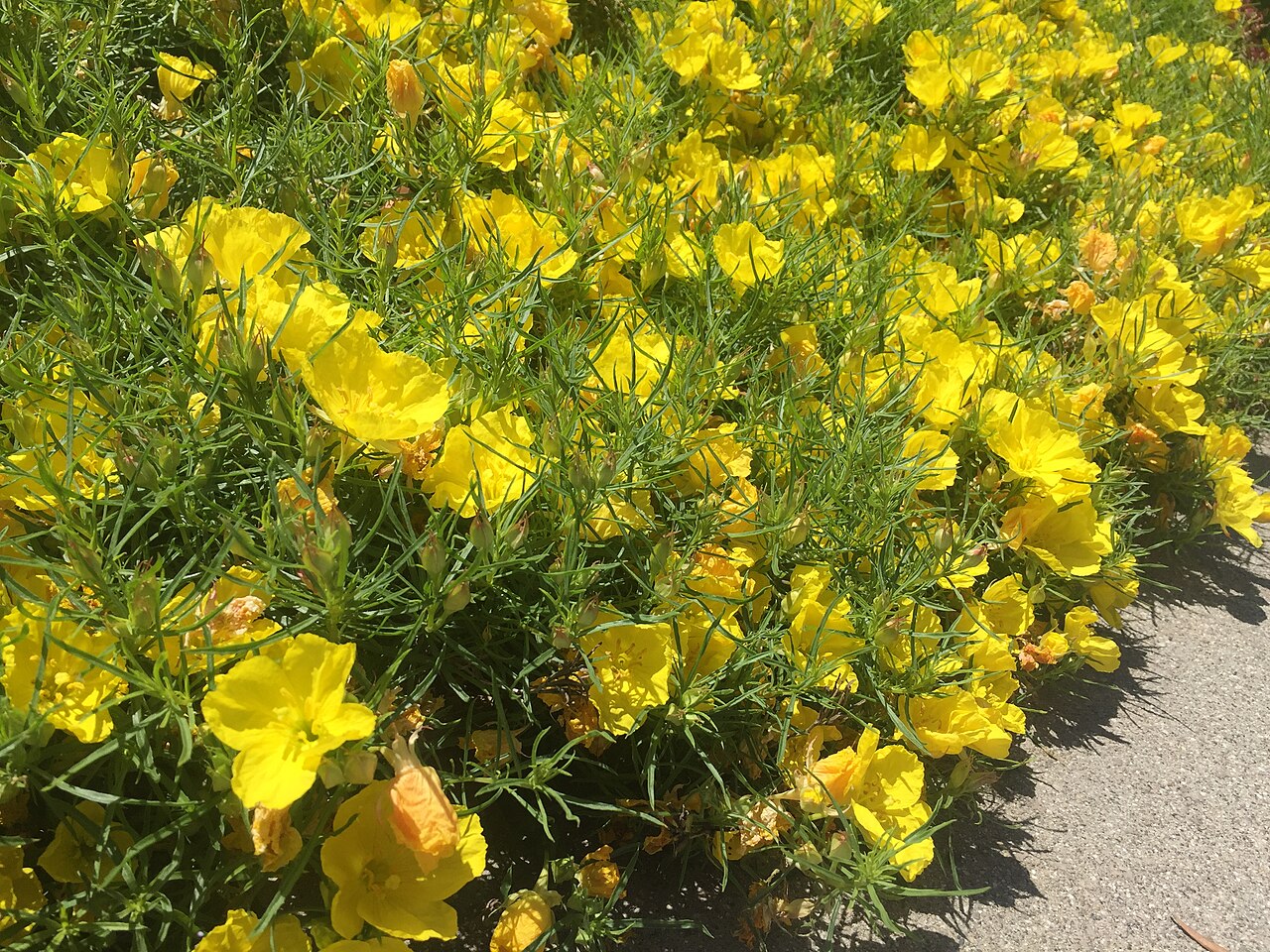
Oenothera hartwegii (often still sold and recorded under its older name, Calylophus hartwegii), commonly called Hartweg’s Sundrops or Hartweg’s Evening Primrose, is a low, woody-based wildflower of the Chihuahuan Desert borderlands. A member of the evening primrose family (Onagraceae), it forms a sprawling mound of narrow, needle-like leaves studded with bright yellow, four-petaled flowers that open in late afternoon or evening and fade to orange by the next day. Despite the “evening primrose” association, many populations open their flowers by mid-morning on cloudy or cooler days, giving gardeners a long season of color from spring through fall.
In the wild it grows on limestone hillsides, caliche flats, sandy draws, and gypsum outcrops across the arid grasslands and desert scrub of Texas, New Mexico, and southeastern Arizona, often rooting into cracks and thin soils where little else competes. Its drought tolerance, compact habit, and long bloom period have made it a popular choice in xeric and rock gardens well beyond its native range, where it is usually sold simply as “Calylophus” or “sundrops.”
Hartweg’s sundrops is an unassuming but tough little plant: a woody crown sends up multiple sprawling or upright stems each year, and established plants can shrug off months without rain. For gardeners in the Southwest looking for a low-water, high-reward native that blooms through the hottest part of summer, it is hard to beat.
Identification
Hartweg’s sundrops is a low, spreading subshrub, typically 10 to 24 inches tall and spreading 18 to 24 inches wide, with a woody base (caudex) from which several herbaceous to semi-woody stems arise each growing season. The overall look is a loose, sprawling mound rather than an upright plant, and older plants often root along lower stems where they touch the soil.
Stems
Stems are slender, often reddish at the base, and either sprawl along the ground or angle upward, becoming more rigid and woody toward the crown with age. New growth is covered in short, fine hairs that give the foliage a slightly grayish-green cast.
Leaves
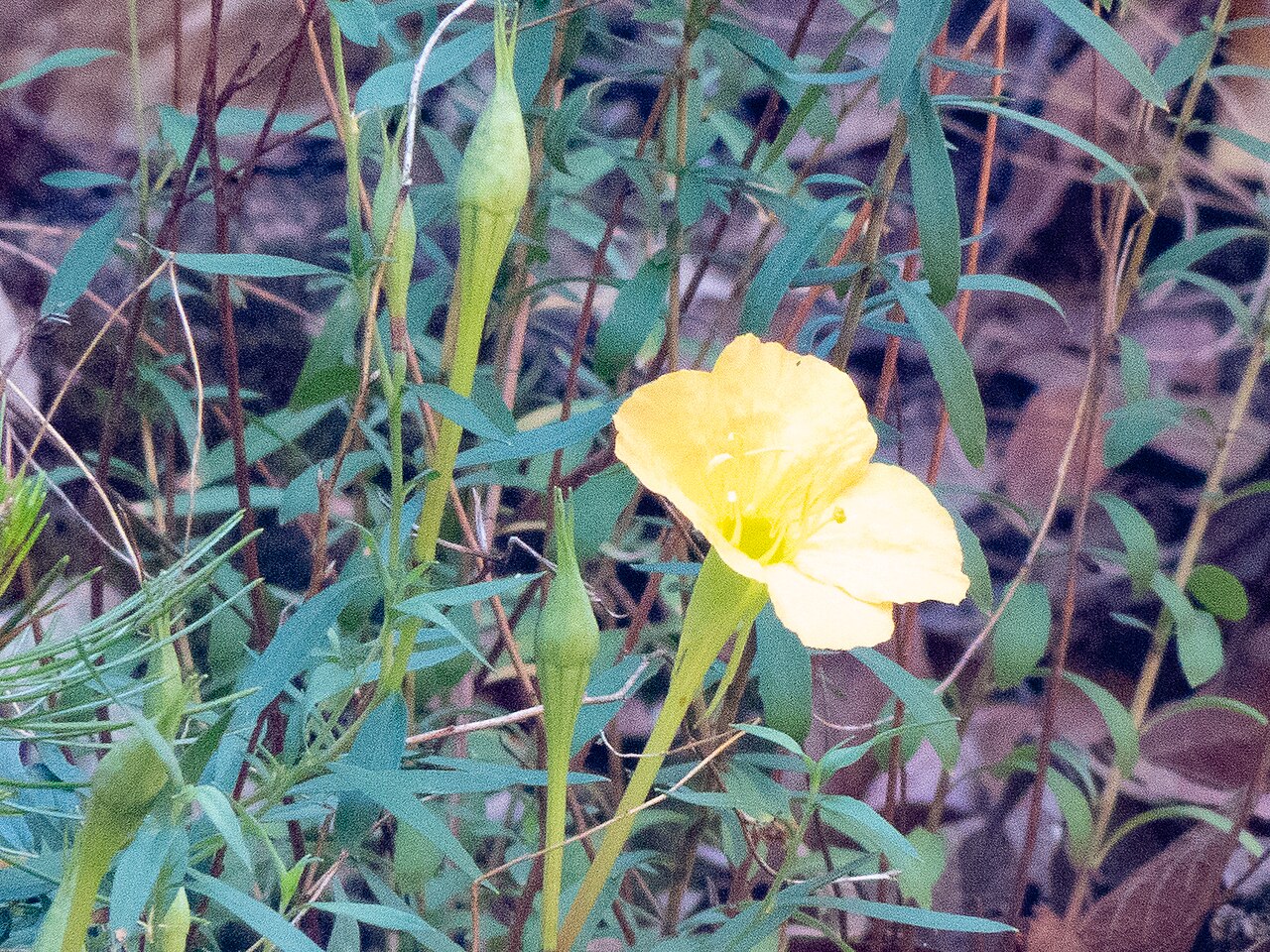
Leaves are simple, alternate, and narrowly linear to lance-shaped, usually ½ to 2 inches long and less than ½ inch wide, with smooth or slightly toothed margins. In the thread-leaf form common on gypsum sands (variety filifolia), the leaves are even narrower, almost needle-like. The fine-textured foliage is a useful field mark that separates this species from the broader-leaved Oenothera species it grows alongside.
Flowers & Fruit
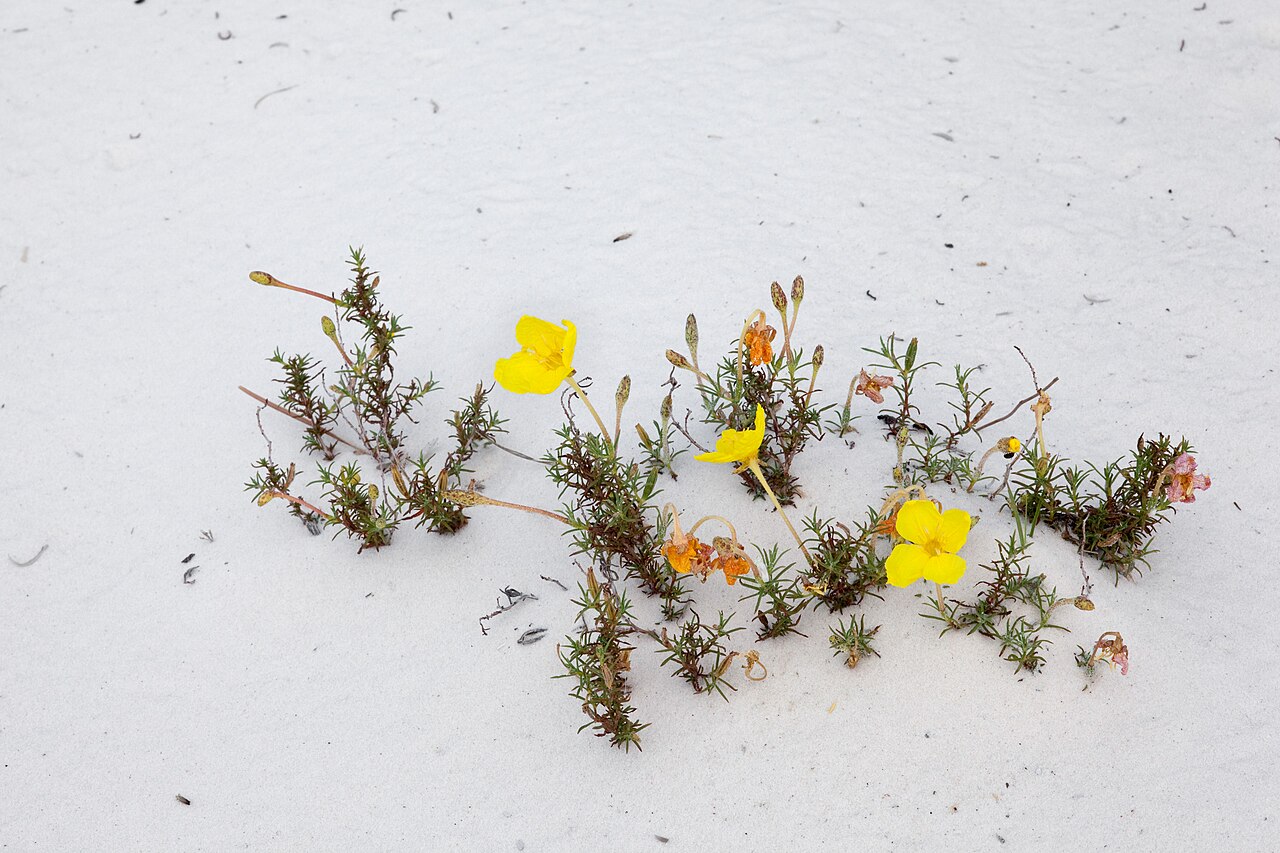
Flowers are solitary in the upper leaf axils, with four broad, overlapping yellow petals that together form a shallow cup 1 to 2 inches across. Buds and tubes are often tinged with red or purple before the petals unfurl. Flowers typically open in late afternoon or evening and last into the next day, fading to a pale orange or apricot color as they age — a two-tone effect that is sometimes mistaken for two different flower colors on the same plant. Bloom runs from spring through fall, with the heaviest flush after rain. The fruit is a narrow, four-angled woody capsule about ¾ to 1¼ inches long that splits open at maturity to release numerous small seeds.
Quick Facts
| Scientific Name | Oenothera hartwegii (syn. Calylophus hartwegii) |
| Family | Onagraceae (Evening Primrose) |
| Plant Type | Perennial Subshrub / Wildflower |
| Mature Height | 10–24 in (25–60 cm) |
| Mature Spread | 18–24 in (45–60 cm) |
| Growth Rate | Slow to Moderate |
| Sun Exposure | Full Sun to Part Shade |
| Water Needs | Low |
| Soil Type | Sandy, caliche, gypsum, or limestone-based; fast-draining |
| Soil pH | 7.0–8.5 (neutral to alkaline) |
| Bloom Time | March – November |
| Flower Color | Yellow, fading to orange/apricot |
| Fall Color | None notable (evergreen-gray foliage) |
| Fruit | Narrow four-angled woody seed capsule |
| Deer Resistant | Yes (generally not browsed) |
| USDA Hardiness Zones | 5–9 |
Native Range
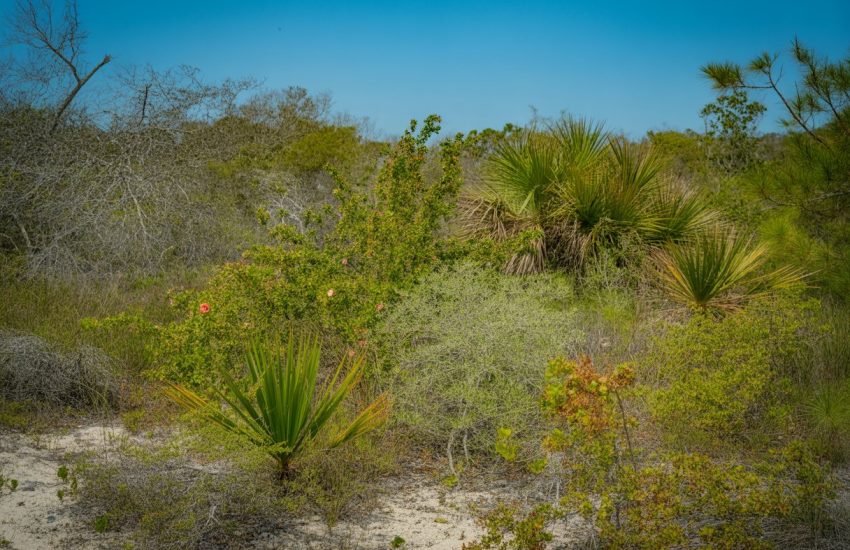
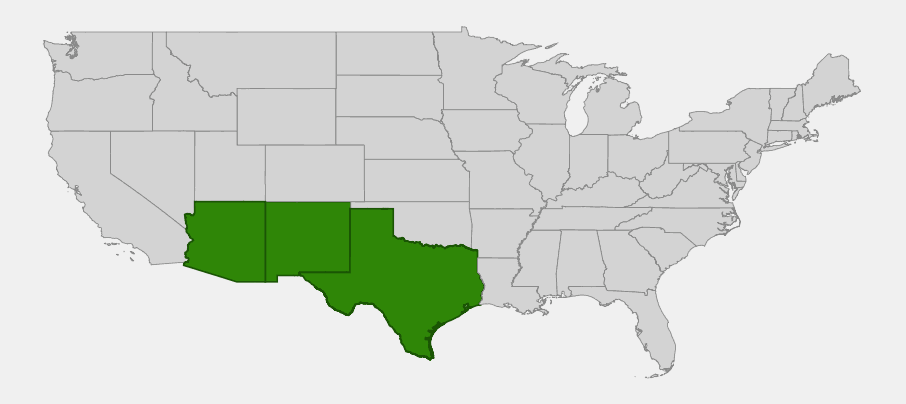
Hartweg’s sundrops is native to the arid grasslands, desert scrub, and limestone or gypsum badlands of the southern Great Plains and northern Chihuahuan Desert, from southeastern Arizona across New Mexico and into central, western, and southern Texas. It is most abundant on the Edwards Plateau, in the Trans-Pecos, and across the gypsum and limestone country of southern New Mexico, including well-known sites such as White Sands.
Within this range it favors open, sun-baked sites with thin, rocky, or sandy soils: limestone hillsides and caprock edges, caliche flats, roadcuts, and the pale gypsum dunes that support a distinctive flora of specialized plants. It is rarely found in dense grass cover or heavy clay, preferring the bare or sparsely vegetated ground typical of desert grassland and Chihuahuan desert scrub communities.
Although sometimes listed in older regional references for areas just north and east of this core range, county-level distribution records support a native range centered on Arizona, New Mexico, and Texas; plantings elsewhere in the southern Plains are garden introductions rather than wild populations.
📋 Regional plant lists featuring Hartweg’s Sundrops: South and West Texas · Arizona & New Mexico
Growing & Care Guide
Hartweg’s sundrops rewards gardeners who can resist the urge to coddle it. Give it sun, sharp drainage, and room to sprawl, and it will bloom for months with almost no attention.
Light
Plant in full sun for the densest, most floriferous mounds. It will tolerate light afternoon shade, especially in the hottest parts of Texas and Arizona, but flowering is reduced and stems tend to stretch and flop more in shadier spots.
Soil & Water
Fast drainage is essential. This species thrives in lean, rocky, sandy, caliche, or gypsum-based soils and is intolerant of heavy clay or poorly drained sites, where its woody crown is prone to rot. Established plants need little or no supplemental water beyond natural rainfall; a deep soak every few weeks during the hottest, driest stretches will extend the bloom season but is not required for survival.
Planting Tips
Set out container plants in fall or early spring so roots can establish before summer heat. Space plants 18 to 24 inches apart to allow for their sprawling habit. Raised beds, berms, rock gardens, and gravel mulch all help keep the crown dry and extend the life of the plant in gardens with heavier native soil.
Pruning & Maintenance
Shear plants back by about half in late winter or very early spring to remove the previous year’s woody growth and encourage a fuller, more compact mound. Deadheading spent flowers through the growing season will prolong bloom, though it is optional on an otherwise low-maintenance plant.
Propagation
Propagate from seed sown in fall or winter, which benefits from exposure to cold temperatures before germinating in spring. Softwood cuttings taken in late spring or early summer root readily in a fast-draining mix and are the most reliable way to reproduce a particular color form.
Landscape Uses
- Rock gardens and gravel beds, where the sprawling habit and fine foliage pair well with boulders and stone
- Xeriscapes and water-wise borders needing long summer color with minimal irrigation
- Slope and bank plantings on dry, sunny grades
- Edging and front-of-border use thanks to its low, mounding form
- Pollinator gardens focused on moths and other evening-active insects
Wildlife & Ecological Value
Like many of its relatives in Oenothera section Calylophus, Hartweg’s sundrops plays an outsized ecological role for a small plant, anchoring loose desert and grassland soils while feeding a specialized set of pollinators through the heat of the Southwest summer.
For Pollinators
The large, pale yellow flowers that open in late afternoon and evening are tuned to hawkmoths (sphinx moths), which hover and feed on the nectar after dark; researchers studying gypsum-dwelling evening primroses in the northern Chihuahuan Desert have documented hawkmoths as the primary pollinators of this species. Bees and other daytime insects also visit flowers that remain open into the morning, making it a useful nectar source across a long daily and seasonal window.
For Birds
Seed-eating sparrows and other grassland and desert birds forage on the small seeds released from the capsules, particularly in fall and winter when other seed sources are scarce.
For Mammals
The foliage is not a preferred browse for deer or livestock, which is part of why the species persists so well on grazed rangeland; small mammals occasionally use the low, branching mounds for cover.
Ecosystem Role
As a deep-rooted perennial on some of the harshest, least-vegetated soils in its range — bare caliche, gypsum, and limestone outcrops — Hartweg’s sundrops helps stabilize thin desert soils and is one of relatively few flowering plants able to colonize these specialized substrates, supporting pollinator communities in places most other wildflowers cannot grow.
Cultural & Historical Uses
Hartweg’s sundrops carries the English name of German-born botanical collector Karl Theodor Hartweg, who collected extensively in Mexico and the American Southwest in the 19th century, and whose name is attached to several Southwestern plants first described from his collections.
The species has no significant recorded history of use by Indigenous peoples of the region as food or medicine, and it has not historically been a commercial crop or forage plant. Its modern significance is almost entirely horticultural and ecological: it has become one of the more widely available native Calylophus species in Southwestern nurseries, promoted for low-water landscaping.
Among botanists, the gypsum and limestone populations of this species — and its close relatives in the same group — have drawn research interest as examples of plants specialized to extreme, mineral-rich soils, and as a textbook case of hawkmoth pollination in the evening primrose family.
Frequently Asked Questions
Is Hartweg’s sundrops the same plant as Calylophus hartwegii?
Yes. Botanists have reclassified the genus Calylophus into Oenothera, so Calylophus hartwegii and Oenothera hartwegii refer to the same plant. Nurseries and older references often still use the Calylophus name.
Why do the flowers change color?
Flowers open bright yellow and gradually fade to orange or apricot as they age over a day or two, so a single plant often shows both colors at once. This is a normal part of the flower’s life cycle, not a sign of stress or a different cultivar.
How much water does Hartweg’s sundrops need once established?
Very little. It is adapted to some of the driest, least fertile soils in the Southwest and generally needs no supplemental irrigation beyond natural rainfall once established, though occasional deep watering during extended drought will keep it blooming longer.
Will Hartweg’s sundrops spread aggressively in my garden?
No. It spreads slowly by sprawling stems and self-sown seed rather than by running roots, and it is easy to keep within bounds with an annual late-winter trim.
Can I grow Hartweg’s sundrops outside its native Southwest range?
It is sometimes grown as a drought-tolerant ornamental farther north and east, including parts of the southern Plains, but it is only native to Arizona, New Mexico, and Texas; gardeners outside that range should check its hardiness and treat it as an introduced xeriscape plant rather than a native one.

Looking for a nursery that carries Hartweg’s Sundrops?
Browse our native plant nursery directory: Arizona · New Mexico · Texas