Fluffgrass (Dasyochloa pulchella)
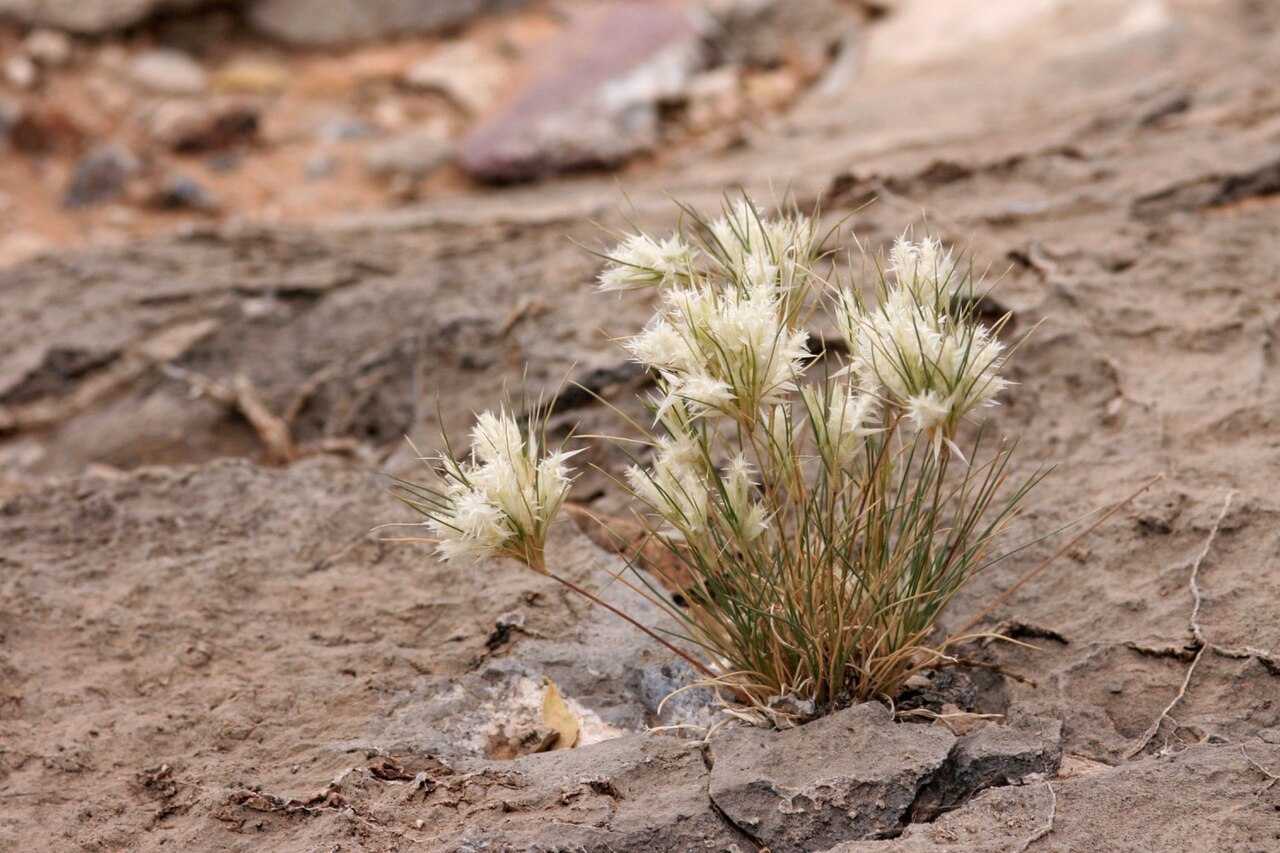
Dasyochloa pulchella (syn. Erioneuron pulchellum, Tridens pulchellus), commonly called Fluffgrass or Desert Fluff-grass, is one of the smallest and toughest native grasses of the American Southwest. This diminutive perennial forms dense, low tufts rarely taller than a fist, but what it lacks in stature it makes up for in sheer persistence — thriving in gravelly desert pavement, rocky slopes, and sun-baked flats where almost nothing else will grow. Its common name comes from the soft, cottony white seed plumes that erupt from each stem after a rain, giving established clumps a fuzzy, almost snow-dusted look against the bare desert ground.
Fluffgrass is the sole member of its genus, Dasyochloa, within the grass family Poaceae. It is an opportunistic grower: unlike many grasses that are strictly warm-season or cool-season, fluffgrass can green up and flower whenever soil moisture allows, whether that is a summer monsoon downpour or a cool winter rain. Within days of rainfall, the wiry, hair-fringed leaves turn from straw-brown to green, and the plant pushes out its characteristic woolly inflorescences — then dries back down to a tan, dormant tuft as the desert reclaims its moisture.
For gardeners working with true desert conditions, fluffgrass is an excellent choice for rock gardens, gravel beds, and naturalistic desert landscaping where a traditional lawn grass would fail outright. It asks for almost nothing — no irrigation beyond rainfall in most of its range, no fertilizer, no mowing — and it quietly stitches together the open ground between cacti, agaves, and desert shrubs the way a groundcover should.
Identification
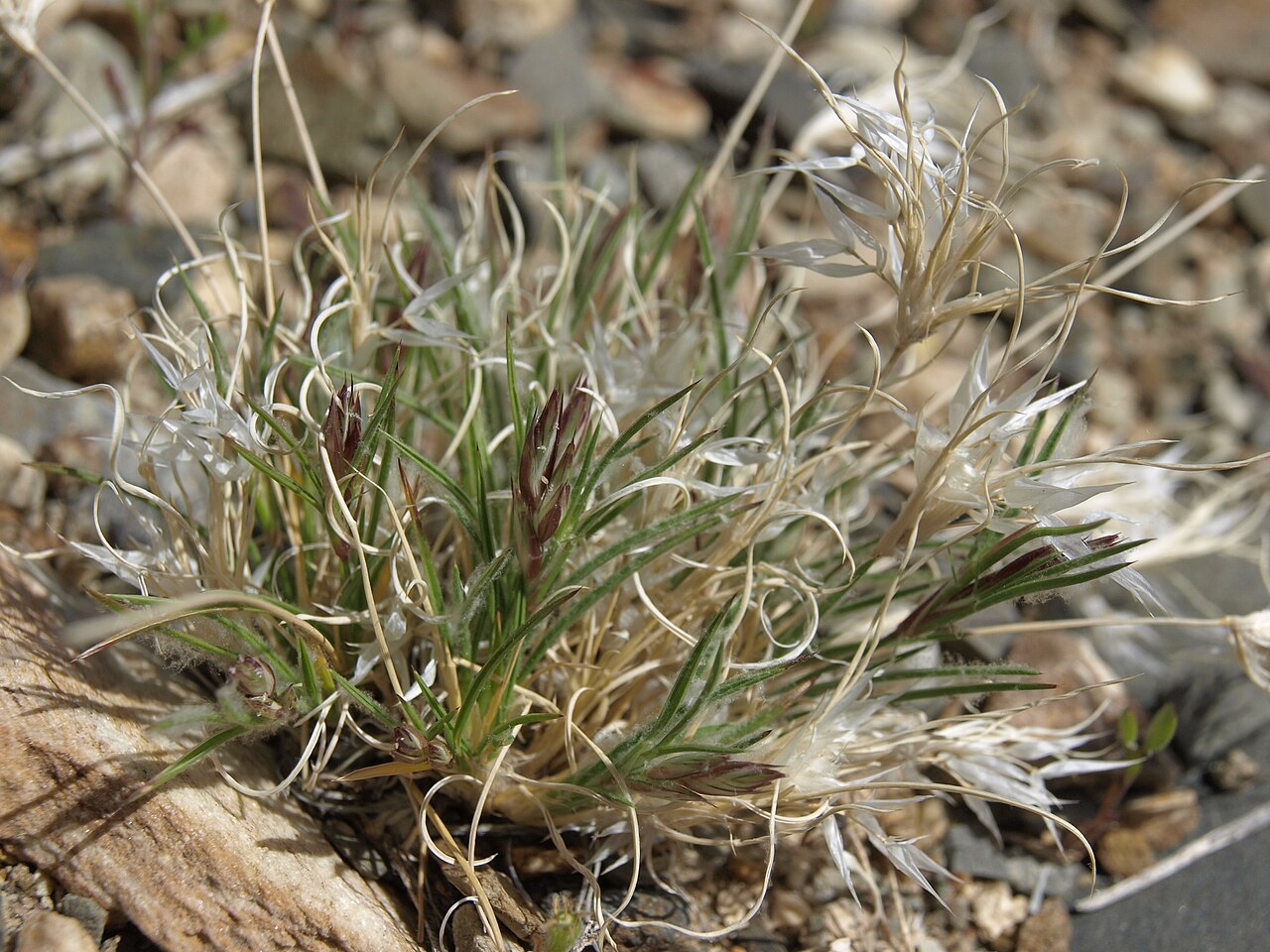
Fluffgrass is unmistakable once you know what to look for: a tight, cushion-like tuft of fine, wiry leaves, usually no more than 4 to 8 inches tall and 6 to 12 inches across, often growing in slightly raised mounds where windblown sand and grit have collected around the root crown.
Leaves & Stems
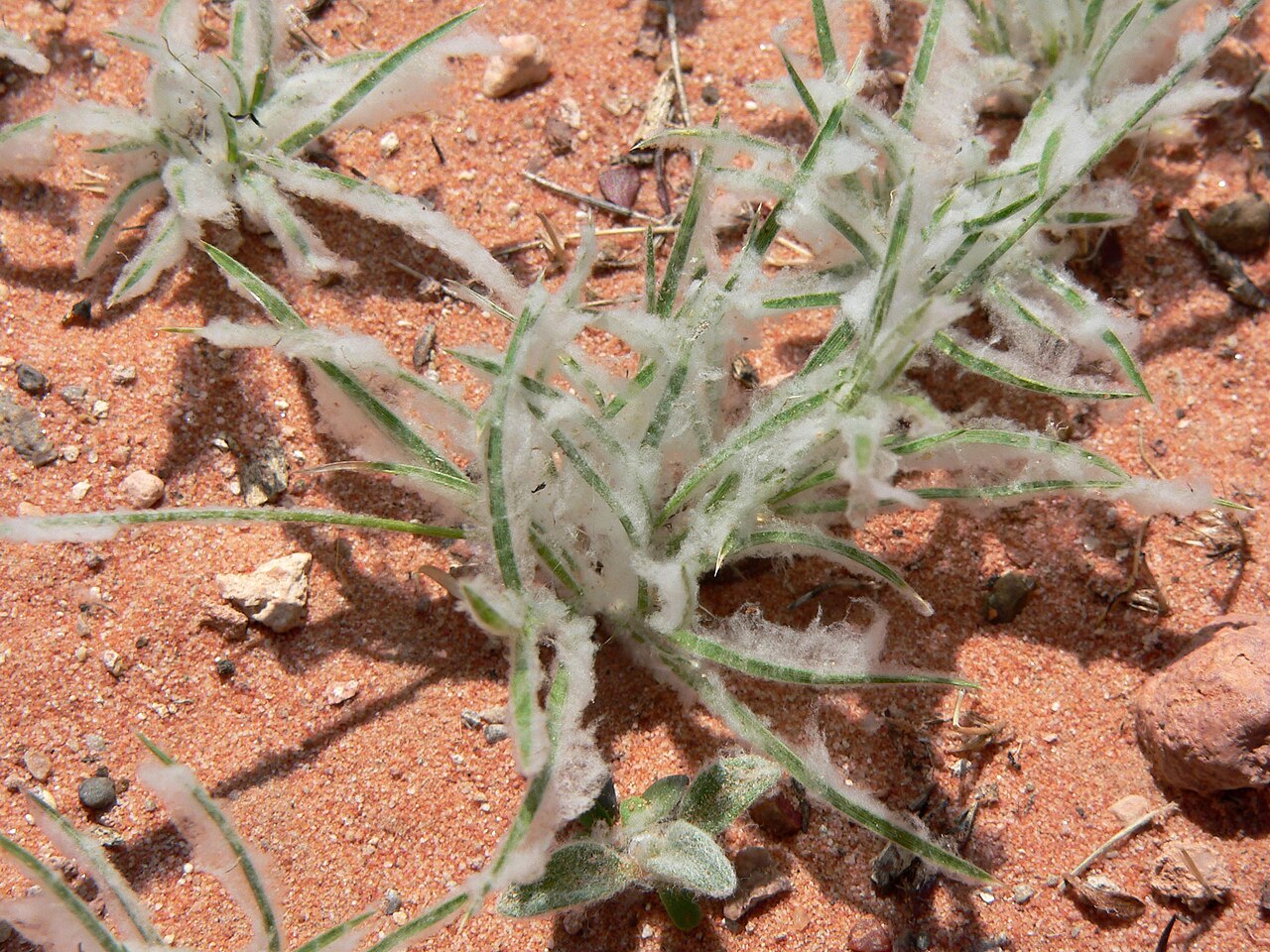
The leaf blades are short, narrow, and stiffly curled or twisted, typically only 1 to 2 inches long, with margins lined by tiny stiff hairs that can feel almost spiny to the touch. The sheaths at the base of the plant are often covered in dense white wool, especially where new shoots emerge — one of the most useful identification marks separating fluffgrass from other small desert grasses. The whole plant has a grayish-green cast that fades to tan and curls into tight spirals during drought.
Flowers & Seed Heads
The inflorescence is a short, dense, plume-like cluster 1 to 2 inches long, packed with silky white hairs that give the whole seed head a cottony, almost flower-like appearance — this is the “fluff” the plant is named for. Spikelets are pale, sometimes faintly striped with red, purple, or green, and the hairy bracts persist long after the seeds have matured, so a healthy stand can look like scattered tufts of cotton candy pinned to the desert floor. Flowering is opportunistic rather than seasonal; a fluffgrass plant can bloom in spring, after summer monsoons, or following any soaking rain, then cycle back to dormancy within a few weeks.
Roots
Beneath its small above-ground profile, fluffgrass maintains a surprisingly extensive, fibrous root system that spreads wide through the top few inches of soil, allowing it to capture even light, scattered rainfall before it evaporates — a key survival adaptation shared with many desert grasses.
Quick Facts
| Scientific Name | Dasyochloa pulchella (syn. Erioneuron pulchellum, Tridens pulchellus) |
| Family | Poaceae (Grass) |
| Plant Type | Perennial Bunchgrass |
| Mature Height | 4–8 in (10–20 cm) |
| Mature Spread | 6–12 in (15–30 cm) |
| Growth Rate | Slow to moderate; opportunistic after rain |
| Sun Exposure | Full Sun |
| Water Needs | Very Low; thrives on rainfall alone |
| Soil Type | Rocky, gravelly, or sandy; low fertility fine |
| Soil pH | 6.5–8.5 (tolerates alkaline soils) |
| Bloom Time | Opportunistic — spring through fall after rain |
| Flower Color | Whitish, sometimes purple- or red-tinged |
| Fall Color | Tan; curls into tight dormant tufts |
| Fruit | Tiny grain (caryopsis) within woolly spikelets |
| Deer Resistant | Yes; wiry foliage is low-palatability |
| USDA Hardiness Zones | 7–10 |
Native Range
Fluffgrass is a true denizen of the Chihuahuan, Sonoran, and Mojave deserts, native from southern California and southern Nevada east across Arizona, Utah, Colorado, and New Mexico to central and western Texas, and south into northern and central Mexico. It is one of the most widely distributed small grasses of the North American warm deserts, equally at home on the gravelly bajadas of the Mojave and the limestone flats of the Trans-Pecos.
Across this range, fluffgrass favors open, disturbed-looking ground: desert pavement, rocky outcrops, roadcuts, arroyo edges, and the thin soils between larger shrubs and cacti. It is often one of the first plants to colonize compacted or previously disturbed desert soils, and it persists on sites too harsh and too dry for most other grasses, from below sea level in Death Valley to rocky slopes above 6,000 feet in elevation.
Because fluffgrass germinates and grows opportunistically after rain rather than on a fixed seasonal schedule, it can be found scattered through its range in any given year depending on recent precipitation, sometimes appearing abundant after a wet winter or summer monsoon and nearly invisible, reduced to dormant tan tufts, during extended drought.
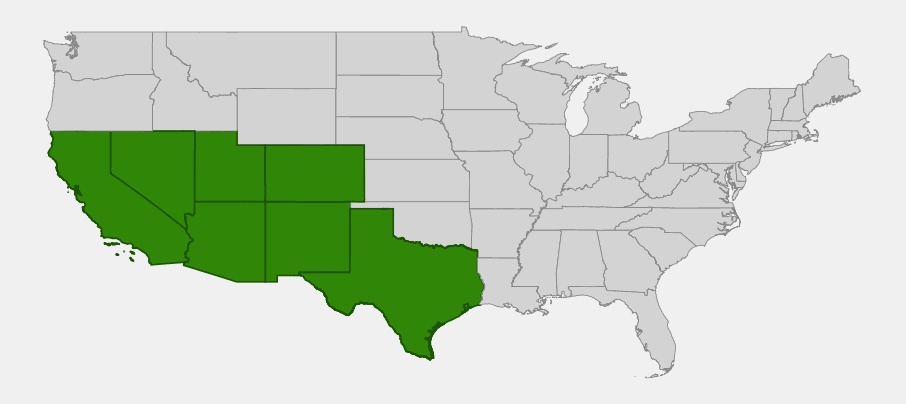
📋 Regional plant lists featuring Fluffgrass: California & Nevada · South & West Texas · Arizona & New Mexico · Utah & Western Colorado
Growing & Care Guide
Fluffgrass is about as low-maintenance as a native grass gets, provided it is given the harsh, well-drained, sun-baked conditions it evolved for. Treat it gently when it comes to water and soil fertility — both kindness that fluffgrass does not need and does not reward.
Light
Give fluffgrass full sun. It is a true desert species adapted to intense, unfiltered sunlight and reflected heat from bare rock and soil; in anything less than full sun it tends to grow sparse and leggy, losing the tight, cushion-like form that makes it attractive in a rock garden.
Soil & Water
Fast drainage is non-negotiable. Fluffgrass is naturally found in gravelly, rocky, or sandy soils with little organic matter, and it performs best in lean, mineral soils rather than rich garden beds. Established plants need no supplemental irrigation in most of their native range — they simply green up after rain and go dormant between storms. In cultivation, an occasional deep soak during long dry spells will keep plants looking fuller, but overwatering or heavy, poorly drained soil is the fastest way to kill fluffgrass through root rot.
Planting Tips
Plant small container starts or direct-sow seed in fall or early spring, timed if possible to coincide with expected rain. Amend heavy clay soils with coarse sand or gravel before planting; fluffgrass does far better in native desert soil left largely unimproved than in enriched garden loam. Space plants 8 to 12 inches apart for a naturalistic, mounded groundcover effect, allowing the tufts to fill in gradually.
Pruning & Maintenance
Fluffgrass needs essentially no pruning. Old, dried flower plumes can be left in place through winter for textural interest and wildlife value, or trimmed back lightly in early spring if a tidier look is wanted. Because it stays so small, it never requires mowing.
Propagation
Fluffgrass reseeds readily where conditions suit it, and established stands will slowly spread by seed into surrounding bare ground. Collect ripe, woolly seed heads after they have dried on the plant, and scatter seed onto prepared, lightly raked soil ahead of the rainy season for best germination.
Landscape Uses
Fluffgrass fills a distinct niche in desert landscaping:
- Rock gardens — tucked into gravel beds and between boulders
- Xeriscaping — a true no-irrigation groundcover for arid yards
- Erosion control on disturbed, compacted, or rocky desert soils
- Contrast planting — its fine, fuzzy texture sets off bold-leaved cacti and agaves
- Desert pavement restoration and reclamation of disturbed sites
- Pathway edging in low-water desert gardens
Wildlife & Ecological Value
Despite its small size, fluffgrass plays a disproportionately useful role in desert ecosystems that otherwise offer very little in the way of ground-level cover and forage.
For Reptiles
Fluffgrass is used throughout the year as forage by the desert tortoise, a species for which green, low-growing plants are scarce for much of the year in its hot desert habitat. The grass’s opportunistic growth after rain makes it one of the more reliably available food sources in an otherwise sparse landscape.
For Birds & Small Mammals
The small seeds produced in fluffgrass’s cottony spikelets are taken by sparrows, quail, and other seed-eating desert birds, as well as by kangaroo rats, pocket mice, and other small rodents. The dense, low tufts also provide modest cover for insects and small animals moving across otherwise open desert ground.
Ecosystem Role
As one of the few grasses able to colonize bare desert pavement and disturbed soils, fluffgrass helps stabilize fine sediments against wind and water erosion and contributes organic matter to notoriously thin desert soils as its tufts die back and decompose. Its presence often marks an early stage in the slow recovery of disturbed desert ground, paving the way, together with biological soil crusts, for longer-lived shrubs and cacti to establish.
Cultural & Historical Uses
Fluffgrass has never been an important forage or fiber plant commercially — its tiny stature and sparse biomass make it impractical for livestock grazing or craft use, and it is generally considered to provide only limited, low-preference forage for cattle and other domestic grazers. Its primary value has always been ecological rather than economic: a small but tenacious colonizer of the harshest ground in the Southwest.
Among desert naturalists and native plant gardeners, fluffgrass has gained appreciation more recently as an accent and groundcover species precisely because of the qualities that made it unremarkable to earlier agricultural eyes — its extreme drought tolerance, its soft textural contrast against spiny desert plants, and its reliable, rain-triggered flush of cottony seed heads that mark the changing desert seasons.
Today, fluffgrass is increasingly specified in low-water, native desert landscaping projects across the Southwest, valued by xeriscape designers for exactly the reasons it survives so well in the wild: it needs nothing from the gardener once established, and it asks for exactly the conditions — heat, sun, and lean rocky soil — that are often hardest to work with in a desert yard.
Frequently Asked Questions
Why is fluffgrass called “fluffgrass”?
The name comes from its seed heads, which are densely covered in soft, cottony white hairs that make the whole plume look fuzzy or fluffy, especially when backlit by low desert sun.
Does fluffgrass need any watering once established?
In most of its native range, no. Fluffgrass is adapted to survive on rainfall alone, greening up after storms and going dormant during dry stretches. An occasional deep soak during extreme drought can help it look fuller, but it is not required for survival.
Is fluffgrass a good lawn substitute?
Not as a walkable turf — it grows in small, separate tufts rather than a dense sod. It works best as a textural groundcover in rock gardens and gravel beds rather than a mowed lawn alternative.
Will fluffgrass spread and become weedy?
No. Fluffgrass is a well-behaved native that spreads slowly by seed into open, bare ground and is not considered invasive or aggressive anywhere within or outside its native range.
What wildlife benefits most from fluffgrass?
Desert tortoises rely on it as a year-round food source, and small desert birds and rodents feed on its seeds. Its low tufts also offer modest shelter for ground-dwelling insects in otherwise exposed desert terrain.

Looking for a nursery that carries Fluffgrass?
Browse our native plant nursery directory: California · Arizona · Colorado · Nevada & New Mexico · Texas & Utah