Meadow Death Camas (Toxicoscordion venenosum)
Meadow death camas (Toxicoscordion venenosum, formerly Zigadenus venenosus) is a widespread western North American wildflower whose common and scientific names both point directly at its defining trait: this plant is highly toxic and must never be eaten. Every part of meadow death camas — bulb, leaves, flowers, and seeds — contains poisonous steroidal alkaloids capable of causing serious illness or death in people and livestock. This page documents it strictly as a toxic native wildflower of ecological and botanical interest, never as a food source.
Despite its danger if ingested, meadow death camas is a legitimate, ecologically important member of grassland and open-woodland plant communities across much of the western United States and adjacent Canada. It grows from an onion-like bulb, sending up narrow, V-folded leaves and a spike of small, off-white, star-shaped flowers in spring and early summer — a bloom that, while attractive from a distance, should never be touched carelessly or handled by anyone unaware of its toxicity, particularly children, foragers, and anyone with grazing livestock nearby.
For native plant gardeners and land managers, meadow death camas is worth knowing primarily for safety and identification purposes: distinguishing it from true edible camas (Camassia species) and from edible wild onions is an essential skill for anyone foraging in western grasslands, since the bulbs of all three plants can look superficially similar when not in flower.
Identification
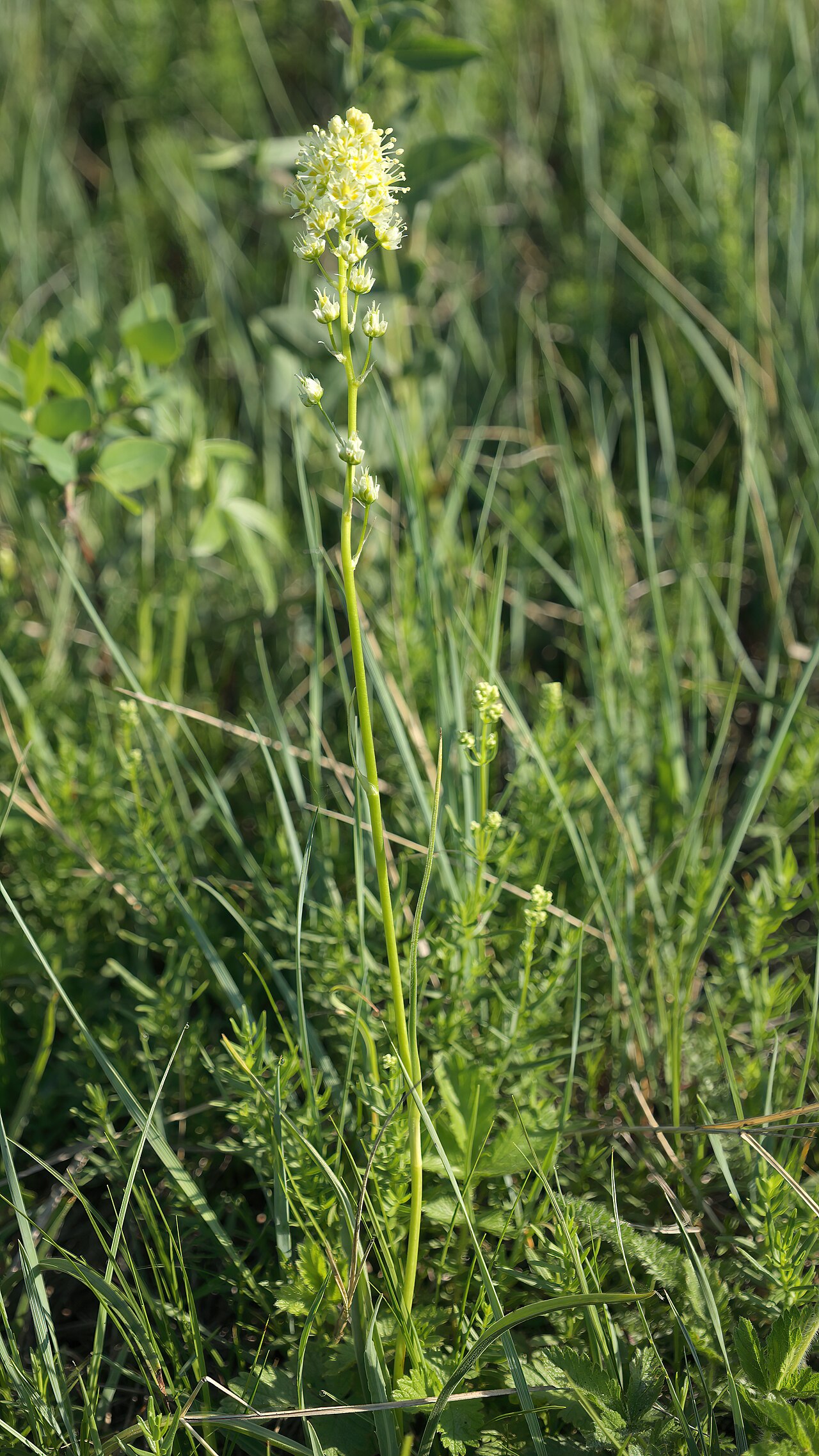
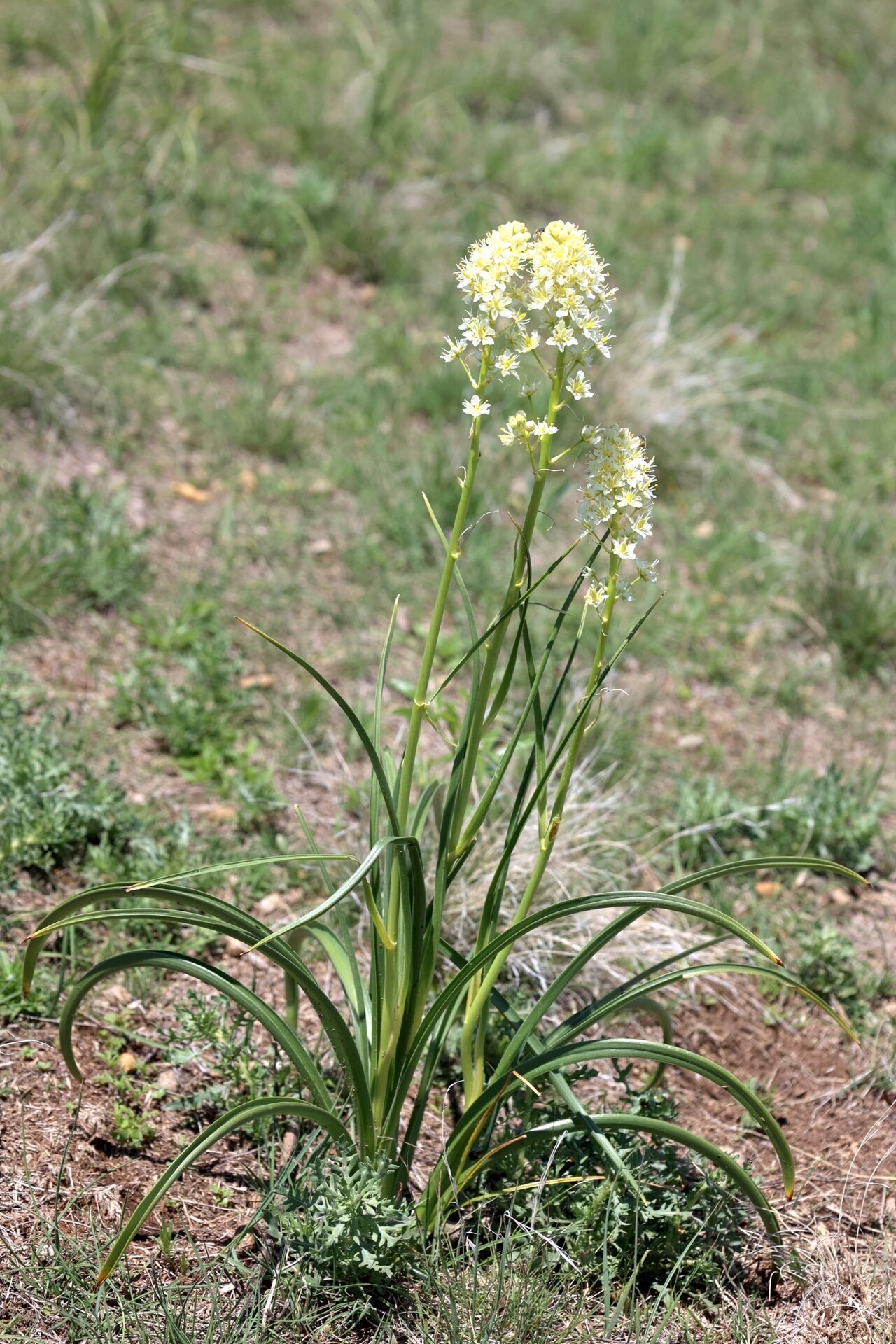
Meadow death camas is a bulb-forming perennial reaching 8 to 28 inches (20–70 cm) tall when in flower during spring or early summer. The underground bulb is egg-shaped and layered like an onion, protected by dried outer scales.
Leaves
Leaves emerge very early in spring, are narrow, and mostly basal, springing directly from the ground near the bulb, with only a few much smaller leaves attached higher on the flowering stem. Leaf blades are 4.5 to 19.5 inches (12–50 cm) long but only 1/8 to 3/8 inch (2–10 mm) wide, and are sharply folded into a V-shape along their length with a distinct ridge (keel) running along the bottom of the fold — a key identification feature that distinguishes the foliage from the round, hollow leaves of true wild onions.
Flowers
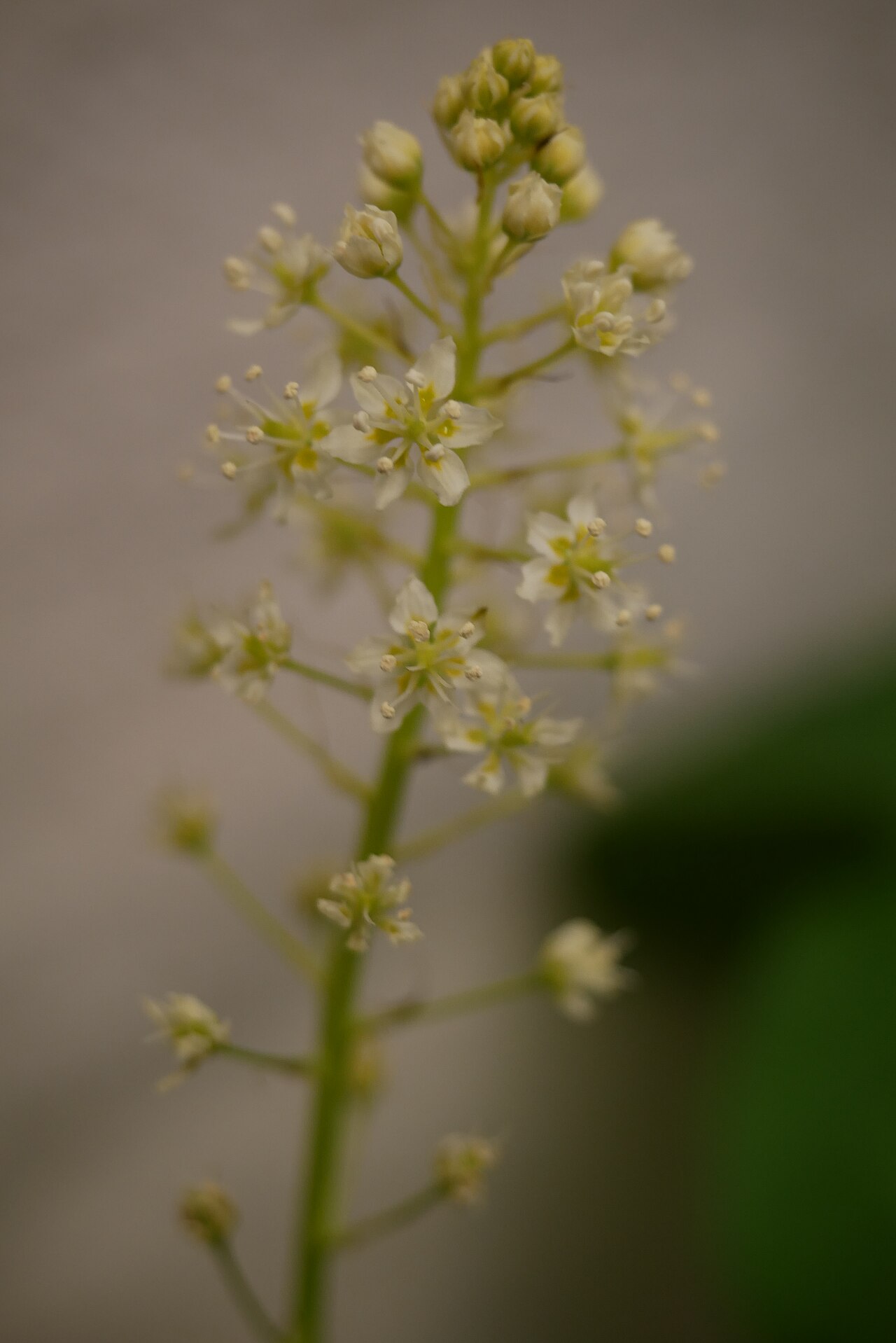
The flower spike is usually unbranched (a simple raceme), occasionally with one or two short branches near the base, and can carry 10 to 50 individual flowers. Each flower is off-white to cream, star-shaped, and 1/4 to 3/8 inch (5–10 mm) across, with six tepals (the combined petals and sepals, which look alike in this genus) — the outer three somewhat egg-shaped and curved inward, the inner three more spear-shaped and tinged yellowish-green. Flowering typically occurs between April and July depending on elevation and location.
Fruit & Seeds
After flowering, the plant produces a dry capsule 1/4 to 3/4 inch (8–20 mm) long containing light brown seeds about 1/4 inch (5–6 mm) long. As with every other part of the plant, the fruit and seeds remain toxic and must never be eaten or used in food preparation.
Quick Facts
| Scientific Name | Toxicoscordion venenosum (syn. Zigadenus venenosus) |
| Family | Melanthiaceae |
| Plant Type | Perennial bulb; highly toxic, not for food or medicinal use |
| Mature Height | 8–28 in (20–70 cm) |
| Mature Spread | Under 1 ft clump of basal leaves |
| Growth Rate | Slow |
| Sun Exposure | Full Sun to Part Shade |
| Water Needs | Low to Moderate (winter-wet, summer-dry) |
| Soil Type | Well-drained grassland soils; also open coniferous forest and sagebrush steppe |
| Soil pH | 6.0–7.5 |
| Bloom Time | April – July |
| Flower Color | Cream to off-white |
| Fall Color | N/A; summer-dormant |
| Fruit | Dry capsule with light brown seeds; toxic |
| Deer Resistant | Yes (toxic; avoided by most grazers) |
| USDA Hardiness Zones | 4–9 |
⚠ Toxicity warning: Meadow death camas is highly toxic to humans and livestock. The bulb in particular can be mistaken for edible wild onion or true camas bulbs when not in flower. Never taste, forage, or prepare any part of this plant as food or home remedy. If ingestion is suspected, contact Poison Control or a veterinarian immediately.
Native Range
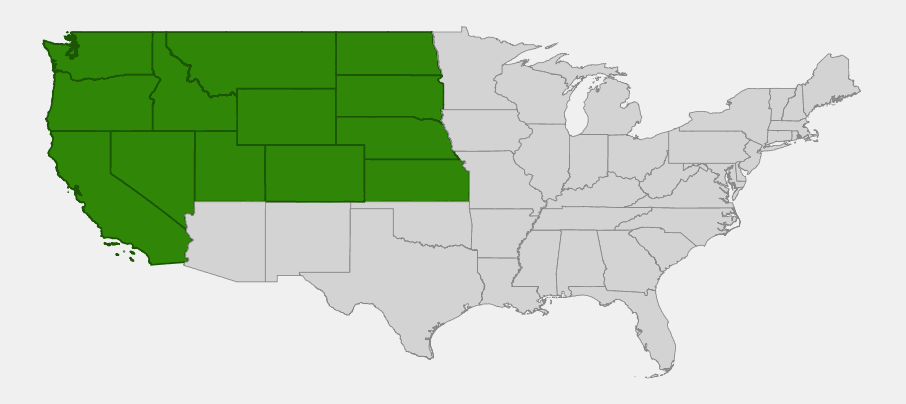
Meadow death camas has one of the broadest ranges of any species in its genus, native across much of western North America. In Canada it occurs in Alberta, British Columbia, and Saskatchewan. In the United States it is found from the West Coast east to the Rocky Mountains, including California, Nevada, Oregon, Washington, Idaho, Montana, Wyoming, Utah, Colorado, New Mexico, Nebraska, North Dakota, and South Dakota — notably, it is absent from Arizona. It also extends south into Baja California, Mexico.
Within this range, meadow death camas favors open, sunny habitats: grasslands, sagebrush steppe, open pine woodlands, and openings in coniferous forest, generally from near sea level up to roughly 8,200 feet depending on the variety and region. It tolerates drier sites than its showier relative, common camas (Camassia quamash), which helps explain its wider ecological distribution across the interior West.
Because meadow death camas occurs so widely, confirm local presence with a regional source before relying on this page as a complete inventory of where it grows, and always treat any unidentified death-camas-like plant encountered in the field with the same caution regardless of exact location.
📋 Regional plant lists featuring Meadow Death Camas: California & Nevada · Western Oregon & Western Washington · Idaho, Eastern Oregon & Eastern Washington · Montana & Wyoming · Utah & Western Colorado · Nebraska, Kansas & Eastern Colorado · North Dakota, South Dakota & Western Minnesota
Growing & Care Guide
Meadow death camas is occasionally included in native grassland restoration and demonstration plantings for its ecological and identification value, but it is not a typical home-garden ornamental given the safety considerations involved. Anyone choosing to grow it should do so deliberately, with clear awareness of its toxicity and appropriate placement away from children, pets, livestock, and food gardens.
Light
Meadow death camas tolerates full sun to partial shade, consistent with its natural range across open grassland, sagebrush steppe, and forest openings.
Soil & Water
It prefers well-drained soils and a winter-wet, summer-dry moisture pattern typical of its native range, though the variety gramineum tolerates somewhat moister coastal conditions than the interior variety venenosum. It is more drought-tolerant than common camas, able to persist on drier hillsides and openings where consistent summer moisture is not available.
Planting Tips
If included in a restoration or demonstration planting, site meadow death camas well away from vegetable gardens, grazing areas, and anywhere children or pets have unsupervised access, and label it clearly. Plant bulbs in fall, at a similar depth and timing to other western native geophytes.
Safety & Maintenance
Always wear gloves when handling the bulbs or digging in areas where this plant grows, and wash hands thoroughly afterward. Keep grazing livestock out of areas with significant meadow death camas populations, particularly in early spring when the toxic young growth emerges before most other forage plants and may be grazed inadvertently by hungry animals.
Landscape & Restoration Uses
Given its toxicity, meadow death camas is best reserved for specific, carefully managed purposes:
- Native grassland and sagebrush steppe restoration where it is a natural component of the plant community
- Educational and demonstration plantings that teach safe plant identification
- Rangeland management reference plantings to help ranchers recognize and avoid the plant
It is not recommended for ornamental home gardens, especially where children, pets, or grazing animals have access.
Wildlife & Ecological Value
Meadow death camas has a genuinely unusual ecological story: its toxicity has shaped a highly specialized relationship with a single group of pollinators rather than simply excluding wildlife interaction altogether.
For Pollinators
The plant’s nectar and pollen are themselves toxic, and controlled studies have shown that honeybees can be fatally poisoned by feeding on the flowers. Despite this, meadow death camas is visited and effectively pollinated by a specialist native bee, the death camas miner bee (Andrena astragali), which appears to be the only bee able to tolerate the plant’s toxins. This bee is an oligolege, meaning it specializes almost exclusively on meadow death camas and its close relative, foothills death camas, and seed production in the plant increases significantly when these specialist bees are present. One proposed explanation for this unusual relationship is that, similar to the monarch butterfly’s use of toxic milkweed, sequestering the plant’s toxins may help protect the bee from predators and parasites.
For Mammals & Livestock
Meadow death camas is one of the most significant poisonous range plants in the western United States, and livestock losses — particularly in sheep, but also cattle — are a documented, ongoing concern on western rangeland, especially in early spring when the plant’s young growth emerges before most other forage and may be grazed by hungry animals before better options green up. Ranchers and land managers actively work to identify and manage pastures where it grows densely.
Ecosystem Role
As a toxic but well-established component of western grassland, sagebrush steppe, and open woodland plant communities, meadow death camas occupies an ecological niche shaped almost entirely by its chemical defenses — deterring most herbivores while supporting a tightly specialized pollination relationship found in few other native wildflowers. Its presence is a normal, expected part of healthy rangeland plant diversity across much of its wide range.
Cultural & Historical Uses
The common name “death camas” reflects the plant’s long-recognized danger relative to true camas (Camassia species), whose similar-looking bulbs were a vital Indigenous food source across the same western landscapes. Distinguishing the two by their flowers — true camas has showy blue to purple blooms, while death camas species have small, cream-colored flowers — was an essential survival skill for Indigenous peoples harvesting camas bulbs, since the plants can grow intermixed and their bulbs look similar when not in flower.
Various Indigenous languages across the plant’s range have names reflecting its danger: in the Northern Pomo language it and related species are called “tsim’bu,” meaning “harmful bulb,” while names in the Umatilla and Ktunaxa languages likewise identify it as a plant to be avoided rather than gathered. This body of traditional ecological knowledge, built over countless generations of careful observation, represents exactly the kind of plant identification expertise this page aims to support — never as a food or medicine, but as essential safety information.
Historically, the plant’s toxicity has also made it a subject of interest in veterinary and rangeland science, given its well-documented role in sheep and cattle poisoning incidents across the western United States; agricultural extension services in many western states continue to publish guidance on recognizing and managing death camas on grazing land.
Frequently Asked Questions
Is meadow death camas safe to eat in any amount or preparation?
No. Meadow death camas is highly toxic in all its parts and under all conditions, including cooking. It must never be eaten, prepared as food, or used as a home remedy under any circumstances.
How can I tell meadow death camas apart from edible wild onion?
True wild onions have round, hollow, onion-scented leaves, while meadow death camas has flat, V-folded, keeled leaves with no onion smell. When in doubt, never taste an unidentified bulb — a strong onion smell is a helpful but not foolproof clue, and the safest approach is confident visual identification of the flowers.
What should I do if a pet or child may have eaten part of this plant?
Treat it as a medical emergency. Contact Poison Control (or a veterinarian for animals) immediately and seek professional medical guidance rather than attempting any home treatment.
Why do bees visit a poisonous flower?
A specialist native bee, the death camas miner bee, has evolved tolerance to the plant’s toxins and feeds almost exclusively on meadow death camas and its close relatives — most other bees, including honeybees, can be harmed or killed by the toxic nectar and pollen.
Should I remove meadow death camas if I find it on my property?
Not necessarily — it is a native plant with ecological value, including its specialized pollinator relationship. The more important step is awareness: fence or otherwise restrict access for children, pets, and grazing livestock rather than treating it as a plant that must be eliminated.

Looking for a nursery in your area?
Browse our native plant nursery directory: California · Oregon · Washington · Idaho · Montana · Wyoming · Utah & South Dakota · Colorado · Nebraska, Nevada & North Dakota