Swamp Rosemallow (Hibiscus grandiflorus)
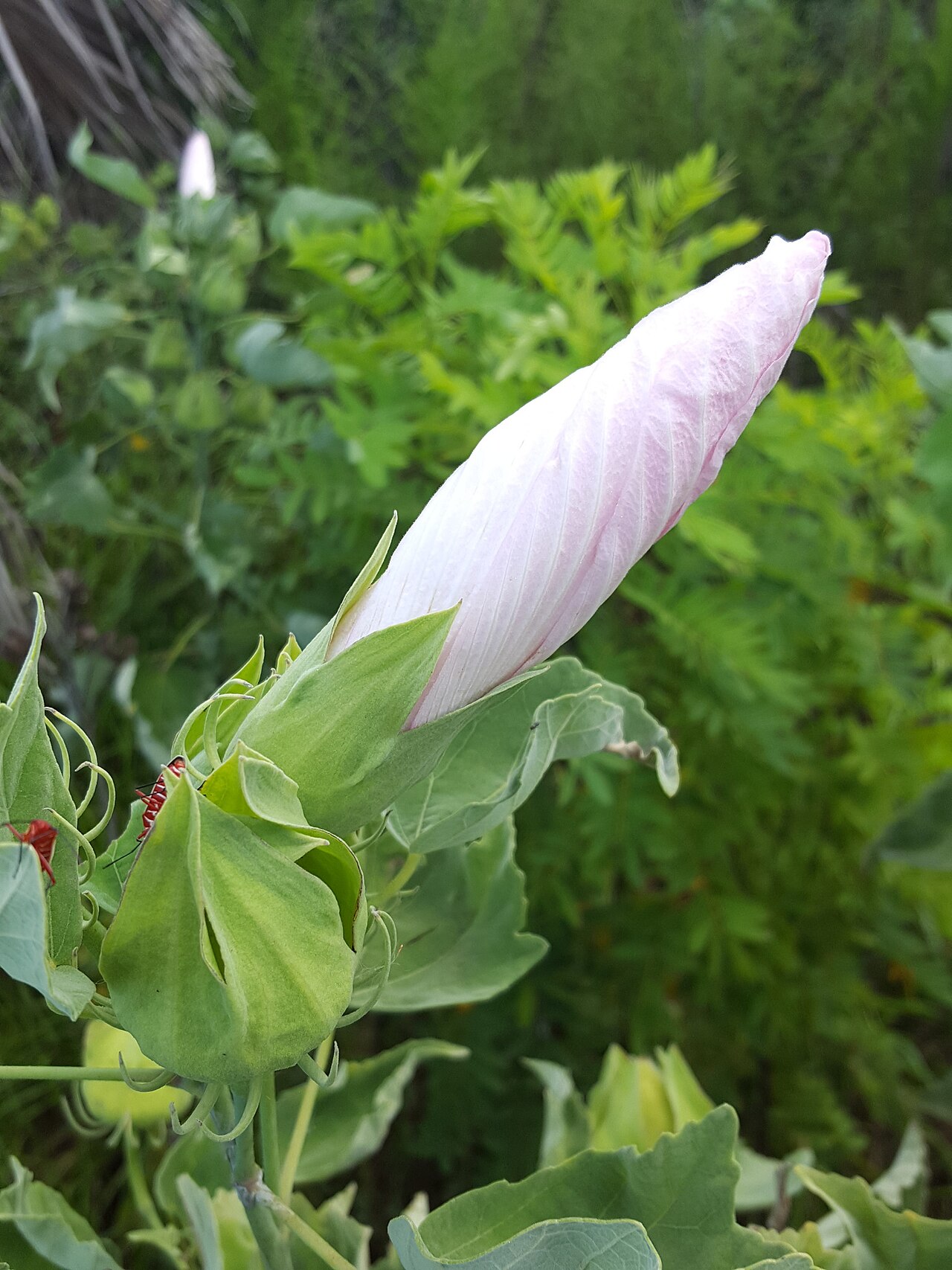
Hibiscus grandiflorus, commonly called Swamp Rosemallow or Large-flowered Hibiscus, is a tall, soft-wooded perennial of the Gulf Coast’s freshwater marshes and wet prairies. A member of the mallow family (Malvaceae), it produces some of the biggest flowers of any native North American wildflower — pale pink to nearly white saucers more than 6 inches across, each centered on a deep reddish-purple throat and a column of bright yellow stamens. From a distance a stand of blooming swamp rosemallow looks like a scatter of pink hubcaps hovering over the marsh grass.
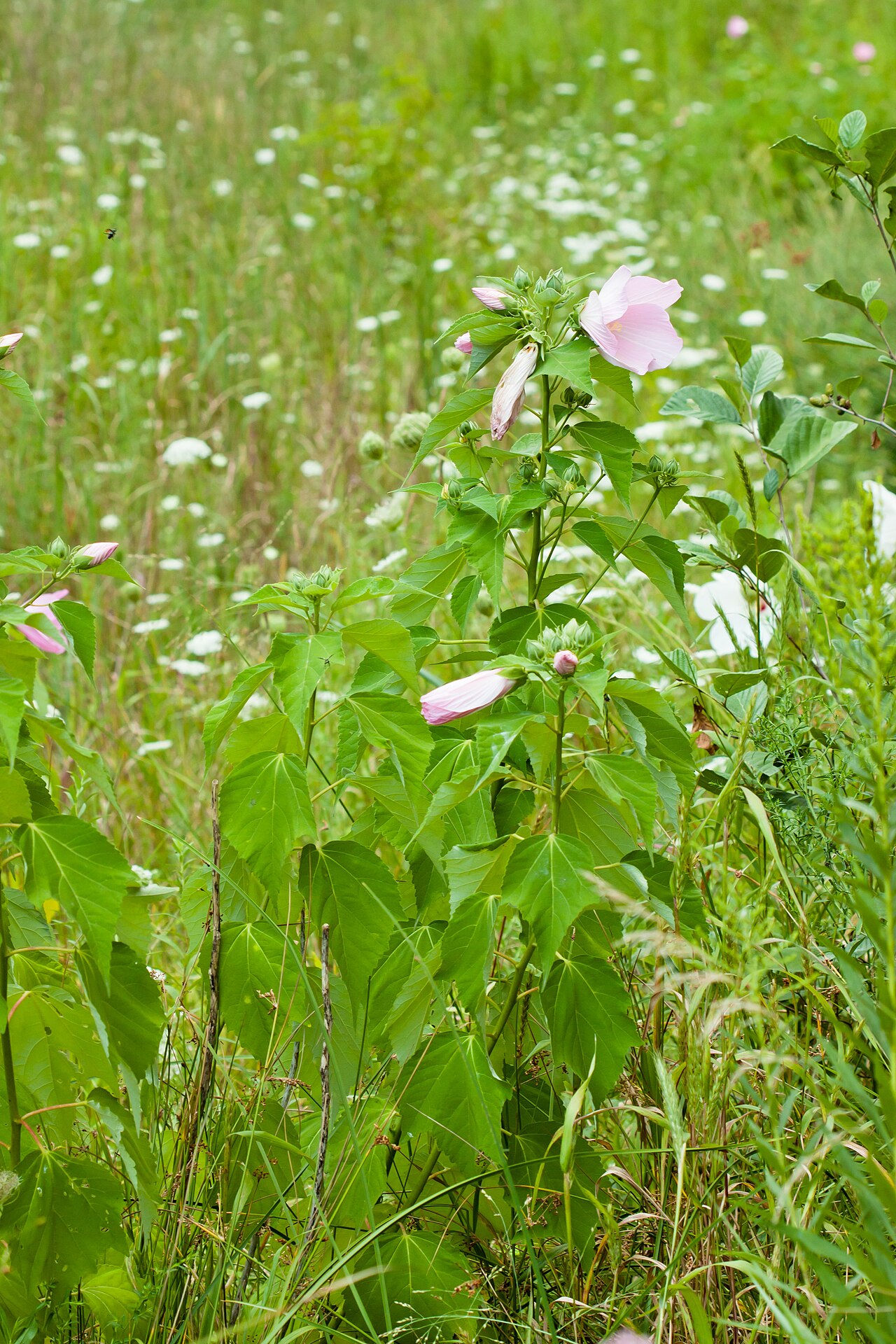
The plant itself is a robust, multi-stemmed perennial that behaves almost like a soft shrub, typically reaching about 6 feet in a season but capable of towering to 15 feet where growing conditions are especially favorable. Its stems, leaf stalks, and seed capsules are all covered in a fine velvety down, and the three- to five-lobed leaves give the whole plant a coarse, textured look that is easy to pick out among finer-leaved marsh grasses and sedges.
Swamp rosemallow is a true wetland specialist, rooted in standing or saturated water for most of the year, and it is not a plant for an average garden bed. In the right setting — a rain garden, pond margin, or the wet edge of a retention basin — it rewards very little effort with months of large, showy flowers that draw hummingbirds and a steady traffic of native bees. Gardeners well outside its native range sometimes grow mallow relatives like Hibiscus moscheutos instead; within its own Gulf Coast range, swamp rosemallow is the better ecological choice.
Identification
Swamp rosemallow is most easily recognized in bloom, but its coarse, velvety foliage and upright, cane-like growth habit identify it even before the flowers open.
Stems
The stems are stout, round in cross-section, and covered in short soft hairs that give new growth a grayish, felted look. Plants typically produce several stems from a single rootstock, forming a loose clump 3 to 5 feet wide. The base of older plants can become somewhat woody by late summer, but the whole top dies back to the root crown after frost in most of its range.
Leaves
Leaves are alternate, 3 to 8 inches long, and shallowly to deeply three- to five-lobed, with the terminal lobe longest and a toothed margin throughout. Both surfaces carry a soft down of star-shaped (stellate) hairs, giving the foliage a dull, grayish-green cast and a slightly rough feel — a useful field mark that separates it from the smoother-leaved swamp rose-mallow (Hibiscus moscheutos), which often grows in similar habitat.
Flowers
Flowers are solitary on short stalks from the upper leaf axils, opening to 6 inches or more across. The five petals are pale pink fading toward white at the outer edge, each marked near the base with a deep maroon to reddish-purple blotch that merges into a dark central throat. A tall staminal column rises from the throat, tipped in bright yellow pollen-bearing anthers, with the pale style branches just visible above them. Bloom runs from roughly June into October across most of the range, peaking in mid- to late summer.
Fruit & Seeds
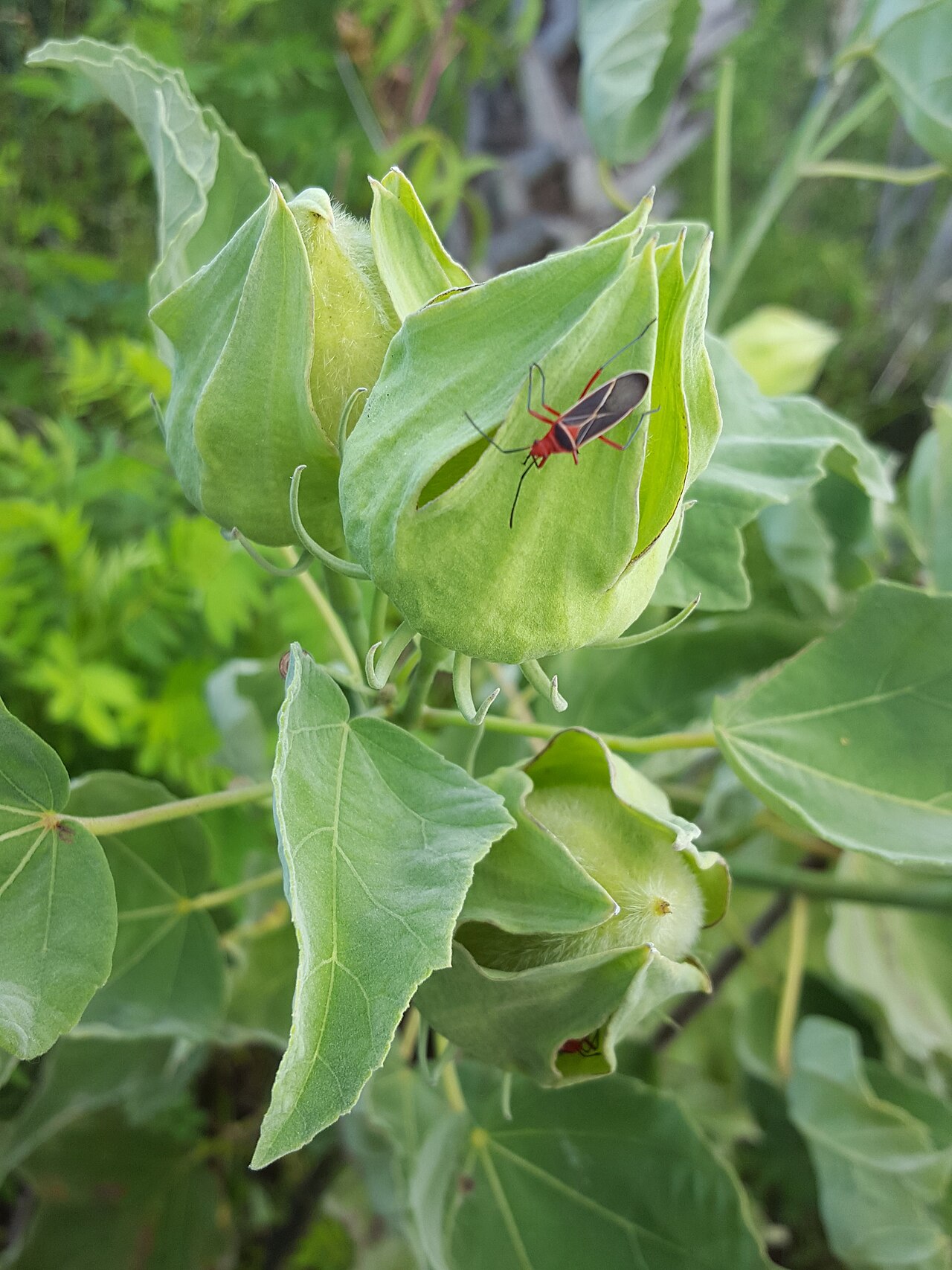
The fruit is an egg-shaped capsule, densely covered in soft velvety hairs, that splits into five sections at maturity to release several brown, kidney-shaped seeds. The fuzzy green capsules are conspicuous on the plant well after the petals have dropped, and they are frequently visited by seed bugs and other insects that feed on the developing seed.
Quick Facts
| Scientific Name | Hibiscus grandiflorus |
| Family | Malvaceae (Mallow) |
| Plant Type | Herbaceous/Soft-wooded Perennial |
| Mature Height | 6–8 ft typical (to 15 ft in ideal sites) |
| Mature Spread | 3–5 ft |
| Growth Rate | Fast (dies back to the root crown each winter) |
| Sun Exposure | Full Sun |
| Water Needs | High; tolerates standing water |
| Soil Type | Wet to inundated muck or sand |
| Soil pH | 5.5–7.5 |
| Bloom Time | June – October |
| Flower Color | Pale pink to white with a reddish-purple throat |
| Fruit | Velvety, 5-chambered seed capsule |
| Deer Resistant | Moderate |
| USDA Hardiness Zones | 8–10 |
Native Range
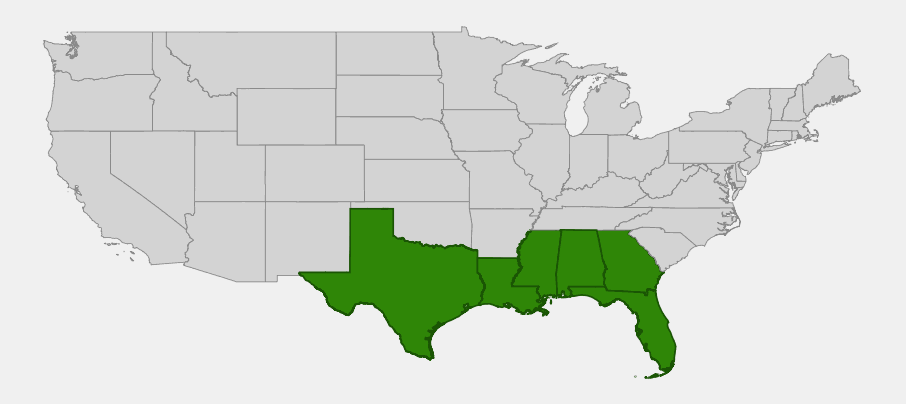
Swamp rosemallow is a Gulf Coastal Plain species, native from southeastern Texas across Louisiana, Mississippi, Alabama, and Georgia into peninsular Florida, with disjunct populations in western Cuba. Older botanical records also list it from the South Carolina coast, but it has not been confirmed there in recent decades and is generally treated as historical in that state today. Within its confirmed range it is most common near the coast and along the lower reaches of Gulf-draining rivers, though it also turns up well inland wherever a freshwater marsh or wet prairie persists.
It grows in full sun in permanently or seasonally flooded freshwater wetlands: tidal freshwater marshes just upstream of brackish influence, the margins of coastal lakes and sloughs, wet pine flatwoods and savannas, roadside ditches, and the edges of cypress ponds. It is almost never found far from standing water, and populations can disappear quickly from sites where wetland hydrology has been altered by ditching or fill.
Because it needs saturated to flooded soil and strong sun, swamp rosemallow is not a plant to force into an ordinary garden bed outside its wetland habitat. Gardeners within its Gulf Coast range who have a pond edge, rain garden, or low spot that holds water for part of the year are in the best position to grow it successfully and support the wetland wildlife that depends on it.
📋 Regional plant lists featuring Swamp Rosemallow: Arkansas, Louisiana, Eastern Oklahoma & Eastern Texas · South & West Texas · Georgia, Alabama & Mississippi
Growing & Care Guide
Swamp rosemallow is one of the easiest native wildflowers to grow once it has the one thing it truly demands: consistently wet soil. Given that, it needs almost no further attention and rewards the gardener with months of enormous blooms.
Light
Give it full sun. Swamp rosemallow flowers best, and stays most compact and sturdy, with at least 6 hours of direct sun a day. In partial shade it stretches, flowers less, and is more prone to flopping.
Soil & Water
This is a true wetland plant: it wants soil that is wet or waterlogged for most of the growing season and tolerates standing water several inches deep. It is a good choice for the saturated edge of a rain garden, pond, or bioswale, or for a naturally low spot that holds water after rain. It is not drought tolerant and will struggle or die back quickly in soil that is allowed to dry out for extended periods.
Planting Tips
Plant container stock in spring after the soil has warmed, setting plants at the same depth they grew in the pot. Space plants 3 to 4 feet apart to allow for their eventual clump width. Established plants self-sow readily in suitable wet ground, so expect volunteer seedlings nearby in following years if seed capsules are left in place.
Pruning & Maintenance
The entire top of the plant dies back to the root crown after the first hard frost; cut back the dead stems in late winter before new growth emerges. No fertilizer is needed in a properly wet, organically rich site. Deadheading is unnecessary unless you want to limit self-seeding.
Landscape Uses
Swamp rosemallow fits naturally into these settings:
- Rain gardens and bioswales that hold standing water after storms
- Pond and water-garden margins
- Freshwater wetland and marsh restoration plantings
- Hummingbird and pollinator gardens with a consistently wet spot
- Low, poorly drained yard corners where few other showy perennials will thrive
Wildlife & Ecological Value
As one of the largest-flowered native wildflowers of Gulf Coast wetlands, swamp rosemallow punches well above its weight for pollinators and nectar-feeding birds.
For Pollinators
The big, open flowers are built for large bees: bumblebees and the specialist mallow bees in the genera Ptilothrix and Melitoma work the pollen-laden staminal column, often returning to the same patch of flowers repeatedly through the morning. Honeybees and smaller native bees visit as well, drawn by the abundant pollen.
For Birds
Ruby-throated hummingbirds regularly visit the flowers for nectar during their nesting season and again on fall migration, when Gulf Coast marshes full of blooming rosemallow are an important refueling stop. Seed-eating sparrows and other marsh birds feed on the capsules once they ripen and split open.
Ecosystem Role
In the freshwater marshes where it grows, swamp rosemallow adds structural and bloom diversity to a plant community often dominated by grasses, sedges, and rushes, giving pollinators a mid-summer nectar source when many other wetland plants have already finished flowering. Its dense stands also help stabilize soft marsh soil and slow water movement during storm surges and heavy rain.
Cultural & Historical Uses
Swamp rosemallow has long been admired simply for its spectacular flowers; early botanical collectors moving through Gulf Coast marshes singled it out as one of the showiest wildflowers of the region, and it remains a favorite subject for native-plant photographers today.
Like other members of the mallow family, the plant’s mucilaginous inner bark and roots were historically used in folk preparations in parts of its range, in the same general tradition as the related marsh mallow (Althaea officinalis) of Europe. These uses are a matter of historical record rather than a recommendation; no part of swamp rosemallow is commonly eaten today, and its chief modern value is horticultural and ecological.
Because it demands consistently wet soil, swamp rosemallow has never been a major agricultural or nursery crop, but interest in native wetland gardening and rain-garden design has brought it into cultivation at specialty native-plant nurseries along the Gulf Coast in recent years.
Frequently Asked Questions
Is Swamp Rosemallow the same plant as Swamp Rose-mallow?
No. “Swamp Rosemallow” (Hibiscus grandiflorus) and “Swamp Rose-mallow” (Hibiscus moscheutos) are closely related but distinct species that often grow in the same wetlands. H. grandiflorus has grayer, more velvety foliage and a somewhat narrower native range centered on the Gulf Coast.
Can I grow Swamp Rosemallow in a normal flower bed?
Only if that bed stays consistently wet. This species needs saturated to flooded soil through most of the growing season; in average well-drained garden soil it will struggle and likely fail, especially during dry spells.
Does Swamp Rosemallow come back every year?
Yes. It is a perennial that dies back to the ground after frost and resprouts vigorously from its root crown each spring, often reaching full height again within a single growing season.
Is Swamp Rosemallow invasive?
No. It is a native Gulf Coast wetland species and is not considered weedy or invasive anywhere in the United States.
What pollinates Swamp Rosemallow?
Large bees are the primary pollinators, especially bumblebees and specialist mallow-visiting bees, while ruby-throated hummingbirds regularly feed at the flowers for nectar.

Looking for a nursery that carries Swamp Rosemallow?
Browse our native plant nursery directories: Alabama · Louisiana & Mississippi · Florida & Georgia · Texas