
Red Mangrove (Rhizophora mangle)
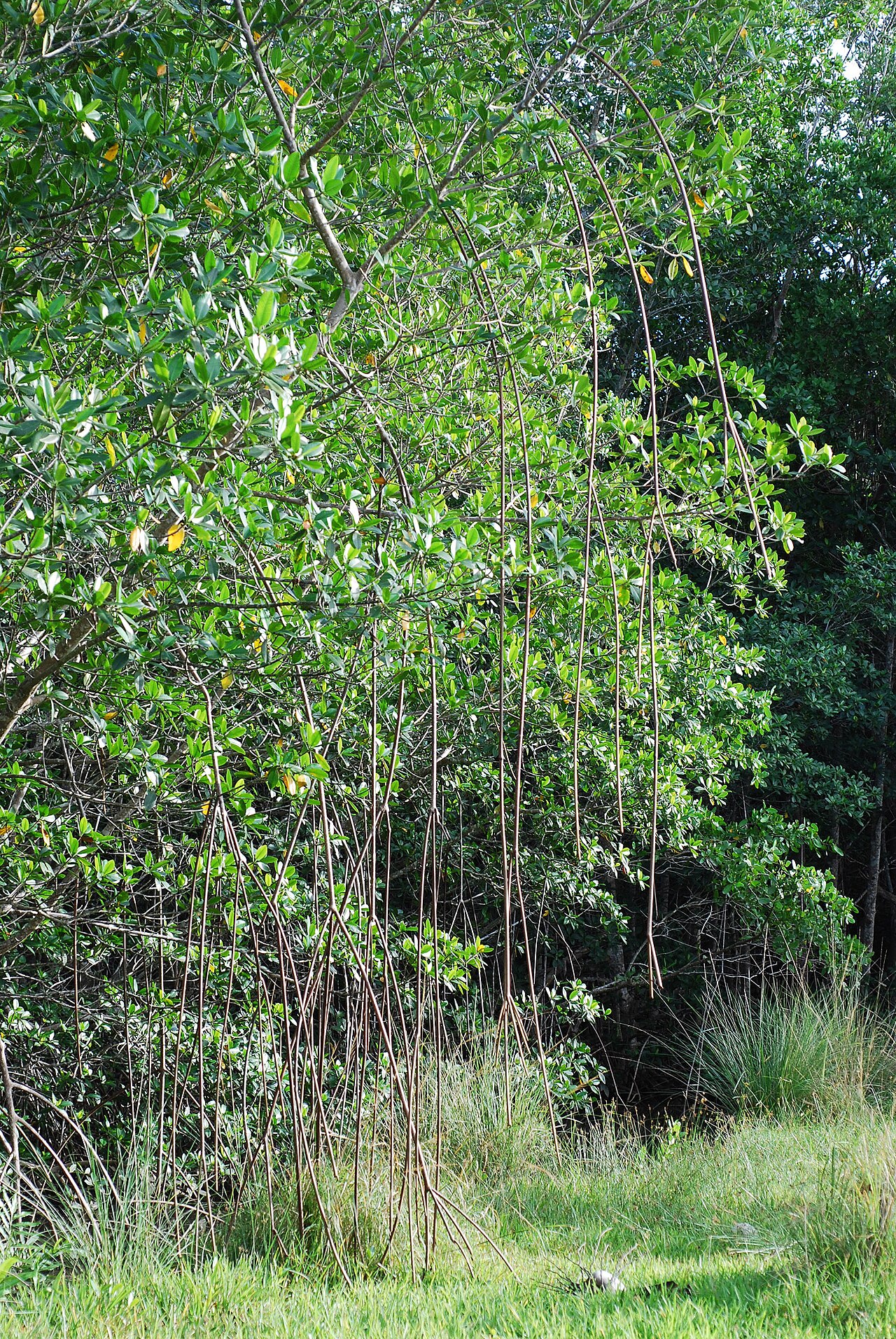
Rhizophora mangle, the Red Mangrove, is the most recognizable of Florida’s three native mangrove species, instantly identified by the tangle of reddish, arching prop roots that lift its trunk above the tide. Growing along the calmest, most sheltered shorelines of South and Central Florida, red mangrove occupies the outermost edge of the mangrove community — the zone most directly washed by salt water — where it builds and stabilizes new land, one root and one seedling at a time.
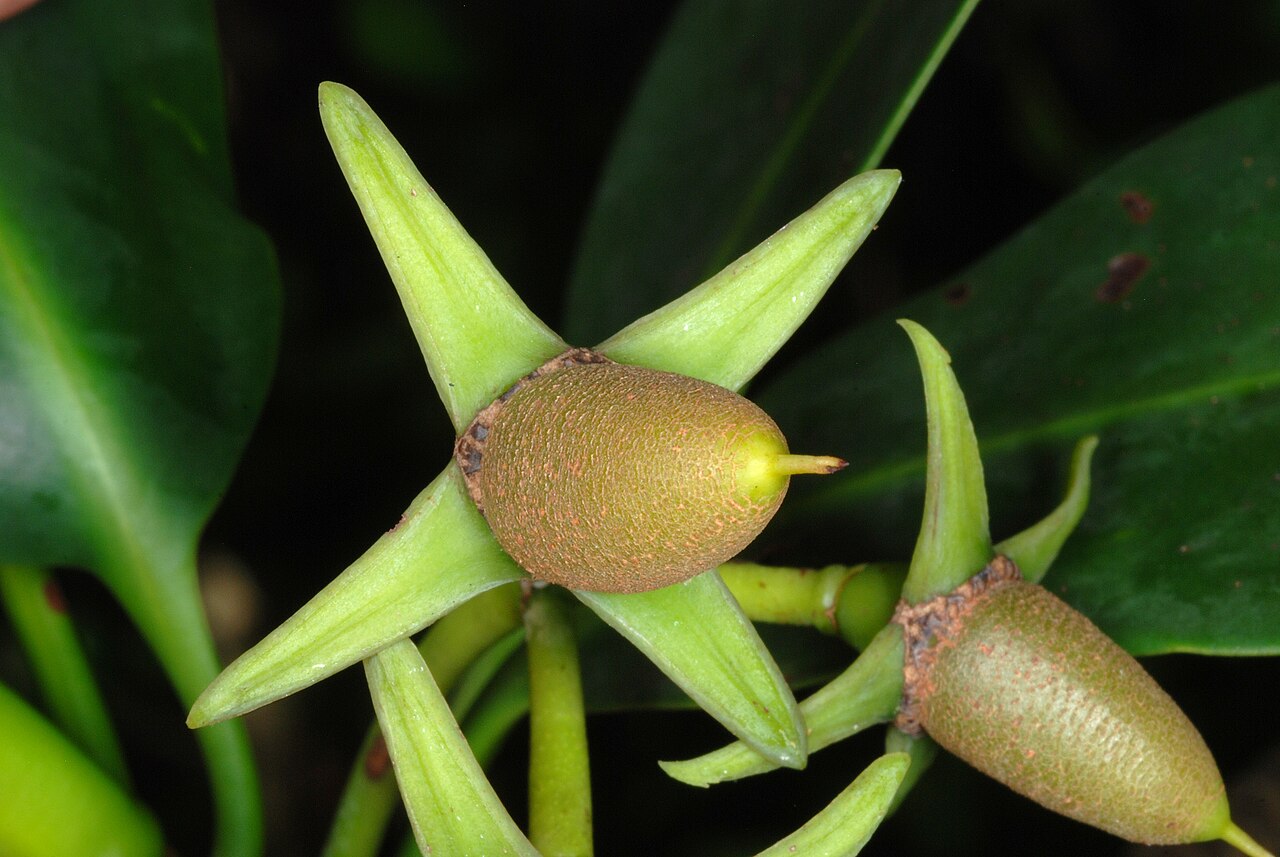
Red mangrove typically grows as a shrub or small tree, 15 to 30 feet tall in Florida though capable of reaching twice that in the tropics, with smooth, dark green, leathery leaves and a crown held above an intricate lattice of looping, stilt-like roots. These prop roots — technically adventitious roots that arise from the trunk and lower branches and arch down into the mud — are the plant’s defining feature, giving it a walking, almost animate appearance along the waterline. Rather than producing an ordinary seed, red mangrove is viviparous: its seeds germinate while still attached to the parent tree, producing long, cigar-shaped propagules that drop and float until they lodge in mud shallow enough to root.
Because mangroves are so critical to Florida’s coastline — buffering storm surge, filtering runoff, and serving as nursery habitat for countless fish and invertebrates — red mangrove and Florida’s other native mangroves are protected under state law. The Mangrove Trimming and Preservation Act strictly limits trimming, and removing or destroying mangroves generally requires a permit; always check current regulations before pruning or removing any mangrove on your property.
Identification
Red mangrove is most easily told apart from Florida’s other mangroves by its roots: where black and white mangrove send up pencil-like breathing roots (pneumatophores) from below, red mangrove arches its roots down and outward from the trunk and branches above the waterline, forming a distinctive tangled lattice that gives the species its common nickname, “walking tree.”
Bark & Stems
The bark is smooth and gray to grayish-brown on the trunk, often streaked or tinged reddish where roots are shed or damaged — a trait, along with the reddish inner bark once used for tanning leather, behind the “red” in the common name. The arching prop roots themselves are reddish-brown, woody, and often numerous enough to form an almost impenetrable thicket at the base of mature trees.
Leaves
Leaves are opposite, elliptical, 2 to 5 inches long, thick and leathery with a glossy dark green upper surface and a paler underside often dotted with tiny black specks (a helpful identification clue). Like the other Florida mangroves, red mangrove’s leaves are adapted to exclude salt at the root level rather than excrete it, so the leaf surfaces themselves stay relatively salt-free.
Flowers
Small, pale yellow, four-petaled flowers appear in clusters at the leaf axils throughout much of the year in Florida’s warm climate, with a late spring to summer peak. The flowers are modest and easy to overlook compared to the plant’s dramatic roots and propagules.
Fruit & Seeds
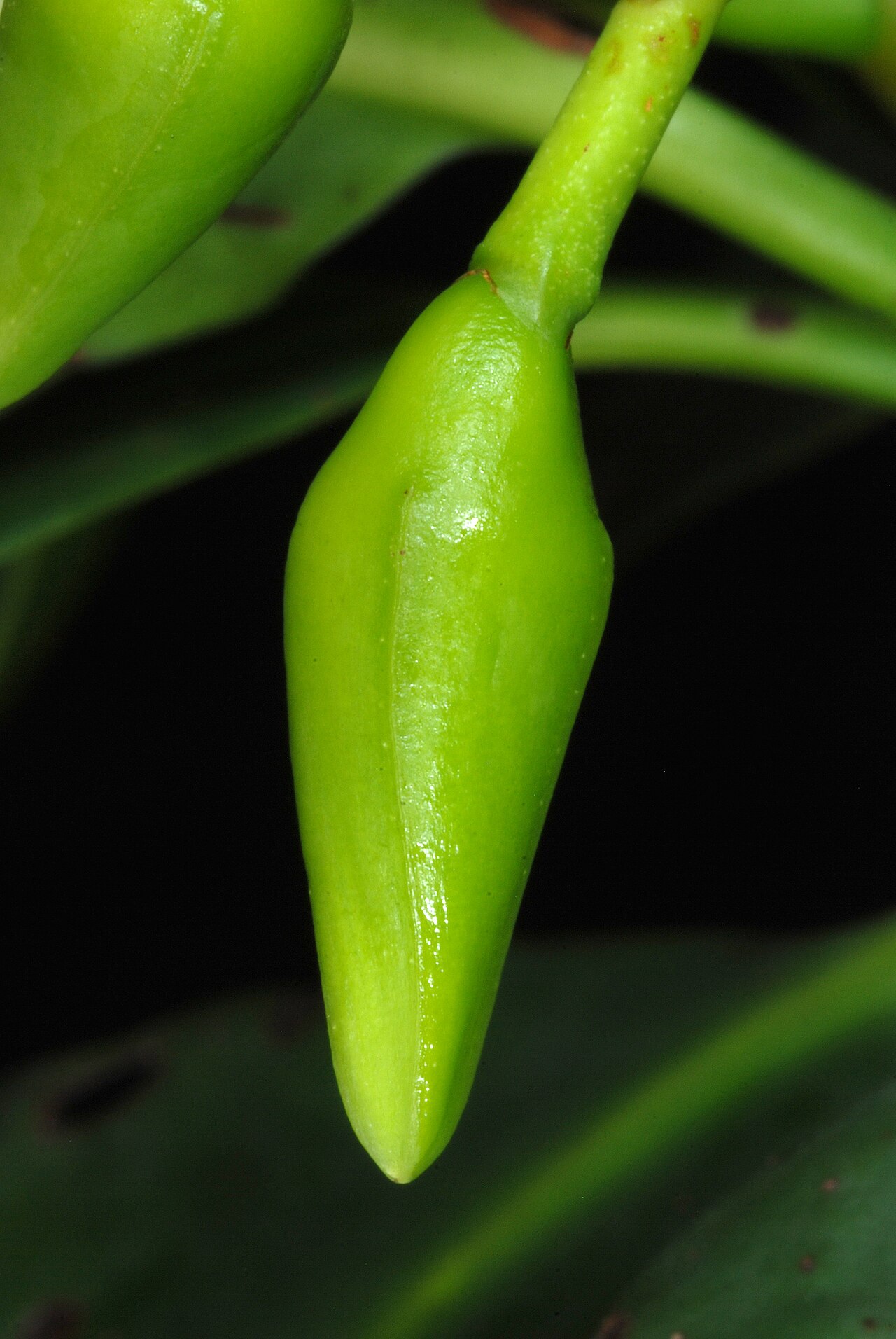
Red mangrove is viviparous — its seeds germinate while still attached to the parent plant, developing into slender, elongated, cigar-shaped propagules 6 to 12 inches long that hang from the branches before dropping. Once released, a propagule can float for weeks to months, drifting on currents until it lodges in shallow mud, at which point it quickly roots and begins growing — an adaptation that lets red mangrove colonize new shoreline far from the parent tree.
Quick Facts
| Scientific Name | Rhizophora mangle |
| Family | Rhizophoraceae (Mangrove) |
| Plant Type | Evergreen shrub or small tree |
| Mature Height | 15–30 ft in Florida |
| Mature Spread | 10–25 ft |
| Growth Rate | Slow to moderate |
| Sun Exposure | Full Sun |
| Water Needs | High; requires tidal or brackish saturation |
| Soil Type | Soft tidal mud and peat |
| Soil pH | Wide tolerance in saline/brackish conditions |
| Bloom Time | Nearly year-round; peak late spring–summer |
| Flower Color | Pale yellow |
| Fall Color | Evergreen; no notable fall color |
| Fruit | Long, cigar-shaped viviparous propagules |
| Deer Resistant | Not typically applicable (tidal habitat) |
| USDA Hardiness Zones | 10 – 11 |
Native Range
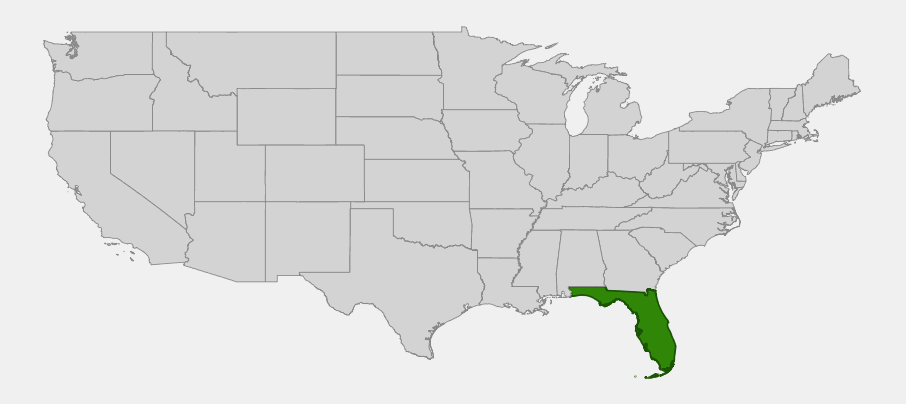
In the United States, red mangrove is native to Florida, where it is most abundant and reaches its largest size in South Florida and the Keys, becoming scarcer and more frost-limited moving up the central Florida coasts on both the Gulf and Atlantic sides. It is strictly a subtropical-to-tropical species with essentially no frost tolerance, so hard freezes set a hard boundary on how far north it can persist, though warming winters have allowed some northward expansion in recent decades.
Red mangrove occupies the seaward-most zone of Florida’s mangrove forests, growing directly in the intertidal zone along calm, sheltered shorelines, lagoons, and estuaries where wave energy is low enough for its seedlings to take root. It typically forms the outer fringe of a mangrove community, with black mangrove and white mangrove occupying slightly higher, less frequently flooded ground farther inland.
Outside Florida, red mangrove is common throughout the Caribbean, the Gulf and Atlantic coasts of Mexico and Central America, and much of tropical South America and West Africa, making it one of the most widely distributed mangrove species in the Americas.
📋 Regional plant lists featuring Red Mangrove: none yet — no plantnative.org regional list currently covers coastal Florida; see our full native plant directory for other Florida-native species.
Growing & Care Guide
Red mangrove is not a typical landscape plant — it is a specialized tidal species best suited to shoreline restoration, mitigation plantings, and large waterfront properties with direct estuarine or lagoon access rather than an ordinary yard.
Light
Red mangrove requires full sun; it does not tolerate significant shade and grows poorly if crowded by taller vegetation or structures that block direct light.
Soil & Water
This species needs regular tidal inundation or consistently saturated, saline-to-brackish soil — ordinary garden conditions, even with irrigation, generally cannot substitute for the tidal exchange red mangrove depends on in the wild. Soft mud or peat substrate is ideal; the prop roots are specifically adapted to anchor in loose, waterlogged sediment that would smother the roots of most other plants.
Planting Tips
Because of its specialized tidal requirements and legal protections, red mangrove is most often planted as part of a permitted shoreline restoration or mitigation project rather than a typical residential planting; check with local and state environmental agencies before planting, removing, or trimming any mangrove, since permits are frequently required. Propagules can be planted directly into suitable intertidal mud, pushed in point-down, where they readily root if conditions are right.
Pruning & Maintenance
Mangrove trimming in Florida is tightly regulated under the Mangrove Trimming and Preservation Act; property owners are generally allowed limited “trimming” for view corridors under specific conditions but need authorization for anything beyond minor maintenance, and removal typically requires a permit. Always confirm current state and local rules before cutting back a red mangrove.
Landscape Uses
Red mangrove’s role is overwhelmingly ecological and restorative rather than ornamental:
- Shoreline stabilization and erosion control along sheltered coasts
- Wetland mitigation and restoration projects
- Storm surge buffering for low-lying coastal properties
- Fisheries habitat enhancement along residential and commercial waterfronts
Wildlife & Ecological Value
Red mangrove forests are among the most productive and ecologically important habitats on the Florida coast, functioning as a nursery, filter, and storm buffer all at once.
For Birds
Red mangrove canopies provide essential nesting and roosting habitat for wading birds including herons, egrets, ibises, pelicans and roseate spoonbills, with some sites hosting large mixed-species rookeries. Ospreys and other raptors also nest and hunt from mangrove branches along the Florida coast.
For Mammals
Manatees graze on surrounding seagrass beds sheltered by mangrove shorelines, while raccoons and other small mammals forage along the mangrove edge. The endangered Florida Key deer in the Lower Keys sometimes browses near mangrove-fringed shorelines, though mangrove leaves are not a primary food source.
For Pollinators
The small flowers attract bees and other insects, and in some regions red mangrove is a notable source of mangrove honey; the dense foliage also shelters a range of insects that support the broader mangrove food web.
Ecosystem Role
Red mangrove’s tangled prop roots create critical nursery habitat for juvenile fish, shrimp, crabs and other marine life, sheltering them from predators before they move out to open water or reef habitats as adults — a service so significant that red mangrove shorelines are directly linked to the productivity of Florida’s commercial and recreational fisheries. The roots also trap sediment and organic matter, building new land over time, while the dense above-water structure dissipates wave energy and buffers the coastline against storm surge and erosion, protecting both natural habitat and adjacent human development.
Cultural & Historical Uses
Red mangrove bark has a long history of use in the tanning industry, valued for its high tannin content, which was extracted and used to cure leather throughout the Caribbean and Florida during the nineteenth and early twentieth centuries — a trade that, along with coastal development, significantly reduced mangrove forests in some areas before conservation protections were established. The dense, hard wood has also traditionally been used for charcoal production and small construction in coastal communities throughout its range.
In Florida specifically, growing recognition of mangroves’ role in protecting the coastline from hurricanes and erosion led directly to the state’s mangrove protection laws beginning in the 1980s, a shift from the earlier decades when extensive mangrove removal accompanied waterfront development. Today red mangrove is widely used in permitted shoreline restoration and mitigation projects throughout the state, reflecting its transition from an often-cleared nuisance plant to a legally protected cornerstone of coastal resilience.
Indigenous and early coastal communities throughout the mangrove’s range also made practical use of its wood and bark locally, though specific historical accounts from Florida’s pre-development mangrove coast are less thoroughly documented than those from the wider Caribbean.
Frequently Asked Questions
Can I cut down or trim red mangroves on my property in Florida?
Only within strict limits. Florida’s Mangrove Trimming and Preservation Act regulates trimming and generally requires a permit for anything beyond minor, specifically defined maintenance trimming; removing mangroves typically requires authorization from state and sometimes federal agencies. Check current regulations before doing any work on mangroves.
Why does red mangrove have roots above the ground?
Those arching prop roots anchor the plant in soft, unstable tidal mud and help lift the trunk and lower branches above most tidal flooding and wave action, while still allowing the plant to take up oxygen through pores in the root bark — an adaptation to growing directly in waterlogged, low-oxygen soil.
What is a mangrove propagule?
It’s the elongated, cigar-shaped structure that develops when a red mangrove seed germinates while still attached to the parent tree (a trait called vivipary). Once it drops, it can float for weeks, carried by currents until it lodges in suitable shallow mud and begins to root.
How is red mangrove different from black and white mangrove?
Red mangrove is identified by its arching above-ground prop roots and typically grows closest to open water. Black mangrove instead sends up pencil-like breathing roots (pneumatophores) from the mud, and white mangrove has rounded leaves with two small glands at the leaf base and usually grows at slightly higher, less frequently flooded elevations than the other two.
Is red mangrove endangered?
It is not federally listed as endangered, but mangrove habitat loss from historical development has been significant, which is why red mangrove and Florida’s other mangroves now receive strong legal protection at the state level.

Looking for a nursery that carries Red Mangrove?
Browse our native plant nursery directory: Florida
For a red mangrove companion species along the Florida shoreline, see our page on Green Buttonwood. If you’re planning a Florida coastal landscape, see our guide to shade trees for South Florida.

