
Nutmeg Hickory (Carya myristiciformis)
Carya myristiciformis, commonly called Nutmeg Hickory (and occasionally Swamp Hickory or Bitter Water Hickory), is one of the rarest native trees in North America. A member of the walnut family (Juglandaceae), it grows as scattered, often small, relict populations across a handful of southern states, usually on rich, moist bottomland soils near rivers and bayous. The common name comes from the small, ridged nut, which resembles a nutmeg seed both in shape and in its distinctly aromatic, somewhat bitter kernel.
Unlike the widespread shagbark or pecan hickories, Nutmeg Hickory is genuinely uncommon everywhere it occurs, and in some states it is tracked as a species of conservation concern. It is a medium to large deciduous tree, typically 60 to 90 feet tall, with a straight trunk, dark furrowed bark, and glossy, dark green compound leaves that have a silvery-gold cast on their undersides — a identification feature shared by very few other hickories. Where it does grow, it is a long-lived, high-value canopy tree that produces nuts relished by squirrels and other wildlife.
Because true wild specimens are so scattered, most people will never stumble across a Nutmeg Hickory by accident. For native-plant gardeners and restoration plantings within its historic range — coastal South Carolina, the Alabama Black Belt, the Mississippi and Red River bottoms of Louisiana and Arkansas, and the river bottoms of eastern Texas — it is a worthwhile, distinctive specimen tree that few neighbors will be able to name.
Identification
Nutmeg Hickory is best identified by the combination of its leaf undersides, bark, and small, ridged nuts, since the overall tree shape is similar to several other bottomland hickories.
Bark & Stems
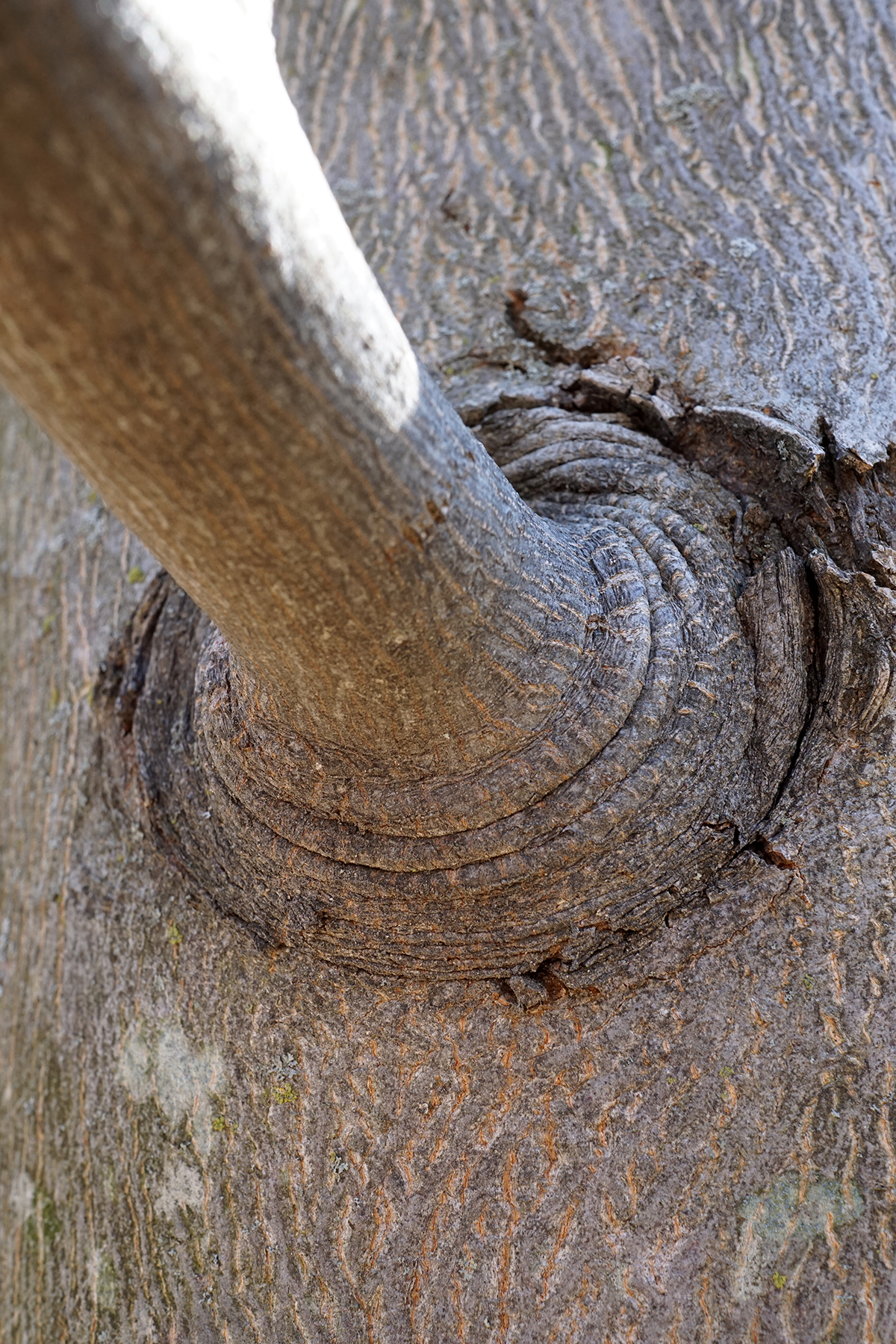
Mature bark is dark gray to blackish-brown and develops tight, interlacing ridges and furrows, sometimes described as similar to pignut hickory but darker and closer-textured. Young twigs are slender and reddish-brown, often with a fine, silvery or golden scurfy coating of tiny scales that is most visible on new growth and on the leaf undersides — this scaly, metallic sheen is one of the most reliable field marks for the species.
Leaves
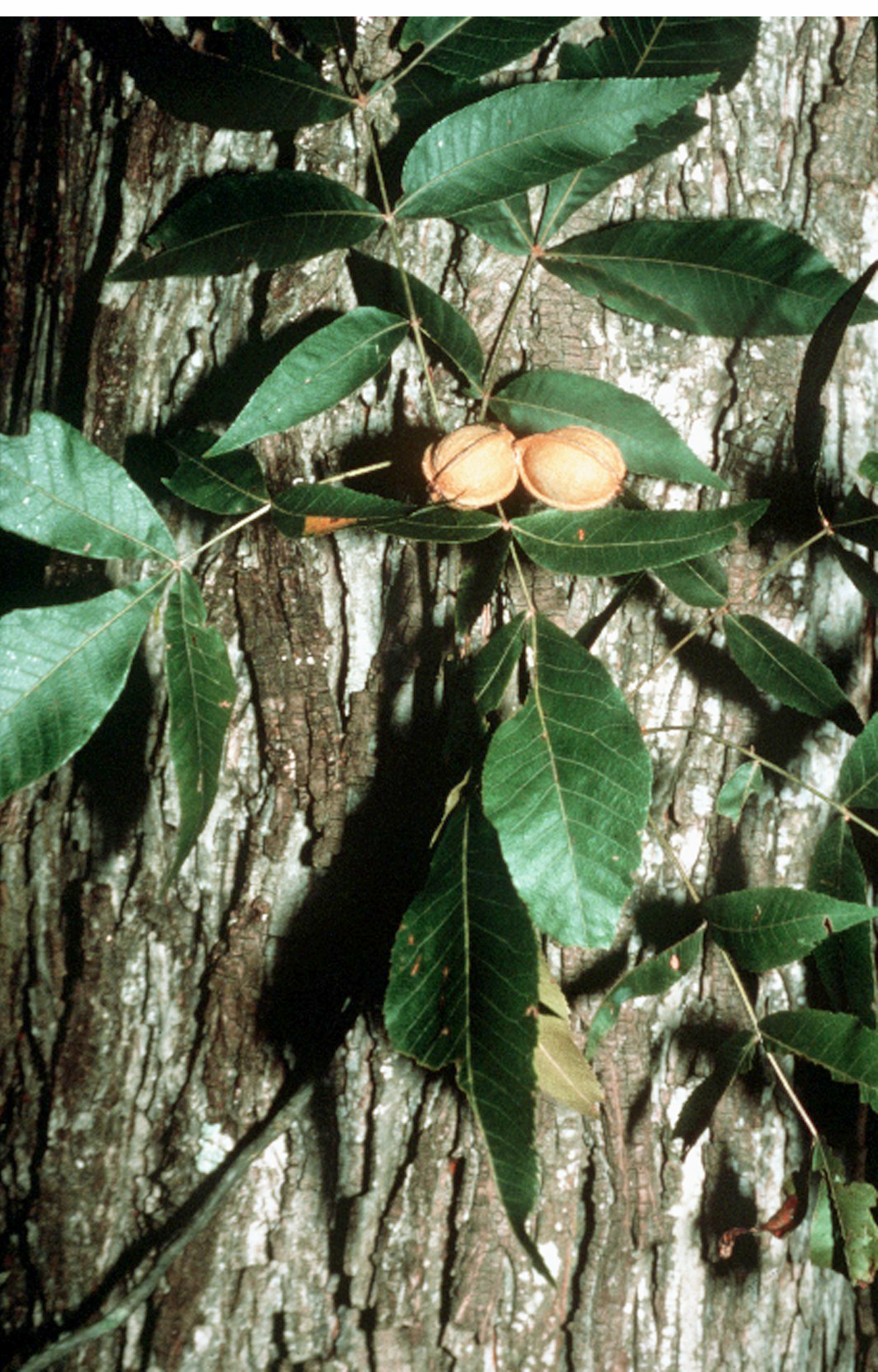
Leaves are pinnately compound, 8 to 15 inches long, usually with 5 (occasionally 7) lance-shaped leaflets that taper to a slender point. The upper leaf surface is glossy dark green; the lower surface is where the tree earns its best identification clue, covered in silvery-white to golden-bronze peltate scales that give it a distinctive shimmer when the breeze turns the leaves over. Leaflet margins are finely toothed.
Flowers
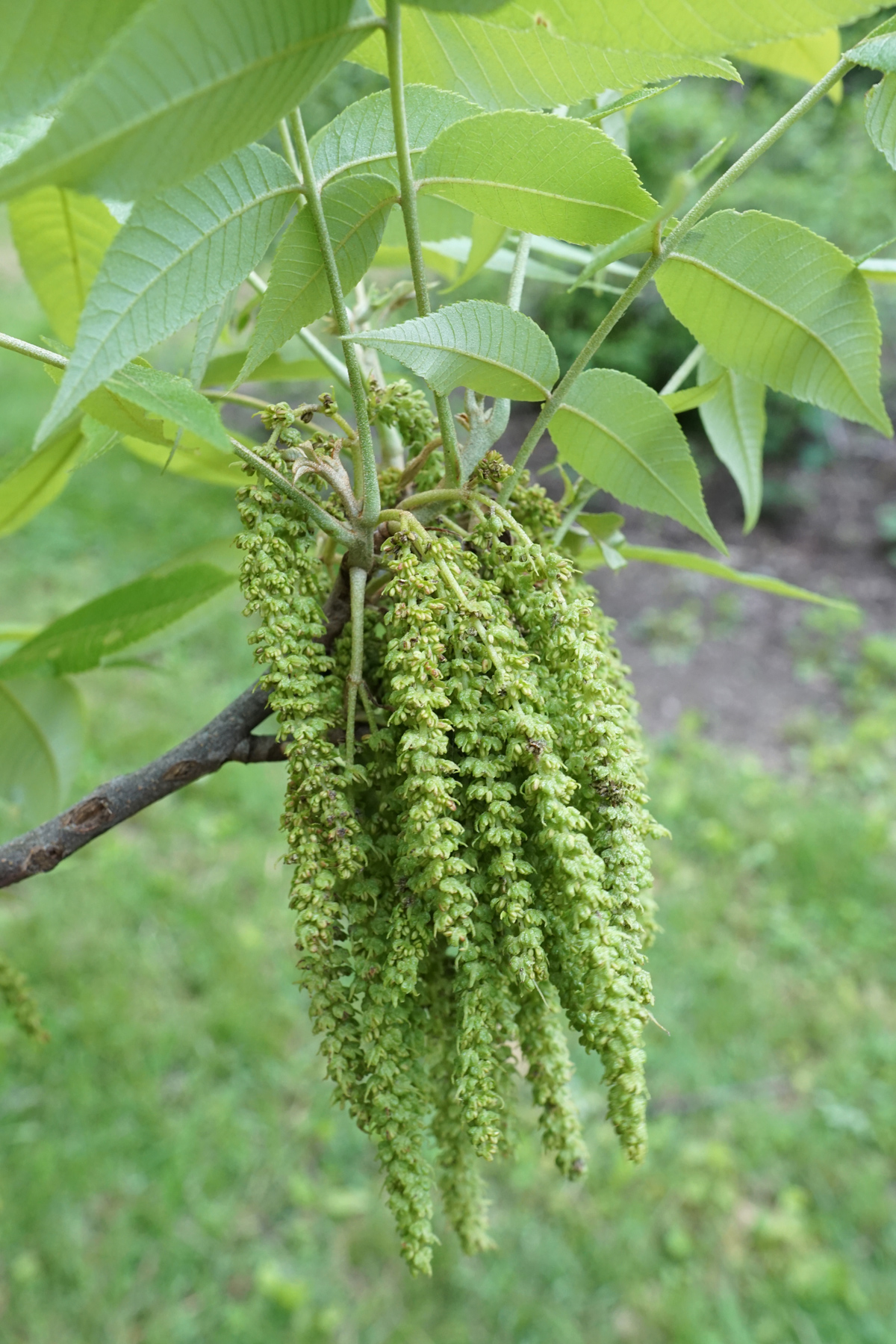
Like other hickories, Nutmeg Hickory is monoecious, with separate male and female flowers on the same tree. Slender, drooping male catkins, pale green and 3 to 5 inches long, appear in spring as the new leaves emerge, hanging in groups of three from the previous year’s growth. Inconspicuous female flowers form in small spikes at the tips of the current season’s twigs.
Fruit & Seeds
The fruit is a small, egg-shaped nut, about 1 to 1.5 inches long, enclosed in a thin husk with four low ridges that splits partway when ripe. The nut itself is smooth, thin-shelled, and strongly 4- to 6-ridged, with a sweet-bitter, aromatic kernel reminiscent of nutmeg — smaller and less palatable to people than shagbark or pecan nuts, but still eaten readily by squirrels, chipmunks, and other mast-feeding wildlife.
Quick Facts
| Scientific Name | Carya myristiciformis |
| Family | Juglandaceae (Walnut) |
| Plant Type | Deciduous Tree |
| Mature Height | 60–90 ft |
| Mature Spread | 35–50 ft |
| Growth Rate | Slow |
| Sun Exposure | Full Sun to Partial Shade |
| Water Needs | Moderate to High |
| Soil Type | Rich, moist, well-drained bottomland loam; tolerates occasional flooding |
| Soil pH | 6.0–7.5 (neutral to slightly alkaline, often on calcareous soils) |
| Bloom Time | April |
| Flower Color | Pale green (catkins) |
| Fall Color | Yellow |
| Fruit | Small ridged nut in a thin husk, ripening in fall |
| Deer Resistant | Mostly (deer may browse young seedlings) |
| USDA Hardiness Zones | 7–9 |
Native Range
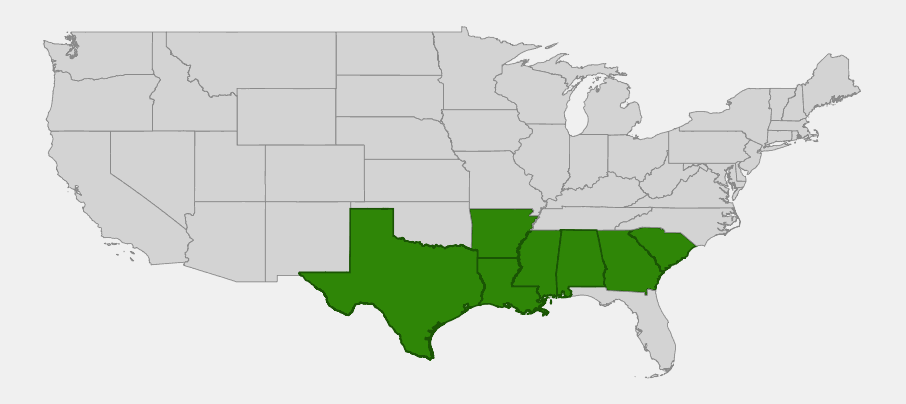
Nutmeg Hickory has one of the most fragmented, naturally patchy ranges of any native North American hardwood. It occurs as scattered, often small, disjunct populations across the Gulf and lower Mississippi River region, with the heaviest concentrations near Selma, Alabama and in southern Arkansas; elsewhere it is found in only a handful of counties per state. Isolated populations also occur in northeastern Mexico. Because the tree was never common to begin with, many of its historic sites have been lost to land clearing in the fertile bottomlands it prefers.
Within the United States, confirmed native populations occur in Texas, Arkansas, Louisiana, Mississippi, Alabama, Georgia, and South Carolina, always tied to specific bottomland and calcareous soil pockets rather than forming a continuous range. It typically grows on rich, well-drained alluvial terraces and low ridges within river floodplains, often on soils derived from limestone or marl, alongside other bottomland hardwoods.
Because populations are naturally small and widely separated, Nutmeg Hickory is considered rare to very rare throughout its range, and several states track it as a plant of conservation concern. Gardeners and restoration projects within its historic range should treat any planting as a meaningful contribution to the species’ persistence, and should source seed or nursery stock responsibly rather than collecting from wild remnant populations.
📋 Regional plant lists featuring Nutmeg Hickory: Arkansas, Louisiana, Eastern Oklahoma & Eastern Texas · Georgia, Alabama & Mississippi · North Carolina & South Carolina
Growing & Care Guide
Nutmeg Hickory is not difficult to grow where it is adapted, but it is slow and demands the rich, moist bottomland conditions it evolved in. It is best suited to larger properties within its historic range rather than small urban lots.
Light
Plant in full sun to light partial shade. Young trees tolerate some overhead shade as understory saplings, the way they would establish beneath a bottomland canopy, but they need increasing sun as they mature to develop a full crown and bear well.
Soil & Water
Give it rich, deep, well-drained loam with consistent moisture — the kind of soil found on river terraces and low ridges within floodplains. It tolerates brief flooding but does not thrive in permanently wet or compacted clay soils. A neutral to slightly alkaline, calcareous soil mimics its natural Black Belt and marl-based sites most closely, though it will grow in ordinary garden loam with regular watering during dry spells.
Planting Tips
Like most hickories, Nutmeg Hickory develops a long taproot early and transplants poorly once established, so plant small container or bare-root stock while young and avoid moving it later. Choose the permanent site carefully, allowing at least 40 feet of clearance for the eventual canopy spread, and keep young trees watered through their first two or three summers.
Pruning & Maintenance
Minimal pruning is needed. Remove dead, crossing, or damaged limbs in late winter while the tree is dormant, and avoid heavy pruning, which hickories tolerate poorly. Established trees are otherwise low-maintenance and long-lived.
Propagation
Propagate from fresh, cleaned nuts planted in fall or cold-stratified over winter and sown in spring; germination can be slow and uneven. Because the species is naturally rare, seed is best obtained from a reputable native-plant nursery rather than collected from wild trees, to avoid further depleting small remnant populations.
Landscape Uses
- Specimen shade tree for large rural or suburban properties with room to grow
- Bottomland and riparian restoration plantings within the species’ historic range
- Wildlife food plots and mast-producing hedgerows for squirrels and other mammals
- Conservation plantings aimed at restoring a regionally rare tree to its former range
Wildlife & Ecological Value
Like other hickories, Nutmeg Hickory is a valuable mast producer and host plant in the bottomland forests where it grows, though its scarcity limits its overall ecological footprint compared to common hickories.
For Pollinators
The wind-pollinated catkins provide an early pollen source for a range of insects in spring, though the tree relies on wind rather than insects for pollination itself.
For Birds
Woodpeckers and other cavity-nesting birds use mature hickory trunks for foraging and nest sites, and the dense canopy offers nesting cover for a variety of songbirds in bottomland forest.
For Mammals
The small, thin-shelled nuts are readily eaten by fox squirrels, gray squirrels, and chipmunks, which also cache and disperse the seed. Deer may browse young seedlings and sprouts.
Ecosystem Role
As a long-lived canopy tree in bottomland hardwood forest, Nutmeg Hickory contributes to the structural diversity and mast base of an increasingly rare habitat type. Because the species is naturally uncommon and slow to reproduce, individual trees and small populations carry outsized conservation value, and protecting or restoring stands helps maintain genetic diversity in a species with few remaining wild sites.
Cultural & Historical Uses
Nutmeg Hickory wood has historically been cut and sold mixed with other hickories for general lumber, tool handles, and fuelwood, since its scarcity never supported a dedicated timber market. The wood shares the characteristic hardness, strength, and shock resistance of other hickories, making it suitable for the same uses where it has been harvested.
The nut gave the tree its common name because of its small size, ridged shell, and aromatic, somewhat bitter kernel, reminiscent of nutmeg spice. While edible, the kernels are thinner and more bitter than those of shagbark hickory or pecan, and they have never been an important food source compared to those more common relatives.
Because of its rarity, Nutmeg Hickory has drawn more interest from botanists and conservationists documenting relict bottomland hardwood populations than from historical industry. Many of the oldest known individuals grow in remnant forest patches that have survived generations of agricultural clearing in the fertile river bottoms the species favors.
Frequently Asked Questions
Is Nutmeg Hickory rare?
Yes. It is one of the rarest native hickories in North America, occurring as small, scattered, often disjunct populations rather than a continuous range, and it is tracked as a species of conservation concern in several states.
Can you eat Nutmeg Hickory nuts?
The nuts are technically edible and have a sweet, somewhat bitter, nutmeg-like aroma, but the kernels are thin and less palatable than shagbark hickory or pecan. They are mostly left to wildlife rather than gathered for food.
How can I tell Nutmeg Hickory from other hickories?
Look at the underside of the leaflets: Nutmeg Hickory has a distinctive silvery to golden-bronze scaly coating on the leaf undersides and young twigs that most other hickories lack, along with smaller, more strongly ridged nuts.
How fast does Nutmeg Hickory grow?
Slowly, like most hickories. Expect gradual growth over many years rather than a fast-maturing shade tree, with the deep taproot developing early and the crown filling in over decades.
Where should I plant Nutmeg Hickory?
Choose a site within or near its historic range with rich, moist, well-drained bottomland or calcareous soil and full sun to light shade, and give it plenty of room — at least 40 feet of eventual canopy spread — since it does not transplant well once its taproot is established.
For background on why regionally rare natives like this one are worth the extra effort, see our guides on the benefits of planting native trees and planting native trees for wildlife. Two more common bottomland relatives are profiled in our Shagbark Hickory and Pecan guides, and if you’re weighing firewood options, our hickory firewood guide covers the family’s burning qualities.

Looking for a nursery that carries Nutmeg Hickory?
Browse our native plant nursery directory: Alabama & Arkansas · Louisiana & Mississippi · Georgia · South Carolina & Texas

