
Alabama Cherry (Prunus alabamensis)
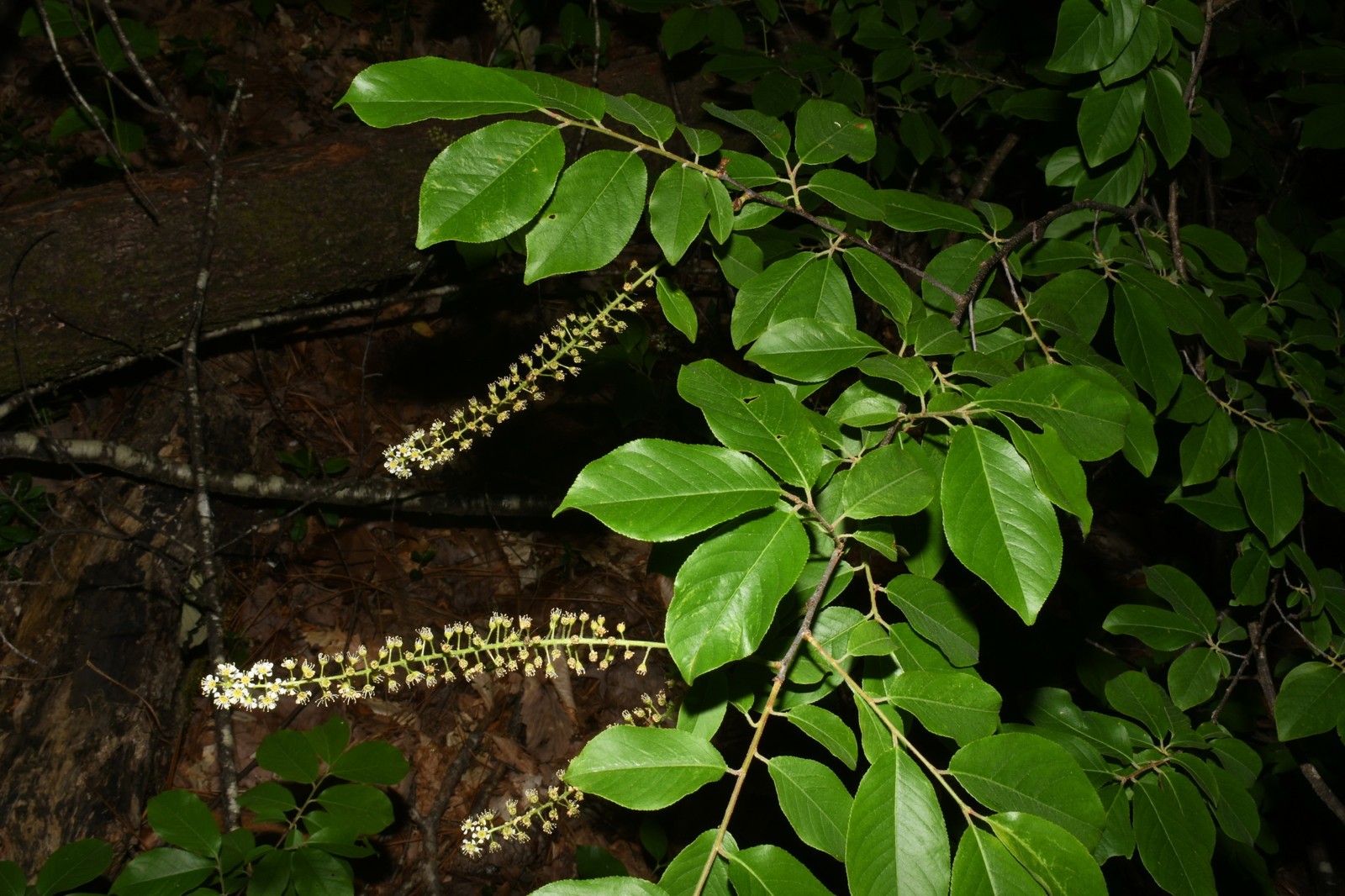
Prunus alabamensis, the Alabama Cherry (also called Alabama black cherry), is an uncommon small to medium tree of the southeastern Piedmont and upper Coastal Plain, found entirely within the broader range of the familiar black cherry (Prunus serotina), which it closely resembles. It typically grows 20 to 40 feet tall with glossy, finely toothed leaves and the same slender, drooping racemes of small white flowers that make black cherry easy to recognize in spring.
Alabama cherry’s taxonomy has long been debated. Some botanists, including the USDA PLANTS database, treat it as a variety of black cherry (Prunus serotina var. alabamensis), since the two are closely related, overlap completely in range, and intergrade where they meet. Most current treatments, however, including the Flora of the Southern and Mid-Atlantic United States (FSUS) and Wikipedia’s synthesis of recent taxonomic literature, recognize it as a distinct species on the strength of consistent differences in leaf texture, bark, and habitat preference. This profile follows that species-level treatment, in line with current flora-based practice, while noting that gardeners may also encounter it labeled as a black cherry variety.
For readers comparing cherry options for the region, our roundup of cherry trees for Alabama covers the wider field this uncommon native sits within. Alabama cherry is a worthwhile, little-known native tree for upland Piedmont gardens within its range. It offers the same wildlife value as black cherry, including larval host status for tiger swallowtail and other butterflies, in a somewhat smaller package suited to drier, rockier upland sites than its more widespread cousin typically favors.
Identification
Alabama cherry is a small to medium deciduous tree, usually 20 to 40 feet tall with a slender trunk up to about 6 inches in diameter, rarely more. It has a more modest stature than black cherry, which can reach 60 to 80 feet, and tends to grow in drier, more upland settings.
Bark
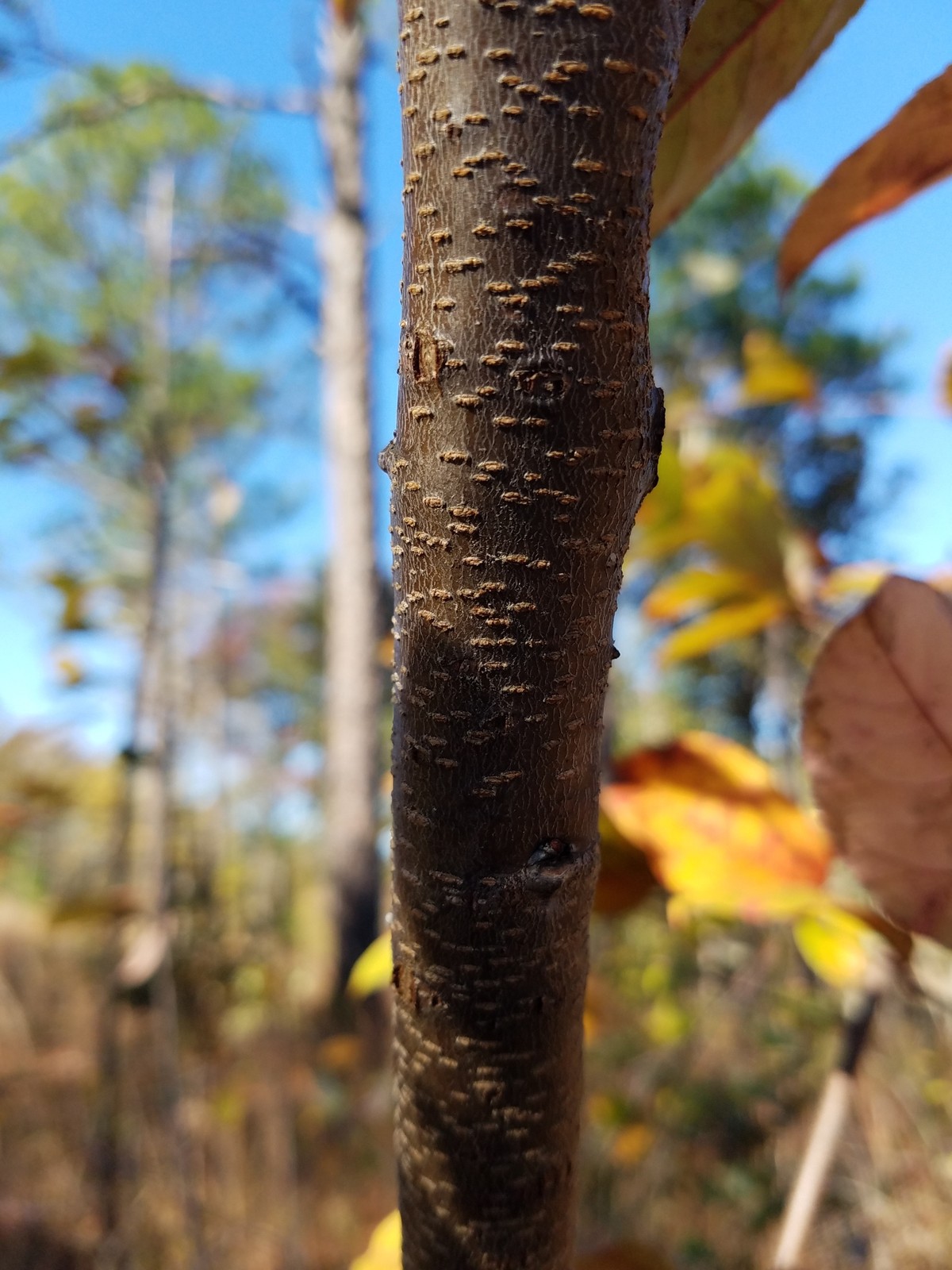
Young bark is smooth, grayish brown, and marked with horizontal lenticels (small raised breathing pores), closely resembling young black cherry bark. With age it roughens and breaks into small, dark gray to blackish plates, though Alabama cherry’s bark is generally described as somewhat smoother and less deeply broken than mature black cherry bark, especially at a given trunk size.
Leaves
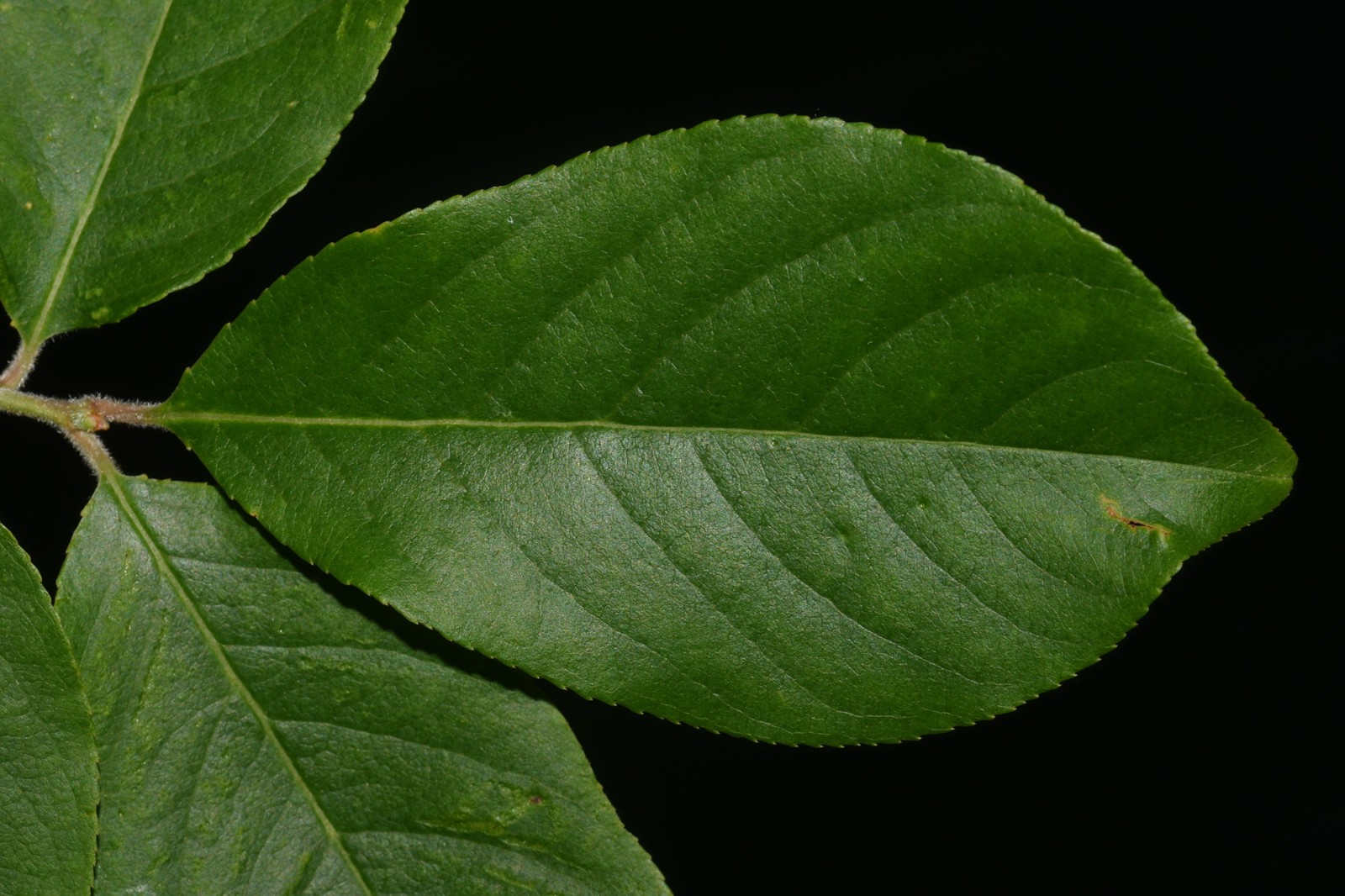
Leaves are alternate, simple, 2 to 5 inches long, elliptic to oblong-ovate, with finely toothed (serrate) margins and a glossy, somewhat leathery dark green upper surface. The underside often shows rust-colored hairs along the midrib, a key field mark distinguishing it from black cherry, whose leaf undersides are typically hairless or only sparsely hairy. Crushed leaves release the characteristic bitter-almond scent shared by all members of the cherry genus.
Flowers & Fruit
In spring, Alabama cherry produces slender, elongated racemes 3 to 6 inches long, each carrying dozens of small, five-petaled white flowers, appearing after the leaves have emerged, just like black cherry. The flowers are followed by small, dark purple to black drupes about 1/3 inch across, ripening in summer. The fruit is edible to wildlife and, once fully ripe, to people as well, though the bitter flesh and modest size make it a wildlife food first and a human snack a distant second.
Quick Facts
| Scientific Name | Prunus alabamensis |
| Family | Rosaceae (Rose) |
| Plant Type | Deciduous small to medium tree |
| Mature Height | 20–40 ft |
| Mature Spread | 15–25 ft |
| Growth Rate | Moderate |
| Sun Exposure | Full Sun to Part Shade |
| Water Needs | Average; reasonably drought tolerant once established |
| Soil Type | Well-drained upland soil; tolerates rocky or sandy ground |
| Soil pH | Acidic to neutral |
| Bloom Time | April – May |
| Flower Color | White |
| Fall Color | Yellow to orange |
| Fruit | Small dark purple-black drupes, about 1/3 in, summer |
| Deer Resistant | Low (deer browse foliage readily) |
| USDA Hardiness Zones | 7–9 |
Native Range
Alabama cherry is native to a band of the southeastern Piedmont and adjacent Coastal Plain running from north-central South Carolina through northwestern Georgia and northern Alabama, south to the Florida Panhandle and southern Alabama. Throughout this range it occurs entirely within the much broader range of black cherry, overlapping with it rather than replacing it, and it is considered uncommon to rare wherever it grows.
Typical habitat is well-drained upland forest: dry to mesic woods, rocky slopes, and bluffs, often on soils derived from granite or other crystalline rock in the Piedmont. This preference for drier, more upland ground, compared with black cherry’s broader tolerance for richer bottomland and disturbed sites, is one of the ecological distinctions supporting its recognition as a separate species in current floras.
Because Alabama cherry is uncommon and easily overlooked among more abundant black cherry populations, it is likely under-recorded across parts of its range. It is not federally listed, but given its genuine rarity and taxonomic uncertainty, foresters and land managers thinning mixed Piedmont woodlands should take care to recognize and retain it where it is found rather than treating it as an ordinary black cherry.
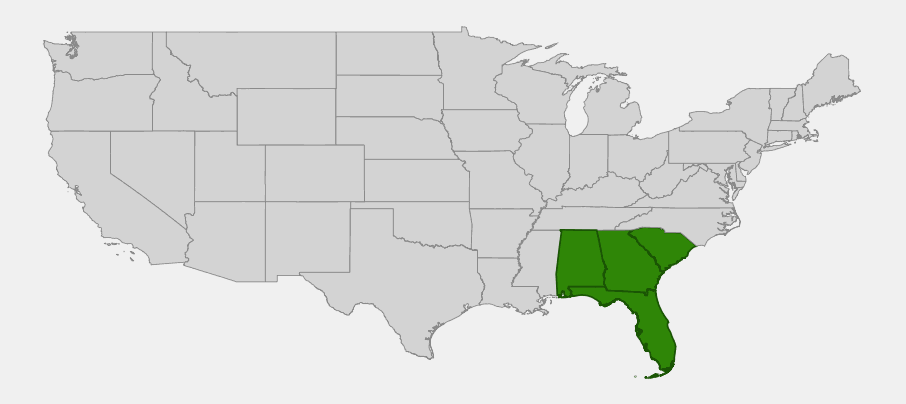
📋 Regional plant lists featuring Alabama Cherry: Georgia, Alabama & Mississippi · North Carolina & South Carolina
Growing & Care Guide
Alabama cherry grows much like its common relative black cherry, but is better suited to drier, upland garden sites than to rich bottomland soil.
Light
Plant Alabama cherry in full sun to light shade. It flowers and fruits best with good sun exposure, though it tolerates some shade as a component of mixed upland Piedmont woodland.
Soil & Water
Give Alabama cherry well-drained soil; it is naturally suited to drier, rockier upland sites than black cherry and does not need, or particularly want, consistently moist bottomland conditions. It is reasonably drought tolerant once established. Water new plantings regularly for the first one to two years, then taper off as the tree settles in.
Planting Tips
Choose an upland site with good drainage, ideally one with some slope or rocky content similar to its native Piedmont habitat. Plant container-grown trees in fall or late winter. Because Alabama cherry stays smaller than black cherry, it fits more readily into mid-sized residential landscapes where a full-sized black cherry might eventually be too large.
Pruning & Maintenance
Prune in late winter to remove dead, crossing, or weak branches and establish a strong central leader while the tree is young. Like black cherry, Alabama cherry can be susceptible to tent caterpillars and black knot fungus; prune out and destroy any black knot galls promptly to limit spread, and avoid planting near commercial stone fruit orchards where black knot is a concern.
Propagation
Propagation is from seed, collected from ripe summer fruit. Clean the pulp from the pits and give them several months of cold, moist stratification over winter before spring sowing, the standard method for Prunus species. Because Alabama cherry can be confused with and may hybridize with black cherry, collect seed only from trees you can confirm show the species’ diagnostic rusty-haired leaf undersides and upland habitat.
Landscape Uses
- Upland native woodland gardens on dry, well-drained Piedmont sites
- Wildlife plantings alongside black cherry and flowering dogwood
- Smaller-scale alternative to black cherry where a full-sized tree would not fit
- Butterfly gardens, since Prunus species are key larval hosts for tiger swallowtail and other butterflies
- Restoration plantings in dry Piedmont woodland and rocky slope habitats
Wildlife & Ecological Value
Alabama cherry provides the same strong wildlife value as its relative black cherry, concentrated in the drier upland habitats it favors.
For Pollinators
The spring flower racemes attract a wide range of bees and other pollinating insects, and as a member of the genus Prunus, Alabama cherry serves as a larval host plant for eastern tiger swallowtail, red-spotted purple, and other butterfly and moth caterpillars.
For Birds
The small summer fruits are eaten by numerous songbirds, including thrushes, waxwings, and woodpeckers, making Alabama cherry a valuable mid-summer food source in upland Piedmont woods, a role explored more generally in our piece on planting native trees for wildlife.
For Mammals
Fruits are also eaten by raccoons, foxes, and other mammals, which help disperse seed. White-tailed deer readily browse the foliage, which can affect young tree survival in areas with high deer pressure.
Ecosystem Role
As an uncommon component of dry Piedmont and upper Coastal Plain woodlands, Alabama cherry adds genetic and ecological diversity to forests often dominated by its far more common relative black cherry, and its rarity makes individual populations worth identifying and conserving.
Cultural & Historical Uses
Alabama cherry has no significant separate history of commercial or traditional use; because it so closely resembles black cherry and was long treated as part of that species, any historical use of its wood or fruit would likely have been folded into the broader use of black cherry, prized for cabinet-grade lumber and used medicinally and as a flavoring by Indigenous peoples and early settlers.
Botanist Charles Mohr first described Alabama cherry in the late nineteenth century based on material from Alabama, and the species has remained a point of ongoing taxonomic discussion ever since, treated variously as a full species, a variety, or a subspecies of black cherry by different authors over the decades.
Today its main significance is as a genuinely uncommon native tree worth recognizing and protecting in southeastern Piedmont woodlands, and as an interesting example of how closely related native trees can diverge in subtle but ecologically meaningful ways, consistent with the broader benefits of planting native trees for regional biodiversity.
Frequently Asked Questions
Is Alabama cherry the same as black cherry?
They are very closely related and some botanists classify Alabama cherry as a variety of black cherry (Prunus serotina var. alabamensis). Most current floras, including FSUS, treat it as a distinct species based on differences in leaf hair, bark, and habitat, and that is the treatment this profile follows.
How do you tell Alabama cherry apart from black cherry?
The most reliable field mark is rust-colored hairs along the midrib on the underside of Alabama cherry leaves, which black cherry generally lacks. Alabama cherry also tends to be smaller and grows on drier, more upland sites than black cherry, which tolerates a wider range of conditions including rich bottomland.
Are Alabama cherry fruits edible?
Yes, the ripe fruit is edible, though small and quite bitter or astringent raw, similar to black cherry. Wildlife eat the fruit readily; people more often use fruit from this group for jelly or wine after cooking down with sugar, if used at all.
Is Alabama cherry toxic to animals?
Like other Prunus species, the leaves, bark, and seeds contain cyanogenic compounds that can be toxic to livestock, especially wilted leaves, and should not be fed to animals. The ripe fruit flesh itself is not toxic.
Why is Alabama cherry hard to find at nurseries?
It is genuinely uncommon in the wild, easily mistaken for black cherry, and rarely propagated commercially, so it is mostly available through specialty native-plant nurseries within its Piedmont range rather than general garden centers.

Looking for a nursery that carries Alabama Cherry?
Browse our native plant nursery directory: Florida & Georgia · Alabama · South Carolina

