
Tawnyberry Holly (Ilex krugiana)
Ilex krugiana, commonly known as Tawnyberry Holly or Krug’s Holly, is a slender evergreen tree of South Florida’s rarest hardwood forest type: rockland hammock. In the United States it is known only from a narrow band of the Miami Rock Ridge in Miami-Dade County, running from Long Pine Key in Everglades National Park northeast to the Miami River, making it one of the most geographically restricted native trees sold anywhere on this site.
Unlike the spiny-leaved hollies familiar to gardeners up north, Tawnyberry Holly has smooth, entire-margined, glossy leaves and a slim, upright habit with pale, nearly white bark on young trees. It is dioecious, meaning individual trees are either male or female, and only female trees bear the small red-to-purple berries that give hollies their wildlife value. The species is listed as threatened in Florida, a result of its inherently tiny range being squeezed further by development, invasive species and rising seas along the Miami Rock Ridge.
For South Florida gardeners building a genuinely regional hammock garden, Tawnyberry Holly is a worthwhile, if hard-to-find, native tree: moderate in size, well mannered, shade-tolerant, and a good source of berries for birds in a part of the state where true native canopy and sub-canopy trees are increasingly scarce in the built landscape.
Identification
Tawnyberry Holly is usually a medium tree, occasionally a large one, with an erect single trunk and an open, somewhat irregular crown. Most wild and landscape specimens reach 20 to 30 feet, though trees in sheltered South Florida hammocks have been documented to 55 feet. Growth is moderate and the overall silhouette is noticeably taller than it is broad, fitting well into a narrow planting space.
Trunk & Bark
The bark is thin, smooth and nearly white to pale gray on younger trees, darkening and roughening somewhat with age. The trunk is typically single and erect, without the low branching habit of many shrubby hollies, giving mature trees a clean, upright look well suited to use as a specimen or accent tree.
Leaves
Leaves are alternate, leathery, and relatively small for a holly, from about a half inch to a little over an inch long in typical South Florida specimens (regional populations elsewhere in its range can run larger, to nearly 5 inches). They are obovate to elliptic in shape, dull to shiny green at maturity, and lack the spine-tipped teeth seen on American Holly or English Holly; the margin is entire or only slightly toothed, with an acute to acuminate tip. This spineless, smooth-edged leaf is one of the more reliable ways to tell Tawnyberry Holly apart from other hollies at a glance.
Flowers & Fruit
Small, four-petaled white flowers form in clusters at the leaf axils. Because the species is dioecious, male (staminate) trees produce flowers with four stamens and a nonfunctional ovary, while female (carpellate) trees produce flowers with a functional four-chambered ovary and sterile stamens; only female trees go on to set fruit. The fruit is a small berry-like drupe that ripens from green to red to purple-black, held close along the twigs rather than in showy hanging clusters. If you want berries for wildlife or seed, you need at least one female tree, ideally with a male nearby for pollination.
Quick Facts
| Scientific Name | Ilex krugiana |
| Family | Aquifoliaceae (Holly) |
| Plant Type | Evergreen tree, dioecious |
| Mature Height | 20–30 ft typical; to 55 ft in sheltered hammocks |
| Mature Spread | 10–15 ft; taller than broad |
| Growth Rate | Moderate |
| Sun Exposure | Part Shade to Full Sun |
| Water Needs | Moderate; does not tolerate standing salt or brackish water |
| Soil Type | Moist, well-drained limestone soils with humusy topsoil |
| Soil pH | Neutral to alkaline |
| Bloom Time | Spring |
| Flower Color | White |
| Fall Color | None (evergreen) |
| Fruit | Small drupe, red ripening to purple-black (female trees only) |
| Deer Resistant | Yes |
| USDA Hardiness Zones | 10b–11 |
Native Range
In the United States, Tawnyberry Holly is native only to Miami-Dade County, Florida, where it grows along the Miami Rock Ridge from Long Pine Key in Everglades National Park northeast to the Miami River. Outside the U.S., its range extends through the Bahamas, Hispaniola (Haiti and the Dominican Republic) and Puerto Rico. This makes South Florida the very edge of its range, and the species genuinely rare even within the small area it occupies.
Tawnyberry Holly grows as a sub-canopy or canopy tree in rockland hammock, a fire-protected, broadleaf evergreen forest type that develops in limestone solution holes and other low spots sheltered from the pine rockland fires around them. This habitat itself is critically reduced, confined mostly to Everglades National Park, a scatter of county and state preserves, and a handful of urban hammock fragments within greater Miami. The species is listed as threatened in Florida, reflecting both its narrow native range and the ongoing loss and degradation of rockland hammock to development, invasive plants and sea level rise.
Because wild populations are so limited, gardeners should buy Tawnyberry Holly only from licensed native plant nurseries that propagate stock rather than collect it, and should expect it to be an uncommon special-order item rather than a garden-center staple.
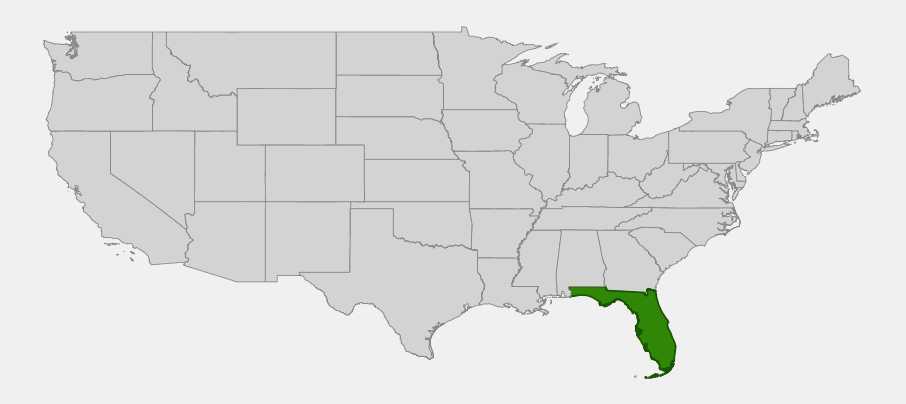
📋 Regional plant lists featuring Tawnyberry Holly: this site does not currently publish a dedicated South Florida regional list; see the Florida nursery directory below.
Growing & Care Guide
Tawnyberry Holly is not difficult to grow within its climate range, but it does need the limestone-based, well-drained conditions of a true South Florida hammock garden, and it is strictly a plant for the warmest part of the state.
Light
Give Tawnyberry Holly part shade to full sun. In the wild it grows as a sub-canopy to canopy tree, often with some overhead protection from taller hammock trees when young, so a site with light shade for the first few years, opening to fuller sun as the tree matures, closely mimics its natural establishment pattern.
Soil & Water
This holly wants moist, well-drained limestone soil with at least some organic, humusy topsoil; it tolerates nutrient-poor sites but grows and fruits better with some organic content. Keep it consistently but not constantly wet. It has low tolerance for salt or brackish flooding, so it is not a beach or immediate-shoreline plant despite being native to coastal Miami-Dade County; site it inland of truly saline conditions.
Planting Tips
Because the species is both threatened and rarely offered commercially, expect to special-order from a native plant nursery rather than find it at a general garden center. Plant container-grown stock in warm weather and keep the root zone evenly moist through the first one to two growing seasons. If fruit production for wildlife matters to you, plant at least one known female alongside a male, since this dioecious species needs both sexes present to set berries.
Pruning & Maintenance
Tawnyberry Holly needs little routine pruning; remove dead or crossing branches and let the naturally upright, open crown develop with minimal shaping. It has no major pest or disease problems reported in South Florida landscapes and requires minimal fertilizer once established in reasonably organic limestone soil.
Propagation
Propagation is from seed, which like many hollies can be slow and irregular to germinate, sometimes taking a year or more; cleaning the pulp from ripe fruit before sowing improves results. Because availability is so limited, most gardeners will source nursery-grown plants rather than propagate their own.
Landscape Uses
- Accent or specimen tree in residential and commercial South Florida landscapes, per its historical use in the region
- Rockland hammock restoration and native plant gardens, where it is ecologically appropriate and regionally authentic
- Narrow planting strips, since its upright, taller-than-broad form fits tight spaces better than rounder shade trees
- Wildlife plantings alongside other hammock natives such as Cassine Holly and American Holly
Wildlife & Ecological Value
As a sub-canopy and canopy species of one of Florida’s rarest forest types, Tawnyberry Holly contributes habitat value disproportionate to how often it appears in the modern landscape.
For Pollinators
The small white spring flowers attract bees and other small pollinating insects, offering a nectar source within the rockland hammock understory and canopy gaps where flowering trees are not especially abundant.
For Birds
The red-to-purple berries produced by female trees are a food source for fruit-eating birds, which in turn help disperse the seed through the fragmented hammock patches where the species survives. Like other native hollies, Tawnyberry Holly’s berries tend to persist into the cooler months, providing food when other fruit is scarce.
For Mammals
Small mammals in rockland hammock habitat take advantage of fallen fruit and use the base of the tree and surrounding understory for cover, a modest but real contribution in a habitat type where undisturbed structure is increasingly hard to find.
Ecosystem Role
Tawnyberry Holly is a characteristic species of South Florida rockland hammock, one of the most geographically restricted and threatened forest communities in the continental United States. Every individual, wild or cultivated, helps maintain genetic diversity in a species whose entire U.S. population is confined to a single county.
Cultural & Historical Uses
Tawnyberry Holly has no documented medicinal uses recorded in the regions where it grows. It has seen occasional use in the South Florida landscape and horticulture trade as an accent or specimen tree, valued for its clean upright form and pale bark, though it has never been common in cultivation given how limited the wild seed source is.
Today its primary significance is ecological and conservation-focused: as a threatened species restricted to the Miami Rock Ridge, it is a priority for rockland hammock restoration projects and a worthwhile, genuinely native choice for South Florida gardeners who want their landscape to reflect the region’s own disappearing forest type rather than imported ornamentals.
Frequently Asked Questions
Is Tawnyberry Holly endangered?
It is listed as threatened in Florida. Its entire U.S. range is confined to Miami-Dade County, and the rockland hammock habitat it depends on has been heavily reduced by development, invasive species and sea level rise. Buy only nursery-propagated stock from a licensed native plant source.
Do I need a male and a female tree to get berries?
Yes. Tawnyberry Holly is dioecious, meaning each tree is either male or female. Only female trees produce the red-to-purple berries, and they need a nearby male tree for pollination to set fruit.
How is Tawnyberry Holly different from American Holly?
Tawnyberry Holly has smooth, spineless, entire-margined leaves, unlike the spine-tipped leaves of American Holly. It is also a tropical species restricted to USDA zones 10b–11 in South Florida, while American Holly is a cold-hardy tree found throughout much of the eastern U.S.
Will Tawnyberry Holly tolerate salty, coastal soil?
No. Despite being native to coastal Miami-Dade County, it has low tolerance for salt or brackish flooding and should be planted on sites with good drainage that are not subject to saltwater inundation.
Where can I buy a Tawnyberry Holly?
Because it is a threatened, narrow-range species, it is rarely carried by general nurseries. Look to native plant specialty nurseries in the South Florida nursery directory below, and expect to special-order.

Looking for a nursery that carries Tawnyberry Holly?
Browse our native plant nursery directory: Florida. For more South Florida tree ideas, see our guides to shade trees for South Florida, privacy trees for Florida and attracting songbirds with native plants.

