
Knowlton Hophornbeam (Ostrya knowltonii)
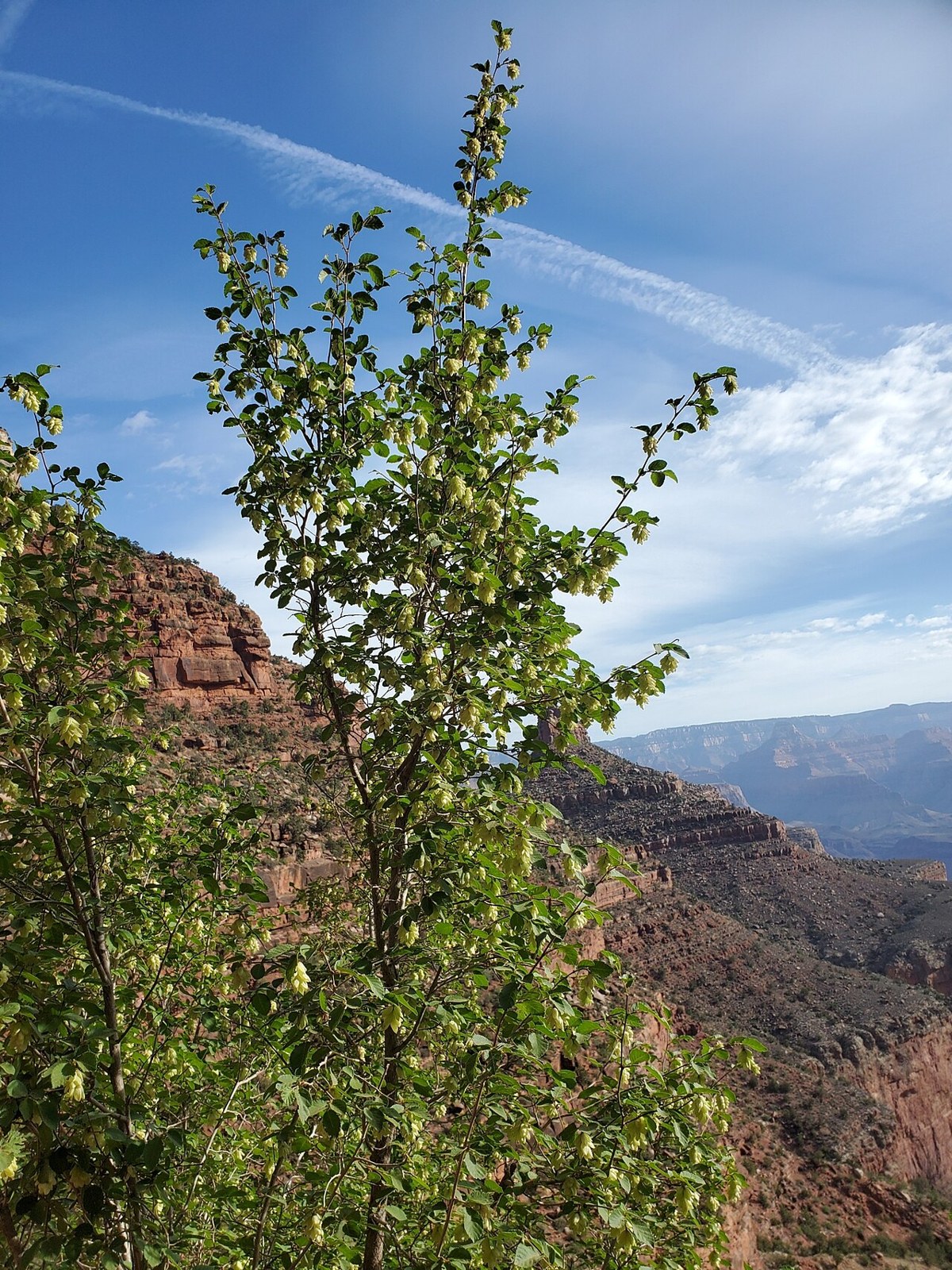
Ostrya knowltonii, known as Knowlton Hophornbeam (also called western hophornbeam, woolly hophornbeam, or simply “ironwood” — a name shared with several unrelated hardwoods), is a small, tough tree of the dry canyon country of the Four Corners region and the Trans-Pecos. It is the southwestern counterpart of the better-known Eastern Hophornbeam (Ostrya virginiana), sharing that species’ famously hard, dense wood and distinctive hop-like papery fruit clusters, but scaled down and adapted to a far drier, rockier world.
Knowlton Hophornbeam rarely forms pure stands. Instead it turns up as a scattered, sporadic presence in oak and pinyon-juniper woodlands and the lower fringes of ponderosa pine forest, tucked into canyon walls, rocky slopes, and rim-rock settings from the Grand Canyon to the Guadalupe and Sacramento Mountains of New Mexico and the Chisos and Davis Mountains of west Texas. Its name honors Frank Hall Knowlton, the American paleobotanist who collected the type specimen.
For gardeners and land managers in its native Four Corners and Trans-Pecos range, Knowlton Hophornbeam is a durable, drought-adapted small tree well suited to rocky, well-drained sites where little else of its stature will grow — valued as much for its toughness and wildlife interest as for any showy ornamental display.
Identification
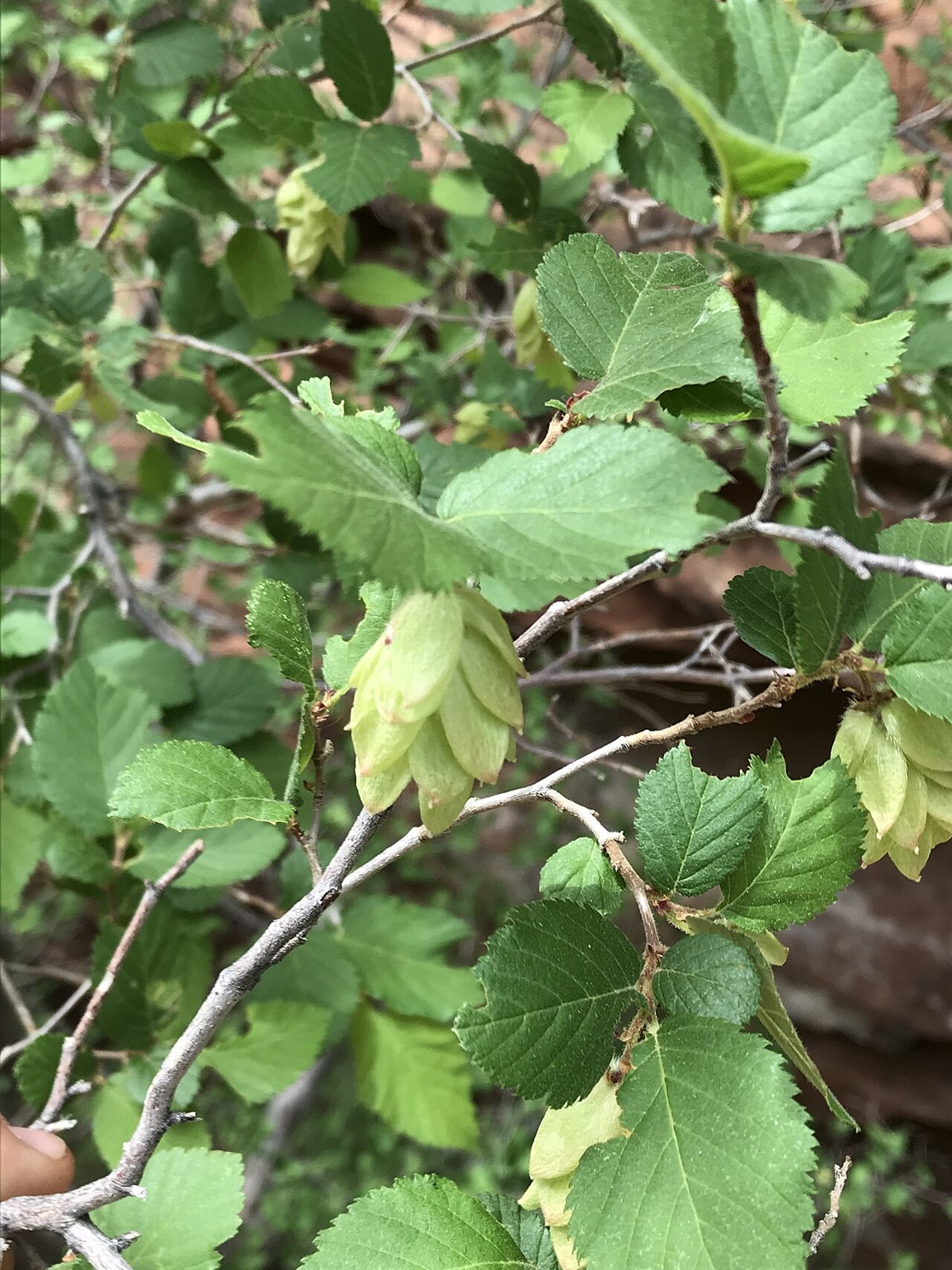
Knowlton Hophornbeam is most easily recognized by the combination of its small, often crooked multi-trunked form, birch-like serrated leaves, and — when present — distinctive clusters of pale green, papery, hop-like fruit that dangle from the branches in summer, giving the tree (and the whole genus Ostrya) its common name.
Bark & Stems
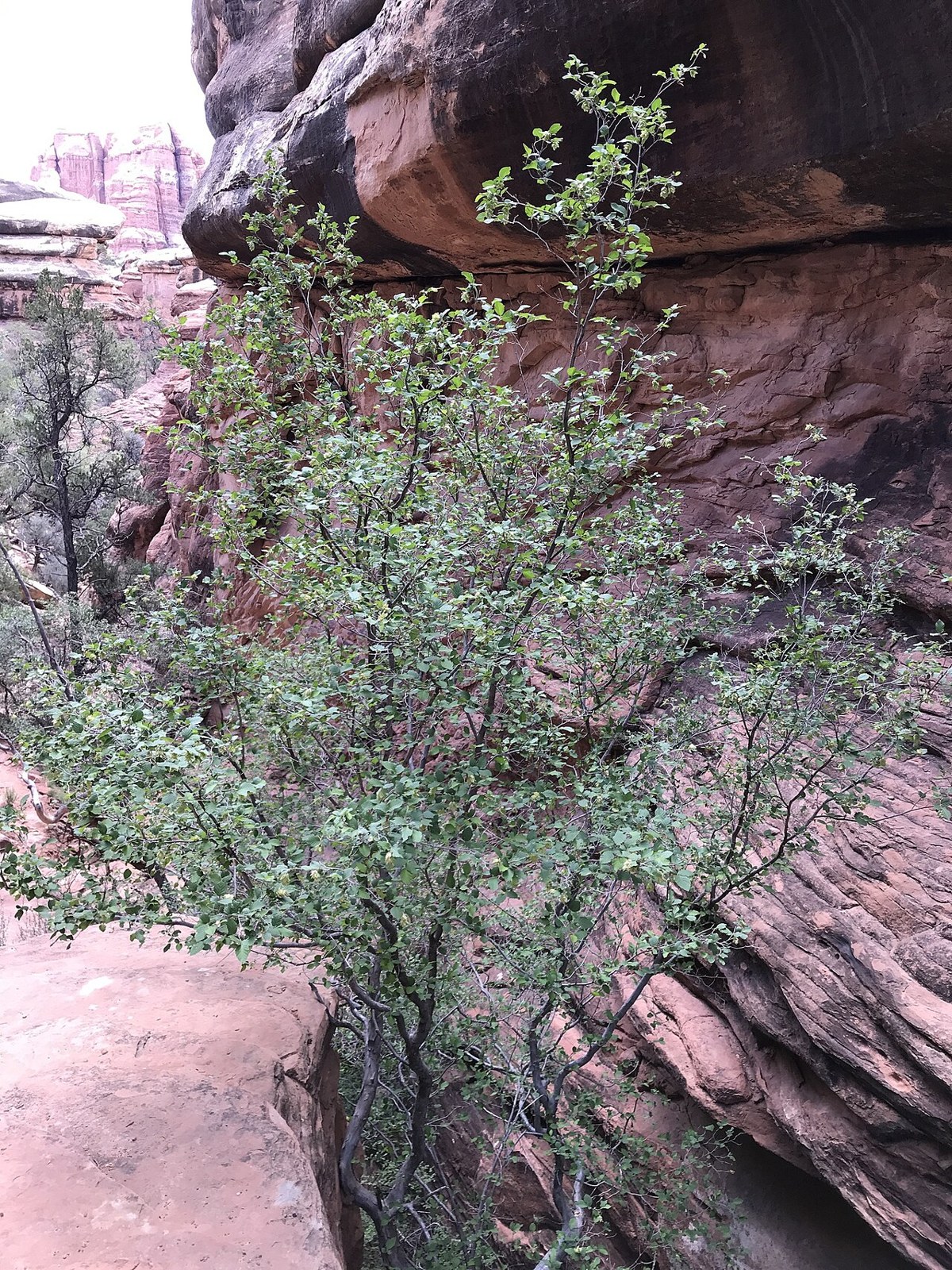
Bark is brownish-gray, furrowing into narrow scales or thin vertical strips with age, similar in character to its eastern relative. The trunk is typically short, often forking low and dividing into numerous crooked, spreading branches that build a rounded, irregular crown rather than a single clean leader. Young twigs are slender and often finely hairy, giving rise to the alternate common name “woolly hophornbeam.”
Leaves
Leaves are deciduous, alternate, simple, and birch- or elm-like in outline — ovate to oblong, up to about 2½ inches long, with sharply double-serrated (toothed) margins and a somewhat rough, dull-green upper surface. They turn an unremarkable yellow-brown in fall before dropping.
Flowers
Like its relatives in the birch family, Knowlton Hophornbeam is monoecious, with male and female flowers in separate catkins on the same tree. Male catkins are slender and pendulous, up to about 1¼ inches long, usually visible through winter before expanding in spring; female catkins are much shorter, under half an inch, and easy to overlook.
Fruit & Seeds
The fruit is the tree’s signature feature: small, flattened nutlets, each enclosed in an inflated, papery, bladder-like husk. These husks cluster together into dangling, pale green structures that closely resemble the fruiting cones of the hops plant — hence “hophornbeam.” The clusters mature from green to tan through summer and persist on the tree into fall, giving it ornamental interest well after most spring wildflowers have faded.
Quick Facts
| Scientific Name | Ostrya knowltonii (syn. O. baileyi, O. chisosensis) |
| Family | Betulaceae (Birch) |
| Plant Type | Deciduous Tree / Large Shrub |
| Mature Height | 30–40 ft |
| Growth Rate | Slow |
| Sun Exposure | Full Sun |
| Water Needs | Low |
| Soil Type | Rocky, well-drained canyon and slope soils |
| Soil pH | Neutral to alkaline |
| Bloom Time | Early spring (with leaf-out) |
| Flower Color | Green (not showy) |
| Fall Color | Yellow-brown |
| Fruit | Pale green, hop-like papery fruit clusters |
| Deer Resistant | Moderate |
| USDA Hardiness Zones | 6–8 |
Native Range
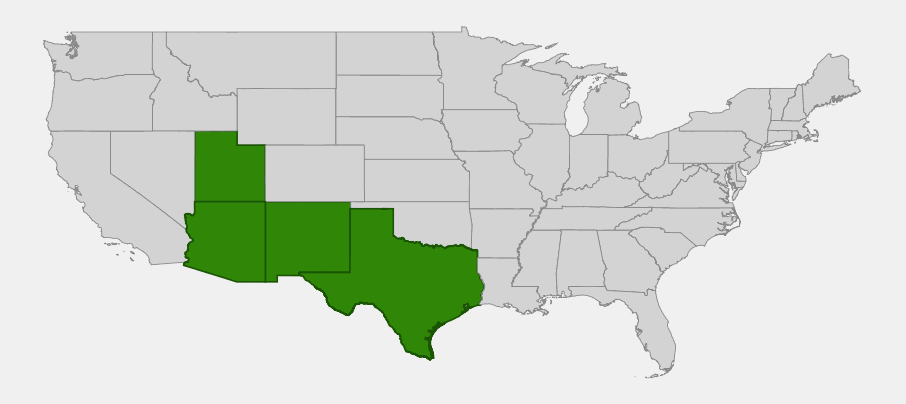
Knowlton Hophornbeam occupies a broken, “sky island” style distribution across the American Southwest: southeastern Utah (including the canyon country around Canyonlands and the San Juan River drainage), northern Arizona (notably the rims and side canyons of the Grand Canyon), southeastern New Mexico’s Guadalupe and Sacramento Mountains in Eddy County, and northern Trans-Pecos Texas, including Guadalupe Mountains National Park and, in some treatments, the Chisos Mountains. Throughout this range it is never common — occurrence is sporadic and scattered even within areas considered part of its range.
Typical habitat includes oak woodlands, pinyon-juniper woodlands, and the lower fringes of ponderosa pine forest, generally in sunny, dry, rocky locations — canyon walls, rim rock, and talus slopes — at roughly 5,000 to 7,500 feet elevation. In Guadalupe Mountains National Park, it becomes more prevalent as deciduous canyon woodlands shift from the driest, most exposed sites toward slightly moister canyon bottoms, before giving way in turn to bigtooth maple and chinkapin oak around springs and canyonheads.
Conservation assessments reflect this scattered, low-density distribution: NatureServe ranks the species G3 (Vulnerable) globally, even though the global IUCN Red List currently lists it as Least Concern. In practice this means Knowlton Hophornbeam is uncommon almost everywhere it occurs, worth conserving in place, but not a species of acute, imminent extinction risk the way some of its Trans-Pecos neighbors are.
📋 Regional plant lists featuring Knowlton Hophornbeam: Utah & Western Colorado · Arizona & New Mexico · South and West Texas
Growing & Care Guide
Knowlton Hophornbeam is a specialist for rocky, arid canyon country, and gardeners in its native range should expect a tough, slow, understated tree rather than a fast-growing showpiece.
Light
Plant in full sun. In the wild it grows in sunny, dry, exposed rocky locations, and it is not adapted to deep shade or competition from taller canopy trees.
Soil & Water
This species thrives in rocky, well-drained soils — exactly the thin, mineral soils of canyon walls, talus, and rim rock that characterize its native habitat. It needs little supplemental water once established and performs poorly in heavy, poorly drained, or consistently moist soils. Light, infrequent deep watering during the first couple of growing seasons helps young trees establish a resilient root system before they are left to fend for themselves.
Planting Tips
Choose a site with excellent drainage — a rocky slope, raised bed, or decomposed-granite area mimics its native canyon habitat well. Because the species is naturally slow-growing and somewhat sparse in the wild, it is best used as an accent or specimen tree rather than relied upon for quick shade or screening.
Pruning & Maintenance
Minimal pruning is needed. Remove dead or damaged wood as it occurs; the tree’s naturally crooked, multi-branched form is typical of the species and doesn’t need correcting. Its tough, dense wood and drought adaptation make it largely trouble-free once established.
Landscape Uses
Knowlton Hophornbeam suits several niche roles in Southwest native landscaping:
- Rock gardens and xeriscapes on steep, rocky, or thin-soiled sites
- Canyon and rim-style native plantings that echo its natural pinyon-juniper and oak-woodland setting
- Wildlife gardens — the hop-like fruit and dense branching provide food and cover
- Specimen or accent tree where a small, irregular, low-water native tree is wanted
Wildlife & Ecological Value
Though never abundant, Knowlton Hophornbeam contributes meaningfully to the plant communities of the dry canyon country it inhabits.
For Birds & Small Mammals
The small nutlets enclosed in the hop-like husks provide seed forage for birds and small mammals in habitats where food sources can be scarce for much of the year. The dense, often tangled branching of multi-stemmed individuals offers useful cover in otherwise open, rocky terrain.
Ecosystem Role
As a scattered, low-density component of oak and pinyon-juniper woodlands across the Colorado Plateau and Trans-Pecos, Knowlton Hophornbeam adds structural and species diversity to habitats that might otherwise be dominated by a narrower set of oaks, pines, and junipers. Its persistence in isolated canyon pockets — including some remarkably scenic settings along the Grand Canyon’s rim trails — makes it a small but genuine piece of the Southwest’s canyon-country biodiversity.
Cultural & Historical Uses
Like its eastern relative, Knowlton Hophornbeam produces exceptionally hard, dense, tough wood — one of the reasons hophornbeams across the genus are commonly nicknamed “ironwood.” Historically, this density made the wood useful for small, high-wear items such as tool handles and fence posts in the rural communities of its range, though the tree’s small size, slow growth, and scattered distribution meant it was never harvested at any commercial scale.
The species carries the name of Frank Hall Knowlton, an American paleobotanist associated with the U.S. Geological Survey, honoring his contributions to the botanical exploration of the American Southwest. Beyond this modest naming history and its practical use for small hardwood items, Knowlton Hophornbeam has little documented tradition of Indigenous or settler use, likely owing to its sparse, scattered presence across a remote and rugged range.
Frequently Asked Questions
How is Knowlton Hophornbeam different from Eastern Hophornbeam?
Knowlton Hophornbeam (Ostrya knowltonii) is the Southwest’s counterpart to the much more widespread Eastern Hophornbeam (Ostrya virginiana) of the central and eastern U.S. They share the same hard wood and distinctive hop-like fruit, but Knowlton Hophornbeam is adapted to dry, rocky canyon habitats rather than the moister eastern woodlands Eastern Hophornbeam favors, and it tends to be a somewhat smaller, more irregularly branched tree.
Why is it called “ironwood”?
The name refers to the wood’s exceptional hardness and density, a trait shared by several unrelated trees that also go by “ironwood” in different parts of North America. It is not related to desert ironwood (Olneya tesota) of the Sonoran Desert despite the shared nickname.
Is Knowlton Hophornbeam endangered?
It is not formally listed as federally threatened or endangered, and the global IUCN Red List currently places it in the Least Concern category. However, NatureServe ranks it G3 (Vulnerable) because of its naturally sparse, scattered distribution — it is uncommon wherever it grows, even within its native range.
Can you grow Knowlton Hophornbeam outside the Southwest?
It’s not recommended. This species is adapted to the specific combination of aridity, rocky soils, and elevation found in its native canyon-country range, and it is unlikely to perform well, or may not survive, in more humid or differently structured climates. Gardeners outside its native Utah–Arizona–New Mexico–Texas range are better served by a hophornbeam or similar tree suited to their own region.
What does the fruit look like, and is it edible?
The fruit forms in dangling clusters of pale green, papery, inflated husks that closely resemble hop cones, each enclosing a small hard nutlet. It is not a food plant for people and has no culinary tradition; its main value is as wildlife forage.

Looking for a nursery that carries Knowlton Hophornbeam?
Browse our native plant nursery directory: Utah & Texas · Arizona · New Mexico
For more on growing native trees in Knowlton Hophornbeam’s range, see our guides to pine trees for Arizona and evergreen trees for Arizona, or browse profiles of its canyon-woodland companions: Gray Oak, Pinyon Pine, Alligator Juniper, Texas Madrone, and Bigtooth Maple.

