
West Indian Cherry (Prunus myrtifolia)
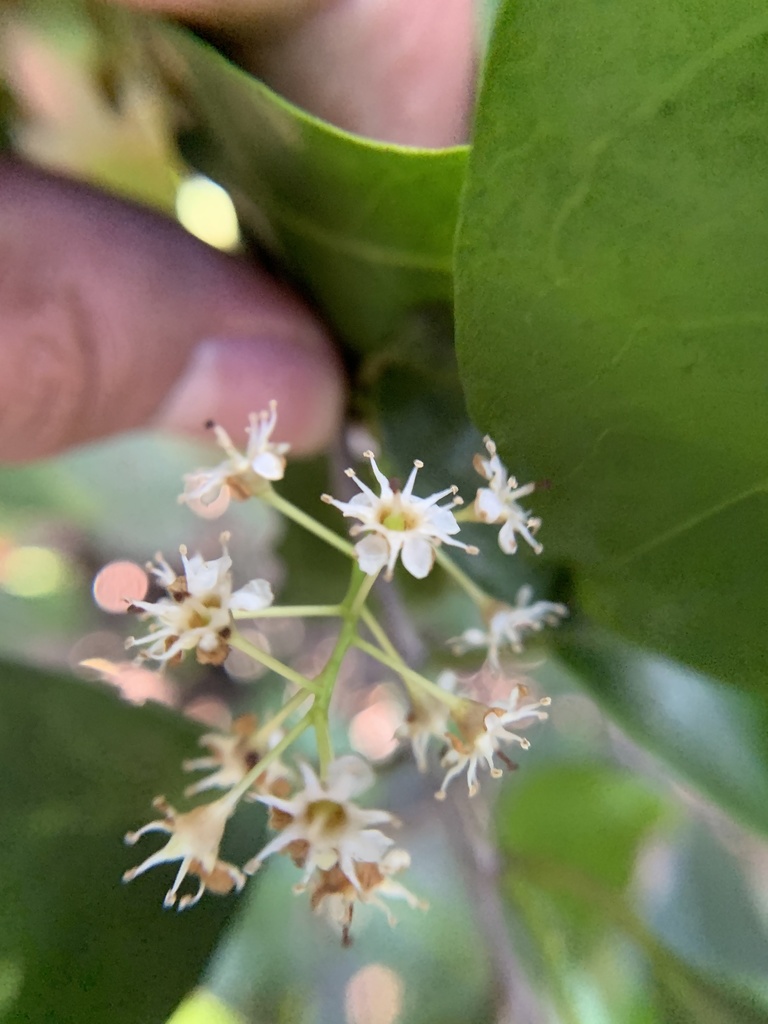
Prunus myrtifolia, known as West Indian Cherry, is an evergreen tree of tropical hardwood hammocks. In the United States it grows wild only in South Florida, where it is rare. It has glossy, dark green leaves, short clusters of small, fragrant white flowers in winter and spring, and round fruits that ripen from red-brown to nearly black and are eaten by birds.
It belongs to the rose family (Rosaceae) and is a tropical cousin of familiar cherries such as Black Cherry and Cherry Laurel. Some botanists place it in the segregate genus Laurocerasus, as Laurocerasus myrtifolia, with the other evergreen laurel cherries. Both the Atlas of Florida Plants and USDA PLANTS use Prunus myrtifolia.
West Indian cherry is listed as Threatened by the State of Florida (FDACS Regulated Plant Index). It is uncommon in the nursery trade, but a few South Florida native nurseries grow it from seed. Buy nursery-propagated trees and never collect plants or seeds from the wild. Like other cherries, its leaves and seeds contain cyanogenic compounds and are toxic if eaten. This guide covers identification, range, care and wildlife value.
Identification
West Indian cherry can look like several other glossy-leaved hammock trees. Crushed leaves and twigs give off a bitter-almond smell, a useful clue shared with other cherries.
Form & Bark
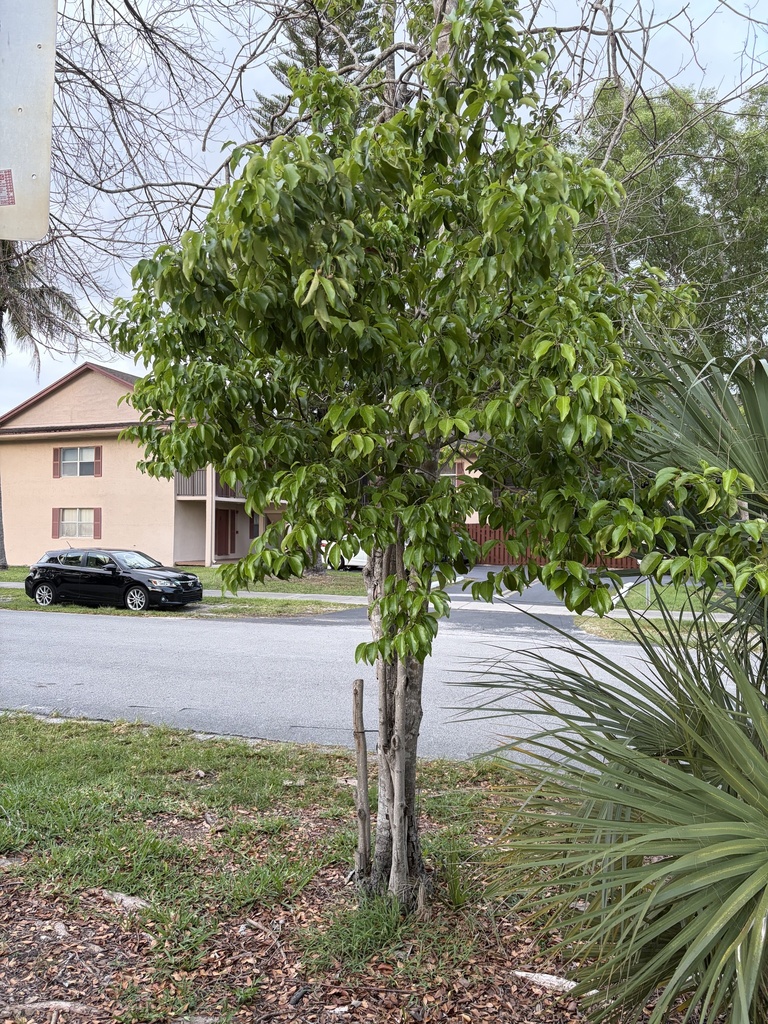
In Florida it is usually a small to medium tree 15 to 30 feet tall, occasionally taller, with a dense, rounded crown. In parts of the tropics it can grow to about 40 feet or more. The bark is smooth and gray to light brown, often mottled with lichens, and becomes slightly rough on older trunks.
Leaves
The leaves are alternate, simple and evergreen, about 2 to 4 inches long, elliptic to oval with a short pointed tip. They are thin but firm, glossy dark green above and paler below, with entire or slightly wavy margins. New growth is light green to bronze. When crushed, the leaves have the bitter-almond scent of cyanogenic compounds.
Flowers
Small white flowers about ¼ inch across grow in short racemes from the leaf axils. Each has five white petals and a ring of long stamens, which gives the clusters a fuzzy look. In Florida they mostly bloom from late fall through spring. The flowers are lightly fragrant.
Fruit & Seeds
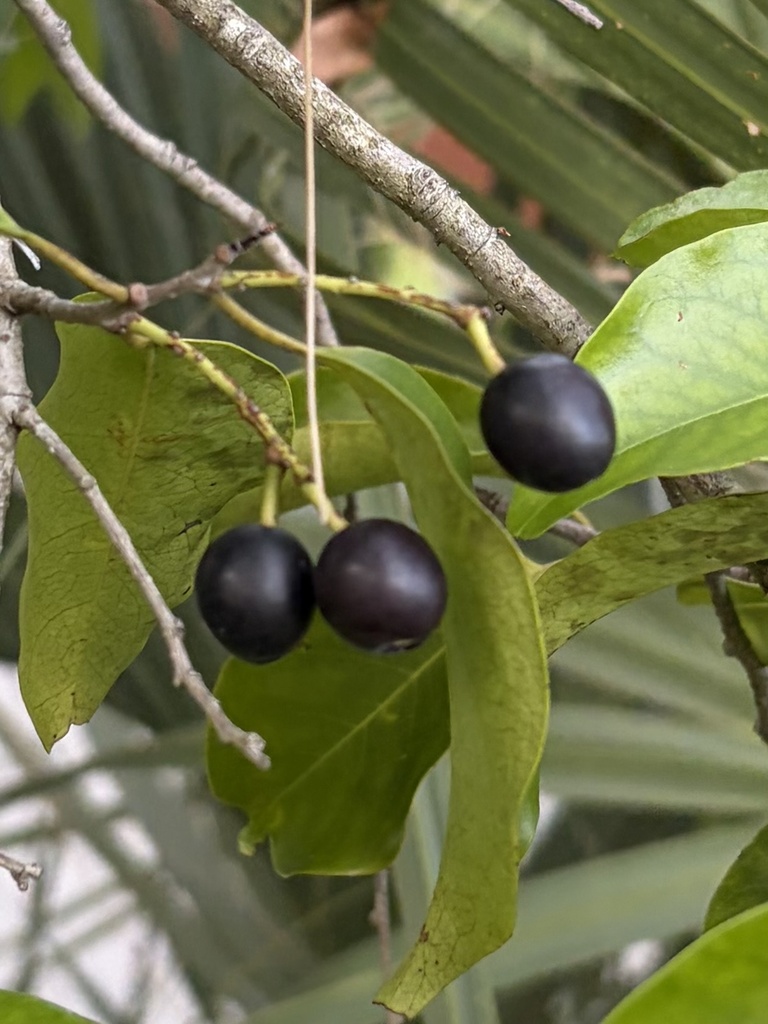
The fruit is a round drupe about ⅓ to ½ inch across. It ripens from green to red-brown and finally to dark purple or nearly black, usually in spring and summer. The flesh is thin around a single large stone. The fruits are eaten by birds but are not considered good to eat for people, and the seed inside is toxic.
Quick Facts
| Scientific Name | Prunus myrtifolia (L.) Urb. (synonym Laurocerasus myrtifolia) |
| Family | Rosaceae (rose family) |
| Plant Type | Evergreen tree |
| Mature Height | 15–40 ft |
| Mature Spread | 10–25 ft |
| Growth Rate | Moderate |
| Sun Exposure | Full sun to part shade |
| Water Needs | Medium; moist, well-drained soil, moderately drought tolerant once established |
| Soil Type | Limestone-based, rocky or sandy soil with organic matter |
| Soil pH | Neutral to alkaline, about 6.5–8.0 |
| Bloom Time | Late fall–spring |
| Flower Color | White |
| Fall Color | None; evergreen |
| Fruit | Round drupe, red-brown ripening to nearly black |
| Deer Resistant | Moderate; leaves are toxic to browsing animals |
| USDA Hardiness Zones | 10–11 |
Native Range
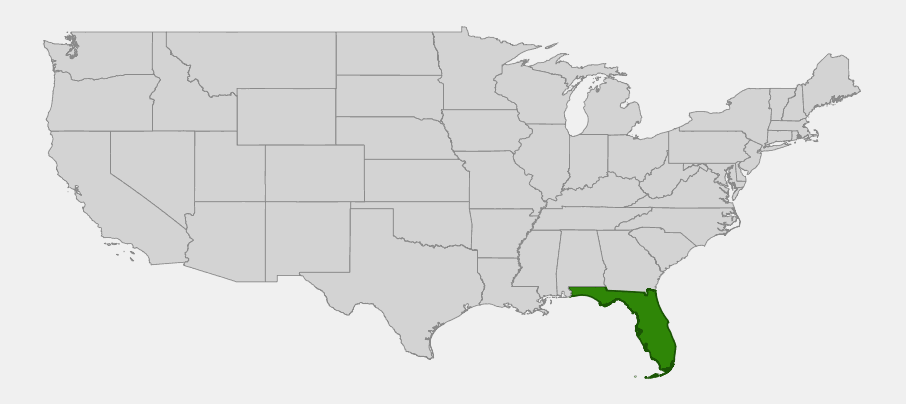
West Indian cherry has a wide range in the American tropics, from South Florida and the West Indies through Mexico and Central America to South America. USDA PLANTS records it as native in Florida, Puerto Rico and the U.S. Virgin Islands. In the continental United States, Florida is the only state where it grows wild.
In Florida, the Atlas of Florida Plants records it from only a few southern counties, chiefly Miami-Dade County, where it grows in the tropical hardwood hammocks of the Miami Rock Ridge. Most of its Florida habitat has been lost to urban development, and it is listed as Threatened by the State of Florida on the FDACS Regulated Plant Index.
Its typical habitat is rockland hammock: a closed forest of tropical hardwoods growing on thin, organic soil over limestone. It also grows at hammock edges and in disturbed openings nearby. In Puerto Rico and elsewhere in the Caribbean it is more widespread and grows in moist forests at a range of elevations.
📋 Regional plant lists featuring West Indian Cherry: North & South Florida
Growing & Care Guide
West Indian cherry makes an attractive small evergreen shade tree for South Florida, but it is rarely sold and usually has to be found through specialty native nurseries or native plant society sales. Because it is listed as Threatened in Florida, buy nursery-propagated trees and never dig plants or collect seed from wild populations.
Light
It grows in full sun to part shade. Young trees do well in the filtered light of a hammock garden, and mature trees develop a fuller crown with more sun.
Soil & Water
It prefers well-drained soil with some organic matter, including the rocky limestone soils of Miami-Dade County. Water regularly during the first year, especially in the dry season. Once established it tolerates short dry spells but grows best with moderate moisture and a layer of leaf mulch. It is not salt tolerant enough for exposed beachfront sites.
Planting Tips
Plant during the rainy season and give it room to reach 15 to 25 feet wide over time. It works as a specimen shade tree in a small yard, in a hammock-style planting with other tropical hardwoods, or as part of a screen. It is sensitive to frost and is suited to roughly USDA zones 10 and 11. Because the leaves and seeds are toxic, avoid planting it where livestock graze, and teach children not to eat the seeds.
Pruning & Maintenance
Little pruning is needed beyond removing low or crossing branches while the tree is young. Clean up and dispose of large piles of pruned branches rather than leaving wilted leaves where animals could eat them. It has few pest problems and does not need fertilizer in most soils.
Propagation
Grow it from fresh seed. Clean the pulp from ripe, dark fruits and sow the stones right away in a well-drained mix; they lose viability if allowed to dry for long. Germination can take several weeks to a few months. Only use seed from cultivated trees or nursery stock.
Landscape Uses
- Small shade tree: an evergreen specimen for South Florida yards
- Hammock gardens: with gumbo limbo, wild tamarind, stoppers and marlberry
- Bird gardens: fruit eaten by many songbirds
- Screens: dense evergreen foliage for privacy plantings
- Conservation plantings: helps keep a state-listed Threatened species in cultivation
Wildlife & Ecological Value
West Indian cherry is a food source for birds and insects in South Florida hammocks, where it flowers and fruits in the dry season and early wet season.
For Pollinators
The small white flowers are visited by bees, flies and other small insects for pollen and nectar. Because it flowers in winter and spring, it provides food when fewer hammock trees are in bloom.
For Birds
Many birds eat the ripe fruit, including mockingbirds, catbirds, thrushes and migrating songbirds, and they spread the seed through the hammock. The dense crown also provides nesting and roosting cover.
For Mammals
Raccoons and other small mammals may eat fallen fruit. The leaves contain cyanogenic compounds, which are especially dangerous to grazing animals in wilted leaves, so browsing is limited.
Ecosystem Role
West Indian cherry is a part of the canopy and subcanopy of South Florida rockland hammocks, one of the most threatened forest types in the United States. Like other Prunus species, it may also be eaten by caterpillars of some moths and butterflies, though few specific records exist for Florida.
Cultural & Historical Uses
The species name myrtifolia means “with leaves like myrtle”. Linnaeus first described the plant under a different genus, and the German botanist Ignatz Urban later moved it to Prunus as part of his work on the flora of the West Indies.
In parts of the Caribbean and South America, the hard, reddish wood has been used locally for posts, tool handles and small construction. The tree is not grown commercially for its fruit, which has only thin flesh around a large stone.
In Florida, conservation efforts for West Indian cherry focus on protecting and restoring the remaining rockland hammocks of Miami-Dade County and on growing nursery plants from seed for restoration and home gardens.
Frequently Asked Questions
Is West Indian cherry edible?
The fruits are eaten by birds, but they are not a good fruit for people: the flesh is thin and the seed inside contains cyanogenic compounds. The leaves are also toxic. It is grown as an ornamental and wildlife tree, not for fruit.
Is West Indian cherry endangered?
It is listed as Threatened by the State of Florida (FDACS Regulated Plant Index). It is not federally listed. Buy nursery-propagated plants and never collect from the wild.
Is it the same as Barbados cherry or Surinam cherry?
No. Barbados cherry (Malpighia) and Surinam cherry (Eugenia uniflora) are unrelated tropical fruit plants, and Surinam cherry is invasive in Florida. West Indian cherry is a true cherry in the genus Prunus.
Can it grow outside South Florida?
It is sensitive to frost and is best suited to roughly USDA zones 10 and 11. In central Florida it may be damaged or killed by freezes. Gardeners farther north can grow the related cherry laurel instead.
How big does West Indian cherry get?
In Florida gardens it usually reaches 15 to 30 feet tall with a rounded crown 10 to 25 feet wide. Wild trees in the tropics can be taller.

Looking for a nursery that carries West Indian Cherry?
Browse our native plant nursery directory: Florida