
Corkystem Passionflower (Passiflora suberosa)
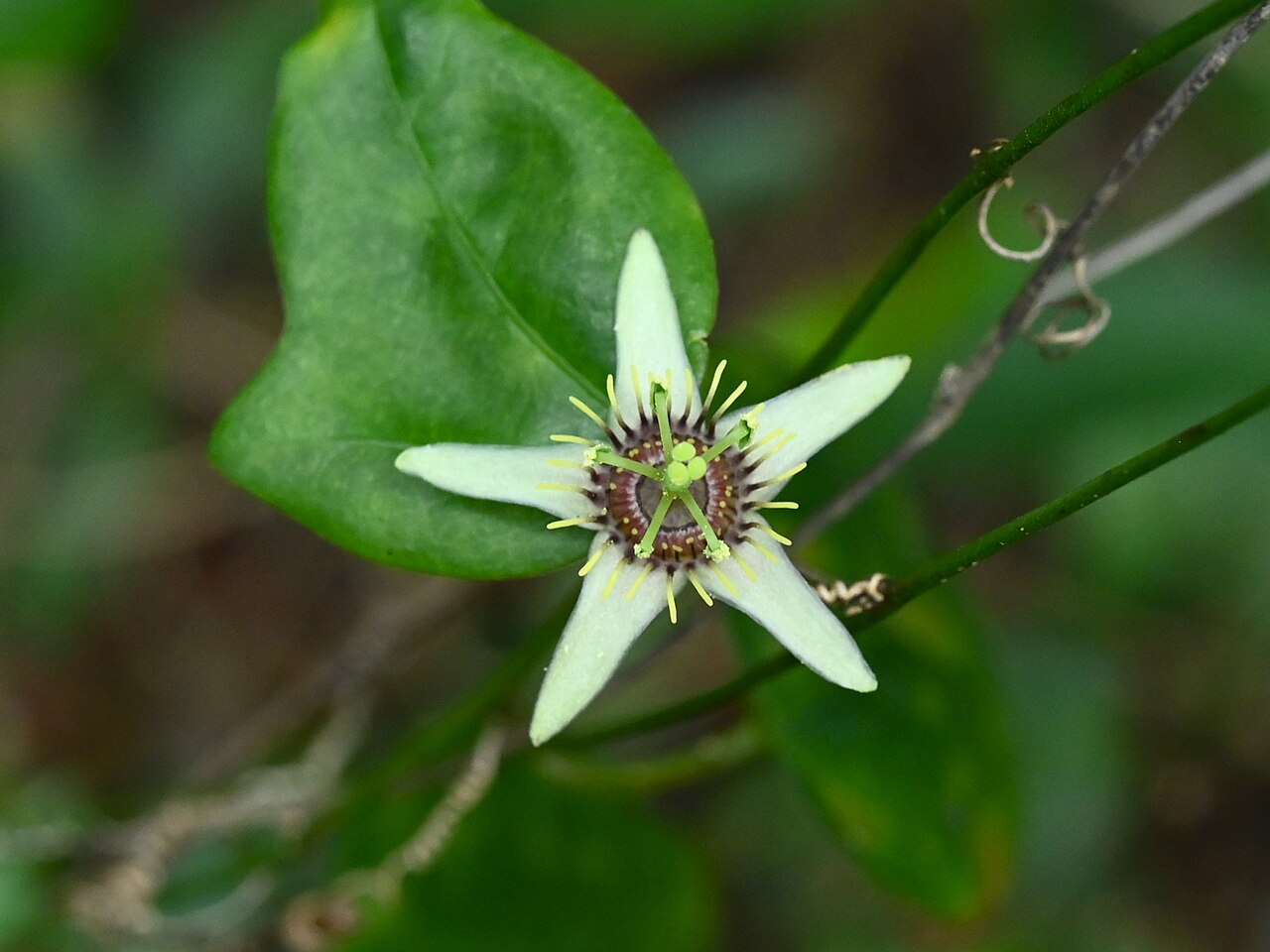
Passiflora suberosa, known as Corkystem Passionflower or corky passionvine, is a small, slender vine in the passionflower family (Passifloraceae). It climbs by coiled tendrils over shrubs, fences and palmetto, or scrambles along the ground. Its flowers are tiny compared with those of other passionflowers, under an inch across, greenish-white with a purple-banded fringe, and they are followed by dark blue-black berries. Older stems near the base develop the thick, ridged, corky bark that gives the plant its name.
The Atlas of Florida Plants lists corkystem passionflower as native to Florida, where it grows in hammocks, coastal thickets, shell mounds, pinelands and along fence rows, mostly in central and southern Florida and along the coasts. The species ranges widely through the American tropics. USDA PLANTS currently records it as native to Puerto Rico and the U.S. Virgin Islands and as introduced in Hawaii, while the Lady Bird Johnson Wildflower Center and other sources include Florida and the Lower Rio Grande Valley of Texas. In Hawaii it is an invasive weed, and it is also a problem in parts of the Pacific and Australia, so it should not be planted outside its native range.
Within Florida it is one of the most useful vines for butterfly gardens. It is a larval host plant for the zebra longwing, Florida’s state butterfly, as well as for the gulf fritillary and julia. This guide covers how to identify it, where it grows, and how to use it in a Florida wildlife garden.
Identification
Corkystem passionflower is easy to overlook until it flowers or fruits. Look for a thin vine with tendrils, very variable leaves, small petal-less flowers, and corky bark on older stems.
Stems & Habit
This is a herbaceous to semi-woody perennial vine. Stems are thin and green when young, climbing with tendrils that arise from the leaf axils. The Lady Bird Johnson Wildflower Center gives stem lengths of up to about 15 feet, though most garden plants are smaller. With age, the lower stems thicken and develop corky, furrowed, tan bark, the most distinctive feature of the species.
Leaves
The leaves are alternate and extremely variable, even on the same plant. Some are narrow and unlobed, lance-shaped to oval, while others have three shallow to deep lobes. They are usually 1 to 4 inches long, smooth to slightly hairy, and medium to dark green. The leaf stalk carries a pair of small, stalked glands, which produce sugary nectar that attracts ants.
Flowers
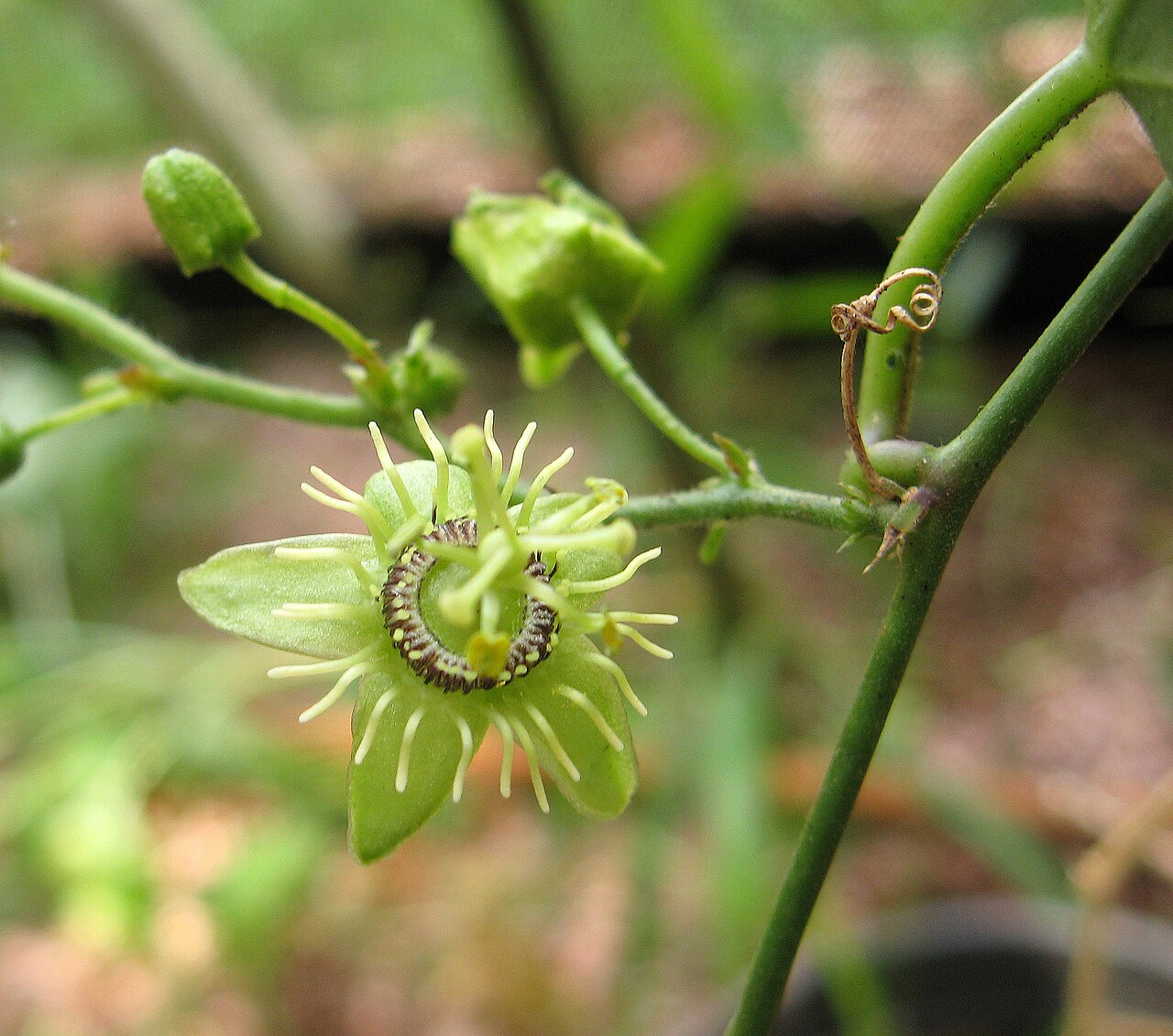
The flowers grow singly or in pairs in the leaf axils. They are about 1/2 to 1 inch across, with five narrow greenish-white to yellowish sepals and no petals. In the center is a fringe of filaments (the corona) that are purple at the base and yellow-green toward the tips, surrounding the raised column of stamens and stigmas typical of passionflowers. In south Florida plants can bloom in any month of the year.
Fruit & Seeds
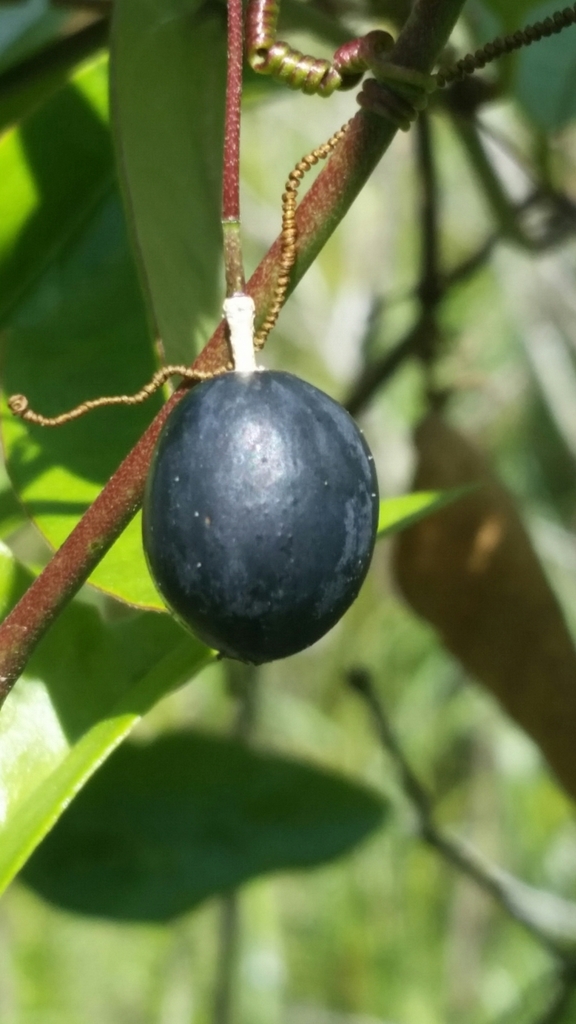
The fruit is a round to slightly oval berry about 1/3 to 1/2 inch across. It turns from green to purple and finally a dark blue-black when ripe and contains many small seeds in a dark pulp. Some sources describe the ripe fruit as edible but of poor flavor, while others call it inedible. Treat it as wildlife food rather than people food.
Similar Species
Pineland Passionflower (P. pallens) of south Florida pinelands has larger, whitish flowers and broad, three-lobed leaves. Yellow passionflower (P. lutea) has rounded, shallowly lobed leaves that are wider than long and pale yellow-green flowers, and it lacks corky stems. Purple Passionflower (P. incarnata) has large, showy lavender flowers and egg-sized fruits.
Quick Facts
| Scientific Name | Passiflora suberosa L. (syn. P. pallida) |
| Family | Passifloraceae (passionflower family) |
| Plant Type | Perennial vine, herbaceous to semi-woody |
| Mature Height | Climbing stems to about 15 ft; often 3–8 ft in gardens |
| Mature Spread | 3–6 ft |
| Growth Rate | Fast |
| Sun Exposure | Full sun to part shade |
| Water Needs | Low to moderate; drought tolerant once established |
| Soil Type | Sand, shell, limestone or loam; well drained |
| Soil pH | About 6.0–8.0; tolerates alkaline shell and limestone soils |
| Bloom Time | Year-round in south Florida; mainly spring to fall farther north |
| Flower Color | Greenish-white to yellow-green with a purple-banded corona |
| Fall Color | None; evergreen in frost-free areas |
| Fruit | Small dark blue-black berry, about 1/3–1/2 in |
| Deer Resistant | Moderately; foliage is not a preferred deer food |
| USDA Hardiness Zones | 9–11 (roots may resprout after light frost) |
Native Range
Corkystem passionflower is a plant of the American tropics and subtropics. Its range covers the West Indies, Mexico, Central America and much of South America. At its northern edge it reaches Florida and the Lower Rio Grande Valley of southern Texas, according to the Lady Bird Johnson Wildflower Center and other sources. USDA PLANTS records it as native to Puerto Rico and the U.S. Virgin Islands and introduced in Hawaii, and its current native status list does not include the lower 48 states. The Atlas of Florida Plants treats it as native to Florida, which is the basis for this page.
In Florida it is most common in the central and southern peninsula and along both coasts, extending north to areas such as the Cedar Key region on the Gulf Coast. It grows in tropical and coastal hammocks, maritime thickets, shell middens, pine rocklands and flatwoods edges, and in disturbed places such as fence rows, vacant lots and road shoulders. Birds spread its seeds widely, so it often appears on its own in gardens.
Outside its native range it has become an aggressive weed. It is invasive in Hawaii, where it smothers native vegetation, and it has also spread in Australia, New Caledonia and other Pacific islands. Gardeners outside Florida, Texas and the tropical Americas should not plant it.
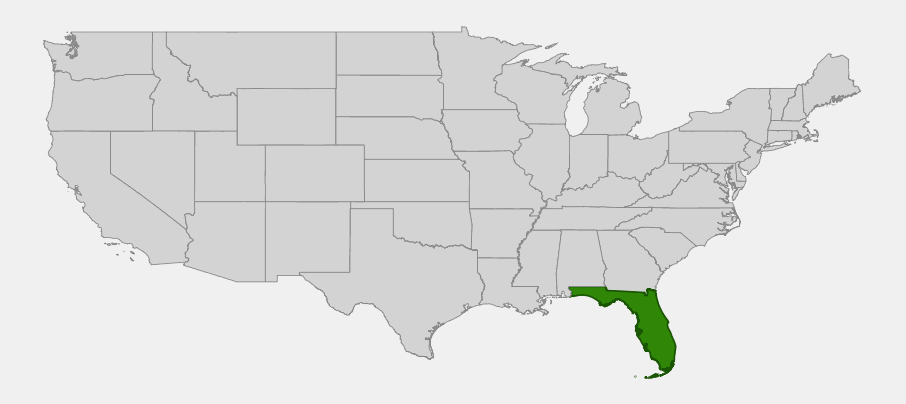
📋 Regional plant lists featuring Corkystem Passionflower: North & South Florida
Growing & Care Guide
Corkystem passionflower is easy to grow in Florida and is often sold by native nurseries for butterfly gardens. Plant it only within its native range. Because birds spread the seed, expect volunteer seedlings, and be ready to pull extras. Outside Florida and the tropical Americas, choose a passionflower that is native to your own area instead.
Light
It grows in full sun to fairly deep shade. Plants in sun flower and fruit more heavily, while plants in shade make longer, leafier stems. Partial shade is a good compromise in hot, dry sites.
Soil & Water
Any well-drained soil works, including sand, shell and limestone. It tolerates alkaline soils better than many natives. Water regularly until established; after that it needs watering only in long droughts. Avoid heavy fertilizing, which produces soft growth and fewer flowers.
Planting Tips
Give it something to climb: a fence, trellis, shrub or small tree. It is light and will not damage sturdy supports. It can also be allowed to sprawl as a loose ground cover among other natives. Plant several vines, or combine it with other native passionflowers, if you want to support zebra longwing and gulf fritillary caterpillars, which can strip a single small vine quickly.
Pruning & Maintenance
Little care is needed. Cut back tangled or frost-damaged stems in late winter. Do not spray insecticides on it, since the caterpillars are the reason to grow it. Vines that are eaten to the stems usually regrow within a few weeks. Pull unwanted seedlings while they are small.
Propagation
Fresh seed cleaned from ripe fruit germinates readily, though sometimes unevenly over several weeks. Stem cuttings root easily in moist potting mix. Volunteer seedlings can be dug and moved while young.
Landscape Uses
- Butterfly gardens: a key larval host for zebra longwing, gulf fritillary and julia in Florida
- Fences and trellises: a light, fine-textured vine for small supports
- Coastal and hammock landscapes: tolerates sand, shell, salt spray and partial shade
- Wildlife plantings: fruits feed birds; flowers feed small bees
- Habitat restoration: in Florida hammocks and coastal thickets, where it grows naturally
Wildlife & Ecological Value
For its size, corkystem passionflower supports an unusually rich range of wildlife, especially butterflies.
For Pollinators
The small flowers are visited by small bees and wasps and other insects that feed on pollen and nectar. More important, the vine is a larval host for heliconian butterflies. Zebra longwing, gulf fritillary and julia caterpillars all eat its leaves, and female butterflies often seek out its tender new shoots to lay eggs. The nectar glands on the leaf stalks also attract ants, which may defend the plant against some herbivores.
For Birds
The dark berries are eaten by mockingbirds, catbirds and other fruit-eating birds, which spread the seeds. The tangle of stems also provides cover for small birds.
For Mammals
Small mammals such as raccoons and opossums may eat fallen fruit. The plant is of minor importance to larger mammals.
Ecosystem Role
In Florida hammocks and coastal thickets it is part of the vine layer that fills gaps and edges. Its importance as a host plant links it to some of Florida’s most familiar butterflies, and its fruit is a regular food source for birds that spread many other native plants.
Cultural & Historical Uses
Linnaeus described Passiflora suberosa in 1753, choosing the species name from the Latin suber, cork, for the corky lower stems. The genus name Passiflora, “passion flower”, comes from Spanish missionaries in the Americas, who saw symbols of the Passion of Christ in the complex flowers of the larger species.
Botanists have noted that P. suberosa varies enormously in leaf shape, hairiness and flower color across its range, and some think it may include several species that look alike. For gardeners, the important point is to use plants from local, native sources within its natural range.
In Florida, corkystem passionflower has become a staple of butterfly gardening because it is small, easy to grow and favored by the zebra longwing, which was named Florida’s state butterfly in 1996. In Hawaii, by contrast, it is known as an invasive weed, a good example of how the same plant can be a valued native in one place and a pest in another.
Frequently Asked Questions
Is corkystem passionflower native to Florida?
Yes. The Atlas of Florida Plants lists it as native to Florida. USDA PLANTS currently lists it as native to Puerto Rico and the U.S. Virgin Islands and introduced in Hawaii, while other sources also include southern Texas in its native range.
Which butterflies use corkystem passionflower?
In Florida its leaves feed the caterpillars of the zebra longwing, gulf fritillary and julia. It is one of the best host plants for zebra longwings, which prefer shady to partly sunny sites.
Can I eat the fruit?
It is not a food plant. Sources disagree on whether the small fruits are edible, and they are bland at best. Leave them for the birds.
Is corkystem passionflower invasive?
Not in Florida, where it is native, though it can self-seed in gardens. It is invasive in Hawaii and several other Pacific regions and in Australia, and should not be planted there.
Will it survive frost?
Light frost kills back the stems, but established plants usually resprout from the roots and lower woody stems. It is best suited to USDA zones 9 to 11.

Looking for a nursery that carries Corkystem Passionflower?
Browse our native plant nursery directory: Florida