
Fan Maidenhair (Adiantum tenerum)
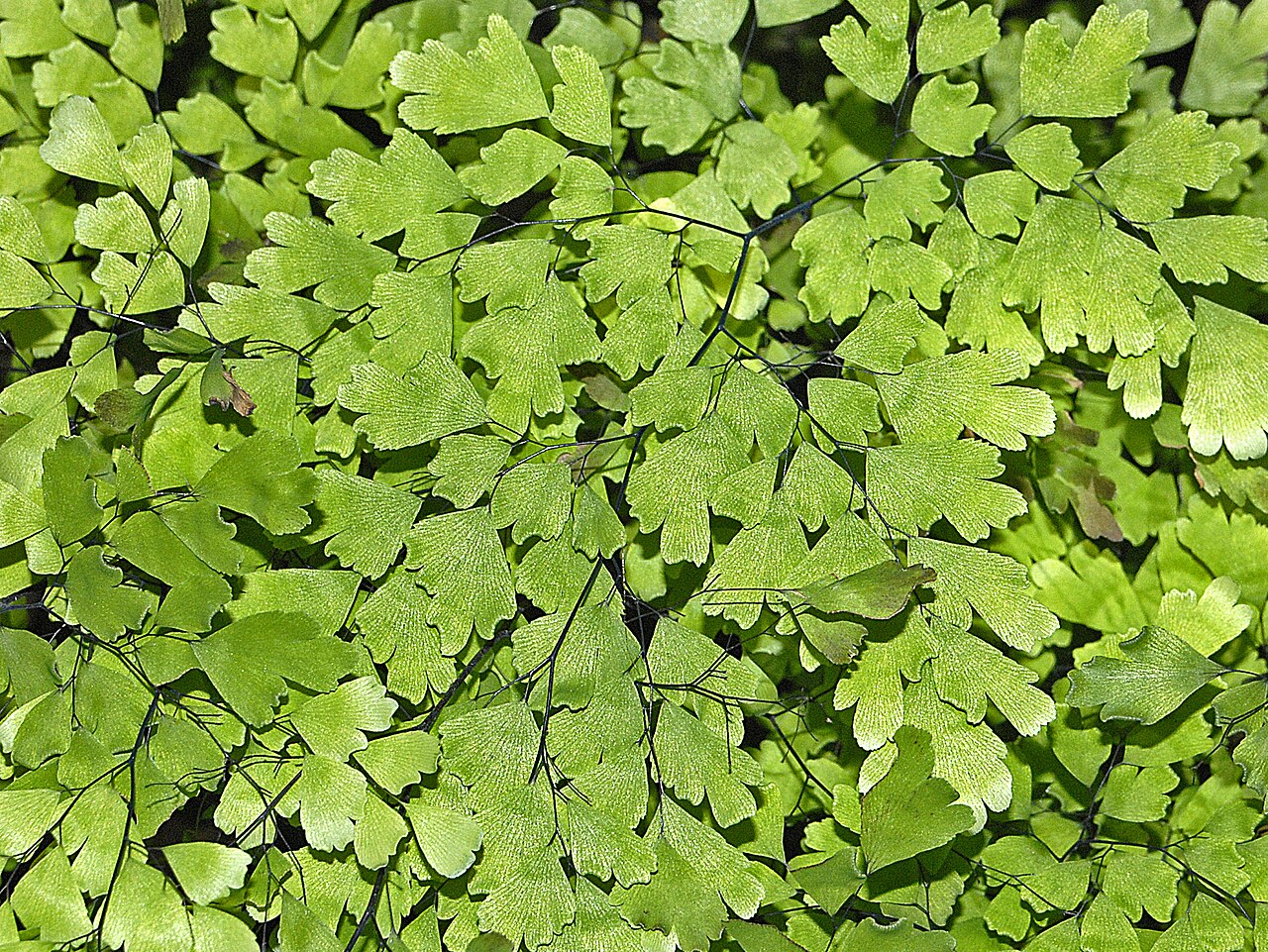
Adiantum tenerum, called Fan Maidenhair by USDA and also known as brittle maidenhair, is a tropical maidenhair fern native to Puerto Rico, Florida and much of the American tropics. In Puerto Rico it is called culantrillo de pozo or helecho culantrillo. It forms airy clumps of arching, lacy fronds up to about 3½ feet long, made of hundreds of small, fan-shaped, bright green leaflets held on shiny black, wiry stalks. It belongs to the maidenhair fern family, Pteridaceae.
This is a fern of limestone. In the wild it grows almost exclusively on moist, shaded limestone: rock ledges, the walls of sinkholes and grottoes, and boulders in damp forest. In Puerto Rico the Institute for Regional Conservation records it from Guánica State Forest on the dry south coast and Río Abajo State Forest in the northern karst region, both at low elevations. In Florida it is rare and listed as endangered by the state, surviving in a few limestone sinks and hammocks.
Fan maidenhair is also one of the most widely grown maidenhair ferns in the world. Its cultivars, including the large-leaved ‘Farleyense’, have been greenhouse and parlor favorites since the 19th century. This guide covers how to tell it from other maidenhairs, where it grows naturally, how to grow it in a frost-free garden or as a container plant, and why wild populations, especially in Florida, should be left alone.
Identification
Maidenhair ferns are easy to recognize as a group by their thin, dark, shiny stalks and their small, rounded or wedge-shaped leaflets with spore cases tucked under the folded leaf edges. Fan maidenhair is one of the larger species, and one detail separates it from its close relatives: every leaflet is jointed to its tiny stalk.
Rhizome & Stalks
The plant grows from a short, creeping rhizome covered in narrow brown scales, so fronds arise close together and form a compact clump. The leaf stalks (stipes) are dark purplish-brown to black, smooth and glossy, and very thin for their length, typically 6 to 24 inches long. The same black color continues through the branching axis of the blade.
Fronds
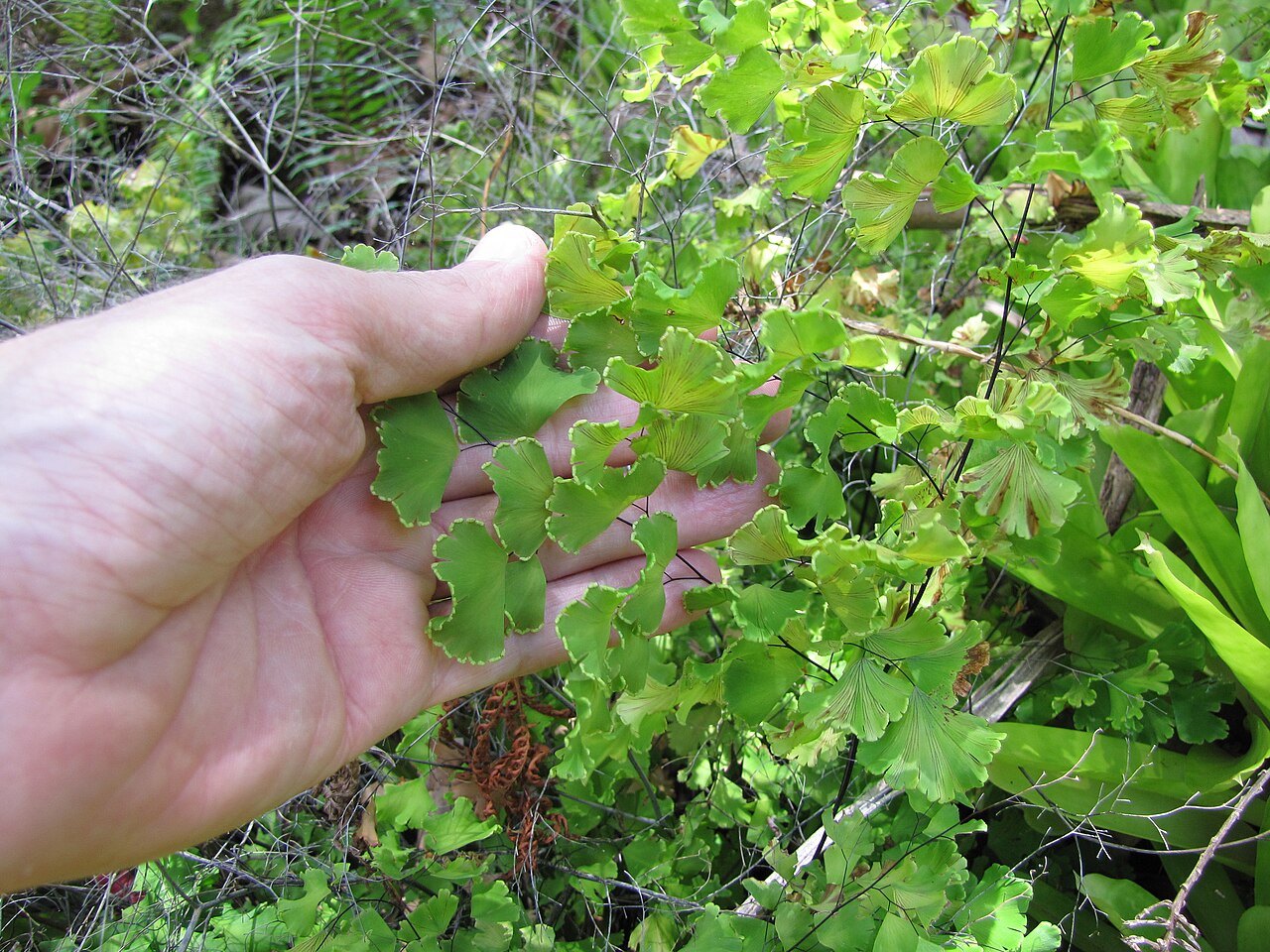
Fronds are broadly triangular to oval, about as long as wide, and arch or hang outward from the rock. Each blade is divided three or four times into many small, separate leaflets (pinnules). The overall effect is a soft, lacy cascade of light green, which is why the plant is so popular as an ornamental. Fronds stay green all year in frost-free climates.
Leaflets
The ultimate leaflets are fan-shaped to wedge- or diamond-shaped, roughly ½ to 1 inch wide, hairless, with a straight or tapered base and a rounded outer edge cut into shallow lobes. Fine veins fan out from the base without a midrib. The key field mark is the joint where each leaflet meets its stalk: in fan maidenhair the leaflet is articulate, with a slightly swollen, darker point of attachment. As fronds age or dry out, the leaflets drop off cleanly at this joint and leave bare black stalks behind, the reason for the name “brittle maidenhair.”
The similar Southern Maidenhair Fern (A. capillus-veneris), which shares Florida and Puerto Rico limestone habitats, has leaflets that are not jointed and do not shed this way, and its fronds are usually narrower and more elongated.
Spores
Like all ferns, fan maidenhair has no flowers or seeds. Spores are produced in small clusters (sori) along the outer edge of fertile leaflets, each covered by a flap of the leaf margin that folds under to form a false indusium. A single leaflet can carry several of these short, crescent-shaped flaps. In warm climates it can produce spores throughout the year.
Quick Facts
| Scientific Name | Adiantum tenerum Sw. |
| Family | Pteridaceae (maidenhair fern family) |
| Plant Type | Evergreen fern; herbaceous perennial from a short creeping rhizome; grows on limestone rock |
| Mature Height | 1–3½ ft (fronds arching or hanging) |
| Mature Spread | 1–3 ft |
| Growth Rate | Moderate |
| Sun Exposure | Part shade to full shade |
| Water Needs | Moderate to high; constant moisture and high humidity |
| Soil Type | Limestone rock, rocky loam or a rich, fast-draining mix with crushed limestone |
| Soil pH | Neutral to alkaline (about 7.0–8.0) |
| Bloom Time | None (fern); spores produced year-round |
| Flower Color | None |
| Fall Color | None; evergreen in frost-free climates |
| Fruit | None; reproduces by spores |
| Deer Resistant | Generally yes; ferns are rarely browsed |
| USDA Hardiness Zones | 10–12 (frost-free); container or greenhouse elsewhere |
Native Range
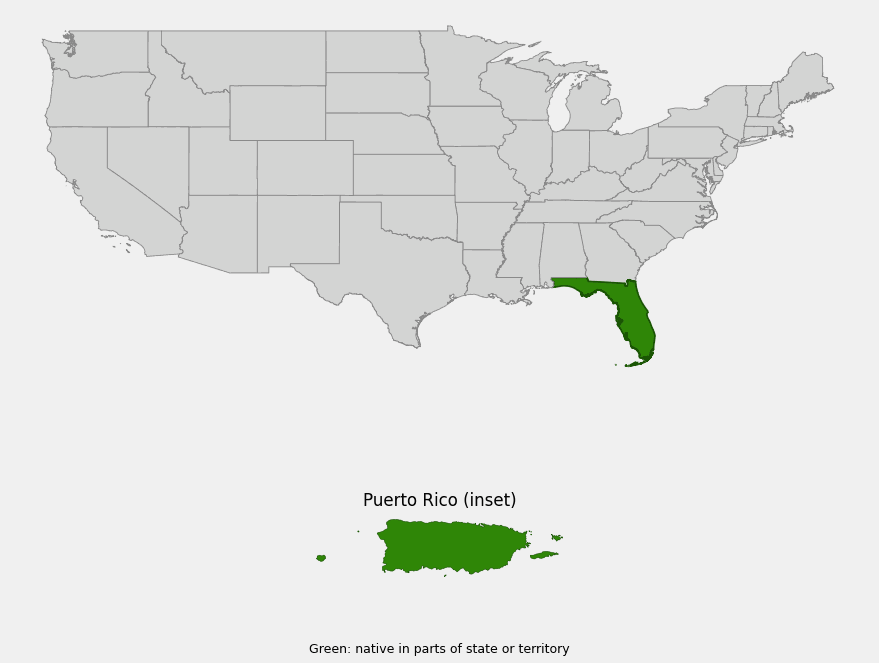
Fan maidenhair is native from Florida and Mexico south through Central America to Colombia, Venezuela and Brazil, and through the West Indies, including the Bahamas, Cuba, Jamaica, Hispaniola, Puerto Rico and the Lesser Antilles. USDA PLANTS lists it as native in Florida, Puerto Rico and the U.S. Virgin Islands. In Hawaii it is grown and has escaped, but it is not native there.
In Puerto Rico it is a plant of low-elevation limestone. The Institute for Regional Conservation lists it from Guánica State Forest, in the subtropical dry forest of the southwestern coast, and from Río Abajo State Forest, in the haystack hills (mogotes) and sinkholes of the northern karst belt. In both places it grows where shade and seepage keep limestone rock damp: cliff bases, crevices, and the walls of sinkholes and ravines.
In Florida it is rare. The Atlas of Florida Plants maps it from about ten counties, mostly the limestone country of north-central Florida (Alachua, Marion, Citrus and Hernando) plus scattered records farther south, including Miami-Dade County. There it clings to the walls of limestone sinkholes, solution holes and grottoes in shady hammocks. The state of Florida lists it as endangered.
📋 Regional plant lists featuring Fan Maidenhair: Puerto Rico · North & South Florida
Growing & Care Guide
Fan maidenhair is a rewarding fern for shady, frost-free gardens and one of the better maidenhairs for containers. On the mainland it can be grown outdoors year-round only in the warmest parts of South Florida (zones 10 to 11), and in protected spots in central Florida where frosts are brief. Elsewhere grow it as a container plant indoors or in a greenhouse, moved outside in summer if you like. Buy plants from nurseries, which raise this fern easily from spores; never dig it from Florida sinkholes, where it is state-listed as endangered, or from Puerto Rico’s forests.
Light
Give it bright shade or dappled light, similar to the shade of a forest canopy or the north side of a building. Morning sun is fine in humid climates, but strong afternoon sun scorches the thin leaflets. Indoors, a spot near a bright window without direct midday sun works well.
Soil & Water
In the wild its roots run through damp limestone, so it prefers a neutral to slightly alkaline, very well-drained medium that never dries out completely. A mix of potting soil or leaf compost with coarse sand and some crushed limestone or a little dolomitic lime imitates its native rock. Keep the soil evenly moist but not soggy: soggy soil rots the rhizome, while a single drying-out causes the leaflets to shrivel and fall. It likes high humidity; in dry indoor air, group it with other plants or set the pot on a tray of wet pebbles.
Planting Tips
Outdoors in South Florida or Puerto Rico, plant it into pockets of soil among limestone rocks, at the base of a shaded wall, or beside a fountain or pond where splashes and seepage keep the area damp. It looks best where its fronds can arch over rock edges. In containers, use a pot only slightly larger than the root mass; maidenhairs tend to sulk in oversized pots that stay wet.
Pruning & Maintenance
Cut old, shabby or leafless fronds back to the base to make room for new growth. If a plant dries out and drops most of its leaflets, cut all fronds back, resume watering, and it will usually regrow from the rhizome within a few weeks. Feed sparingly with a diluted balanced fertilizer during active growth; heavy feeding burns the leaflet tips. Protect containers from frost: temperatures near freezing damage the fronds.
Propagation
Divide established clumps in spring, keeping several fronds and a section of rhizome with each piece. Fan maidenhair also grows readily from spores: collect a fertile frond when the sori turn brown, let the spores drop onto paper, and sow them on a sterile, moist, lime-amended medium under a cover. Tiny heart-shaped prothalli appear first, followed by young fronds after a few months. Spore-grown plants often appear on their own in damp greenhouses and on the walls of pots.
Landscape Uses
- Shade and rock gardens: in frost-free areas, tucked among limestone rocks or along a shaded wall
- Water features: beside fountains, pond edges and seeping rock walls where humidity stays high
- Containers and hanging baskets: a classic patio, greenhouse and house plant almost anywhere in the U.S.
- Native karst gardens in Puerto Rico: paired with other plants of the limestone hills in shaded courtyards and patios
- Terrariums and conservatories: young plants and small cultivars do well in high humidity
Wildlife & Ecological Value
Fan maidenhair is a small part of the forest floor, but it is a good indicator of a particular microhabitat: shaded, permanently damp limestone. Where it grows abundantly, the forest canopy and the water seeping through the rock are usually intact.
For Pollinators
As a fern, fan maidenhair has no flowers and offers nothing to pollinators. Its value is as part of the shady, humid groundcover in which many insects, spiders, snails and other small invertebrates live.
For Birds
Birds do not eat this fern, but the moist, rocky understory where it grows is foraging ground for insect-eating birds. In Puerto Rico’s karst and dry forests these include ground-feeding and understory species that search mossy rocks and leaf litter for prey.
For Mammals
Ferns of this group contain bitter compounds and are rarely eaten by mammals. Deer are not a factor in Puerto Rico, and in Florida this fern usually grows on rock faces that browsers cannot easily reach.
Ecosystem Role
Fan maidenhair is one of the pioneers of limestone rock faces, helping to hold moisture and organic matter on cliffs and sinkhole walls where few vascular plants can root. Its spores are carried on air currents, which allows it to colonize isolated sinkholes. Because it depends on stable moisture and shade, it disappears when sinkholes are filled, drained or cleared, or when groundwater levels fall. This explains its rarity in Florida, where much of its limestone habitat has been altered.
Cultural & Historical Uses
The Swedish botanist Olof Swartz described Adiantum tenerum in 1788, in a work based on his collecting in the West Indies, especially Jamaica, earlier that decade. The epithet tenerum means “delicate” or “tender” in Latin, a fitting name for its thin leaflets. The genus name Adiantum comes from the Greek for “unwetted,” because water beads up and runs off maidenhair leaves without wetting them.
In Puerto Rico, the names culantrillo and culantrillo de pozo are used for maidenhair ferns in general and are diminutives of culantro, coriander, comparing their finely divided leaves to coriander leaves. Maidenhairs have a long history in folk medicine around the Caribbean and Latin America, mostly as teas for coughs and colds. Such uses are traditional, not medical recommendations, and gathering wild plants for them is not advisable.
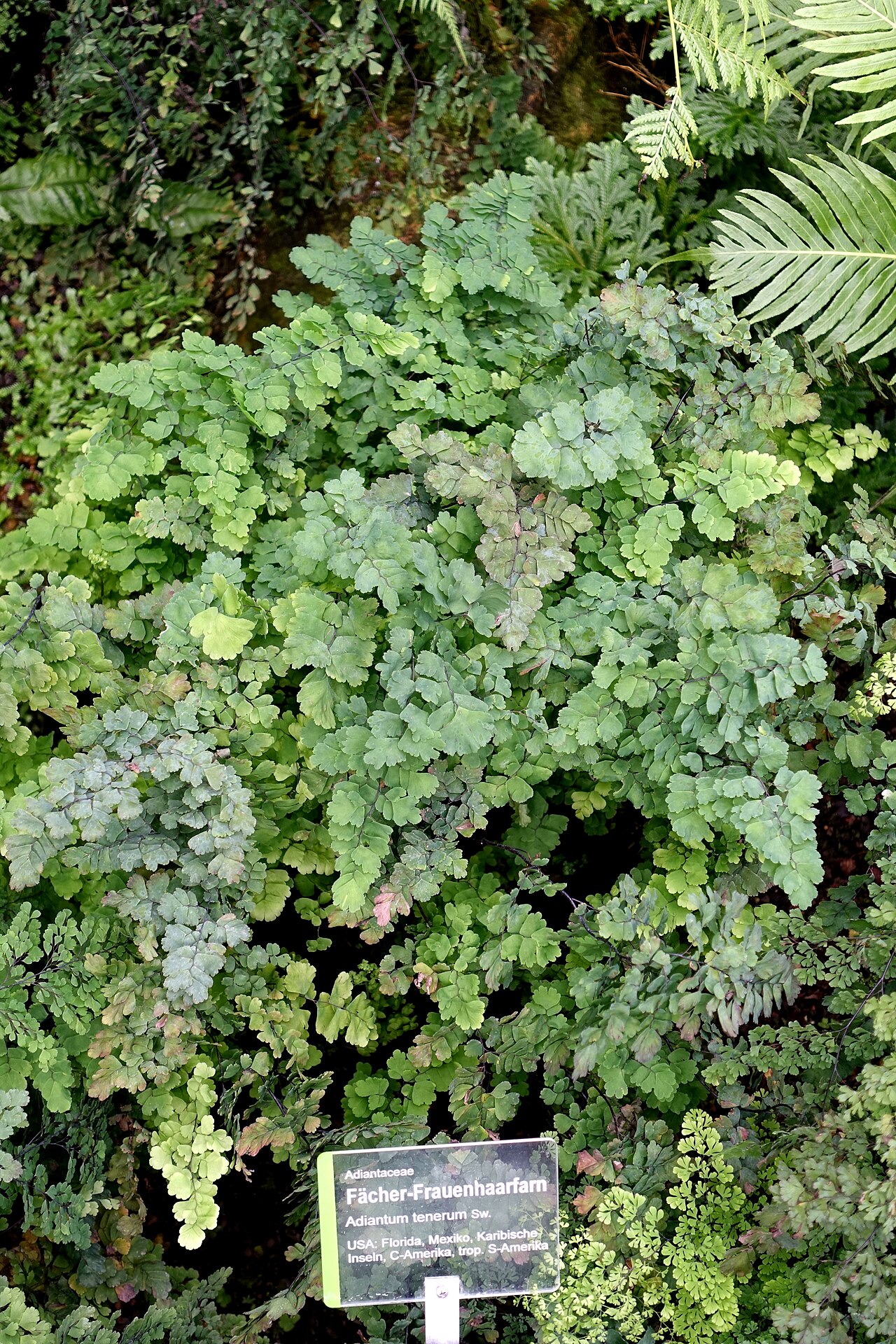
In the Victorian era, fan maidenhair became a star of the fern craze. Nurseries in Britain and continental Europe selected dozens of forms. The most famous, ‘Farleyense’, was reportedly found in Barbados in the 1860s and named after Farley Hill, the estate where it grew. It has large, ruffled, drooping leaflets and is propagated by division. These cultivars are still sold as house plants, so many people have grown this Puerto Rican and Floridian native without realizing it.
Frequently Asked Questions
Is fan maidenhair the same as the common house-plant maidenhair?
Often, yes. Many maidenhair ferns sold as house plants, including the cultivar ‘Farleyense’, are forms of Adiantum tenerum. Others are the closely related A. raddianum from South America or the southern maidenhair, A. capillus-veneris. Check for leaflets that are jointed to their stalks and shed cleanly when dry, the hallmark of fan maidenhair.
Why do the leaflets fall off?
Each leaflet is attached to its stalk by a joint. When the plant dries out, gets too cold, or a frond ages, the leaflets break off at this joint and leave bare black stalks. This is normal for the species. Keep it evenly moist and humid, and cut back bare fronds; new ones will grow from the rhizome.
Can I grow fan maidenhair outdoors on the U.S. mainland?
Only where frost is rare: South Florida and the warmest parts of central Florida (USDA zones 10 to 11). It grows outdoors year-round in Puerto Rico and the U.S. Virgin Islands. In colder areas, grow it in a pot indoors or in a greenhouse.
Is fan maidenhair endangered?
It is globally secure and fairly common in the tropics, but the Atlas of Florida Plants lists it as endangered in Florida, where only a few populations remain on limestone. It is not federally listed. Buy nursery-propagated plants, which are widely available, and never collect it from the wild.
Does it need lime?
It grows naturally on limestone and prefers neutral to slightly alkaline conditions. In a pot, adding some crushed limestone or a little dolomitic lime to the mix helps, especially if you water with rainwater or other soft water.

Looking for a nursery that carries Fan Maidenhair?
Our nursery directory does not yet include Puerto Rico. Browse the native plant nursery directory by state: Alabama–Arkansas · California · Colorado–Hawaii · Idaho–Kansas · Kentucky–Montana · Nebraska–Oklahoma · Oregon · Pennsylvania–Virginia · Washington · West Virginia–Wyoming