
Roble Cimarrón (Tabebuia haemantha)
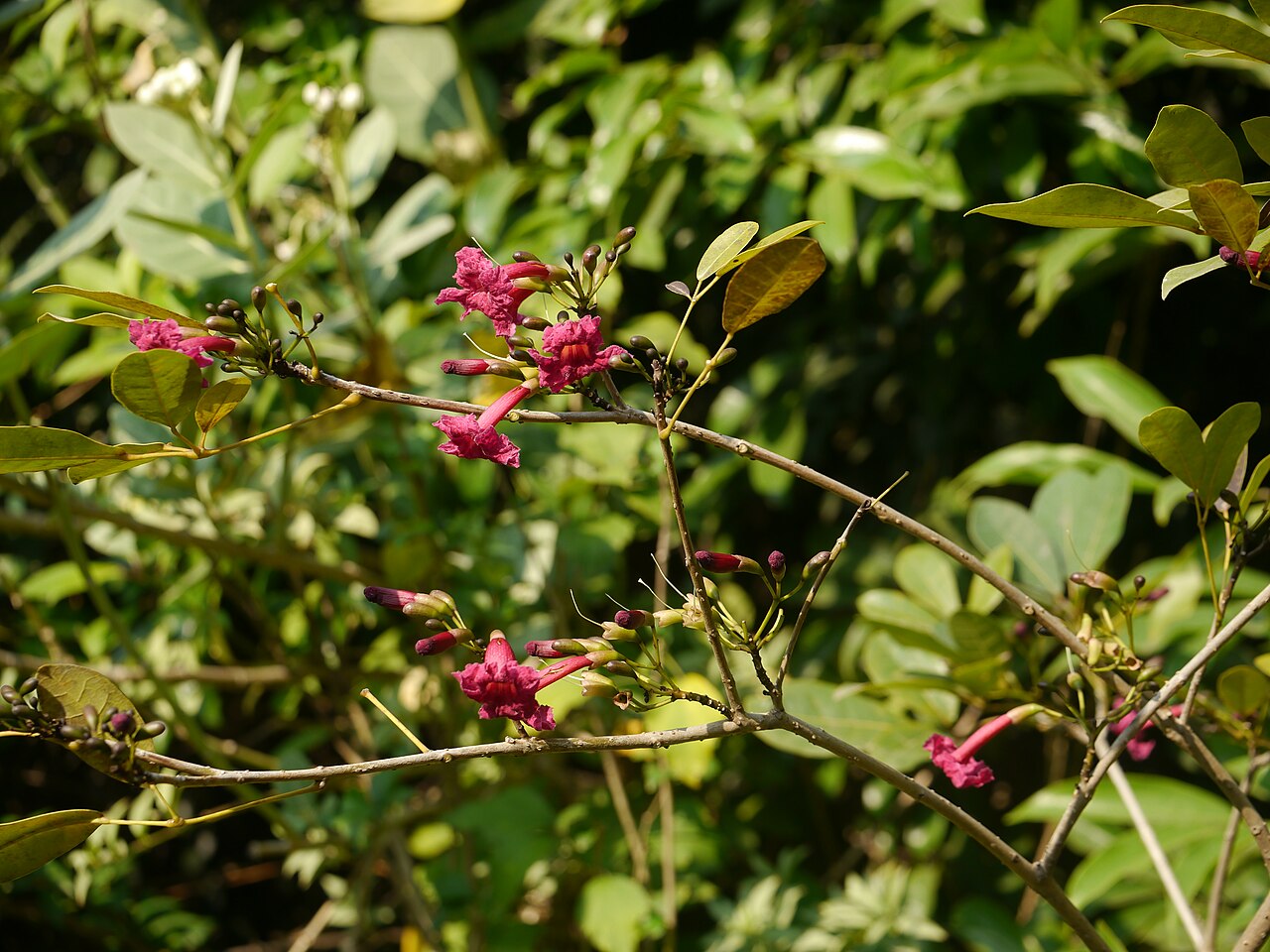
Roble Cimarrón (Tabebuia haemantha) is a small evergreen tree or large shrub found only in Puerto Rico. USDA PLANTS lists it under the common name roble cimarron, and Puerto Ricans also call it roble bobo and roble colorado. Unlike the pale pink and white trumpet trees most visitors know, this one carries narrow, deep pink to blood-red flowers in tight clusters at the branch tips. The species name haemantha means “blood flower,” and it is the only Puerto Rican Tabebuia with that color.
It is a plant of hard places. Roble cimarrón grows on the island’s poorest soils: the serpentine hills around Maricao and Susúa, the limestone and karst country, and dry foothill thickets from near sea level up to about 850 meters (2,800 feet). On those sites it often stays a multi-stemmed shrub only 10 to 15 feet tall, branching close to the ground, with a narrow, almost columnar crown. In better soil and shelter it can reach 23 feet or more.
Because the flowers never open fully, they are built for hummingbirds, which push their bills into the tube for nectar. That makes roble cimarrón one of the most useful small flowering trees for a Puerto Rican native garden: compact, drought-hardy, evergreen, and in bloom when the dry season has stripped color out of most of the landscape. This guide covers how to recognize it, where it grows wild, and how to grow it.
Identification
Puerto Rico has several Tabebuia species, and most gardeners meet the widespread pink trumpet tree (T. heterophylla) first. Flower color separates them at a glance: roble cimarrón is deep pink to crimson, with narrow tubes that stay nearly closed, while pink trumpet tree has wide, pale pink to white bells.
Form & Bark
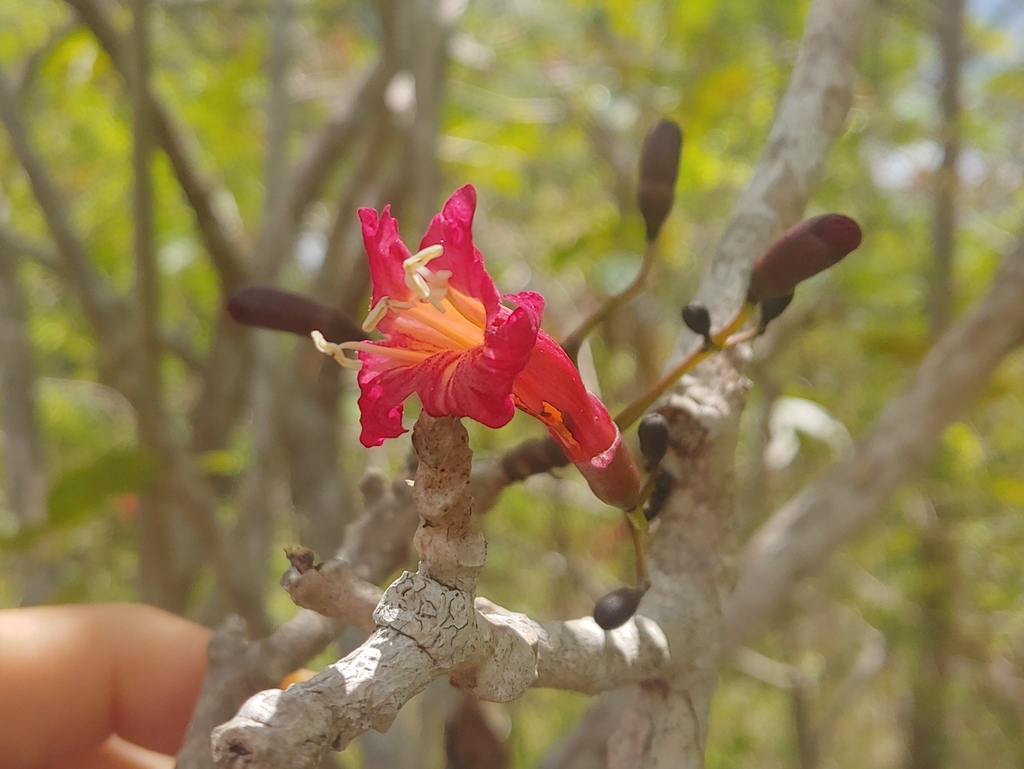
An evergreen shrub or small tree, usually 10 to 23 feet (3–7 m) tall and sometimes taller on sheltered sites, with a distinctive narrow, columnar crown. It frequently branches from near the ground into several leaning stems rather than forming a single trunk, especially on dry, rocky ground. Twigs and small branches are pale gray to nearly white and conspicuous when the plant is leafless or sparsely leaved.
Leaves
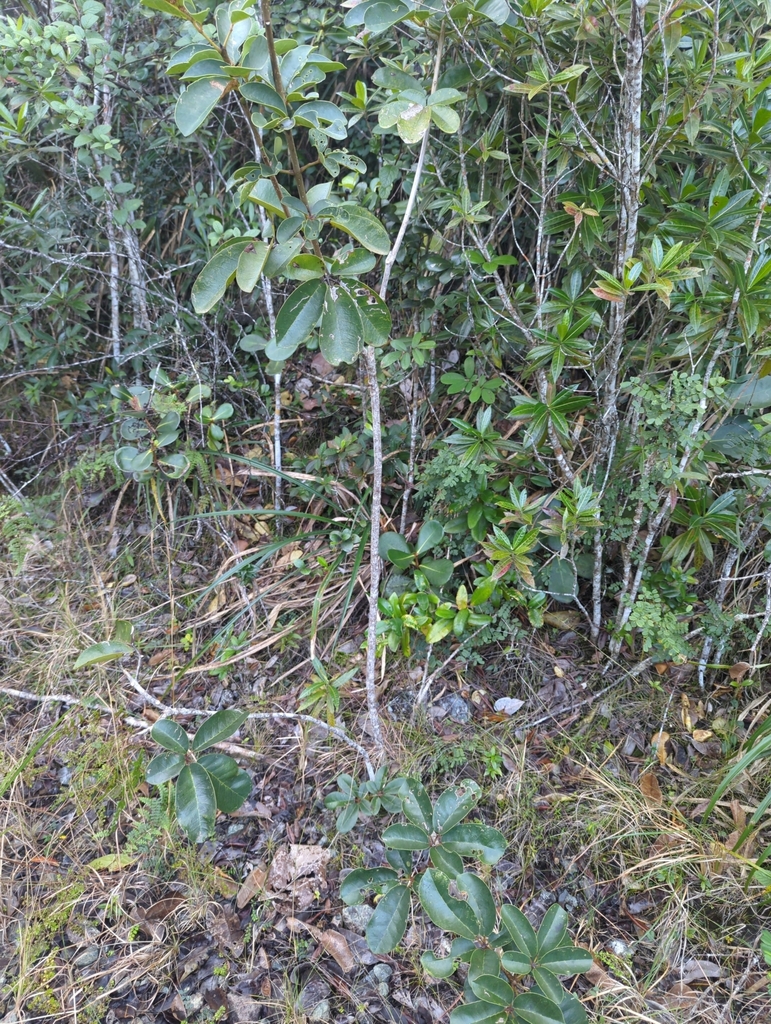
Leaves are opposite and palmately compound, with the leaflets spreading from the tip of a long leaf stalk like the fingers of a hand. Most leaves have three to five leaflets; shoots on young or stressed plants may carry fewer. Leaflets are obovate (widest above the middle), leathery, smooth-edged, glossy dark green above and paler beneath, mostly 1½ to 4 inches long. The plant is evergreen, though it may thin out in a hard drought.
Flowers
Flowers appear in small clusters at the ends of the twigs, often on nearly bare branch tips. Each is a slender tube roughly 1½ to 2½ inches long, deep pink, rose-red or crimson, flaring into five short, crinkled lobes that never spread fully open. The calyx and the unopened buds are dark purple-brown, so a flowering branch shows dark buds, bright tubes and pale bark all at once. Four stamens and a slender style sit inside the tube near the mouth.
Fruit & Seeds
As in other trumpet trees, the fruit is a slender, elongated capsule that hangs from the twig, dries to brown and splits lengthwise to release many flat seeds with papery wings. The seeds are wind-dispersed, which is how the species spreads across open hillsides and road cuts.
Quick Facts
| Scientific Name | Tabebuia haemantha (Bertol. ex Spreng.) DC. |
| Family | Bignoniaceae (trumpet creeper family) |
| Plant Type | Evergreen shrub or small tree |
| Mature Height | 10–23 ft; occasionally to 26 ft (8 m) |
| Mature Spread | 6–12 ft; narrow, columnar crown |
| Growth Rate | Slow to moderate |
| Sun Exposure | Full sun to light shade |
| Water Needs | Low once established; drought tolerant |
| Soil Type | Well-drained rocky soils, including limestone/karst and serpentine |
| Soil pH | Adaptable, from slightly acid serpentine to alkaline limestone soils |
| Bloom Time | Mainly the dry season, roughly December to May; scattered flowers at other times |
| Flower Color | Deep pink to rose-red or crimson |
| Fall Color | None; evergreen |
| Fruit | Slender capsule splitting to release many winged seeds |
| Deer Resistant | Not applicable; Puerto Rico has no native deer |
| USDA Hardiness Zones | 10–12 (frost-free tropical climates) |
Native Range
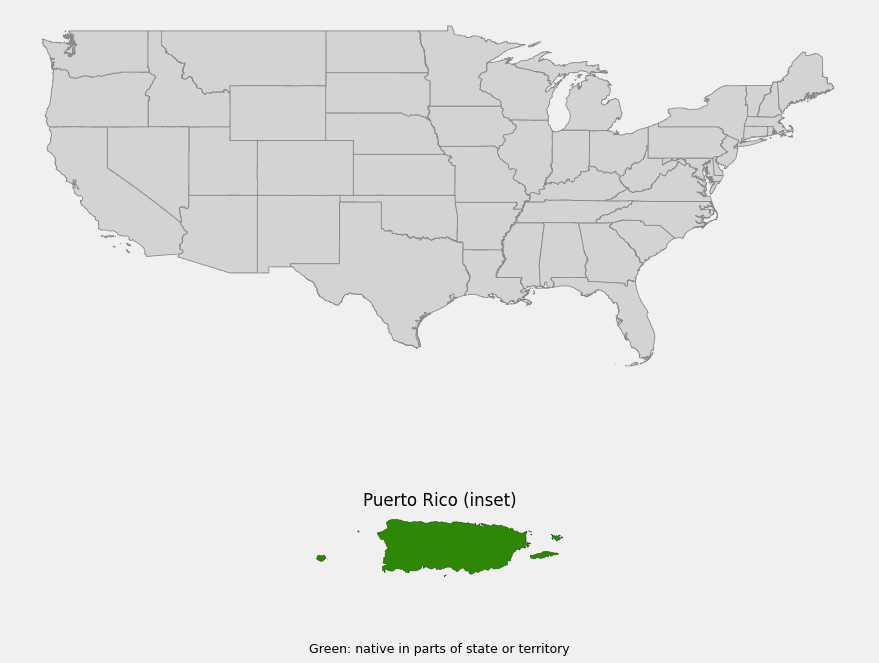
Roble cimarrón is endemic to Puerto Rico: it grows wild nowhere else on earth. USDA PLANTS lists it as native in Puerto Rico and in no other state or territory, and the Smithsonian’s Flora of the West Indies (Acevedo-Rodríguez & Strong) treats it as a Puerto Rican endemic. That makes it a true island specialty, in the same way that maga and the Puerto Rico royal palm are.
Within the island it is widespread at low and middle elevations, roughly 50 to 850 meters (160–2,800 feet). The Institute for Regional Conservation records it from the southeastern foothills, the eastern cordillera near Aibonito, the southern coastal lowlands at Juana Díaz, the Central Cordillera in Susúa State Forest, the Western Cordillera in Maricao State Forest and the southwestern lowlands around Cabo Rojo. Its strongholds are the serpentine hills of Maricao and Susúa, where thin, metal-rich soils keep the vegetation low and open.
Habitat is dry forest, thickets and open scrub in the foothills and lower mountains, on both limestone (karst) and serpentine substrates, and it also appears on road banks and in disturbed openings. It is not a plant of the wet tabonuco forest of El Yunque, nor of mangroves or salt flats. Nothing in USDA PLANTS places it anywhere in the mainland United States, Hawaii or the U.S. Virgin Islands.
📋 Regional plant lists featuring Roble Cimarrón: Puerto Rico
Growing & Care Guide
Roble cimarrón is a low-maintenance plant for frost-free gardens with sharp drainage. It asks for sun, lean soil and very little water once it is rooted in, and it rewards that neglect with dry-season flowers. It is slow, so buy the largest nursery plant you can find rather than expecting fast cover.
Light
Plant in full sun for the heaviest flowering. It tolerates light shade and grows naturally at the edges of thickets, but a shaded plant stretches and blooms sparsely. In the open it keeps its narrow, upright shape.
Soil & Water
Sharp drainage matters far more than fertility. This species thrives on shallow, rocky limestone and serpentine soils that defeat most ornamentals, and it will not tolerate soil that stays wet. Water new plants every few days through their first dry season, then taper off; established plants need no irrigation in most of Puerto Rico. Skip fertilizer, which pushes soft growth on a plant adapted to lean ground.
Planting Tips
Choose a permanent spot with room for a narrow crown about 6 to 12 feet across, and set the plant at the same depth it grew in the container. On heavy or compacted soil, plant on a low mound of gravelly mix rather than digging a pit that holds water. A 2-inch mulch ring, kept off the stem, helps young plants through the first year. Good companions are other dry-forest natives that take the same conditions.
Pruning & Maintenance
Very little is needed. Remove dead or crossing stems after flowering, and if you want a single-trunk small tree rather than a multi-stemmed shrub, select one leader early and shorten the competing stems over two or three years. Do not shear it; the narrow natural outline is the point. There are no serious pests or diseases to manage.
Propagation
Grow it from seed. Collect capsules when they turn brown and begin to split, shake out the winged seeds and sow them fresh in a free-draining mix, barely covered. Germination is usually within a few weeks in warm conditions. Seedlings are slow and resent wet feet, so keep the mix on the dry side and grow them on in a bright, sheltered spot before planting out.
Landscape Uses
- Puerto Rico native gardens: an endemic small tree with dry-season color
- Hummingbird gardens: narrow red-pink tubes made for hummingbird bills
- Dry and rocky sites: thrives on shallow limestone or serpentine soils
- Small spaces and courtyards: a narrow, columnar crown that rarely outgrows its spot
- Restoration and road banks: useful in dry-forest and serpentine-hill plantings within its range
Wildlife & Ecological Value
In Puerto Rico’s dry and serpentine forests, roble cimarrón is a nectar plant that flowers when little else does. Its value to wildlife comes mostly from that dry-season bloom.
For Pollinators
The flowers are specifically adapted to hummingbird pollination: the tube never opens fully, holding nectar at the base where only a long bill or tongue can reach. Puerto Rico’s hummingbirds, including the green mango and the Antillean mango, are the expected visitors, and bananaquits and insects also work the flowers. Because it blooms in the dry season, it helps bridge a lean stretch of the year for nectar feeders.
For Birds
Beyond nectar, the dense, twiggy crown gives small birds perches and cover in open scrub where tall vegetation is scarce. The seeds are dry and winged rather than fleshy, so they are not a bird food of note.
For Mammals
Puerto Rico has no native browsing mammals, and the plant is not a notable food source for the island’s bats or introduced mammals. Its ecological contribution is nectar and structure rather than fruit.
Ecosystem Role
Roble cimarrón is part of the specialized flora of serpentine soils, where high levels of nickel, chromium and magnesium exclude most plants. Communities like those at Maricao and Susúa hold an unusual concentration of Puerto Rican endemics, and this shrub is one of the woody plants that holds those thin soils together and shades the ground. Its wind-blown seeds let it colonize road cuts and other raw openings in dry country.
Cultural & Historical Uses
The name roble (“oak” in Spanish) was applied by Spanish settlers to Caribbean trumpet trees because of their hard, oak-like timber, not because they are related to oaks. Cimarrón means wild or feral, marking this one as the untamed version beside the better-known robles; roble bobo (“foolish roble”) and roble colorado (“red roble”) are used for the same plant in different parts of the island.
The botanical name has a long paper trail. The Italian botanist Carlo Bertero collected the plant in Puerto Rico in the 1820s, Kurt Sprengel published it as Bignonia haemantha, and Augustin Pyramus de Candolle moved it to Tabebuia. It has also appeared in the literature as Tecoma haemantha and, from Domingo Bello y Espinosa’s Puerto Rican flora of 1881, as Spathodea portoricensis.
Its wood is hard and light brown and has been cut locally, but the stems are too small for timber of any size, so the species has little commercial history. Its real reputation is ornamental: a tree of elegant, narrow form and unusual flower color that is occasionally planted in gardens and botanical collections in the tropics.
Frequently Asked Questions
Where does roble cimarrón grow naturally?
Only in Puerto Rico. It is endemic to the island, growing in dry forest, thickets and scrub at roughly 50 to 850 meters elevation, with strongholds on the serpentine hills of Maricao and Susúa State Forests and on limestone country in the southwest.
How is it different from the pink trumpet tree?
Flower color and shape. Roble cimarrón has narrow, deep pink to crimson tubes that stay nearly closed, while pink trumpet tree (Tabebuia heterophylla) has wide, pale pink to white bells. Roble cimarrón is also much smaller, usually a shrub or small tree with a narrow crown.
Is roble cimarrón federally listed as threatened or endangered?
No. USDA PLANTS records no federal listing status for Tabebuia haemantha. As a single-island endemic it still deserves care: buy nursery-propagated plants and do not dig plants or strip seed from wild populations.
When does it flower?
Chiefly in the dry season, roughly December through May, with scattered flowers at other times of year. The blooms appear in clusters at the branch tips, often while the branch is nearly bare.
Will it grow outside Puerto Rico?
Only in frost-free tropical climates, roughly USDA zones 10 to 12, and it is rare in the trade. Gardeners in the mainland United States should plant their own regional natives instead; for a hummingbird plant on the mainland, look to native trumpet-flowered species in your own state list.

Looking for a nursery that carries Roble Cimarrón?
Our nursery directory does not yet include Puerto Rico. Browse the native plant nursery directory by state: Alabama–Arkansas · California · Colorado–Hawaii · Idaho–Kansas · Kentucky–Montana · Nebraska–Oklahoma · Oregon · Pennsylvania–Virginia · Washington · West Virginia–Wyoming