
Beach Moonflower (Ipomoea violacea)
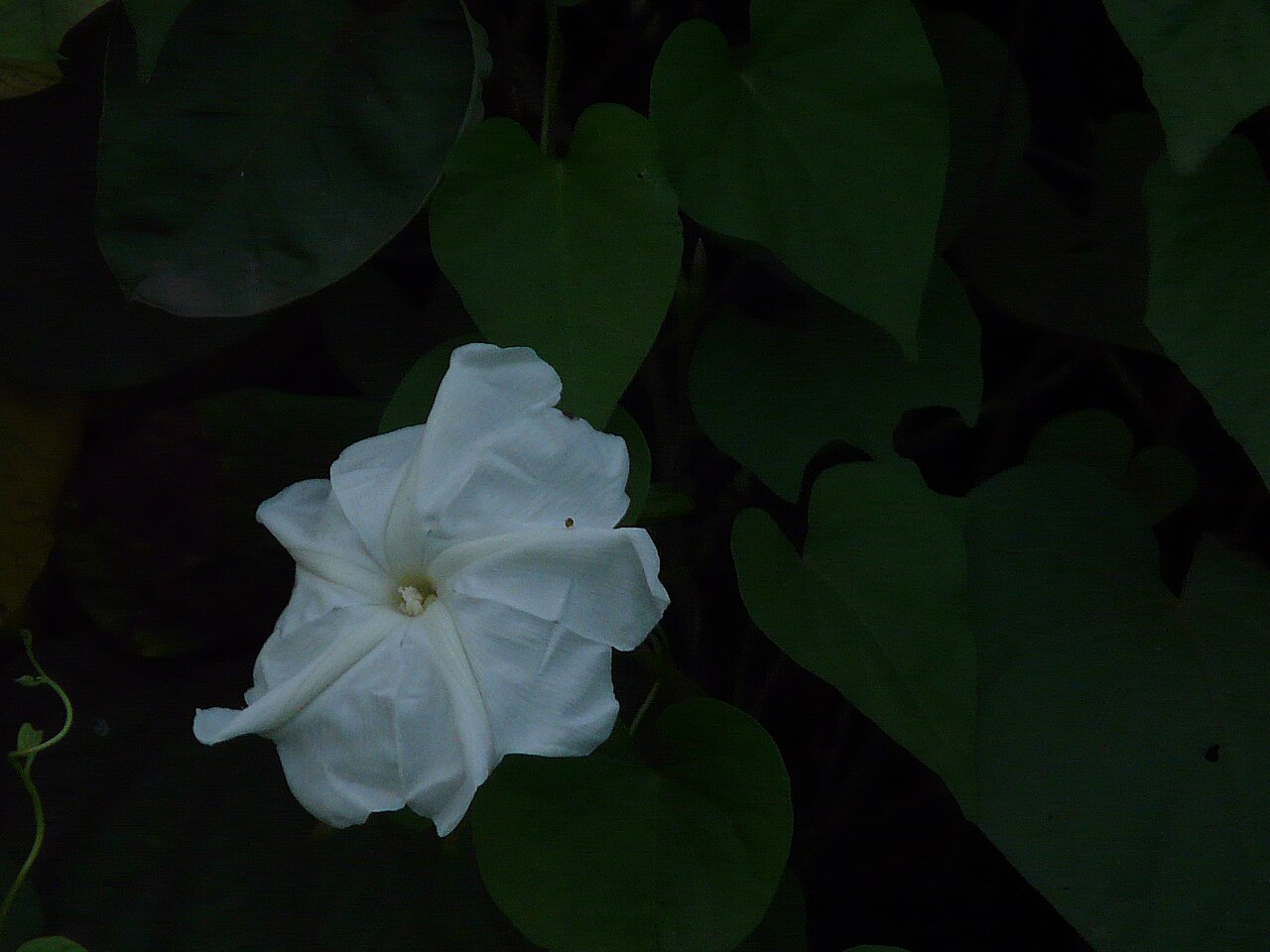
Ipomoea violacea, the Beach Moonflower (also called sea moonflower or coast moonvine), is a vigorous perennial vine of tropical seashores. In Puerto Rico it is known as bejuco de luna or flor de luna. It trails over dunes and climbs into coastal shrubs and small trees, with thick, glossy, heart-shaped leaves and large, pure white, funnel-shaped flowers that open at dusk and close the next morning. It belongs to the morning glory family, Convolvulaceae.
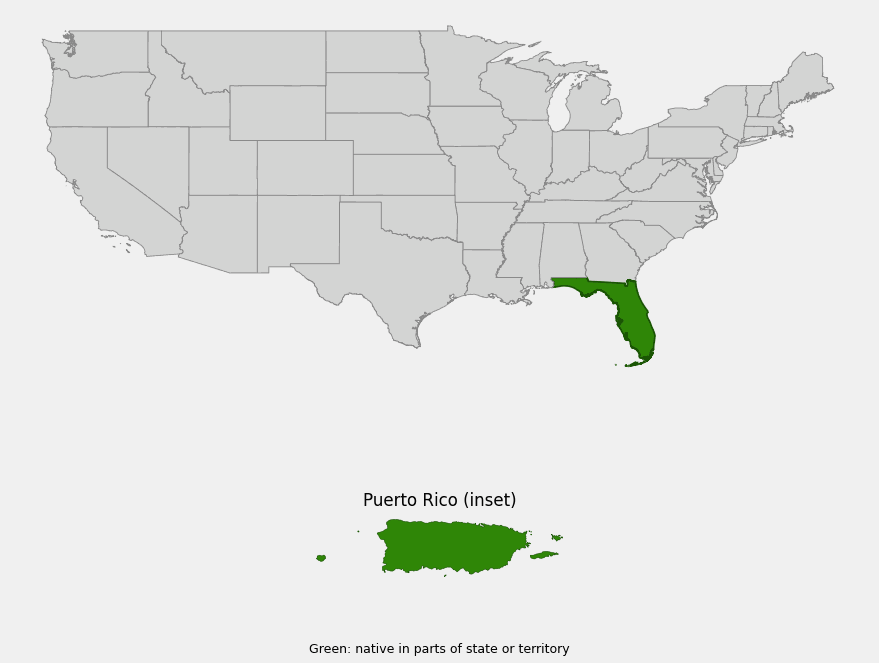
Beach moonflower is a true strand plant. Its round capsules hold seeds that can float in seawater, and the species has spread along tropical coasts around the world. In Puerto Rico the Institute for Regional Conservation records it from Guánica State Forest on the dry southwestern coast and from Piñones State Forest, the beach, mangrove and coastal woodland east of San Juan. In Florida it grows on coastal strands, dunes, shell mounds and the edges of maritime hammocks from Tampa Bay and the Indian River Lagoon south to the Keys.
Despite its Latin name, which means “violet,” this species has white flowers. The name Ipomoea violacea was long misapplied to the blue garden morning glory, Ipomoea tricolor, and that confusion still causes mistakes in seed catalogs and on the internet. This guide covers how to identify the true beach moonflower, where it grows, and how to use it in coastal gardens in Puerto Rico and South Florida.
Identification
Several white-flowered, night-blooming morning glories grow on tropical coasts, and beach moonflower is easily mistaken for the more familiar garden Moonflower (Ipomoea alba). Look closely at the flower tube, the sepals and the leaves to tell them apart.
Stems & Growth Habit
Beach moonflower is a herbaceous to slightly woody perennial vine with smooth, hairless stems that twine around supports or sprawl across sand. Stems commonly reach about 10 feet and can run much farther over shrubs and fences in frost-free climates. Unlike the garden moonflower, its stems are not prickly. Older stems near the base can become somewhat woody.
Leaves
The leaves are alternate, on long stalks, broadly heart-shaped to nearly round, about 2 to 6 inches long, with a smooth edge and a short pointed or rounded tip. They are thick, slightly fleshy and glossy green, an adaptation to salt spray and drying sea winds. Unlike many morning glories, they are not lobed.
Flowers
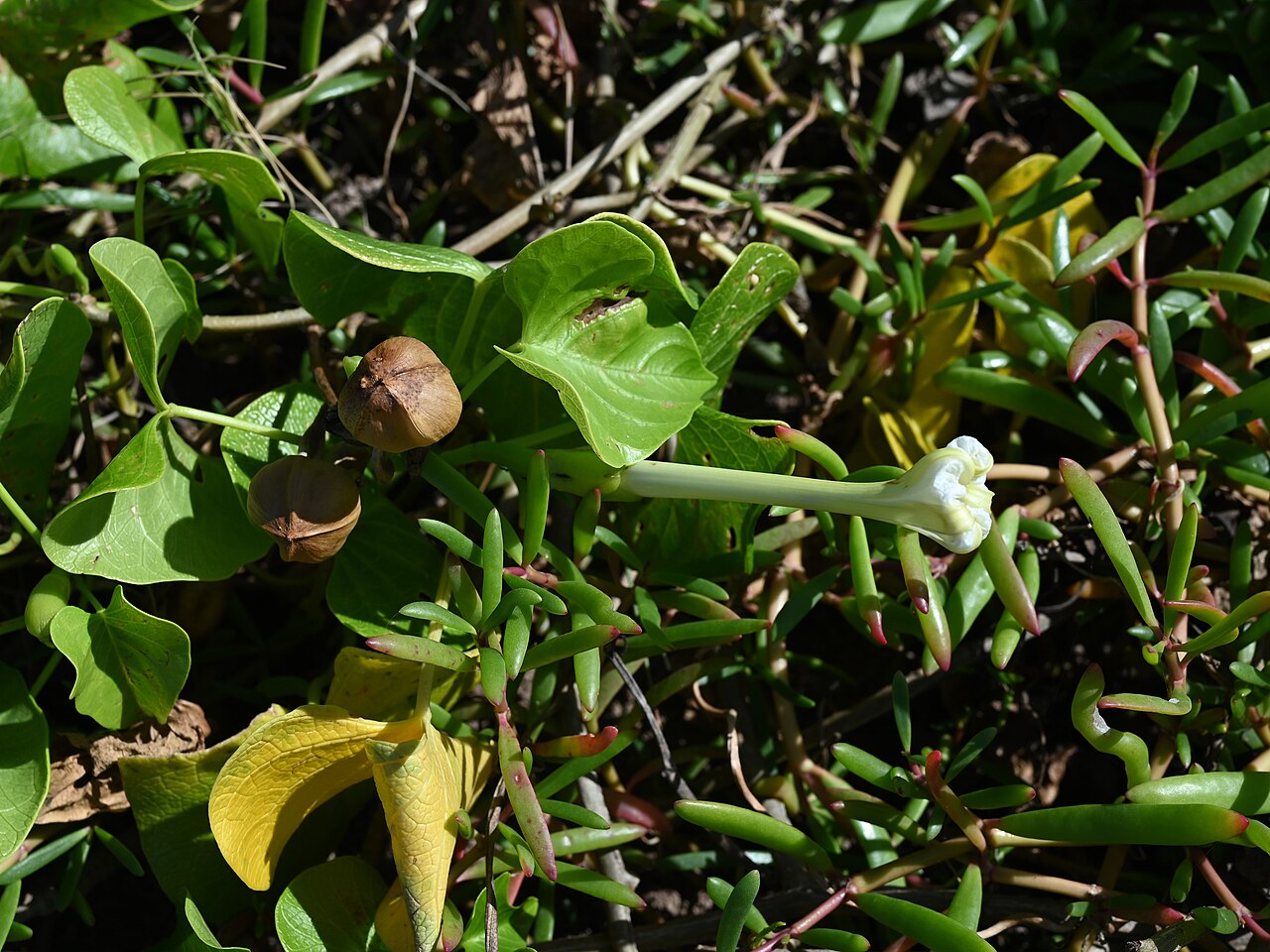
The flowers are large, pure white funnels about 3 to 4 inches long and nearly as wide, with five faint greenish-white bands running from the throat to the rim. They open at dusk and usually close by mid-morning the next day. Flowers come singly or in small clusters on stalks from the leaf axils, from late winter into fall. The sepals are a good field mark: they are broad, rounded, leathery and smooth, about ¾ inch long, and they curl back as the fruit ripens.
The garden Moonflower has a much longer, pencil-thin tube (4 to 6 inches) below a flat, round face, sepals tipped with short bristles, and often prickly stems. Beach moonflower’s tube is shorter and gradually widens into a funnel.
Fruit & Seeds
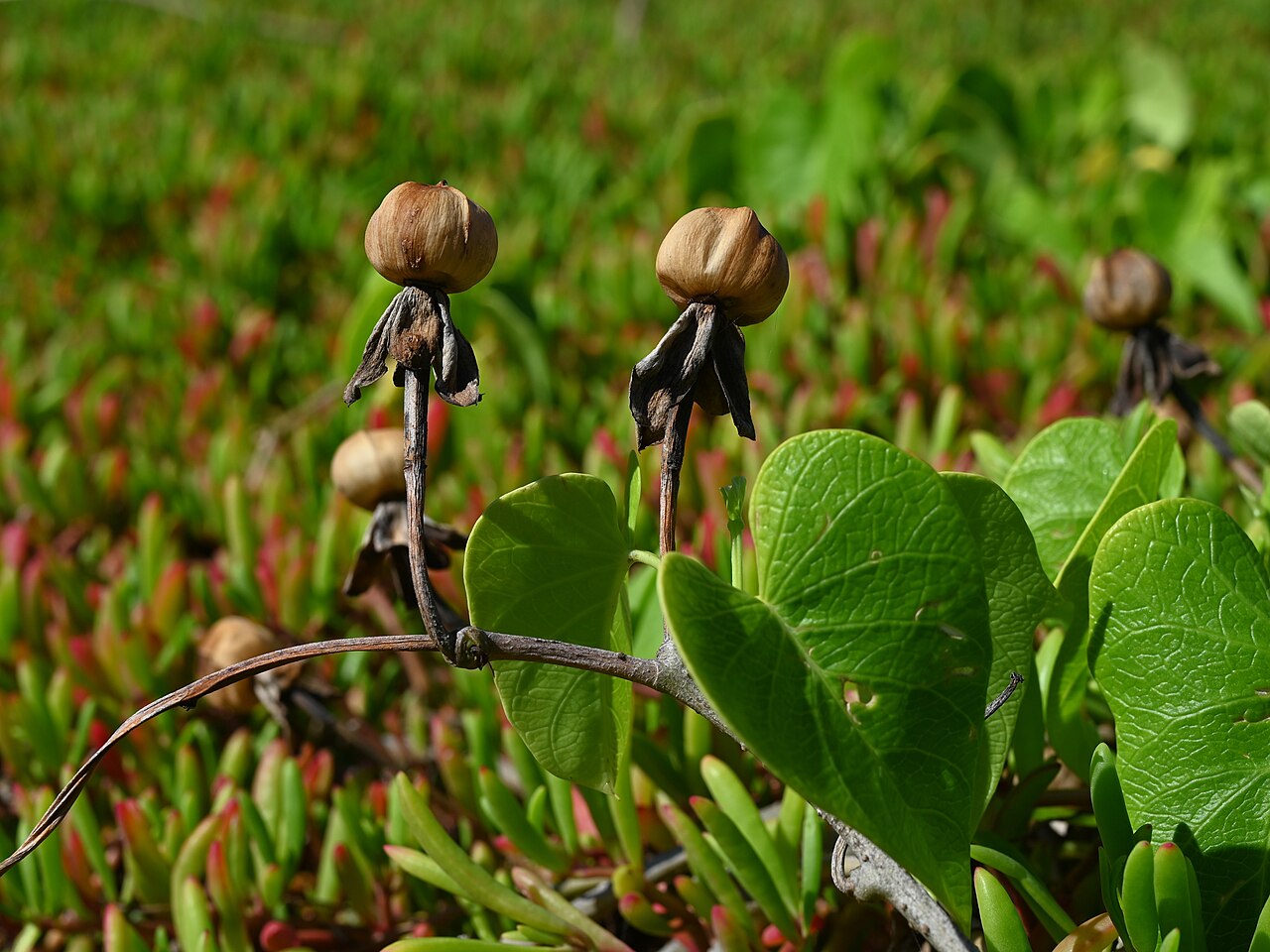
After flowering, the flower stalk thickens and the capsule forms. Each capsule is round, about ¾ to 1 inch across, turning brown and papery when ripe, with the leathery sepals curled back beneath it. It usually contains four dark, finely hairy seeds. The seeds are tolerant of seawater and can float, so ripe capsules that fall on beaches can spread the plant along coastlines.
Quick Facts
| Scientific Name | Ipomoea violacea L. (syn. I. tuba, I. macrantha, Calonyction tuba) |
| Family | Convolvulaceae (morning glory family) |
| Plant Type | Perennial twining or trailing vine |
| Mature Height | Vine; stems commonly to 10 ft or more, climbing or trailing |
| Mature Spread | 6–15 ft or more |
| Growth Rate | Fast |
| Sun Exposure | Full sun to part shade |
| Water Needs | Low to moderate; drought tolerant once established |
| Soil Type | Sand, shell and coral sand, limestone; well-drained soils |
| Soil pH | About 6.5–8.5 (tolerates alkaline coastal soils) |
| Bloom Time | Mostly February–November; nearly year-round in the tropics |
| Flower Color | White |
| Fall Color | None; evergreen in frost-free climates |
| Fruit | Round capsule about 1 in across with 4 seeds |
| Deer Resistant | Unknown; rarely browsed in salt-sprayed beach habitat |
| USDA Hardiness Zones | 10–12 (frost-free coastal areas) |
Native Range
Beach moonflower is pantropical. It grows on tropical and subtropical coasts of the Americas, Africa, Asia and the Pacific islands. In the Western Hemisphere it ranges from Florida and the Bahamas through the Greater and Lesser Antilles to Mexico, Central America and northern South America. The Smithsonian’s Flora of the West Indies lists it as native in Puerto Rico, Hispaniola, Jamaica, Cuba, the Cayman Islands and many of the Lesser Antilles. In Hawaii it is regarded as introduced.
In Puerto Rico it is a plant of the coast. It scrambles over beach scrub and coastal thickets and into the edges of dry and littoral forest at low elevations, with records from Guánica State Forest on the southwestern dry coast and Piñones State Forest near San Juan. In Florida, the Atlas of Florida Plants maps it from coastal counties on both sides of the peninsula: Hillsborough, Pinellas, Sarasota, Lee and Collier on the Gulf side, St. Lucie and Martin on the Atlantic side, and Miami-Dade and the Florida Keys in the far south.
USDA PLANTS and the Lady Bird Johnson Wildflower Center also list Texas. We found only a single historic specimen there, collected in 1945 near High Island on the upper Texas coast, which could have come from a drifted seed. Because no established Texas population could be confirmed from a second source, this guide treats the U.S. range as Florida and Puerto Rico (plus the U.S. Virgin Islands).
📋 Regional plant lists featuring Beach Moonflower: Puerto Rico · North & South Florida
Growing & Care Guide
Beach moonflower is an excellent native vine for coastal gardens in Puerto Rico and South Florida, where it handles sand, salt spray, wind and heat that would defeat most flowering vines. It is frost-tender and grows outdoors year-round only in USDA zones 10 to 12, which on the mainland means coastal South Florida and the Keys, with occasional success in protected spots of central Florida. It is rarely sold, so seed from a native plant nursery or from plants growing in a friend’s garden is the usual source. Make sure you are getting the white-flowered beach species, not the blue garden morning glory sold under the same name.
Light
Plant it in full sun for the most flowers. It tolerates part shade, such as the edge of a coastal hammock, but blooms less and becomes leggier as it reaches toward the light.
Soil & Water
Beach moonflower grows in pure sand, shell sand and thin soil over limestone, and it needs good drainage. It tolerates alkaline soil and salt spray. Water new plants regularly for the first few weeks; once established, it survives drought by drawing on deep roots, though it looks fuller with occasional summer watering in very dry spells. Do not fertilize heavily: rich soil produces masses of leaves and few flowers.
Planting Tips
Nick or file the hard seed coat and soak seeds overnight before sowing about ½ inch deep in sandy soil in warm weather. Seedlings grow quickly. Give the vine a fence, trellis, arbor or a sturdy shrub to climb, or let it ramble over a dune or slope as a ground cover. Plant it near a patio, porch or path where people sit in the evening, so the flowers can be enjoyed when they open.
Pruning & Maintenance
This is a vigorous vine, so plan for its size. Cut stems back as often as needed to keep them off neighboring shrubs, windows and gutters. A hard cutback in late winter renews old, tangled plants. Remove seed capsules if you do not want volunteers, though seedlings are easy to pull. In a cold snap, frost may kill the top growth; established plants often resprout from the base.
Propagation
Grow it from seed, scarified and soaked as above. It can also be propagated from stem cuttings taken in warm weather and rooted in moist sand. Collect seed only from garden plants or with permission; do not strip wild plants on protected beaches, where every seed helps the dune ecosystem.
Landscape Uses
- Coastal and beachfront gardens: one of the few flowering vines tolerant of sand, salt spray and wind
- Moon gardens: white flowers that open at dusk and glow in the evening
- Dune and coastal restoration: scrambles over sand and coastal shrubs in its native range in Puerto Rico and Florida
- Fences, trellises and arbors: fast cover for screening in frost-free gardens
- Butterfly and moth gardens: an evening nectar source for hawk moths
Wildlife & Ecological Value
On tropical beaches, plants like beach moonflower are part of the first line of vegetation behind the high-tide mark. Their stems knit sand, catch windblown debris, and create shelter for other plants and animals.
For Pollinators
Large, white, night-opening, funnel-shaped flowers are the classic design for pollination by hawk moths (sphinx moths), which hover in front of flowers at dusk and probe for nectar with long tongues. Flowers that are still open in the early morning are also visited by bees and other insects.
For Birds
The dense tangles of vines over beach scrub provide cover for small birds and nesting sites for some, and the insects that live on the foliage are food for insectivorous birds on coastal flyways. The seeds are not an important food source for birds.
For Mammals
Beach moonflower is of little direct value to mammals. Like many morning glories, its leaves and seeds are not known as food plants; treat the seeds as potentially toxic and keep them away from children and pets.
Ecosystem Role
Beach moonflower is a pioneer of coastal strand. Its trailing stems help stabilize sand and its leaf litter adds organic matter to poor beach soils. Seeds that float and survive in seawater let it colonize new beaches after storms, which is why the species is found on coasts and islands throughout the tropics.
Cultural & Historical Uses
Linnaeus named Ipomoea violacea in 1753. The violet color implied by the name does not match the white flowers of the true beach moonflower. For much of the 20th century the name was widely used, wrongly, for the blue-flowered garden morning glory now called Ipomoea tricolor. The two belong to different subgenera of Ipomoea, and current authorities treat them as separate species. The beach moonflower has also been known as Ipomoea tuba, I. macrantha and Calonyction tuba.
This confusion matters because the seeds of I. tricolor and some other morning glories contain ergoline alkaloids, and old publications reported these under the name I. violacea. In Eckart Eich’s survey of morning glory chemistry, the true beach moonflower is not among the species known to contain them. Even so, no morning glory seed should be eaten.
In Puerto Rico, the names bejuco de luna (“moon vine”) and flor de luna (“moon flower”) reflect its nighttime blooming, and similar names are used for white night-blooming morning glories across the Spanish-speaking Caribbean. Because its seeds can travel on ocean currents, it is one of the plants that link the beaches of Puerto Rico with coasts across the tropics.
Frequently Asked Questions
Is beach moonflower the same as the garden moonflower?
No. The common garden Moonflower is Ipomoea alba, which has a long, thin flower tube, often prickly stems, and sepals with short bristle tips. Beach moonflower has a shorter funnel-shaped flower, smooth stems, smooth rounded sepals and thicker, salt-tolerant leaves.
Why is a white flower called “violacea”?
The name was given by Linnaeus in 1753 and has caused confusion ever since. For decades it was misapplied to the blue garden morning glory (Ipomoea tricolor). Today I. violacea refers only to the white beach moonflower.
Can I grow beach moonflower outside Florida and Puerto Rico?
As a perennial, only in frost-free climates (USDA zones 10 to 12). It is native along the coasts of South and Central Florida, Puerto Rico and the U.S. Virgin Islands. Elsewhere it would have to be treated as a tender warm-season vine, and it is rarely offered for sale.
When do the flowers open?
The flowers open around dusk and stay open through the night, usually closing by mid-morning. On cloudy days they may stay open longer. Plants flower over much of the year in the tropics, with a peak in the warm months.
Is beach moonflower invasive?
It is native in Florida and Puerto Rico, where it is part of natural beach and coastal thicket vegetation. It is vigorous and can smother small shrubs in a garden, so give it room and prune as needed. It is considered introduced in Hawaii.

Looking for a nursery that carries Beach Moonflower?
Our nursery directory does not yet include Puerto Rico. Browse the native plant nursery directory by state: Alabama–Arkansas · California · Colorado–Hawaii · Idaho–Kansas · Kentucky–Montana · Nebraska–Oklahoma · Oregon · Pennsylvania–Virginia · Washington · West Virginia–Wyoming