
Cardinal Airplant (Tillandsia fasciculata)
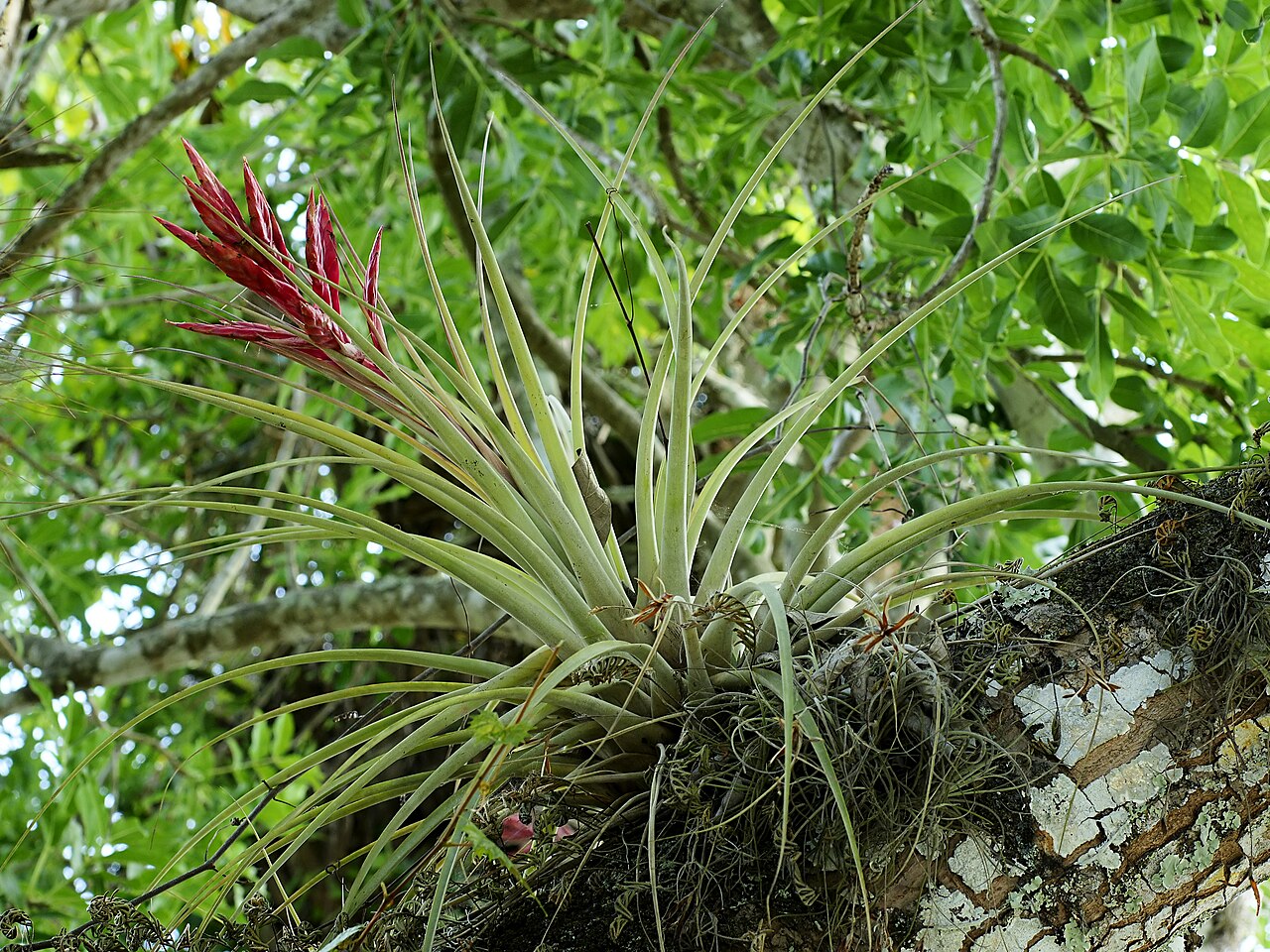
Tillandsia fasciculata, the Cardinal Airplant, is one of the showiest native bromeliads of the Caribbean and Florida. USDA PLANTS calls it giant airplant, and it is also known as giant wild pine. It is an epiphyte: it grows perched on the trunks and branches of trees, taking water and nutrients from rain, dew and debris rather than from the tree itself. A mature plant forms a dense, vase-like rosette of stiff, narrow, gray-green leaves, and when it blooms it sends up a fan of flattened flower spikes covered in overlapping bracts of brilliant red, often tipped with yellow or green.
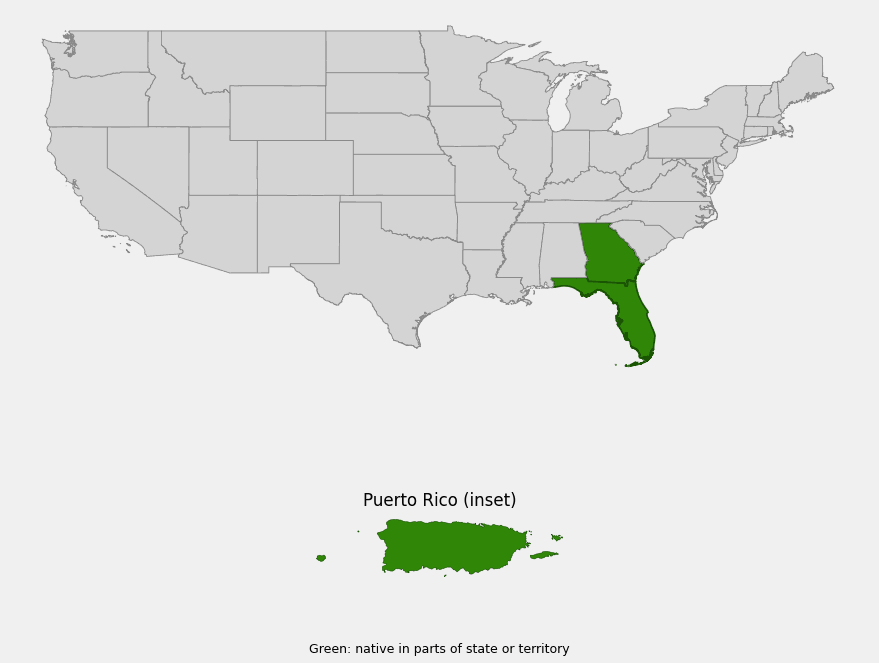
USDA PLANTS lists cardinal airplant as native in Puerto Rico, the U.S. Virgin Islands and the lower 48 states, where it grows wild in Florida (and is reported from Georgia). In Puerto Rico, the Institute for Regional Conservation records it in the Guánica, Susúa, Maricao and Río Abajo state forests and the Punta Guaniquilla natural reserve, so it ranges from the coastal dry forest of the southwest to the serpentine hills and the northern karst. Across its full range it reaches from Florida and Mexico through the West Indies and Central America to northern South America.
This guide covers how to tell cardinal airplant from other native air plants, where it grows, how to grow nursery-raised plants on a tree or mount, and why this species needs protection on the mainland, where it is listed as endangered in Florida.
Identification
Cardinal airplant is the largest common air plant in many areas where it grows. Look for a stiff, upright to spreading rosette of narrow, tapering, gray-green leaves on a tree branch, and in season a cluster of flat, paddle-shaped red spikes rising from its center.
Leaves
The leaves form a dense rosette, usually 4 to 12 inches tall and up to about a foot or more across. Each leaf is stiff and leathery, broad at the base and tapering to a long, narrow point, so the plant looks a little like a clump of rushes or a small pineapple top. The surface is covered with tiny gray scales (trichomes) that absorb water and give the leaves a silvery or grayish-green color. Unlike the related giant wild pine (Tillandsia utriculata), the leaves are not widened into a large, water-holding tank at the base.
Flowers
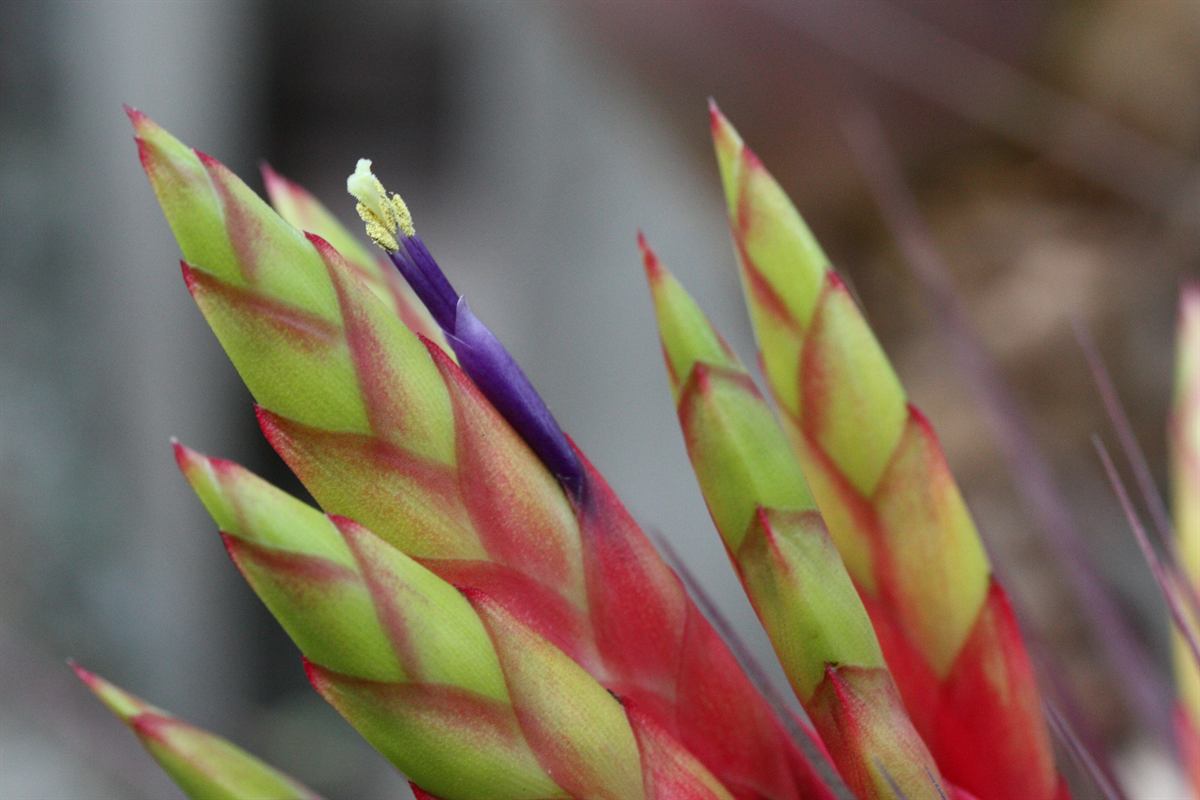
The flower stalk rises from the center of the rosette and carries one to many flattened spikes, often spreading like the fingers of a hand. Each spike is built of tightly overlapping, keeled bracts, usually bright red, sometimes red and yellow or red and green. The true flowers are long, slender violet tubes that emerge from between the bracts one or a few at a time. The bracts stay colorful for weeks, much longer than any single flower. In Florida it blooms mainly in spring and summer; Lady Bird Johnson Wildflower Center records bloom from January into August.
Fruit & Seeds
After flowering, the plant produces narrow capsules that split open to release many small seeds, each carrying a tuft of fine, silky hairs. The seeds drift on the wind like tiny parachutes and lodge in the bark of new host trees.
Life Cycle
Each rosette blooms only once. After flowering, it produces one or more offsets (“pups”) at its base and slowly declines, while the pups grow on to bloom in later years. Over time this can create a small clump of rosettes.
Quick Facts
| Scientific Name | Tillandsia fasciculata Sw. |
| Family | Bromeliaceae (bromeliad family) |
| Plant Type | Epiphytic perennial bromeliad (air plant) |
| Mature Height | Rosette about 8–12 in; to about 1½–2 ft in flower |
| Mature Spread | About 1–2 ft |
| Growth Rate | Slow |
| Sun Exposure | Bright filtered light to partial sun |
| Water Needs | Low to moderate; needs rain, dew or regular misting |
| Soil Type | None; grows on tree bark or a mount |
| Soil pH | Not applicable (epiphyte) |
| Bloom Time | Mainly winter to summer; peak in spring |
| Flower Color | Violet flowers among red, red-and-yellow or red-and-green bracts |
| Fall Color | None; evergreen |
| Fruit | Narrow capsule; wind-borne seeds with silky hairs |
| Deer Resistant | Yes; grows out of reach on trees |
| USDA Hardiness Zones | 9b–12; damaged by hard frost |
Native Range
Cardinal airplant has a wide range in the American tropics and subtropics. It grows from Florida and Mexico through the West Indies and Central America to northern South America. Within the United States, USDA PLANTS lists it as native in Puerto Rico, the U.S. Virgin Islands and the lower 48 states, with state records for Florida and Georgia. The Atlas of Florida Plants records it as native in 27 Florida counties, mainly in the southern half of the peninsula, where the Lady Bird Johnson Wildflower Center describes it growing in cypress swamps and hammocks, usually on cypress trees.
In Puerto Rico, the Institute for Regional Conservation records it as native and present, growing as an epiphyte at low and middle elevations up to about 1,000 meters. Its records there include the Guánica State Forest in the coastal dry forest of the southwest, the Punta Guaniquilla Natural Reserve near Cabo Rojo, the Susúa and Maricao state forests in the western serpentine hills, and the Río Abajo State Forest in the northern karst region. It tolerates more sun and drought than many bromeliads, which helps explain its success in dry forest.
A note on Georgia. USDA PLANTS and some other references list Georgia in the range, but the Flora of North America gives Florida as the only U.S. state, and a 1993 review by bromeliad specialist Harry Luther noted that earlier reports from Georgia had not been confirmed. Any Georgia occurrence would be at the extreme northern edge of the range. Taxonomists also disagree on how broadly to define the species. The Institute for Regional Conservation notes that some Puerto Rico floras include the closely related Tillandsia compressa within T. fasciculata.
📋 Regional plant lists featuring Cardinal Airplant: Puerto Rico · North & South Florida
Growing & Care Guide
Cardinal airplant is easy to keep in frost-free gardens as long as it is attached to a tree or mount rather than planted in soil. Buy plants from nurseries that raise them from seed or offsets. Wild plants should never be collected: in Florida the species is state-listed as endangered, and wild populations everywhere are slow to replace losses.
Light
Give it bright, filtered light or partial sun, such as the open canopy of an oak, gumbo limbo, mahogany or other rough-barked tree. Plants in very deep shade grow soft and rarely flower; plants in harsh, all-day sun may yellow but usually adapt if moved gradually.
Soil & Water
It needs no soil. In humid, rainy climates, rainfall and dew are enough once a plant is established. In drier spots or during long dry seasons, mist or soak it every few days, then let it dry within a few hours. Never let water sit in the center for long periods in cool weather, and avoid chlorinated or softened water if possible. A very weak, occasional orchid or bromeliad fertilizer is optional.
Planting Tips
Attach the plant to a branch, trunk or mount (cork bark, driftwood or a rough board) with soft plant ties, cotton string or a dab of non-toxic, waterproof glue at the base. Set it upright or tilted so water drains from the center. Within a few months new roots will grip the bark and the ties can be removed. Copper wire and treated wood can harm bromeliads, so avoid them.
Pruning & Maintenance
Remove dead outer leaves and spent flower stalks once they dry. In Florida, inspect plants for the Mexican bromeliad weevil (Metamasius callizona), an introduced pest whose larvae tunnel into the base of large native bromeliads and kill them; report suspected infestations to your county extension office.
Propagation
The easiest method is to separate pups once they reach about a third to half the size of the parent and mount them on their own. Plants can also be raised from seed sown on a damp, rough surface such as cork or a mesh screen, but seedlings take several years to reach flowering size.
Landscape Uses
- Tree plantings: a living accent on the trunks and limbs of native trees
- Mounted displays: on driftwood or cork on a bright patio or porch
- Hummingbird gardens: red bracts and tubular violet flowers
- Native dry forest gardens: an epiphyte suited to drier Puerto Rico sites
- Habitat restoration: re-establishing nursery-raised plants in protected forests
Wildlife & Ecological Value
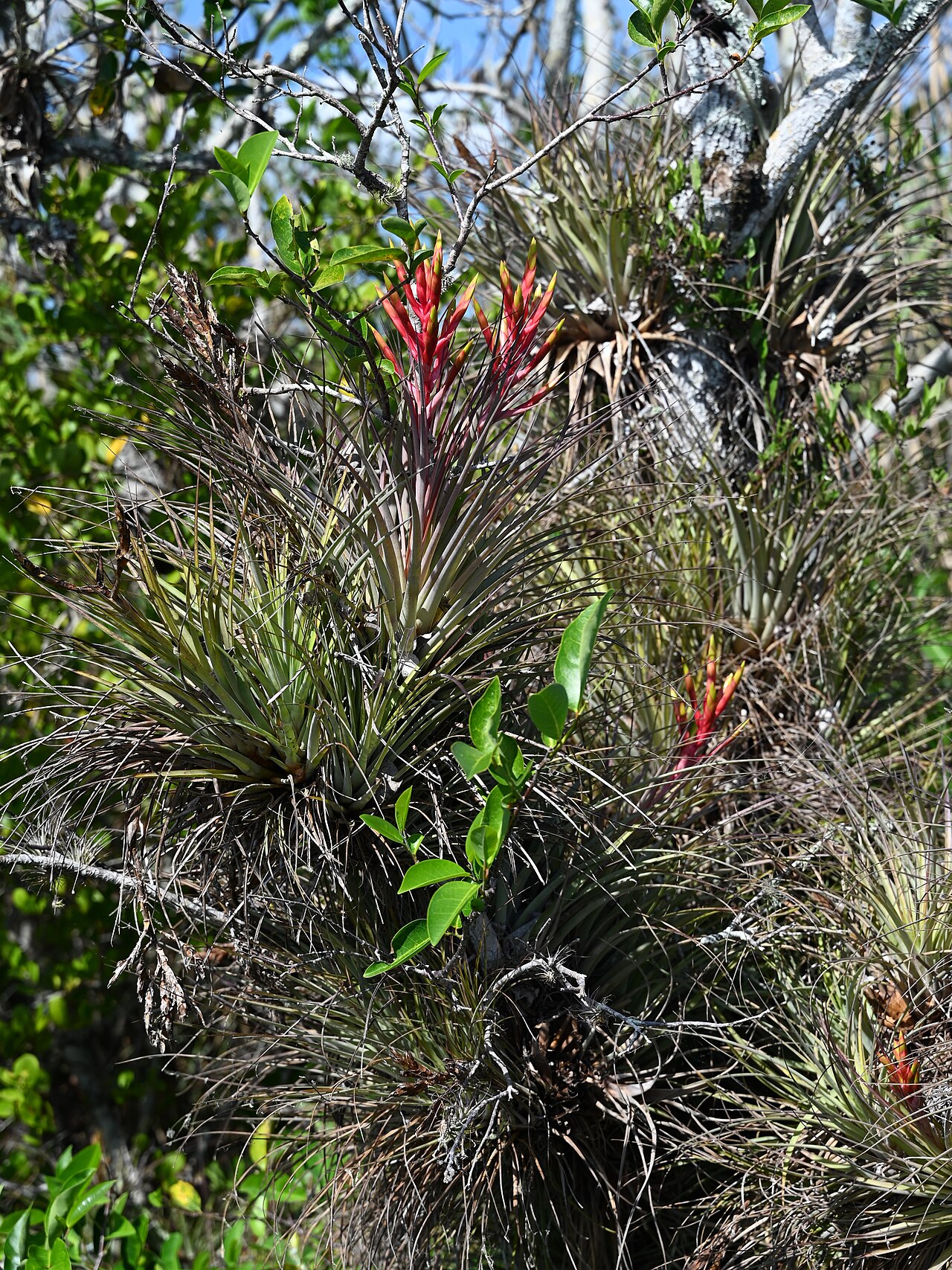
Large epiphytes like cardinal airplant add structure and small habitats to the canopy of tropical and subtropical forests.
For Pollinators
The combination of bright red bracts and long, tubular violet flowers is the classic look of a hummingbird flower, and hummingbirds visit cardinal airplant where the two occur together. Bees and other insects may also visit the flowers.
For Birds
Besides hummingbirds, small insect-eating birds may search the dense rosettes for insects and spiders.
For Mammals
It has little direct value for mammals, but its rosettes shelter insects and spiders that in turn feed small lizards and other wildlife.
Ecosystem Role
Epiphytes capture water, dust and fallen leaf litter from the air and slowly recycle nutrients in the forest canopy. Dense rosettes create sheltered, humid microhabitats for many small invertebrates. In Florida, cardinal airplant is one of several large native bromeliads being devastated by the introduced Mexican bromeliad weevil, which is why the species is listed as state endangered there.
Cultural & Historical Uses
The Swedish botanist Olof Swartz described Tillandsia fasciculata in 1788 from plants collected in the West Indies, where he spent several years studying the flora of Jamaica and nearby islands. The name fasciculata means “clustered” or “bundled”, a reference to the cluster of flower spikes. The genus honors the seventeenth-century Swedish-Finnish physician and botanist Elias Tillandz.
Its many common names, including cardinal airplant, giant airplant, giant wild pine and quill-leaf tillandsia, reflect both its red “cardinal” bracts and its resemblance to a small pineapple top, since bromeliads are members of the pineapple family. The early twentieth-century botanical artist Mary Vaux Walcott painted it for her series of North American wildflowers under the name quill-leaf tillandsia.
Cardinal airplant is widely grown by bromeliad enthusiasts, and many varieties and named cultivars exist. Because large bromeliads have been collected from the wild for the plant trade, conservationists stress buying only nursery-propagated plants, especially in Florida where wild populations are also under attack by the Mexican bromeliad weevil.
Frequently Asked Questions
Is cardinal airplant native to Puerto Rico?
Yes. USDA PLANTS lists Tillandsia fasciculata as native in Puerto Rico, and the Institute for Regional Conservation records it in Guánica, Susúa, Maricao and Río Abajo state forests and the Punta Guaniquilla natural reserve.
Does an air plant hurt the tree it grows on?
No. Cardinal airplant is an epiphyte, not a parasite. It uses the tree only for support and takes its water and nutrients from rain, dew and debris.
Can I collect cardinal airplants from the wild?
No. It is listed as endangered by the state of Florida, and taking plants from parks and forests is generally prohibited. Buy nursery-propagated plants or grow pups from plants you already own.
Why did my airplant die after blooming?
Each rosette blooms once and then slowly declines, but before it does it produces pups at its base. Keep the pups attached or mount them separately, and they will bloom in a few years.
What other native air plants are worth growing?
Spanish moss (Tillandsia usneoides) is native in both Florida and Puerto Rico. Ball moss (T. recurvata) and the giant wild pine (T. utriculata) are other native Tillandsias of the region.

Looking for a nursery that carries Cardinal Airplant?
Our nursery directory does not yet include Puerto Rico. Browse the native plant nursery directory by state: Alabama–Arkansas · California · Colorado–Hawaii · Idaho–Kansas · Kentucky–Montana · Nebraska–Oklahoma · Oregon · Pennsylvania–Virginia · Washington · West Virginia–Wyoming