Spanish Moss (Tillandsia usneoides)
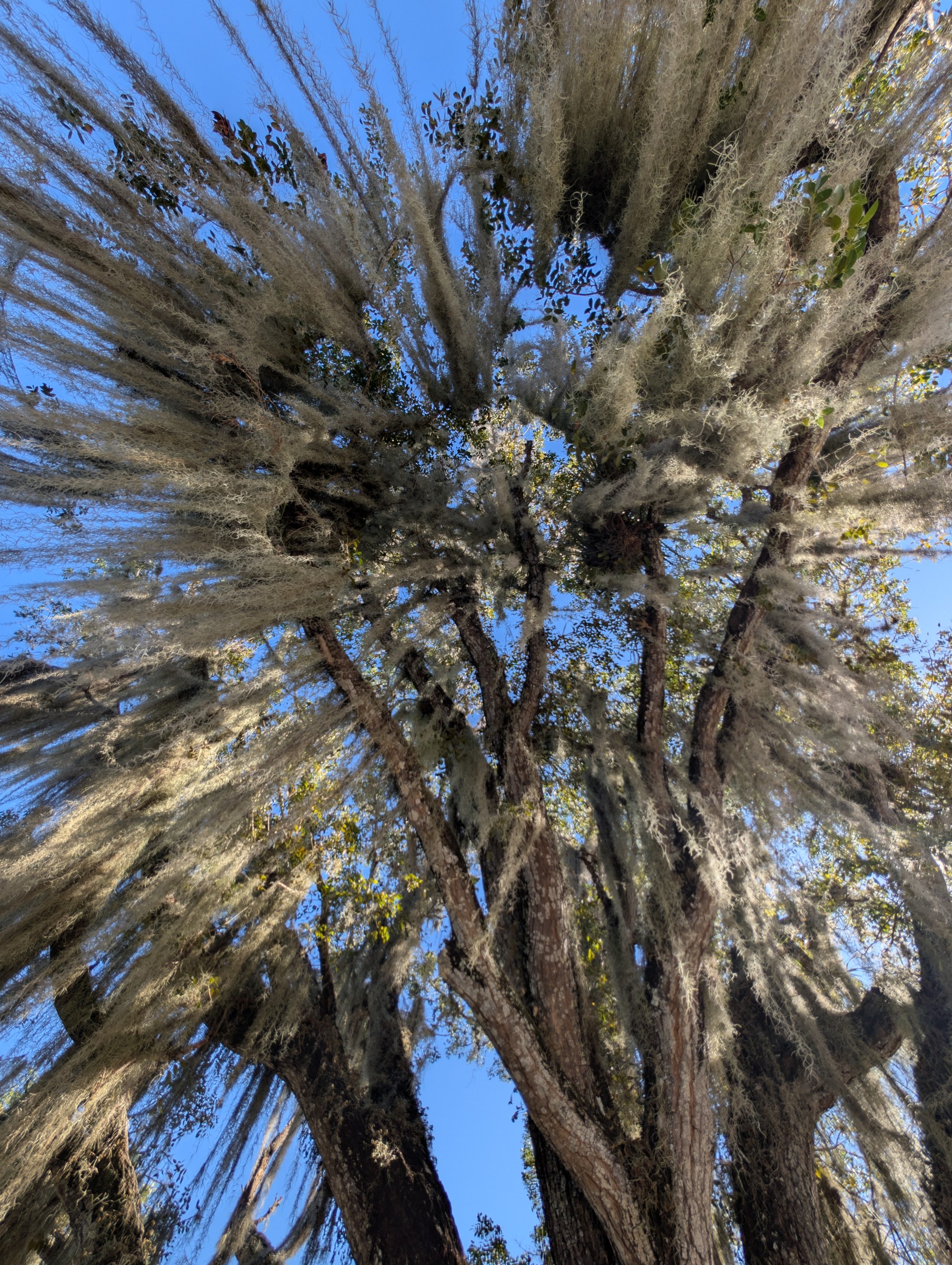
Tillandsia usneoides, commonly known as Spanish Moss, is one of the most instantly recognizable native plants of the American South, though it is neither Spanish nor a moss. It is a flowering bromeliad — a close relative of the pineapple — and an epiphyte, meaning it grows entirely on the surface of other plants without rooting into soil or parasitizing its host. Long, silvery-gray strands of overlapping, scale-covered stems drape from live oaks, bald cypresses, and other broad-limbed trees across the humid lowlands of the southeastern United States, swaying in Spanish-moss curtains that have become shorthand for the whole region’s landscape.
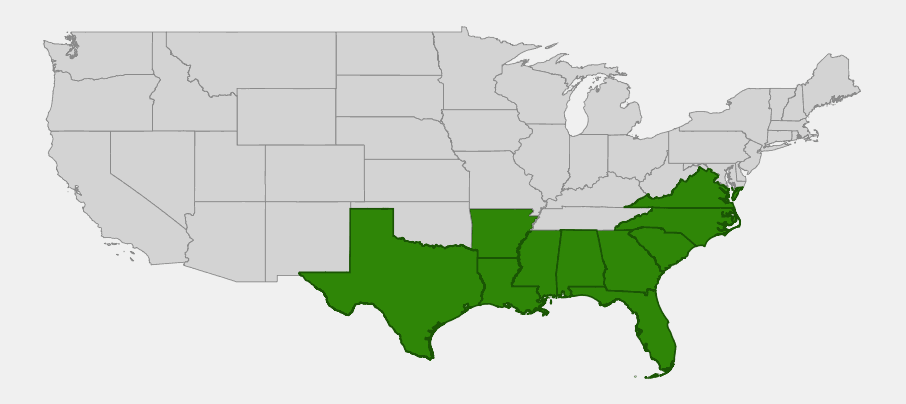
Despite its delicate, wispy appearance, Spanish Moss is a remarkably self-sufficient plant. It has no roots at all once mature, taking in water and nutrients directly from humid air, rain, and windblown dust through specialized scales covering its thread-like stems and leaves. This adaptation lets it thrive in the muggy, high-humidity climate of the Gulf and South Atlantic coastal plains, where it can be found festooning tree limbs from southeastern Virginia down through Florida and west into southern Arkansas and Texas.
Spanish Moss causes no harm to the trees it grows on — it uses them only as a physical support, not as a food source — and it plays a genuine ecological role, from nesting material to habitat for a surprising number of small creatures. Gardeners in its native range often leave it alone entirely or actively encourage it for the atmosphere and habitat it provides, while gardeners further north sometimes grow it as a houseplant or seasonal decoration since it survives easily draped over any support with enough humidity.
Identification
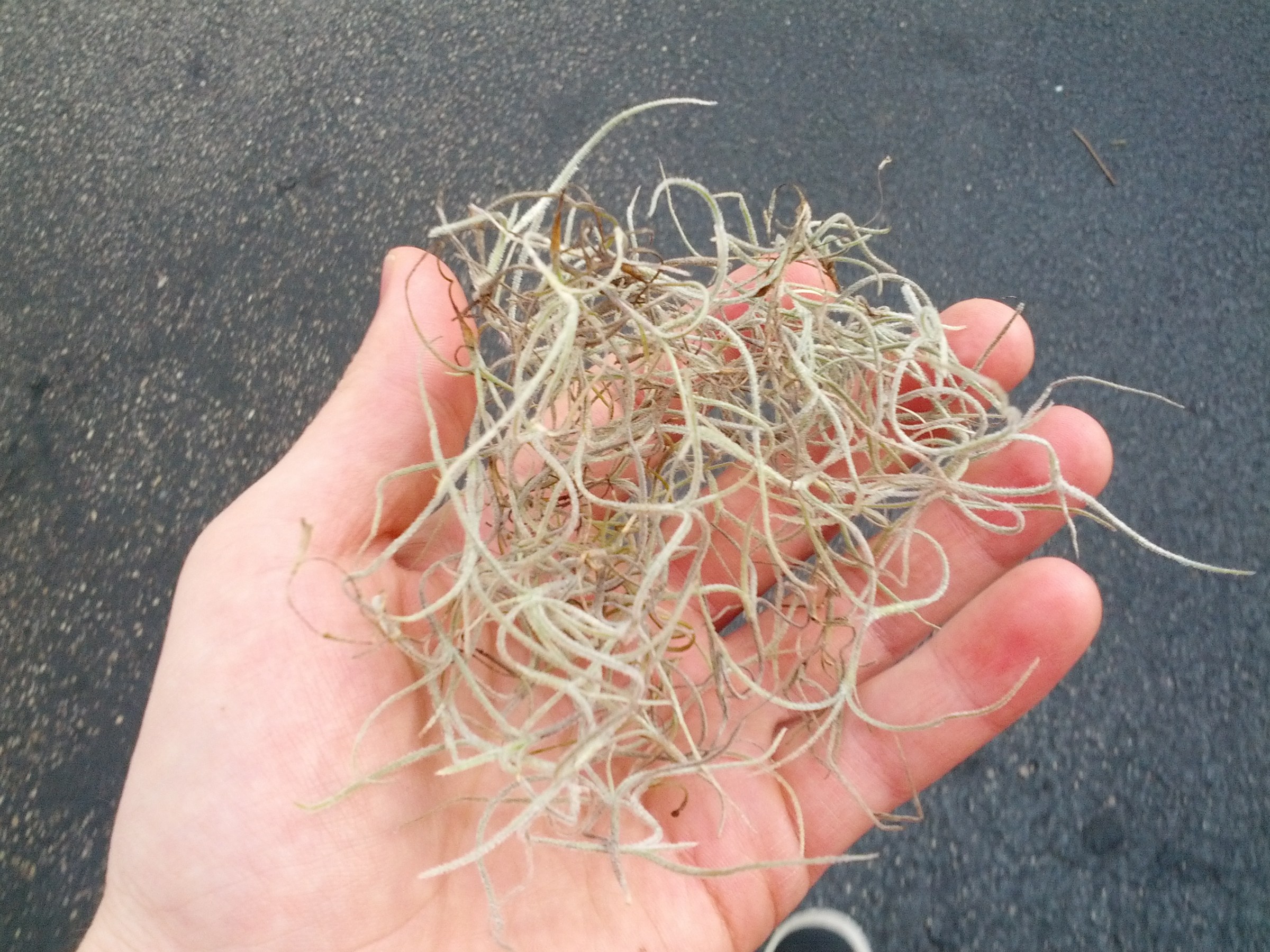
Spanish Moss has no conventional roots, trunk, or leaves in the usual sense. Instead, it consists of long, slender, branching stems, typically 2 to 8 feet long (though strands can stretch to 20 feet or more in old, undisturbed growth), that hang in loose chains from tree branches, wires, and fence lines.
Stems & Scales
The wiry stems are covered edge to edge in tiny, overlapping silvery-gray scales called trichomes, which give the whole plant its characteristic dusty, grayish-green color and its soft, slightly fuzzy texture. These trichomes are the plant’s lifeline: they absorb water and dissolved minerals directly from rain, fog, and airborne dust, which is why Spanish Moss needs no soil contact and can cling to almost anything with enough surface area to twine around, from oak bark to utility lines.
Leaves
What look like fine leaves are actually the same thread-like, curling stem segments; true leaves are reduced to narrow, 1 to 2 inch scaly segments pressed close along the stem. The whole plant has a soft, hair-like appearance from a distance that is easy to mistake for an actual moss or a lichen, though it is unrelated to either.
Flowers & Fruit
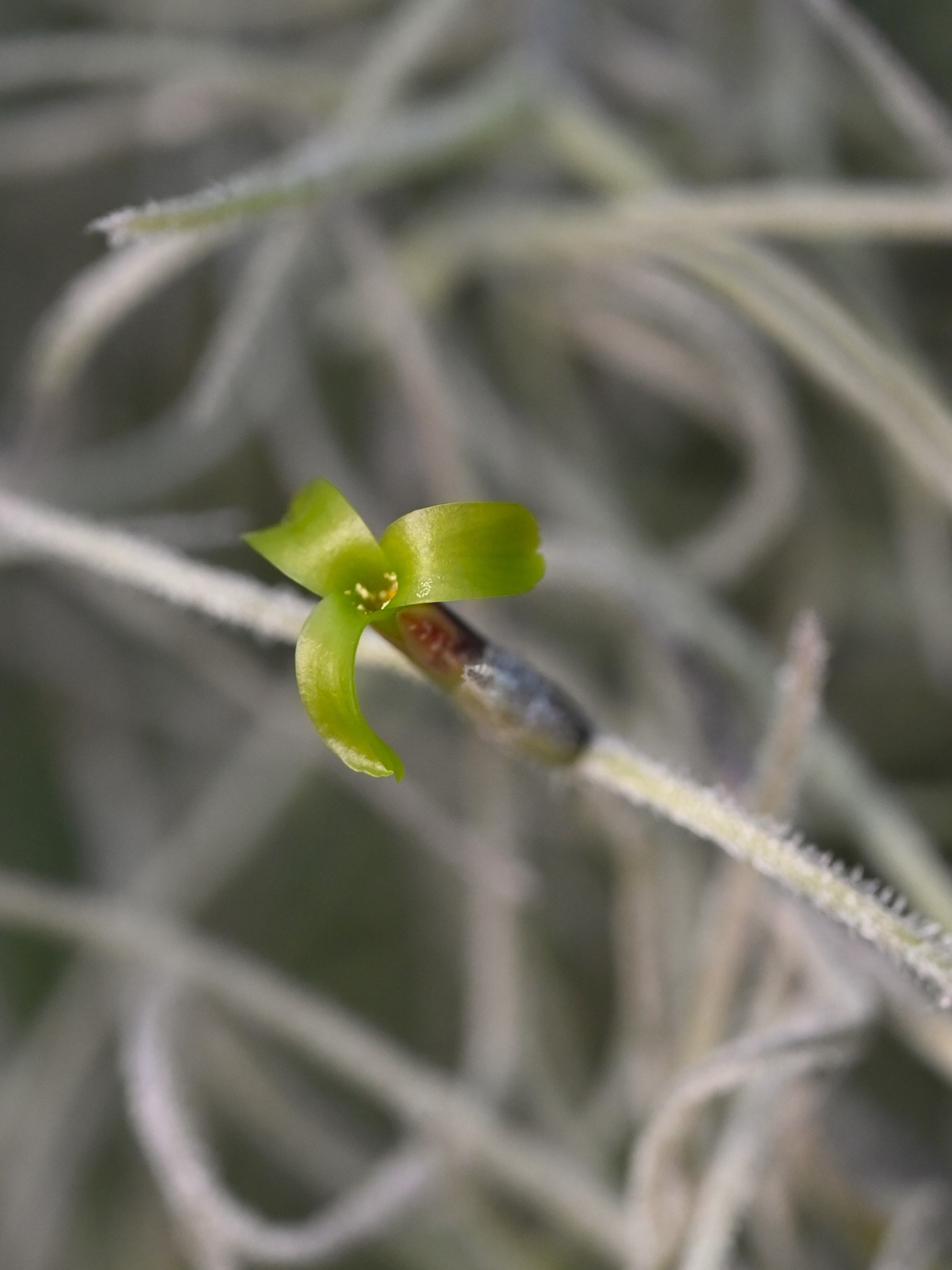
Spanish Moss blooms are easy to miss: tiny, fragrant, pale yellow-green to blue flowers only about ¼ inch across appear singly along the stems in late spring and summer, each with three narrow petals. Pollinated flowers eventually produce small, slender seed capsules that split open to release tiny seeds equipped with feathery tufts of hair, allowing wind to carry them to new branches — though the plant spreads far more commonly by fragments blown or carried by birds to new perches, where a piece as small as a single strand can root into a new colony.
Quick Facts
| Scientific Name | Tillandsia usneoides |
| Family | Bromeliaceae (Bromeliad) |
| Plant Type | Epiphytic Perennial (air plant) |
| Mature Length | 2–8 ft trailing strands (occasionally to 20 ft) |
| Growth Rate | Slow to moderate |
| Sun Exposure | Part Shade to Full Sun (prefers filtered light) |
| Water Needs | High humidity; no soil watering needed |
| Soil Type | None — epiphytic, grows on bark or structures |
| Soil pH | Not applicable |
| Bloom Time | Late spring – summer |
| Flower Color | Pale yellow-green to blue, inconspicuous |
| Fall Color | None (evergreen gray-green year-round) |
| Fruit | Slender capsule with wind-dispersed, hairy-tufted seeds |
| Deer Resistant | Yes (out of browse reach; not palatable) |
| USDA Hardiness Zones | 8 – 11 |
Native Range
Spanish Moss is native to the humid coastal plain of the southeastern United States, from southeastern Virginia south through the Carolinas, Georgia, and all of Florida, and west along the Gulf Coast through Alabama, Mississippi, Louisiana, southern Arkansas, and eastern and southern Texas. Its range continues south through the West Indies and into Mexico, Central America, and South America, making it one of relatively few native plants shared almost continuously between the temperate Southeast and the tropics.
Within this range, Spanish Moss is most abundant in warm, humid, low-elevation settings — river bottoms, swamps, coastal hammocks, and the moist lowland forests typical of the Gulf and South Atlantic coastal plains. It depends on consistently high atmospheric humidity to take up water through its leaf scales, which is why it thins out and disappears in the drier interior and higher-elevation parts of the Southeast even where winter temperatures would otherwise allow it to survive.
It is especially characteristic of live oak and bald cypress stands, where its long gray festoons are often the first thing visitors notice about southern swamps and coastal live oak groves. A few isolated historical reports place it as far north as coastal Maryland, but those occurrences were marginal and are not considered part of its reliable current native range.
📋 Regional plant lists featuring Spanish Moss: Maryland, Virginia & West Virginia · North Carolina & South Carolina · Georgia, Alabama & Mississippi · Arkansas, Louisiana, Eastern Oklahoma & Eastern Texas
Growing & Care Guide
Spanish Moss is about as low-maintenance as a native plant gets, provided its one essential requirement — humidity — is met. It needs no soil, no planting hole, and no fertilizer, which makes it one of the easiest ways to add instant native character to a shaded tree or trellis.
Light
Spanish Moss grows best in dappled or part shade, mimicking the filtered light beneath an oak canopy, though it also tolerates considerable sun in humid climates. Strands in deep shade tend to grow longer and more sparsely as they reach for light, while those in brighter conditions stay denser and more compact.
Humidity & Water
Because it has no roots, Spanish Moss draws all of its water and nutrients from the air through its scaly leaf surfaces. In its native humid Southeast it typically receives all the moisture it needs from rain, dew, and ambient humidity. Where humidity is lower, an occasional misting or rinse under a hose helps it thrive; prolonged dry spells cause strands to brown and go dormant, though they usually green back up once moisture returns.
Planting Tips
“Planting” Spanish Moss simply means draping a handful of strands over a tree limb, fence, or trellis with enough texture to catch and hold it — no tying or anchoring is required, since the plant naturally snags and spreads on its own. Live oak, bald cypress, and other rough-barked trees in humid, shaded sites take to it fastest. Avoid draping it over very smooth-barked or fast-growing ornamental trees if a tidy appearance is a priority, since it can spread opportunistically once established nearby.
Maintenance
Established Spanish Moss needs essentially no care. If growth becomes heavier than desired on a particular limb, simply pull handfuls away — it detaches easily without harming the host tree. It is not a parasite and does not weaken healthy trees, though an extremely heavy load on an already stressed or diseased limb can add enough weight to contribute to breakage in storms.
Landscape Uses
Few native plants deliver so much atmosphere for so little effort:
- Naturalistic southern garden character draped over oaks, cypress, or arbors
- Wildlife and nesting material encouraged in habitat gardens
- Seasonal or event decor, sustainably harvested from established colonies rather than wild-collected
- Humidity-loving houseplant in bright, humid indoor settings outside its hardy range
- Erosion-free vertical greening for fences, trellises, and dead or living tree limbs
Wildlife & Ecological Value
Beyond its iconic appearance, Spanish Moss functions as a small, self-contained habitat within the larger tree canopy it hangs from, hosting an entire community of organisms that rarely gets noticed from the ground.
For Birds
Numerous songbirds, including Northern Parulas and Yellow-throated Warblers, use dense Spanish Moss curtains almost exclusively as nesting material and nest sites in the Southeast, weaving strands into cup nests or tucking nests directly into a hanging clump for camouflage and insulation. Other birds line nests with smaller amounts of the soft, fibrous material.
For Other Wildlife
Spanish Moss clumps shelter a surprising range of small creatures, including spiders, insects, tree frogs, and at least one species of jumping spider found nowhere else, which lives its entire life cycle within the moss itself. Bats have also been documented roosting in thick festoons during warmer months.
Ecosystem Role
As a true epiphyte, Spanish Moss does not draw water or nutrients from its host tree, instead cycling moisture and airborne nutrients through the forest canopy layer. Old, fallen strands break down slowly on the forest floor, and historically, the plant’s durable fiber was gathered commercially; today it mostly contributes quietly to canopy biodiversity and nutrient cycling in the swamps and live oak groves of the coastal Southeast.
Cultural & Historical Uses
Spanish Moss has a long history of practical use across the Southeast. Indigenous peoples of the region used the fibrous strands, after they were cleaned of the stiff outer scale layer, for weaving, cordage, and insulating material. Enslaved and free Black craftspeople and other Southern communities later dried and processed it commercially on a large scale during the 19th and early 20th centuries, stripping away the outer cuticle to expose a wiry black fiber used to stuff mattresses, upholstery, and automobile seats before synthetic fibers became widely available.
The plant’s common name is a colonial-era misnomer with a tangled history: French settlers reportedly called it “Spanish Beard” as a jab at Spanish colonizers, a name the Spanish are said to have returned by calling it “French Hair.” Neither name reflects any actual connection to Spain, and the plant is entirely native to the Americas, with no link to Spanish moss-like lichens of Europe.
Today, Spanish Moss remains deeply tied to the cultural identity of the American South, appearing throughout regional literature, photography, and tourism imagery as visual shorthand for live oak allées and low-country landscapes. Small-scale harvesting for crafts and floral decoration continues, generally sustainable given the plant’s fast regrowth from even small fragments left behind.
Frequently Asked Questions
Does Spanish Moss hurt the trees it grows on?
No. Spanish Moss is an epiphyte, not a parasite — it uses tree branches only as physical support and draws all its water and nutrients from the air, not from the host tree. In rare cases, an extremely heavy load on an already weak or diseased limb can add enough weight to contribute to breakage, but the moss itself does not harm healthy trees.
Is Spanish Moss actually a moss?
No. Despite the name, it is a flowering bromeliad related to the pineapple, not a true moss. True mosses are non-flowering plants in an entirely different group; Spanish Moss simply resembles one from a distance.
Can I grow Spanish Moss outside the South?
It can be grown as a houseplant or seasonal decoration well outside its native range, as long as it gets bright, indirect light and regular misting to replace the humidity it would naturally absorb from southern air. It is only reliably winter-hardy outdoors in USDA zones 8–11.
Is it true that chiggers live in Spanish Moss?
Fresh, green Spanish Moss pulled directly from a tree can harbor chiggers and other small arthropods, which is why handling it with gloves or letting it dry out first is a common precaution. Commercially processed or thoroughly dried moss has typically been cleaned and poses little risk.
How do I start Spanish Moss on a tree in my yard?
Simply drape a handful of strands over a rough-barked limb in a shaded or partly shaded, humid spot; no planting, soil, or anchoring is needed. It will cling on its own and gradually spread if conditions stay humid enough.

Looking for a nursery that carries Spanish Moss?
Browse our native plant nursery directory: Virginia, South Carolina & Texas · North Carolina · Georgia & Florida · Alabama & Arkansas · Mississippi & Louisiana