
Baybean (Canavalia rosea)
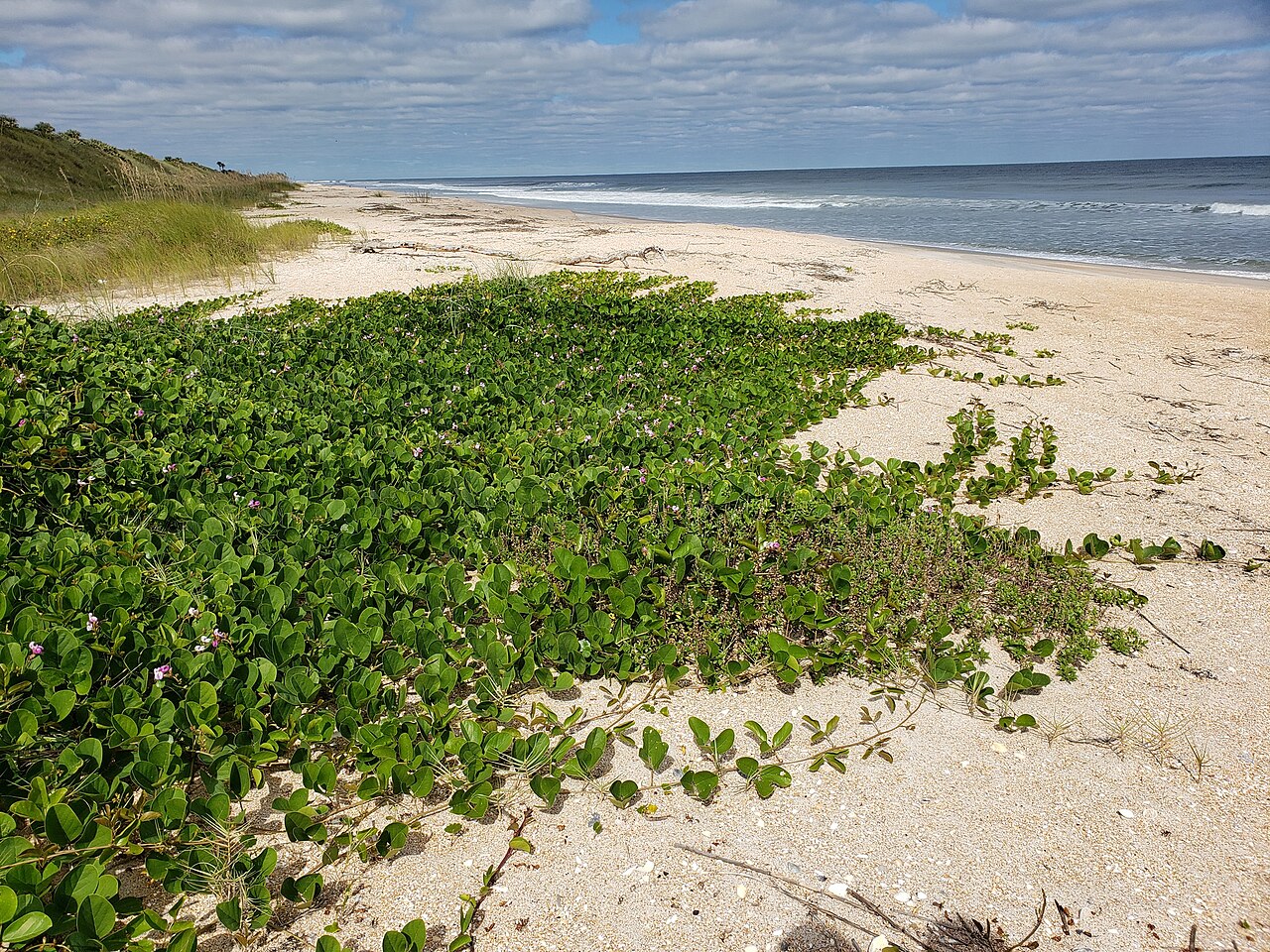
Canavalia rosea, known as Baybean, seaside jackbean or beach bean, is a sprawling vine of tropical and subtropical beaches. Its thick, trailing stems run for many feet across the upper beach and the face of the dunes, carrying leaves of three broad, rounded, leathery leaflets. From summer into fall, and nearly year-round in south Florida, it produces upright stalks of rosy pink to purple pea flowers, followed by thick bean pods.
Baybean is a member of the bean family (Fabaceae). Like most legumes it works with bacteria in its root nodules to fix nitrogen, which helps it grow in nutrient-poor beach sand. It is one of the pioneer plants that colonize bare sand above the high-tide line, and its long runners help trap blowing sand and start new dunes. Its seeds float and can survive long periods in salt water, which explains why the species is found on tropical coasts around the world.
In the United States it grows along the Gulf Coast from Texas to Florida and around the Florida peninsula, and USDA PLANTS also lists it as native in Puerto Rico and the U.S. Virgin Islands. Older references often call it Canavalia maritima. This guide covers how to identify it, where it grows, and how to use it in coastal landscapes and dune restoration.
Identification
Baybean is easy to recognize on the beach. Few other vines in its habitat have leaves of three thick, rounded leaflets, and none have its large pink pea flowers and fat bean pods.
Stems & Growth Habit
Baybean is a perennial vine with stout, smooth to slightly hairy stems that trail along the sand for 20 feet or more and root at some nodes. Where it meets shrubs or dune grasses it can scramble over them, but on open beaches it forms low mats usually less than a foot high.
Leaves
The leaves are alternate and compound, with three leaflets on a stalk several inches long. Each leaflet is broadly oval to nearly round, often notched or rounded at the tip, 2 to 4 inches long, thick, leathery and bright to yellowish green. The leaflets often fold upward along the midrib in strong sun and heat.
Flowers
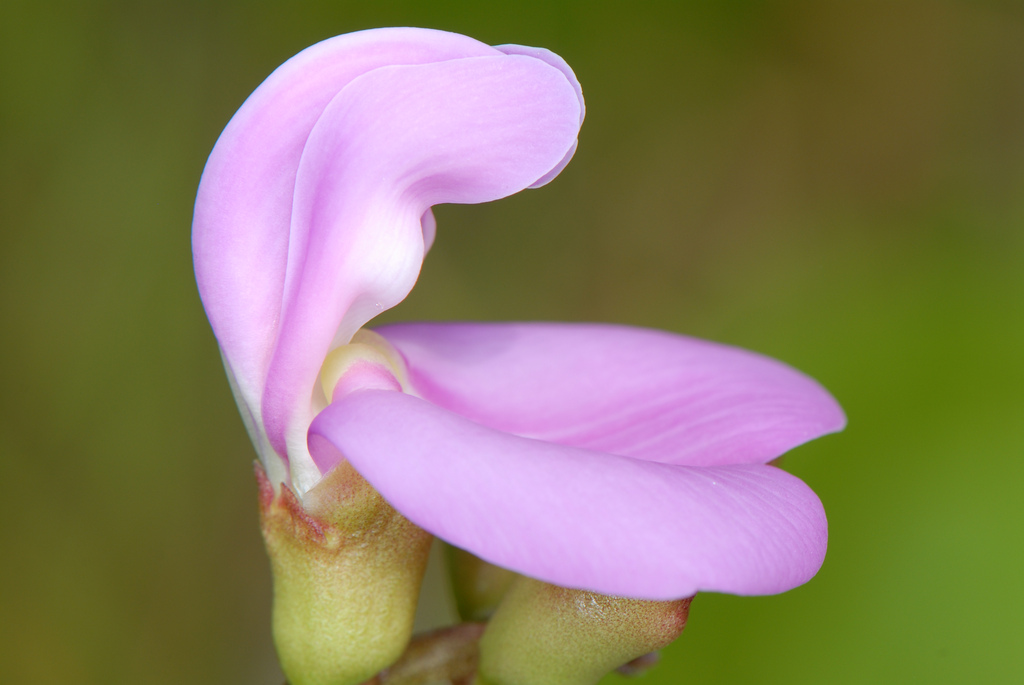
The flowers are carried on upright stalks that rise from the leaf axils, each with several to many flowers opening a few at a time. Each flower is about 1 inch long, rosy pink to lavender-purple, with a broad, curved banner petal that often has a pale or white center, and a curled keel. In the Gulf states the main flowering season is June to November; in south Florida it can flower in almost any month.
Fruit & Seeds
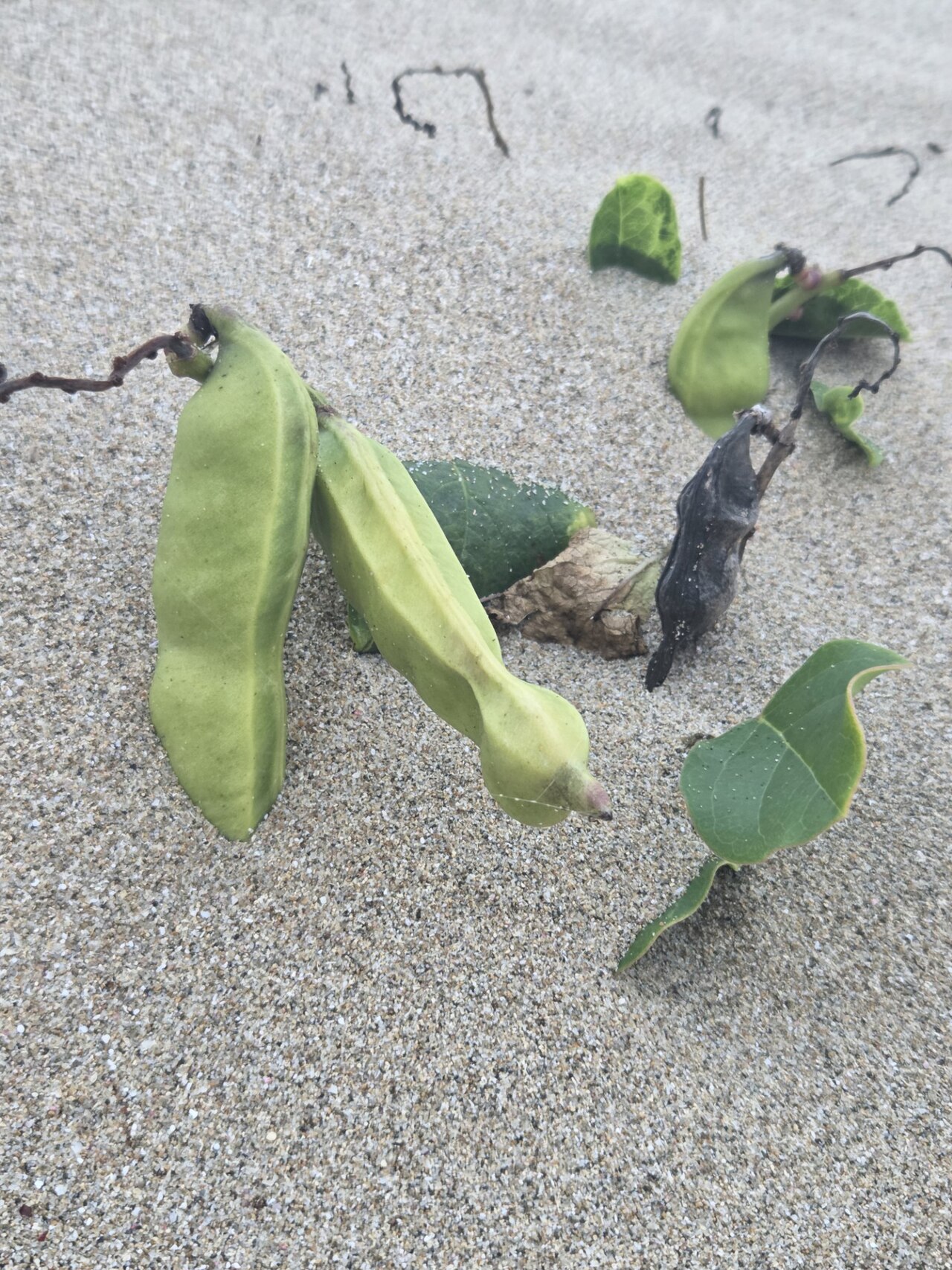
The pods are thick, flattened, ridged legumes about 4 to 6 inches long, green at first and drying brown. Each holds several large, oval, brown, often mottled seeds. The seeds float and are dispersed by ocean currents, and they are one of the many “sea beans” collected by beachcombers.
Similar Species
Other Canavalia species, such as the cultivated jack bean, are upright or climbing plants of farms and gardens rather than beach runners. Beach morning glory (Ipomoea pes-caprae), which often grows alongside it, has single, two-lobed leaves and funnel-shaped pink flowers. Beach peas (Vigna species) have yellow flowers and smaller, thinner leaflets.
Quick Facts
| Scientific Name | Canavalia rosea (syn. Canavalia maritima) |
| Family | Fabaceae (bean family) |
| Plant Type | Perennial trailing vine |
| Mature Height | 6–12 in as a ground cover |
| Mature Spread | 10–20 ft or more |
| Growth Rate | Fast |
| Sun Exposure | Full sun |
| Water Needs | Low; drought and salt-spray tolerant |
| Soil Type | Beach sand, dune sand, shell and coastal fill |
| Soil pH | About 6.5–8.5 (neutral to alkaline) |
| Bloom Time | June–November; nearly year-round in south Florida |
| Flower Color | Rosy pink to lavender-purple |
| Fall Color | None; evergreen in frost-free areas |
| Fruit | Thick ridged pod 4–6 in long with large floating seeds |
| Deer Resistant | Not well documented |
| USDA Hardiness Zones | 9b–11 |
Native Range
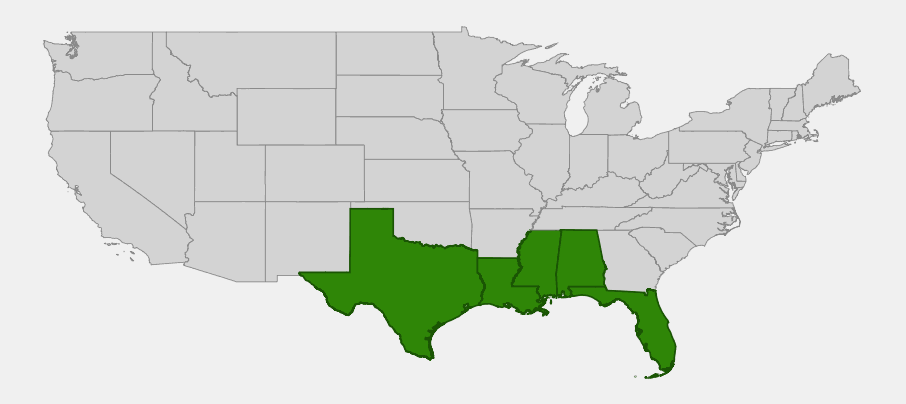
Baybean is a pantropical beach plant, native to coasts of the Americas, Africa, Asia, Australia and the Pacific islands. In the United States, USDA PLANTS and the Lady Bird Johnson Wildflower Center record it from five states along the Gulf of Mexico: Texas, Louisiana, Mississippi, Alabama and Florida. USDA also lists it as native in Puerto Rico and the U.S. Virgin Islands; these are not drawn on the map.
In Florida it grows on beaches along both coasts of the peninsula and in the Florida Keys, and it becomes less common toward the north, where winter frosts kill back the stems. On the northern Gulf Coast and in Texas it is found mainly on the more southerly barrier islands and beaches. Throughout its range it occupies the upper beach and foredunes, where it tolerates salt spray, blowing sand, drought and occasional overwash.
Like other beach plants, baybean has lost habitat to coastal development, beach raking and heavy foot traffic. It recovers quickly on protected beaches and is increasingly used in dune restoration in Florida, where its spreading stems help stabilize newly placed sand.
📋 Regional plant lists featuring Baybean: North & South Florida · Alabama, Georgia & Mississippi · Arkansas, Louisiana, Eastern Oklahoma & Eastern Texas · South & West Texas
Growing & Care Guide
Baybean is one of the best plants for open, sunny beachfront landscapes in Florida and the Gulf Coast. It is available from native nurseries in Florida, especially those that supply dune restoration projects. Check local rules before planting on a public or regulated dune, where permits are often required.
Light
Give it full sun. It tolerates the heat and glare of an open beach and does poorly in shade.
Soil & Water
It grows in pure beach sand, shell and sandy fill, and tolerates salt spray and salty soil. Water new plants until they root, then leave them alone; established plants are very drought tolerant. Rich, moist garden soil is not necessary and can make it grow too lush.
Planting Tips
Plant rooted cuttings or container plants 2 to 3 feet apart in spring or summer, when the sand is warm. Plant them deeply enough that the roots reach moist sand. On a dune, plant it together with sea oats and other dune grasses so that the vine covers the ground between them. Allow plenty of room: a single plant can spread 20 feet or more.
Pruning & Maintenance
Little maintenance is needed. Trim runners that grow onto paths or into other plantings. Frost kills back the stems in colder parts of its range, but plants usually regrow from the base in spring.
Propagation
Propagate from seed or stem cuttings. Scarify the hard seeds by nicking the seed coat or soaking them overnight, then sow them in sand; they germinate quickly in warm weather. Stem pieces with a few nodes root easily in moist sand.
Landscape Uses
- Dune restoration: stabilizes blowing sand and helps build foredunes
- Beachfront landscapes: a salt-tolerant ground cover for open coastal sites
- Pollinator gardens: large pink flowers visited by carpenter bees and other bees
- Erosion control: covers slopes of sand and fill near the shore
- Coastal wildlife plantings: shelter for beach insects and small animals
Wildlife & Ecological Value
Baybean is a pioneer of the upper beach, and its flowers and dense mats support a variety of coastal wildlife.
For Pollinators
The large pea flowers are pollinated mainly by large bees, such as carpenter bees and leafcutter bees, which are strong enough to push open the keel and reach the nectar. Butterflies and other insects also visit the flowers.
For Birds
The large seeds are not an important bird food, but the low mats shelter insects and other invertebrates that shorebirds and songbirds eat.
For Mammals
Beach mice and other small mammals use dune vegetation for cover. The raw seeds contain toxic compounds, and the plant is not an important food for mammals.
Ecosystem Role
As a nitrogen-fixing legume, baybean adds nitrogen to nutrient-poor beach sand, which benefits other dune plants. Its long runners trap sand and help start new dunes, and its sea-dispersed seeds allow it to recolonize beaches after storms.
Cultural & Historical Uses
Olof Swartz described the species in the late 1700s from plants collected in the West Indies, as Dolichos roseus. Augustin Pyramus de Candolle later placed it in Canavalia. Many books use the name Canavalia maritima, which is now treated as a synonym.
The beans are related to the jack bean (Canavalia ensiformis) and sword bean (Canavalia gladiata), which are cultivated in the tropics. Baybean seeds and pods have been eaten in some coastal cultures after long cooking, but the raw seeds contain toxic compounds, including canavanine. Do not eat them.
Its seeds wash up on beaches around the world, and they are among the “sea beans” that beachcombers collect and identify. In Florida, baybean is valued today as a tough native ground cover for beachfront properties and as a pioneer species in dune restoration.
Frequently Asked Questions
Is baybean native to Florida?
Yes. It is native along Florida’s beaches and the Gulf Coast to Texas. USDA PLANTS also lists it as native in Puerto Rico and the U.S. Virgin Islands.
Are baybean seeds edible?
Not safely. The raw seeds contain toxic compounds such as canavanine. Although they have been eaten in some places after long cooking, they should not be eaten.
Can I plant baybean on my beach dune?
It is an excellent dune plant, but many coastal areas require permits for planting or altering dunes. Check with your local or state coastal authority first, and use nursery-grown plants.
Is baybean the same as seaside jackbean?
Yes. Baybean, seaside jackbean and beach bean are common names for Canavalia rosea. It is also known by the older scientific name Canavalia maritima.
Will baybean survive frost?
Frost kills back the stems, and hard freezes can kill plants. It is best suited to zones 9b to 11, but plants in north Florida often regrow from the base after a mild winter.

Looking for a nursery that carries Baybean?
Browse our native plant nursery directory: Alabama · Florida · Louisiana & Mississippi · Texas