
Beachberry (Scaevola plumieri)
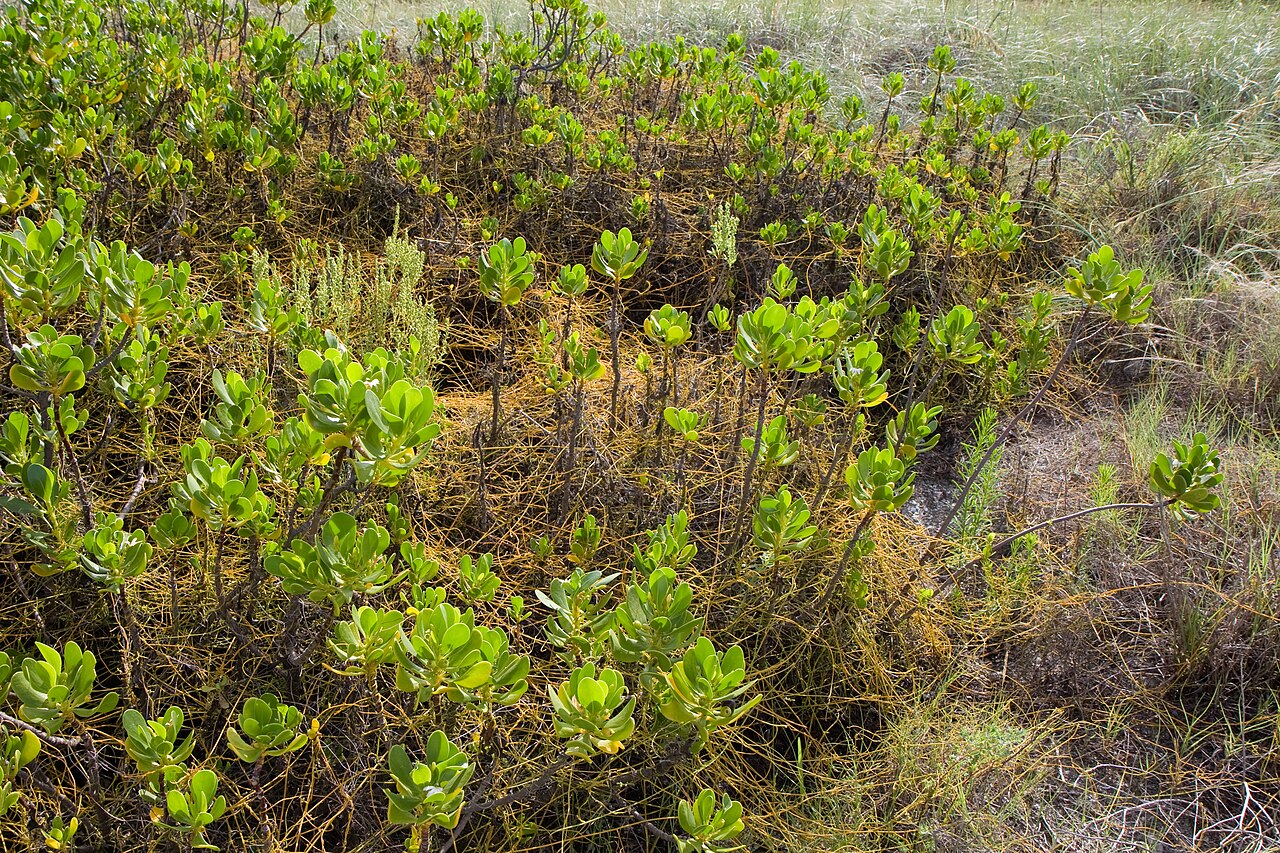
Scaevola plumieri, known as Beachberry (also inkberry, gullfeed and black-fruited scaevola), is a low, succulent-leaved shrub of tropical and subtropical beaches. In the United States it grows mainly on the coastal dunes of central and south Florida. It spreads by underground stems through loose sand, producing thick, glossy, spoon-shaped leaves, odd fan-shaped white flowers and shiny black berries for much of the year.
Beachberry is listed as a Threatened species by the State of Florida (FDACS Regulated Plant Index), and the Atlas of Florida Plants records the same status. Coastal development, beach grooming and competition from invasive plants have reduced many populations. Gardeners who want to grow it should buy nursery-propagated plants from a native plant nursery and never dig or collect plants or cuttings from the wild.
In Florida, beachberry is often confused with beach naupaka (Scaevola taccada, also sold as S. sericea), a much larger Pacific species that is invasive on Florida beaches and should not be planted there. Beachberry is the native alternative: lower, with black rather than white fruit. This guide covers how to tell them apart, where beachberry grows, and how to use it in dune and seaside plantings.
Identification
Beachberry is easy to recognize in its beach habitat once you know the half-flower of the Scaevola genus. The main challenge in Florida is separating it from invasive beach naupaka, which has similar flowers. Beachberry is lower (usually under 3 feet), has hairless, smaller leaves, and ripens black fruits; beach naupaka grows into a shrub up to 10 feet or more, has larger, often slightly hairy leaves, and produces white fruits.
Stems & Habit
Beachberry is a sprawling, evergreen shrub usually 1 to 3 feet tall. Its stems run under and along the sand and send up short, thick, yellowish-green branches, so a single plant can form a broad, low colony. Leaves crowd toward the tips of the branches, leaving leaf scars on the stems below.
Leaves
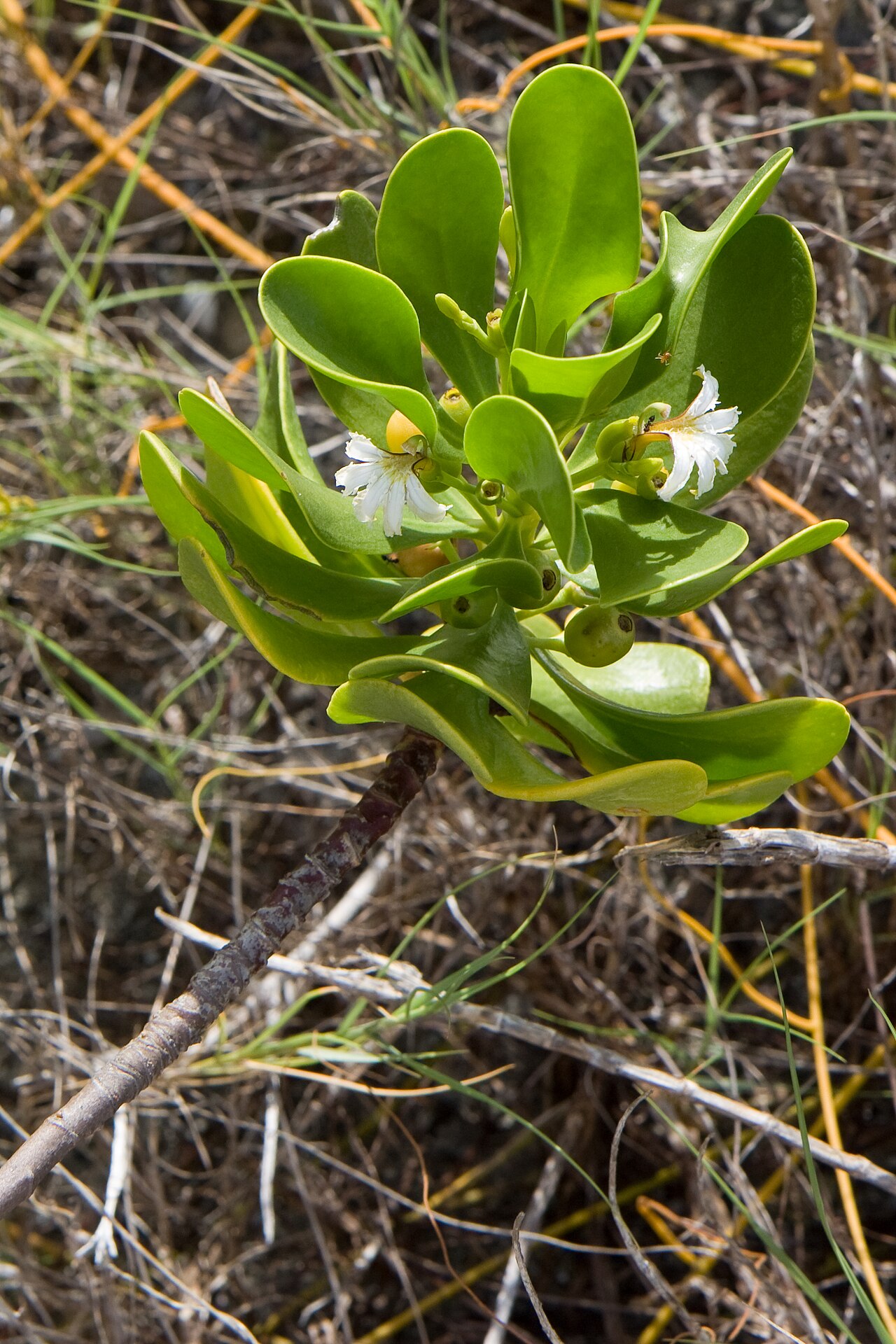
The leaves are thick, fleshy and hairless, obovate to spoon-shaped, about 2 to 4 inches long, with smooth edges. They are bright to yellow-green and slightly glossy. The succulent leaves help the plant cope with salt spray, drought and heat on open dunes.
Flowers
The flowers grow in small clusters in the leaf axils near the branch tips. Each is about an inch long, white to greenish-white, with a tube that is hairy inside. The five petal lobes are all spread to one side, so each flower looks like half a flower or a small fan. In south Florida flowers can appear in almost any month; the Lady Bird Johnson Wildflower Center lists bloom from January to November.
Fruit
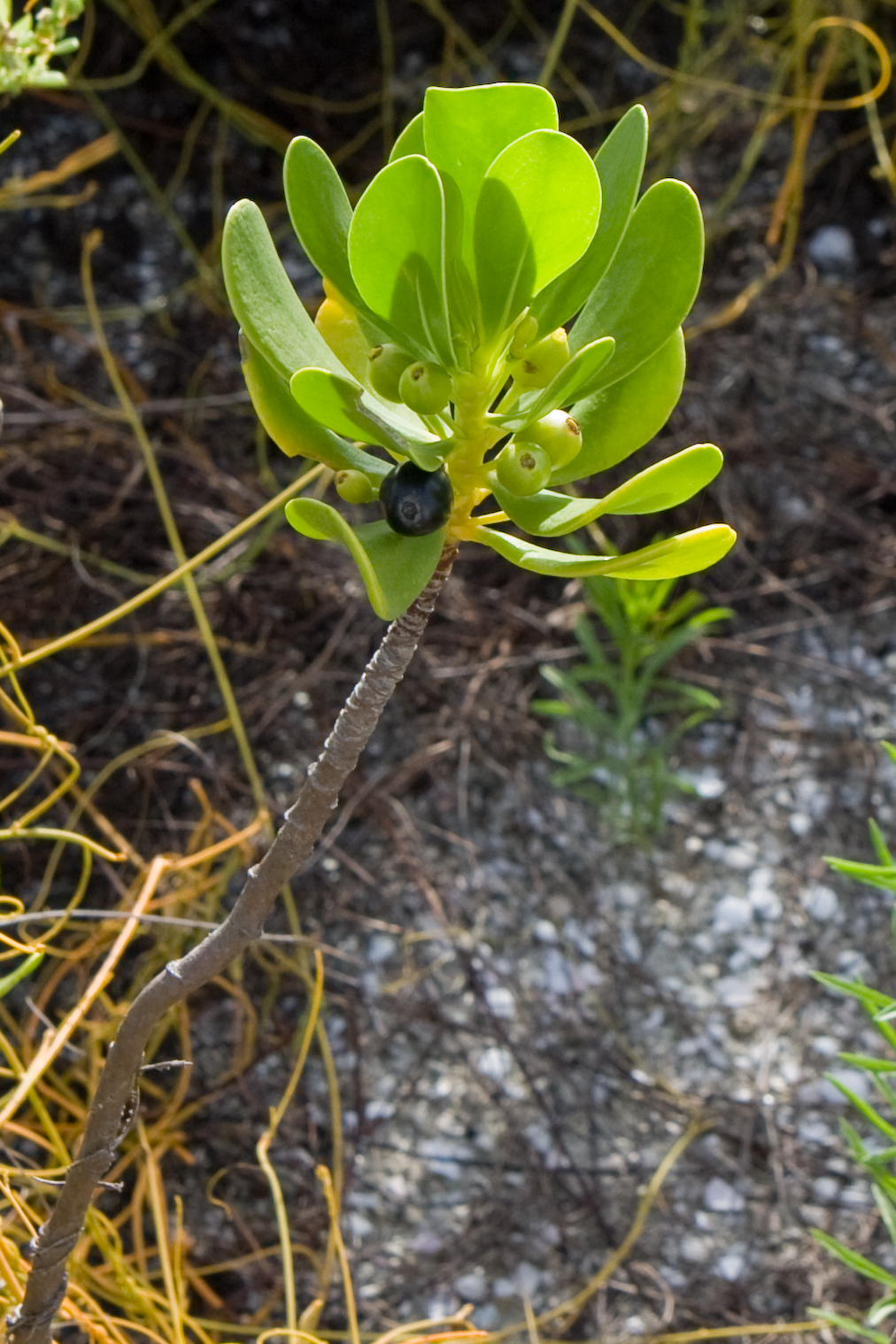
The fruits are round, fleshy drupes about ½ inch across, green at first and ripening glossy black or blue-black. The calyx lobes are tiny or missing on the ripe fruit, another difference from beach naupaka, whose white fruits carry visible calyx lobes. The fruits float and can be carried by sea currents, which helps explain the plant’s wide distribution on tropical coasts.
Quick Facts
| Scientific Name | Scaevola plumieri (USDA symbol SCPL) |
| Family | Goodeniaceae (goodenia family) |
| Plant Type | Low, spreading evergreen shrub with succulent leaves |
| Mature Height | 1–3 ft |
| Mature Spread | 3–6 ft or more, spreading by underground stems |
| Growth Rate | Moderate |
| Sun Exposure | Full sun |
| Water Needs | Low; dry, well-drained beach sand |
| Soil Type | Sand, including salty beach and dune sand |
| Soil pH | Neutral to alkaline (about 6.5–8.5) |
| Bloom Time | Most of the year in south Florida |
| Flower Color | White to greenish-white |
| Fall Color | None; evergreen |
| Fruit | Glossy black drupe, about ½ in |
| Deer Resistant | Usually; rarely browsed |
| USDA Hardiness Zones | 9b–11 |
Native Range
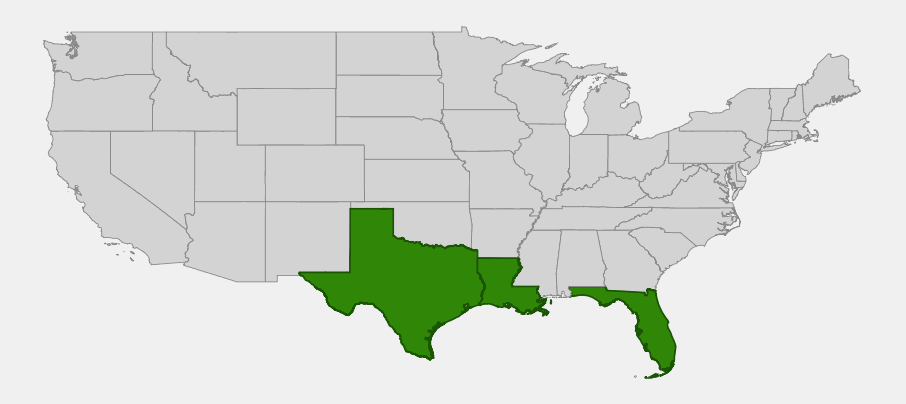
Beachberry grows on tropical and subtropical coasts around the Atlantic and Indian Oceans, including the Caribbean, Bermuda, the Atlantic coast of South America, and the coasts of West, South and East Africa. In the United States it is native to Florida, and USDA PLANTS, Puerto Rico and the U.S. Virgin Islands also list it as native. USDA and the Lady Bird Johnson Wildflower Center also record it from Louisiana and Texas, at the western edge of its range on the Gulf Coast, where it is rare.
In Florida it is found on the beaches of the central and southern peninsula on both coasts and in the Florida Keys. It grows on the upper beach and the front of coastal dunes, in coastal strand and among the low shrubs at the edge of maritime hammocks. It is a pioneer plant: its spreading stems trap blown sand and help build and stabilize dunes.
Many Florida beaches have lost their natural dune vegetation to development, mechanical beach cleaning and invasive plants such as beach naupaka and Brazilian pepper. Beachberry is now protected under Florida’s state law for listed plants, and it is planted in dune restoration projects using nursery-grown stock.
📋 Regional plant lists featuring Beachberry: North & South Florida · Arkansas, Louisiana, Eastern Oklahoma & Eastern Texas
Growing & Care Guide
Beachberry is one of the best native plants for oceanfront gardens in central and south Florida. It tolerates salt spray, wind, drought and shifting sand, and it needs very little care once established. Plant only nursery-propagated plants of this state-listed species.
Light
Give it full sun. It grows on open beaches and dunes and becomes thin and leggy in shade.
Soil & Water
Plant in sandy, very well-drained soil; it does well in pure beach sand and tolerates salt in the soil and salt spray on the leaves. Water regularly for the first few weeks after planting, then only during long dry spells. It does not tolerate soggy soil and does not need fertilizer.
Planting Tips
Set container-grown plants 2 to 3 feet apart in spring or early summer, at the start of the rainy season. On the beach side of a property, check local rules first: work seaward of Florida’s Coastal Construction Control Line may need a permit. Choose beachberry instead of beach naupaka, which is listed as an invasive species in Florida.
Pruning & Maintenance
Little pruning is needed. Trim stray stems if they spread onto paths. Do not bury the plants under deep mulch; on dunes, a light covering of blown sand is natural and the plant grows up through it. Pull out any beach naupaka seedlings that appear nearby.
Propagation
Nurseries propagate beachberry from seed and from stem cuttings, which root fairly easily in a sandy mix. Seeds can be slow to germinate. Because it is a state-listed species, home gardeners should start with purchased nursery plants rather than collecting seeds or cuttings from wild populations.
Landscape Uses
- Dune restoration: a native sand-binder for foredunes and coastal strand
- Oceanfront gardens: tolerates salt spray, wind and drought
- Native replacement for beach naupaka: similar look, lower growth, no invasive risk
- Low groundcover for sandy yards: near the coast in central and south Florida
- Wildlife gardens: fruit for birds and flowers for small pollinators
Wildlife & Ecological Value
Beachberry is part of the low, salt-tolerant plant community that holds Florida’s beaches and dunes together and supports coastal wildlife.
For Pollinators
The white flowers are visited by small bees, flies, moths and other insects. Because beachberry flowers through much of the year in south Florida, it provides nectar on the beach when few other plants are blooming.
For Birds
Birds eat the black fruits, which is the source of the name gullfeed. Songbirds that pass through coastal areas during migration also feed on the fruit, and the low, dense colonies offer cover on open beaches.
For Mammals
Raccoons and other small mammals may eat fallen fruit, and the low thickets give cover to animals of the dunes.
Ecosystem Role
Beachberry is a dune builder. Its spreading underground stems and dense foliage trap wind-blown sand, helping dunes grow and recover after storms. Healthy dune vegetation, in turn, protects inland areas from storm surge and erosion.
Cultural & Historical Uses
Linnaeus first described the plant in 1753 as Lobelia plumierii, naming it after the French botanist Charles Plumier, who explored and illustrated the plants of the Caribbean in the late 1600s. It was later moved to Scaevola. The genus name comes from the Latin scaevus, “left-handed”, a reference to the one-sided flowers.
The common names inkberry and gullfeed refer to the dark, juicy fruit and the birds that eat it. Because “inkberry” is also used for the unrelated holly Ilex glabra, beachberry is the clearer name for gardeners.
Beachberry has become a symbol of the effort to replace invasive beach naupaka on Florida’s coasts. Native plant societies and coastal restoration groups encourage homeowners to remove naupaka and plant beachberry and other native dune plants instead.
Frequently Asked Questions
Is beachberry protected in Florida?
Yes. It is listed as a Threatened species by the State of Florida (FDACS Regulated Plant Index). Do not collect plants, cuttings or seeds from the wild; buy nursery-propagated plants from a native plant nursery.
How do I tell beachberry from beach naupaka?
Beachberry is a low shrub, usually under 3 feet, with hairless leaves and glossy black fruits. Beach naupaka (Scaevola taccada or S. sericea) becomes a large shrub up to 10 feet or more and has white fruits. Beach naupaka is invasive in Florida and should be removed.
Why do the flowers look like half a flower?
All five petals of a Scaevola flower spread to one side, forming a fan. This is normal for the genus, and Hawaiian legends about the related naupaka are based on this half-flower shape.
Can beachberry grow away from the beach?
Yes, in sandy, well-drained soil and full sun in central and south Florida. It is best suited to coastal gardens, though, where its tolerance of salt and wind is most valuable.
Is beachberry the same as inkberry?
It is one of several plants called inkberry. The holly Ilex glabra is also widely sold as inkberry. To avoid confusion, use the name beachberry or the scientific name Scaevola plumieri.
