
Red Passionflower (Passiflora rubra)
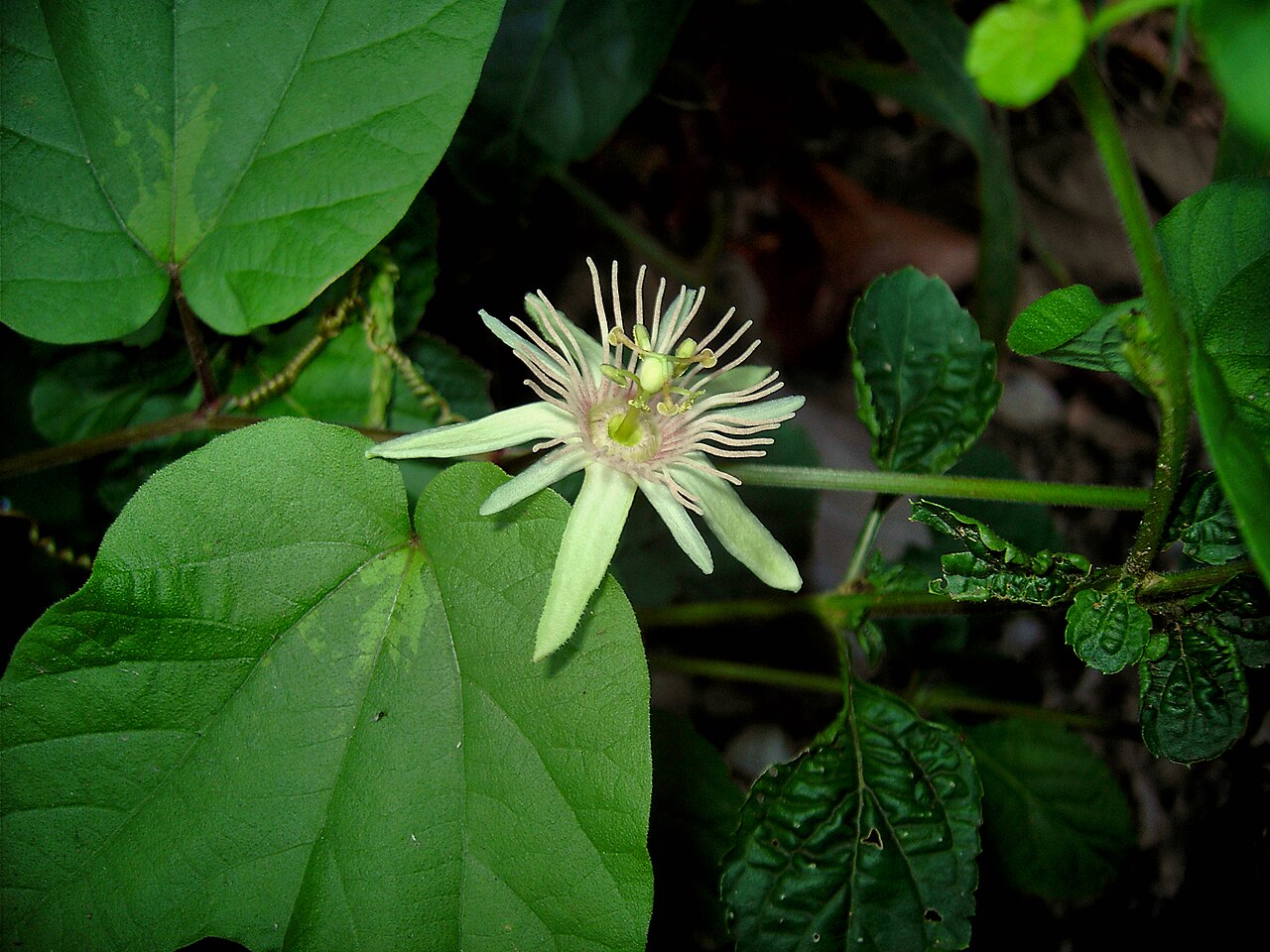
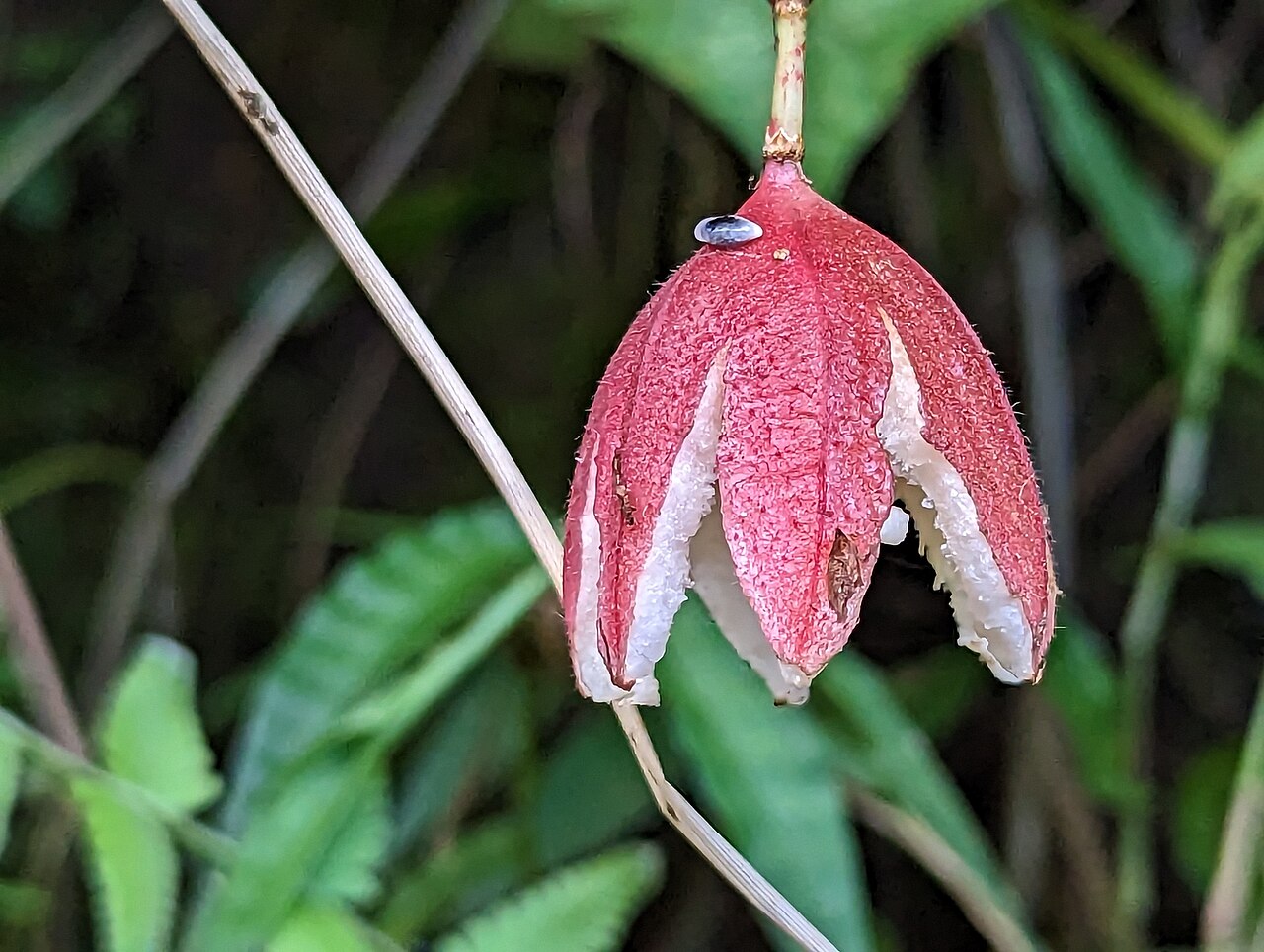
Passiflora rubra, the Red Passionflower, is a native vine of Puerto Rico’s moist forests and thickets. In Puerto Rico it is called flor de pasión or parcha colorada (red passion fruit), and USDA PLANTS lists it under the old English name dutchman’s laudanum. It is a softly hairy, slightly woody climber with broad two-lobed leaves and coiling tendrils. Its flowers are small for a passionflower, pale greenish white with a fringe of pink-banded filaments, and they are followed by rose-red, hairy fruits that split open to show seeds wrapped in white pulp.
The species belongs to the passionflower family (Passifloraceae). The name rubra, meaning red, refers to the fruit rather than the flowers. In Puerto Rico it climbs through forest edges and second-growth thickets from the northern lowlands and haystack karst hills through the Luquillo Mountains and the Cordillera Central to the Maricao and Susúa forests, and it flowers and fruits in every month of the year.
Like other passionflowers, it is a host plant for the caterpillars of longwing butterflies, and it is easy to grow on a fence or trellis. It is not grown for its fruit, which is not a culinary passion fruit. This guide covers how to recognize it, where it grows in Puerto Rico, how to grow it in a butterfly garden, and why it should be planted only within its native range.
Identification
Red passionflower is easiest to recognize by its combination of softly hairy, two-lobed leaves and red, hairy fruits. Puerto Rico has several native passionflowers, and some of them also have lobed leaves, so check the flowers and fruit when you can.
Stems & Tendrils
The vine climbs by unbranched tendrils that grow from the leaf axils and coil around twigs and wire. The stems are slender, angled to rounded, and covered with dense grayish hairs. Older stems become slightly woody at the base. Vines typically reach 10 to 20 feet, scrambling over shrubs or climbing into small trees.
Leaves
The leaves are alternate and softly hairy, roughly 1 to 4 inches long and up to about 4 inches wide. Most are two-lobed: the blade is broader than long, with two widely spreading lobes and sometimes a small point between them, so a leaf can look like a wide, shallow heart or a bat’s wings. The leaf stalks have no glands, which helps separate it from some other passionflowers.
Flowers
The flowers grow singly or in pairs from the leaf axils on slender stalks. They are about 1½ to 2 inches across, with five narrow, greenish-white sepals and five pale petals. Inside is the passionflower’s typical corona, a ring of thread-like filaments, here whitish and banded with pink or purple toward the base. A central stalk carries the stamens and the ovary, which is densely covered in white hairs. In Puerto Rico flowers can appear at any time of year.
Fruit & Seeds
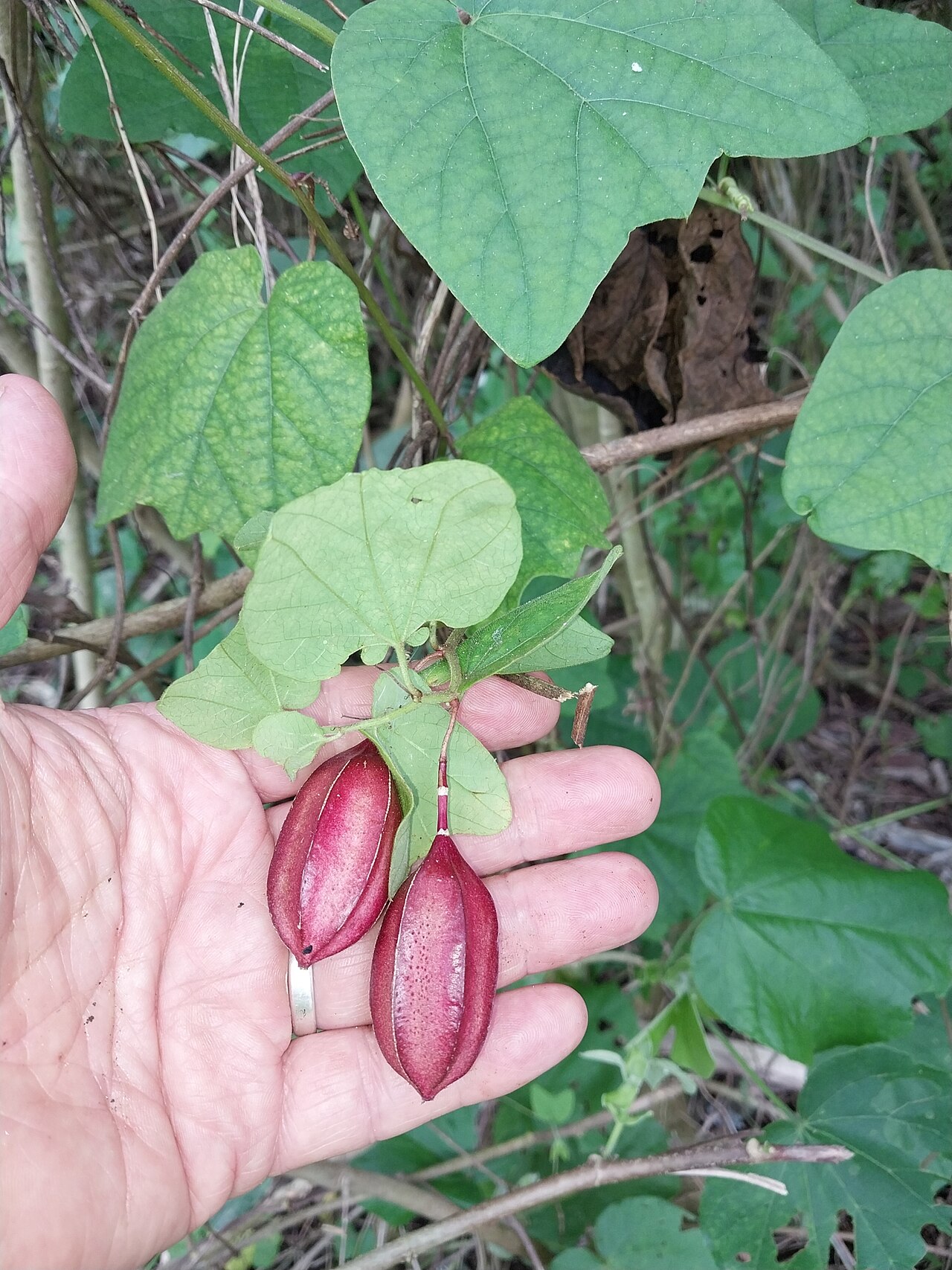
The fruit is a hairy, ribbed capsule about 1 to 2 inches long, obovoid (broadest toward the tip) and rose-red to purplish when ripe. It splits open while still hanging on the vine, exposing many small dark seeds, each enclosed in a white, juicy aril. A close relative, Passiflora capsularis, looks almost identical when not in flower or fruit, but its fruit tapers at both ends and its ovary is less hairy.
Quick Facts
| Scientific Name | Passiflora rubra L. |
| Family | Passifloraceae (passionflower family) |
| Plant Type | Perennial climbing vine with tendrils; slightly woody at the base |
| Mature Height | Climbs 10–20 ft |
| Mature Spread | 6–15 ft, depending on support |
| Growth Rate | Fast |
| Sun Exposure | Full sun to partial shade |
| Water Needs | Medium; regular moisture, moderate drought tolerance once established |
| Soil Type | Well-drained loam, clay or limestone-derived soils |
| Soil pH | Slightly acidic to alkaline (about 6.0–8.0) |
| Bloom Time | Year-round in Puerto Rico |
| Flower Color | Greenish white with a pink- or purple-banded corona |
| Fall Color | None; evergreen |
| Fruit | Hairy, ribbed red capsule that splits open; seeds with white arils |
| Deer Resistant | Not applicable in Puerto Rico; foliage contains defensive compounds |
| USDA Hardiness Zones | 10–11 (frost-tender) |
Native Range
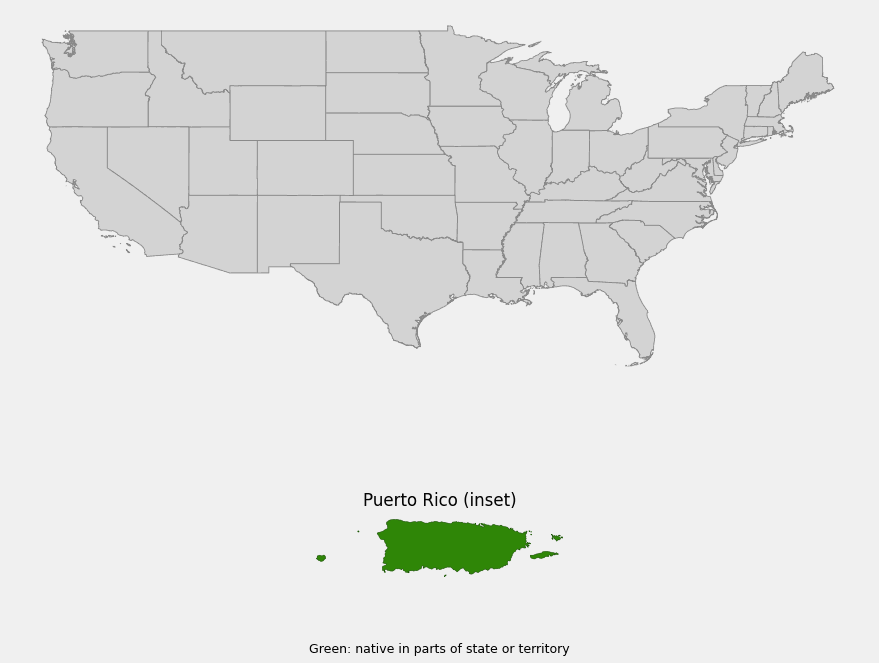
USDA PLANTS lists red passionflower as native to Puerto Rico and the U.S. Virgin Islands; it is not native anywhere in the continental United States. Beyond U.S. territory it occurs throughout the West Indies, from Cuba, Jamaica and Hispaniola through the Lesser Antilles to Trinidad, and in northern and western South America (Colombia and Venezuela south to Peru, Bolivia and eastern Brazil). Axelrod also lists Mexico.
In Puerto Rico it is a common vine of woodlands and thickets in moist and wet districts. Axelrod’s Systematic Vademecum to the Vascular Plants of Puerto Rico records it from the northern coastal lowlands (Trujillo Alto, Guaynabo), the northern limestone hills and Río Abajo Forest Reserve, the Sierra de Luquillo, the Caguas Valley, the Sierra de Cayey and the Central Cordillera, and south and west to Yauco, Susúa and Maricao, from about 150 to 2,500 feet (50–750 m). Older accounts also record it on Vieques.
Outside its native range the vine has become invasive in parts of the Pacific. On Rarotonga in the Cook Islands it smothers vegetation, and a longwing butterfly was introduced there in 2016 to help control it. That is a good reason to plant it only where it is native.
📋 Regional plant lists featuring Red Passionflower: Puerto Rico
Growing & Care Guide
Red passionflower is an easy, fast-growing vine for gardens in Puerto Rico and the U.S. Virgin Islands, especially butterfly gardens. Plant it only within its native range: it can become weedy where it is not native, and it is not suited to frost-prone areas.
Light
It flowers and fruits best in full sun to light shade, such as a sunny fence line or the edge of a tree canopy. In deeper shade it climbs toward the light and flowers less.
Soil & Water
It adapts to most well-drained soils, from loam and clay to the limestone soils of the north coast. Water regularly until established; afterward it tolerates short dry spells, though it grows and flowers most in moist conditions. Rich soil and heavy fertilizer produce lush leaves at the expense of flowers.
Planting Tips
Give it something to climb: a chain-link fence, trellis, arbor, or a sturdy shrub. Space plants about 6 to 10 feet apart along a fence. It is a good choice for screening a fence quickly, and for butterfly gardens plant it near nectar plants so adult butterflies can find it.
Pruning & Maintenance
Cut back overgrown stems at any time to keep the vine within bounds; it regrows quickly. Expect caterpillars to eat leaves in a butterfly garden, which is the point of planting it, and the vine recovers. Pull unwanted seedlings, which can appear where birds drop seeds.
Propagation
Grow it from seed or cuttings. Clean the seeds of their pulp, soak them overnight and sow them shallowly in moist, well-drained mix; germination can be slow and irregular. Semi-woody cuttings 4 to 6 inches long root readily in moist, well-drained mix in light shade.
Landscape Uses
- Butterfly gardens: a larval host for longwing butterflies in Puerto Rico
- Fences and trellises: a fast, light screen for chain-link fences and arbors
- Forest-edge restoration: in moist native plantings and second-growth thickets within its native range
- Wildlife gardens: fruits with juicy seed arils for birds
- Native vine collections: with other Puerto Rican passionflowers such as corkystem passionflower
Wildlife & Ecological Value
Red passionflower is a modest-looking vine, but like other passionflowers it feeds a specialized group of butterflies and gives birds a supply of fruit.
For Pollinators
Bees and other insects visit the flowers for nectar and pollen. In the Caribbean, passionflowers are the main larval host plants of the longwing butterflies, including the gulf fritillary, julia and zebra longwing, all of which occur in Puerto Rico. Their caterpillars eat the leaves, and the adults visit flowers for nectar.
For Birds
The juicy white arils around the seeds are eaten by birds, which disperse the seeds. This is how the vine reaches forest gaps, roadsides and hedges.
For Mammals
The vine is of limited importance to mammals. Like many passionflowers, its leaves contain defensive chemical compounds that discourage most browsers; the longwing caterpillars are specialists that tolerate them.
Ecosystem Role
Red passionflower is a quick colonizer of disturbed, sunny ground, forest edges and treefall gaps, where it scrambles over young trees and shrubs. Its leaves support caterpillars that feed birds and other predators, and its fruits move seed around the landscape. In Puerto Rico’s second-growth forests it is one of many native vines that knit together the forest edge.
Cultural & Historical Uses
Linnaeus named Passiflora rubra in 1753 in Species Plantarum. The name “dutchman’s laudanum” goes back to colonial times in the West Indies, when the plant was reputed to be a narcotic or sedative; laudanum was an opium tincture. These uses are poorly documented, and the plant should not be used as a medicine.
The Spanish name flor de pasión (passion flower) comes from Spanish missionaries in the Americas, who saw symbols of the Passion of Christ in passionflowers: the corona as the crown of thorns, the five stamens as the wounds, and the three styles as the nails. In Puerto Rico, the edible passion fruit is called parcha, and the name parcha colorada for this species refers to its red fruit.
Today red passionflower is mostly grown by butterfly gardeners and native plant enthusiasts in the Caribbean. Its invasion of Rarotonga is a reminder that a well-behaved native vine in one place can become a weed in another, which is the case for planting local natives.
Frequently Asked Questions
Is the fruit of red passionflower edible?
It is not grown as a food plant. The fruit is small, with only a little pulp around the seeds, and the plant has a history as a supposed narcotic. Grow it for butterflies and birds, not for fruit. For edible passion fruit (parcha), gardeners grow Passiflora edulis, which is not native to Puerto Rico.
Why is it called red passionflower when the flowers are white?
The name rubra (red) refers to the rose-red fruit. The flowers are pale greenish white with a fringe of pink- or purple-banded filaments.
Which butterflies use red passionflower?
Passionflowers are the larval host plants of the longwing butterflies. In Puerto Rico those include the gulf fritillary, julia and zebra longwing. Expect caterpillars to eat some of the leaves.
Can I grow it in Florida or elsewhere in the U.S.?
It is not native to the mainland United States and is frost-tender. Florida gardeners can choose native passionflowers instead, such as corkystem passionflower or purple passionflower.
Is red passionflower invasive?
Not in Puerto Rico, where it is native. It has become invasive in parts of the Pacific, including the Cook Islands, so it should not be planted outside its native range.

Looking for a nursery that carries Red Passionflower?
Our nursery directory does not yet include Puerto Rico. Browse the native plant nursery directory by state: Alabama–Arkansas · California · Colorado–Hawaii · Idaho–Kansas · Kentucky–Montana · Nebraska–Oklahoma · Oregon · Pennsylvania–Virginia · Washington · West Virginia–Wyoming