
Tabonuco (Dacryodes excelsa)
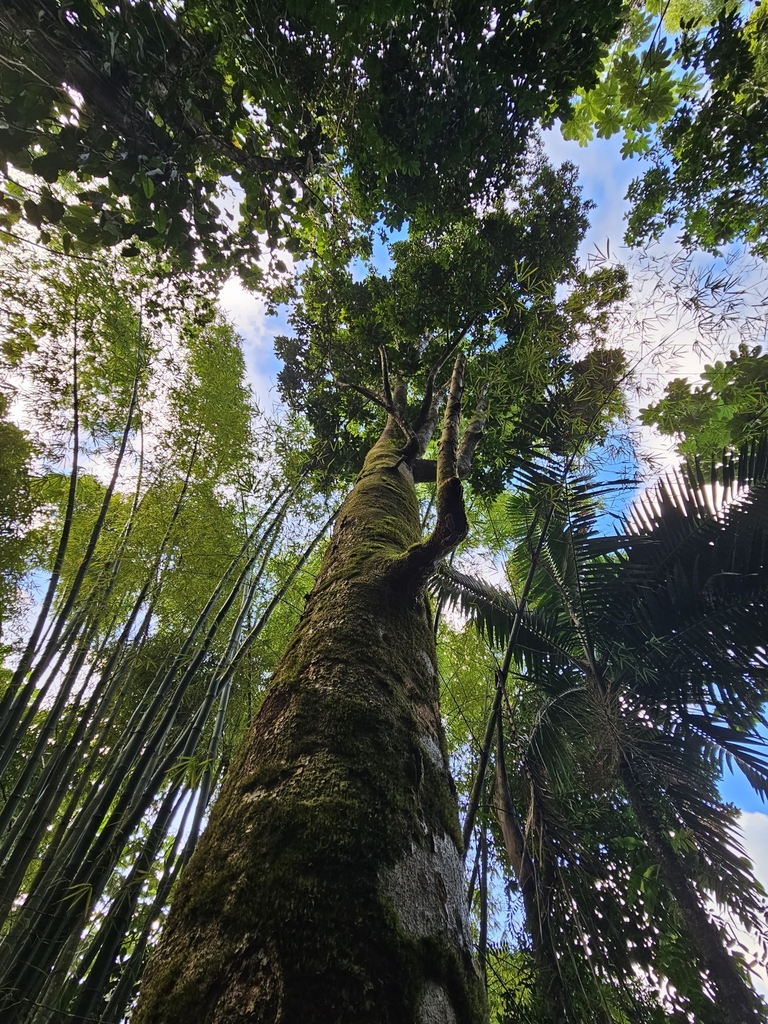
Dacryodes excelsa, known in Puerto Rico as Tabonuco, is the giant of the island’s lower mountain rain forests and the tree that gives the tabonuco forest its name. USDA PLANTS calls it candletree, and in the Lesser Antilles it is known as gommier; it has also been called candlewood. Both English names come from its clear, fragrant, flammable resin, which country people in Puerto Rico once burned in candles and torches.
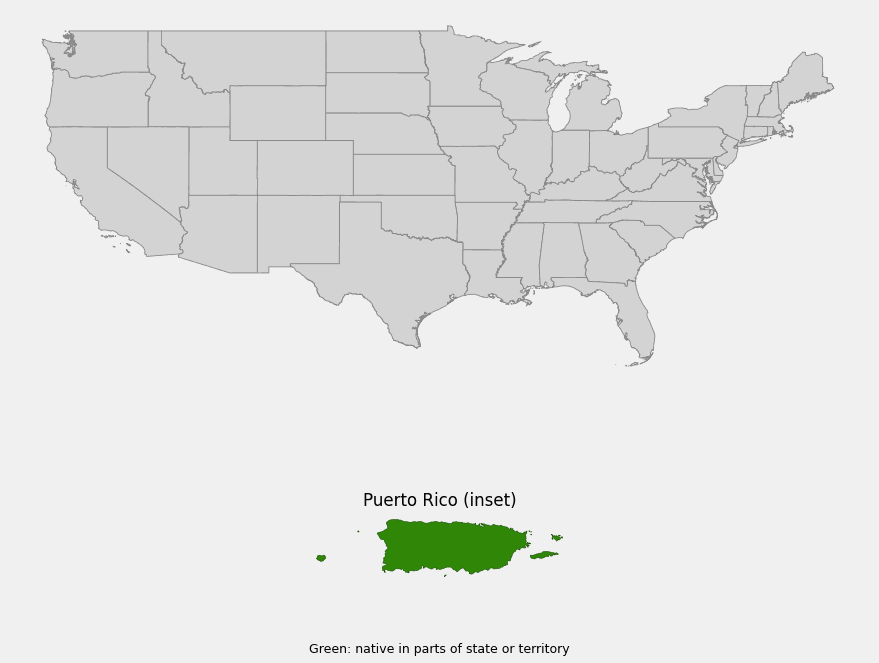
Tabonuco is the dominant large tree of the native forests that once covered the lower and middle mountain slopes of northern Puerto Rico. In the Luquillo Mountains of El Yunque National Forest it can make up about a third of the forest’s basal area and most of its timber volume, and large trees may be up to 400 years old, according to USDA Forest Service researchers. USDA PLANTS lists it as native in Puerto Rico, and its range continues through the Lesser Antilles to Grenada.
This guide covers how to recognize tabonuco, the forest type it defines, how it survives hurricanes, why it is a challenging but rewarding tree to plant, and its importance to the endangered Puerto Rican parrot, which feeds on its seeds.
Identification
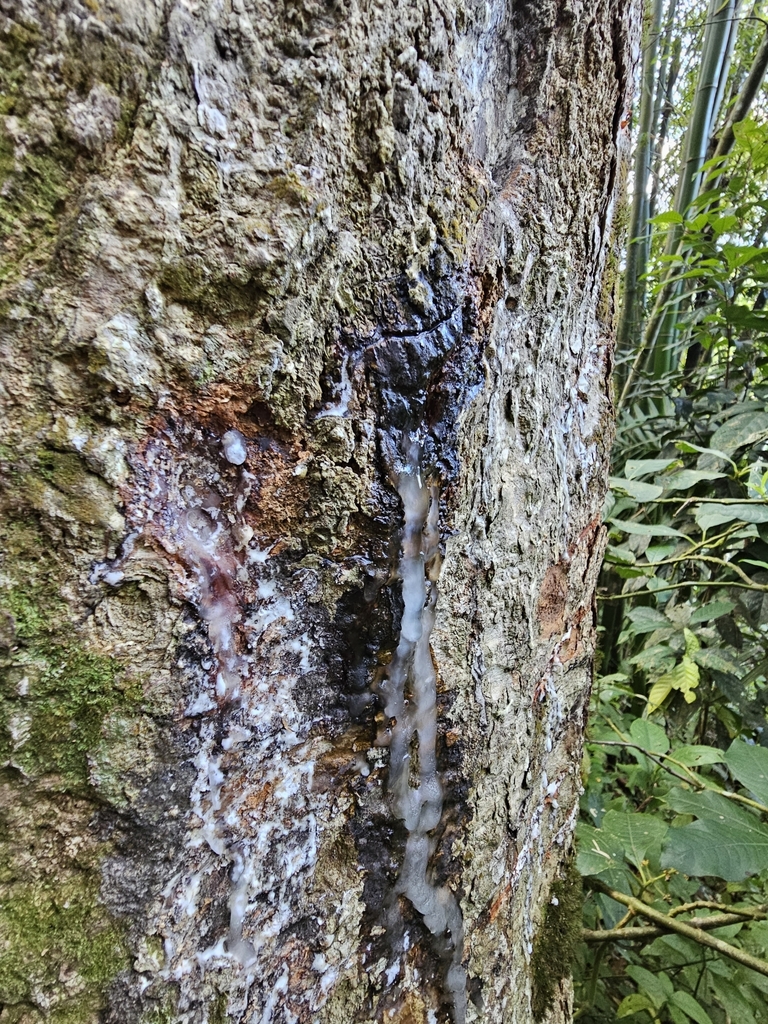
In the forest, tabonuco is recognized by its broad, low buttresses, tall columnar trunk, smooth gray bark and spreading crown. Its compound leaves and its resin are the surest field marks: any wound in the bark quickly bleeds clear, fragrant resin that hardens into white crusts.
Form & Bark
Mature trees reach about 115 feet (35 m) tall with trunks up to about 6 feet (180 cm) in diameter. The trunk is straight and columnar above wide, low buttresses, and the crown is broad and spreading. The bark is smooth and gray, often patched with moss and lichens in the humid forest.
Leaves
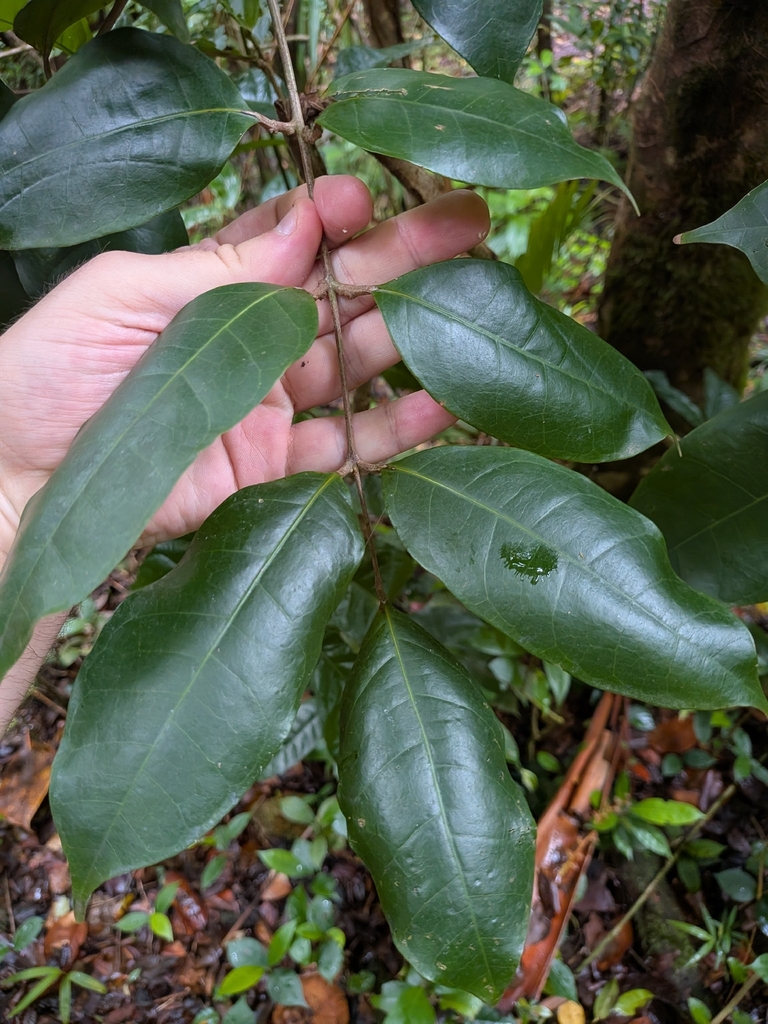
The leaves are alternate and pinnately compound, with five to seven fragrant, dark green leaflets. Each leaflet is lance-shaped to elliptic, glossy above, with a pointed tip and smooth edges. Crushed leaves and twigs release the same resinous scent as the bark.
Flowers
Tabonuco is dioecious: male and female flowers grow on separate trees. The flowers are small, greenish and about 3/16 inch (4 mm) wide, in much-branched clusters along the twigs. Flowering peaks between May and November, with some bloom at other times of year.
Fruit & Seeds
The fruit is an oblong to egg-shaped, one-seeded drupe, similar in form to a small olive, that falls from about October to December. Fallen fruits often carpet the ground beneath the mother tree. Dark-colored fruits are heavier and much more likely to be viable than green ones, and many fruits are empty: in one autumn study, two-thirds of the crop had no seed.
Quick Facts
| Scientific Name | Dacryodes excelsa Vahl |
| Family | Burseraceae (torchwood or gumbo-limbo family) |
| Plant Type | Large evergreen canopy tree |
| Mature Height | 80–115 ft |
| Mature Spread | Broad, spreading crown |
| Growth Rate | Slow |
| Sun Exposure | Partial shade when young; sun on the crown when mature |
| Water Needs | High; very wet climates (about 80–160 in of rain a year) |
| Soil Type | Deep, well-drained, often stony red clays from volcanic rock |
| Soil pH | Acidic (about 4.5–5.5) |
| Bloom Time | Mainly May–November |
| Flower Color | Greenish |
| Fall Color | None; evergreen |
| Fruit | Oblong, olive-like drupe with one seed, falling October–December |
| Deer Resistant | Not rated (no deer in Puerto Rico) |
| USDA Hardiness Zones | Frost-free, humid tropics only (about zone 11–12) |
Native Range
Tabonuco grows naturally from Puerto Rico through the Lesser Antilles, including St. Kitts, Montserrat, Guadeloupe, Dominica, Martinique, St. Lucia, St. Vincent and Grenada. USDA PLANTS lists it as native in Puerto Rico. Other species of Dacryodes grow in South America and Africa, but this species is found only in the Caribbean.
In Puerto Rico, tabonuco grows at elevations of about 650 to 3,000 feet (200–900 m) in the island’s wet mountain forests, where average temperatures are 70 to 77°F (21–25°C) and yearly rainfall is roughly 80 to 160 inches (2,000–4,000 mm). The best-known stands are in the Luquillo Mountains (El Yunque). At the El Verde research station there, about 1,380 feet (420 m) up the northwest slope, rainfall averages about 146 inches (3,700 mm) a year and relative humidity about 91 percent.
The tree grows on deep, red, acid clay soils formed from volcanic rock, typically stony and well drained. Large tabonucos cluster on upper slopes and ridges, where they may form nearly pure groves. Foresters believe the trees favor ridges for their better drainage and for the anchorage the boulders give against hurricane winds.
📋 Regional plant lists featuring Tabonuco: Puerto Rico
Growing & Care Guide
Tabonuco is a long-lived forest giant best suited to large properties, reforestation projects and parks in Puerto Rico’s wet uplands. It grows slowly and needs a humid, sheltered start, but it repays patience with centuries of shade and a tree that is central to the island’s natural heritage.
Light
Seedlings are very shade-tolerant and do best in low light; in nursery trials, young seedlings did not tolerate direct sun during their first month. Older trees need sun on the crown to grow well. However, Forest Service researchers found that mature trees suddenly left exposed after logging often suffered sunscald on bark that had always been shaded, and their crowns declined. Plant tabonuco among other trees or in partial shade rather than alone in an open lawn.
Soil & Water
Give it deep, well-drained, acid soil and abundant moisture. In the wild it grows where rainfall is high almost year-round, with a short drier season from February to April. It is not suited to dry coastal areas, limestone soils or poorly drained low spots.
Planting Tips
Use container-grown trees with an intact root ball. Like many large-seeded trees, tabonuco does not survive bare-root transplanting, while container stock reached about 85 percent survival in Forest Service trials. Direct seeding in the forest germinated well but rarely established, so planting is recommended over sowing. Keep vines and competing growth away until the young tree is about 10 to 13 feet (3–4 m) tall.
Pruning & Maintenance
Little pruning is needed beyond removing damaged branches after storms. Growth is slow: in one Forest Service planting, nine-year-old trees were 10 to 14 feet (3.0–4.3 m) tall. Trees released from competition grow several times faster than suppressed ones.
Propagation
Grow from fresh seed. Collect dark, heavy fruits from beneath female trees in the fall; fully developed fruits usually sink in water, while most floaters are empty. The seed is short-lived and should be sown promptly in moist shade, where it germinates within a few days. Shade gave about 28 percent germination in one trial versus 11 percent in full sun. There is no known vegetative propagation.
Landscape Uses
- Forest restoration: the keystone canopy tree of Puerto Rico’s lower montane wet forests
- Large parks and estates: a long-lived shade tree in wet upland areas
- Wildlife plantings: seeds feed the endangered Puerto Rican parrot
- Woodworking (traditional): a mahogany substitute for furniture and cabinetry
- Resin (traditional): candles, torches, incense and boat caulking
Wildlife & Ecological Value
Tabonuco is the foundation species of the tabonuco forest, a forest type studied for decades in the Luquillo Experimental Forest.
For Pollinators
The small greenish flowers are produced over a long season, mostly from May to November. Because the tree is dioecious, insects must carry pollen from male trees to female trees for fruit to set.
For Birds
The endangered Puerto Rican parrot (cotorra puertorriqueña) feeds on tabonuco seeds, according to the USDA Forest Service, and the species is part of the parrot’s native forest home in the Luquillo Mountains.
For Mammals
Forest Service researchers note that parrots, other vertebrates and invertebrates remove fertile seeds, though how much this affects regeneration is not known. Puerto Rico’s native mammals are mostly bats.
Ecosystem Role
On favorable sites tabonuco can make up 35 percent of the basal area and 80 percent of the timber volume of the forest. Neighboring trees commonly fuse through root grafts, forming living unions of 10 to 20 trees, and stumps connected this way can stay alive for decades. This interconnected root system, together with deep roots anchored among boulders on ridges, helps tabonuco survive hurricanes that snap off the crowns of other trees; storms more often break its crown than uproot it.
Cultural & Historical Uses
Tabonuco resin has a long history in the Caribbean. In Puerto Rico, country people used it to make candles and torches, to caulk boats, as incense and as a medicine, according to the USDA Forest Service. The same uses lie behind the English names candletree and candlewood, and the Antillean name gommier refers to the gum.
The wood is moderately heavy (specific gravity about 0.53), dries easily and stays in place well. It has been used for furniture, cabinetwork, interior trim, general construction, crates, shingles and small boats, and compares favorably with mahogany. Its high silica content dulls saw teeth, and it is not durable in contact with soil. Sawmill workers recognized two kinds of tabonuco based on how red the wood was.
The botanist Martin Vahl named the species Dacryodes excelsa. The species name excelsa means “lofty”, a fitting name for one of the tallest trees in Puerto Rico. Today the tabonuco forest of El Yunque is a centerpiece of long-term ecological research on how tropical forests recover from hurricanes.
Frequently Asked Questions
Is tabonuco native to Puerto Rico?
Yes. USDA PLANTS lists Dacryodes excelsa as native in Puerto Rico, where it is the dominant large tree of the lower mountain rain forests, especially in the Luquillo Mountains. It also grows in the Lesser Antilles.
What is tabonuco forest?
Tabonuco forest is the forest type of Puerto Rico’s wet lower mountain slopes, including the lower slopes of the Luquillo Mountains, named for its dominant tree. It is a rich mix of trees, averaging about 50 tree species per hectare, with tabonuco, motillo and sierra palm among the most common.
Why is it called candletree?
Its clear, fragrant resin is flammable and was once used to make candles and torches. The resin oozes from any wound in the bark and hardens into white crusts.
Can I grow tabonuco in my yard?
Only in a wet, humid, frost-free climate and with plenty of space. It grows slowly, needs shade when young and deep acid soil, and becomes a very large tree. It is best used in reforestation and large properties in Puerto Rico’s wet uplands.
Is tabonuco related to gumbo limbo?
Yes. Both belong to the Burseraceae, a family of resin-producing trees. Gumbo limbo (almácigo, Bursera simaruba) is a fast-growing, drought-tolerant native that suits drier and coastal areas where tabonuco would not thrive. For a fast-growing native timber tree that also grows in disturbed tabonuco forest, see capá prieto.

Looking for a nursery that carries Tabonuco?
Our nursery directory does not yet include Puerto Rico. Browse the native plant nursery directory by state: Alabama–Arkansas · California · Colorado–Hawaii · Idaho–Kansas · Kentucky–Montana · Nebraska–Oklahoma · Oregon · Pennsylvania–Virginia · Washington · West Virginia–Wyoming