
Barbasco (Jacquinia arborea)
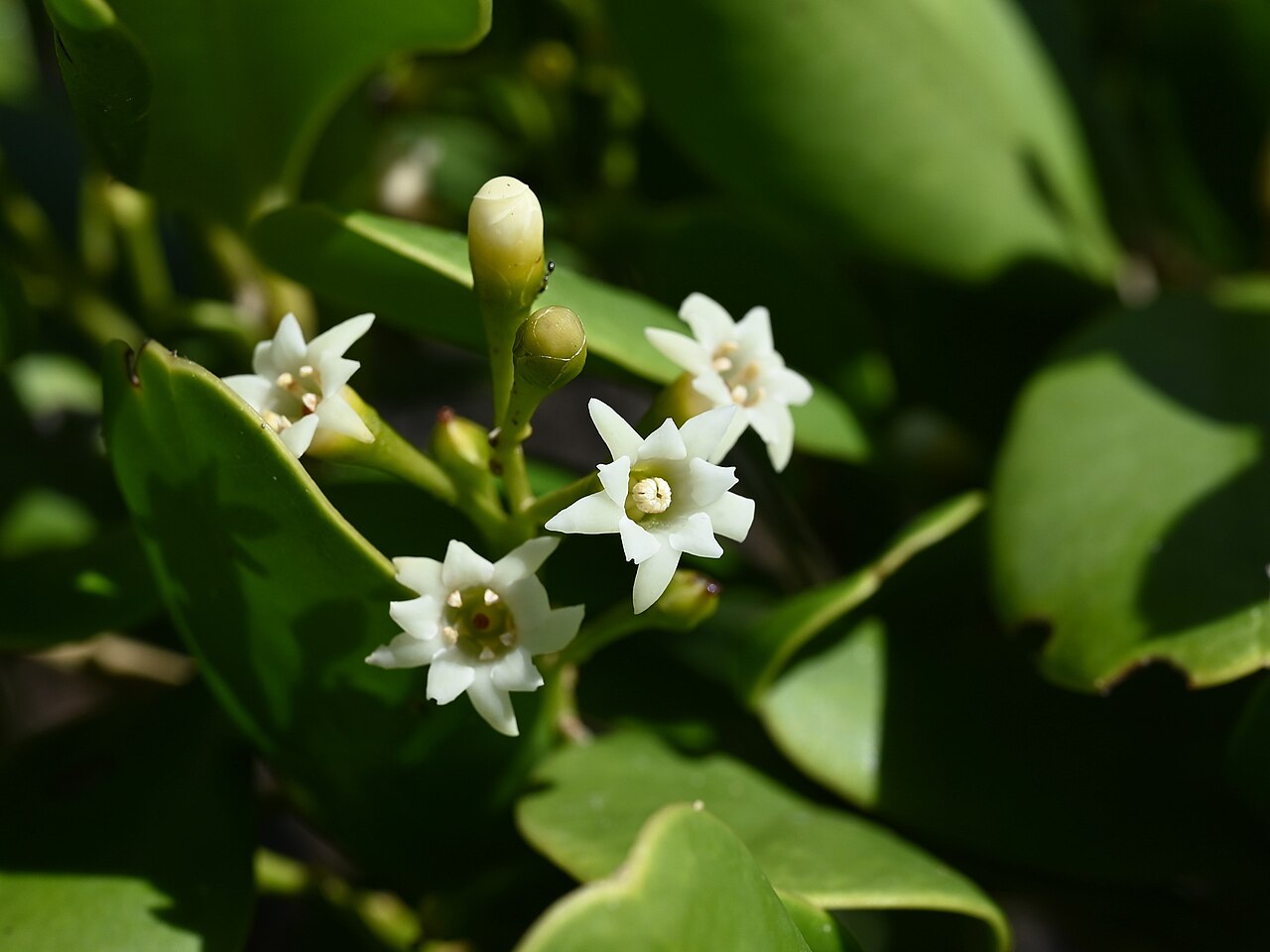
Jacquinia arborea, called barbasco or azúcares in Puerto Rico and braceletwood in English, is a tough evergreen shrub or small tree of Caribbean coasts and dry forest. It has stiff, leathery, blunt-tipped leaves crowded toward the branch ends, clusters of small white flowers that age to yellow, and hard round fruits that ripen orange to red. USDA PLANTS treats it under the name Jacquinia armillaris (common name braceletwood).
The Puerto Rican name barbasco is a general Caribbean and Latin American word for plants used to stun fish, and it points to the plant’s chemistry: the fruits and seeds contain saponins and are poisonous. The English name braceletwood comes from the old practice of stringing the hard seeds into bracelets.
For gardeners in Puerto Rico it is one of the most dependable native shrubs for hot, dry, salty and rocky sites, from the southern coast to the offshore islands. It grows slowly, never needs watering once established, and offers fragrant flowers and bright fruit in a compact, wind-proof form.
Identification
Barbasco is easiest to recognize by its foliage: thick, stiff, almost plastic-feeling leaves that are widest near the rounded or slightly notched tip and are packed in near-whorls at the ends of the twigs. In Florida the closely related joewood (Jacquinia keyensis) is the native species; it has smaller, more yellow-green leaves and creamy, strongly fragrant flowers.
Form
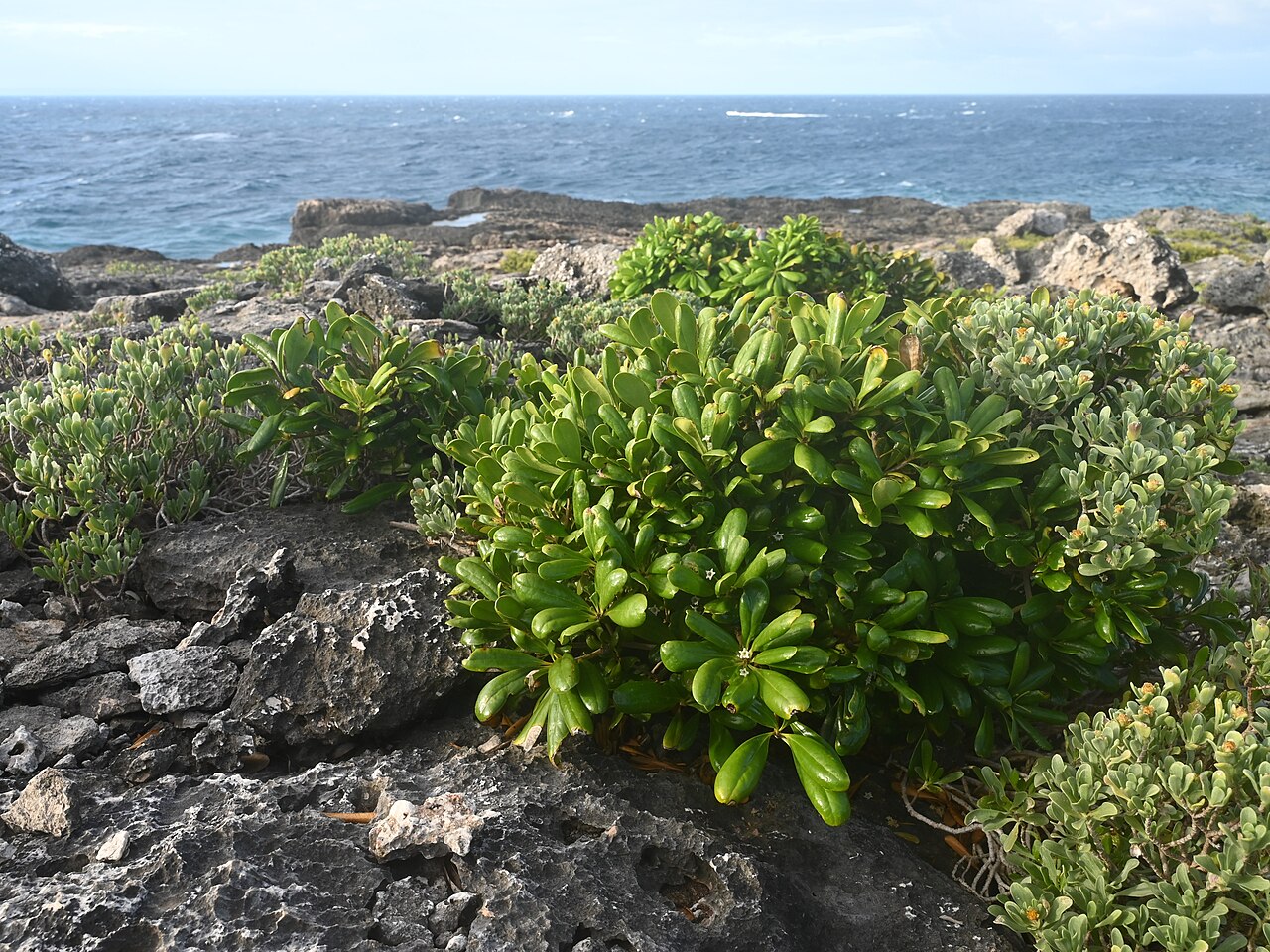
Usually a dense, rounded shrub 6 to 15 feet tall, occasionally a small tree to about 20 feet with a short trunk and gray bark. On exposed rocky coasts it stays low and compact, sheared by wind and salt; in sheltered dry forest it grows more upright and tree-like.
Leaves
Leaves are simple, evergreen and leathery, roughly 1½ to 4 inches long, obovate to spoon-shaped with a rounded, blunt or slightly notched tip that may carry a tiny point. They are dark, glossy green above and paler below, with a thickened margin, and are crowded in near-whorls toward the ends of the branches.
Flowers
Flowers are borne in short clusters at the branch tips. Each is small, under ½ inch across, waxy white, with five rounded corolla lobes and five petal-like staminodes forming an inner ring. The flowers are fragrant and darken to yellow as they age. In Florida and the Caribbean the main flowering season is winter to spring.
Fruit
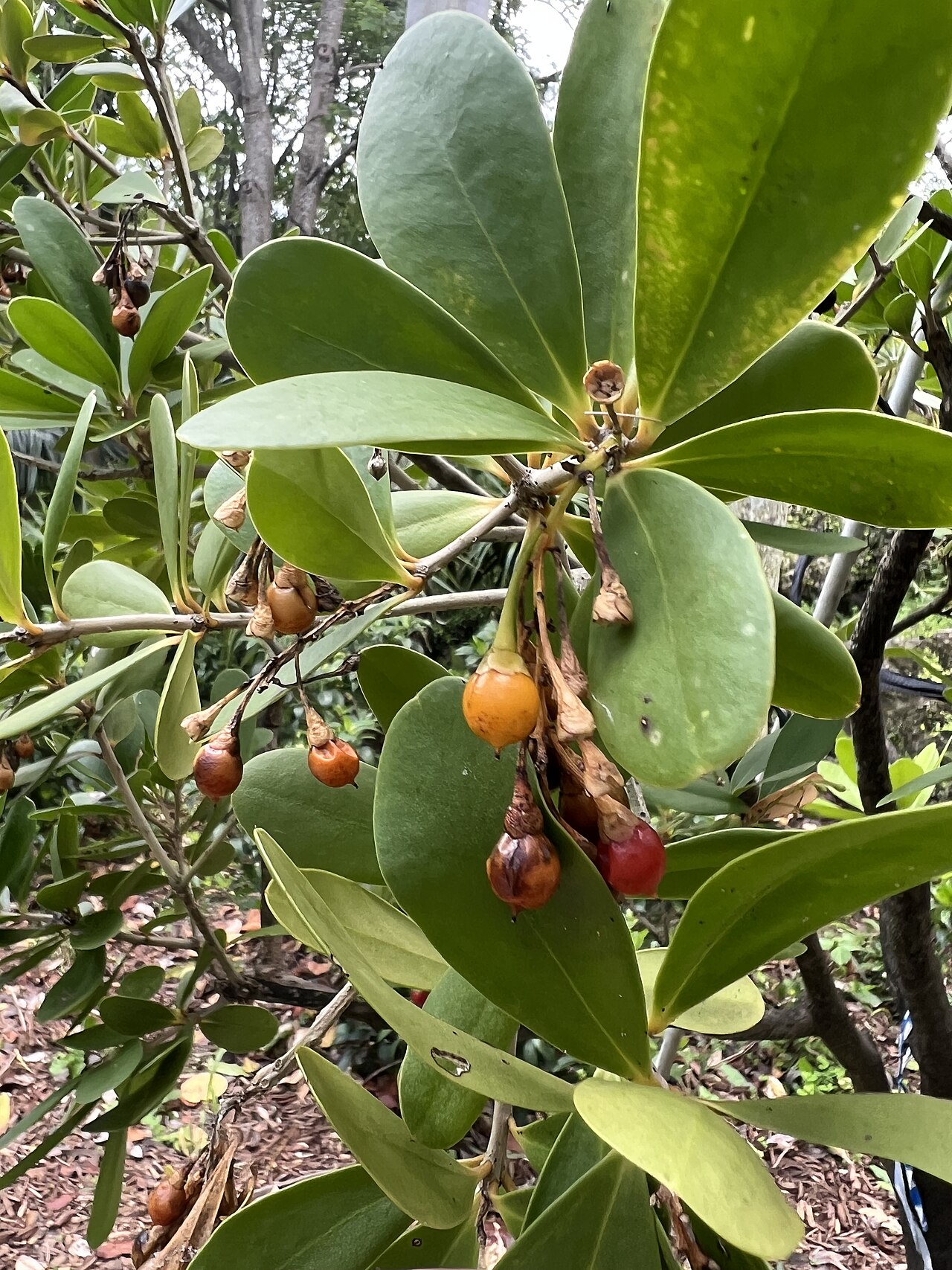
The fruit is a round berry about ½ to ¾ inch across with a hard, smooth skin, ripening from green to orange and then red. Inside are a few seeds embedded in pulp. The fruits are poisonous and should not be eaten.
Quick Facts
| Scientific Name | Jacquinia arborea Vahl; USDA PLANTS name: Jacquinia armillaris Jacq. |
| Family | Primulaceae (primrose family); formerly Theophrastaceae |
| Plant Type | Evergreen shrub or small tree |
| Mature Height | 6–15 ft, occasionally to about 20 ft |
| Mature Spread | 5–10 ft |
| Growth Rate | Slow |
| Sun Exposure | Full sun to part shade |
| Water Needs | Low; very drought tolerant once established |
| Soil Type | Well-drained limestone, sand and rocky soil |
| Soil pH | Neutral to alkaline |
| Bloom Time | Mainly winter to spring; scattered flowers at other times |
| Flower Color | White, aging to yellow |
| Fall Color | None; evergreen |
| Fruit | Hard round berry, orange to red; poisonous |
| Deer Resistant | Not applicable in Puerto Rico; no native deer on the island |
| USDA Hardiness Zones | 10–12; frost-sensitive |
Native Range
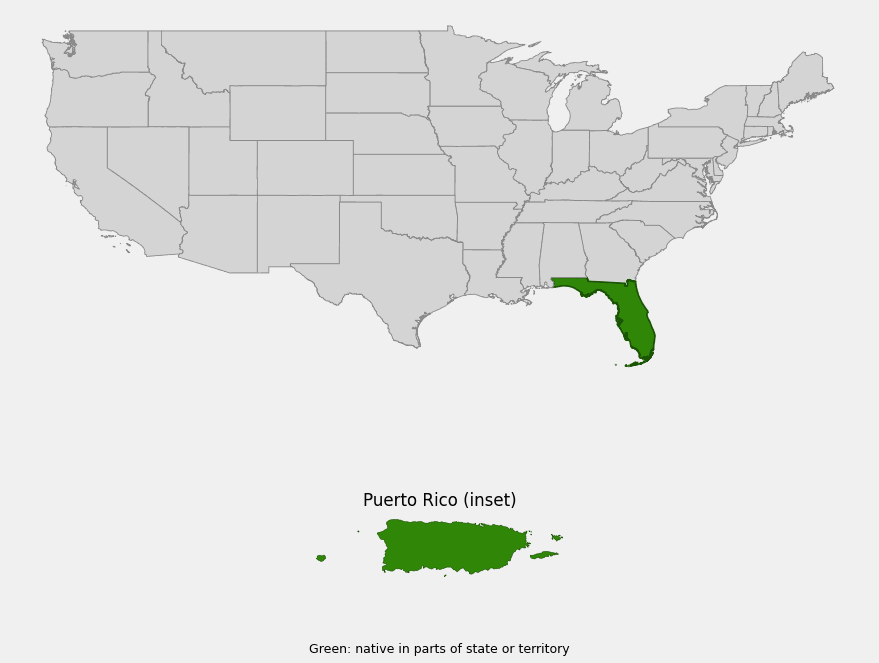
Barbasco is native to the West Indies and the Caribbean margins of the mainland. USDA PLANTS lists it as native in Puerto Rico, the U.S. Virgin Islands and Florida. The Smithsonian Flora of the West Indies records it in Puerto Rico, including Mona, Vieques, Culebra and smaller cays, and across the Greater and Lesser Antilles, and it also reaches Mexico, Central America and northern South America.
Where the sources disagree. The Atlas of Florida Plants treats the few Florida records of Jacquinia arborea as not native, while USDA PLANTS lists the species as native there. PlantNative therefore does not include it in its Florida regional lists. Florida gardeners who want a native Jacquinia should plant joewood (Jacquinia keyensis) instead. The map above shades Florida because USDA PLANTS is the mapping source.
In Puerto Rico barbasco belongs to the dry coastal belt: limestone shores, coastal thickets and the dry forests of the south and southwest such as Guánica, plus the offshore islands of Mona, Vieques and Culebra. It grows on rocky, salt-sprayed ground near the sea and on dry limestone hills, usually in full sun or the broken shade of low scrub forest.
📋 Regional plant lists featuring Barbasco: Puerto Rico
Growing & Care Guide
Barbasco is built for exactly the conditions that kill most garden shrubs: drought, salt spray, wind, thin soil over rock and relentless sun. It asks for good drainage and patience, since it grows slowly.
Light
Full sun gives the densest habit and the most flowers and fruit. It tolerates part shade, as under the open canopy of dry forest, but grows looser and blooms less in deep shade.
Soil & Water
Plant in fast-draining soil: limestone rubble, sand, or rocky fill are all fine, and alkaline soils suit it. Avoid heavy, poorly drained ground. Water regularly through the first dry season while roots establish; afterwards it needs no irrigation in coastal Puerto Rico and is very drought and salt tolerant.
Planting Tips
Use it on the windward, salt-exposed side of a coastal garden, as a low screen, or as a specimen shrub in a dry native planting. Space plants 4 to 6 feet apart for a hedge. Because the fruit is poisonous, avoid placing it where small children play unsupervised.
Pruning & Maintenance
Little is needed. It naturally forms a dense, rounded shape; light trimming after flowering keeps hedges tidy. It is long-lived and rarely troubled by pests or disease in dry, sunny sites.
Propagation
Grow from fresh seed cleaned of pulp (wear gloves). Germination is slow and erratic, and seedlings grow slowly at first. Buy nursery-grown plants where possible.
Landscape Uses
- Coastal gardens: one of the best natives for salt spray, wind and rocky shore conditions
- Dry native plantings: a slow, tidy evergreen for southern Puerto Rico and the offshore islands
- Informal hedges and screens: dense, stiff foliage that holds its shape with little trimming
- Pollinator plantings: fragrant winter–spring flowers for bees and other insects
Wildlife & Ecological Value
Barbasco is a structural plant in dry coastal scrub: an evergreen, wind-proof shrub that gives shelter where little else grows tall.
For Pollinators
The small, fragrant white flowers open in the dry season, when nectar sources on the coast are scarce, and are visited by bees and other small insects.
For Birds
Dense, stiff evergreen foliage gives cover and nesting sites to small birds in otherwise open coastal scrub. The fruits are toxic to people; their use by native birds is not well documented, so don’t plant it as a bird food plant.
For Mammals
Puerto Rico’s only native land mammals are bats, and barbasco is not a known bat plant. The poisonous fruit and leaves are generally avoided by livestock.
Ecosystem Role
On exposed limestone shores barbasco is one of the woody plants that knits coastal scrub together, holding soil and organic matter among the rocks and sheltering smaller plants and animals from wind and salt.
Cultural & Historical Uses
The name barbasco is used across the Caribbean and Latin America for plants that stun fish, and Jacquinia fruits and crushed leaves were traditionally used this way. The active compounds are saponins, which is also why the plant should be treated as poisonous to people and pets. Fish poisoning is illegal in most places today.
The English name braceletwood refers to the hard seeds, which were once strung into bracelets and necklaces. The other Puerto Rican name, azúcares, is recorded by the Smithsonian Flora of the West Indies.
The genus honors Nikolaus Joseph von Jacquin, the 18th-century Austrian botanist who explored the Caribbean, and it was named by Linnaeus in 1760. Botanists have long debated how to divide the Caribbean braceletwoods: USDA PLANTS uses the name Jacquinia armillaris for these plants, while most Caribbean and Florida references, including the Atlas of Florida Plants, use Jacquinia arborea. The genus was formerly placed in its own family, Theophrastaceae, now merged into the primrose family.
Frequently Asked Questions
Is barbasco native to Puerto Rico?
Yes. USDA PLANTS lists it as native in Puerto Rico and the U.S. Virgin Islands, and the Smithsonian Flora of the West Indies records it on the main island and on Mona, Vieques and Culebra.
Is it native to Florida?
The sources disagree. USDA PLANTS lists it as native in Florida, but the Atlas of Florida Plants treats Florida records as not native. Florida gardeners should plant the native joewood (Jacquinia keyensis) instead.
Is barbasco poisonous?
Yes. The fruits and seeds contain saponins and are poisonous; historically they were used to stun fish. Don’t eat any part of the plant, and keep fruit away from children and pets.
Will it grow right on the coast?
Yes. It tolerates salt spray, wind, drought and rocky limestone, which makes it one of the most useful native shrubs for front-line coastal gardens in Puerto Rico.
Why is it called braceletwood?
The hard seeds were traditionally strung into bracelets. USDA PLANTS uses braceletwood as the official common name for the species.

Looking for a nursery that carries Barbasco?
Our nursery directory does not yet include Puerto Rico. Browse the native plant nursery directory by state: Alabama–Arkansas · California · Colorado–Hawaii · Idaho–Kansas · Kentucky–Montana · Nebraska–Oklahoma · Oregon · Pennsylvania–Virginia · Washington · West Virginia–Wyoming