
West Indian Tufted Airplant (Guzmania monostachia)
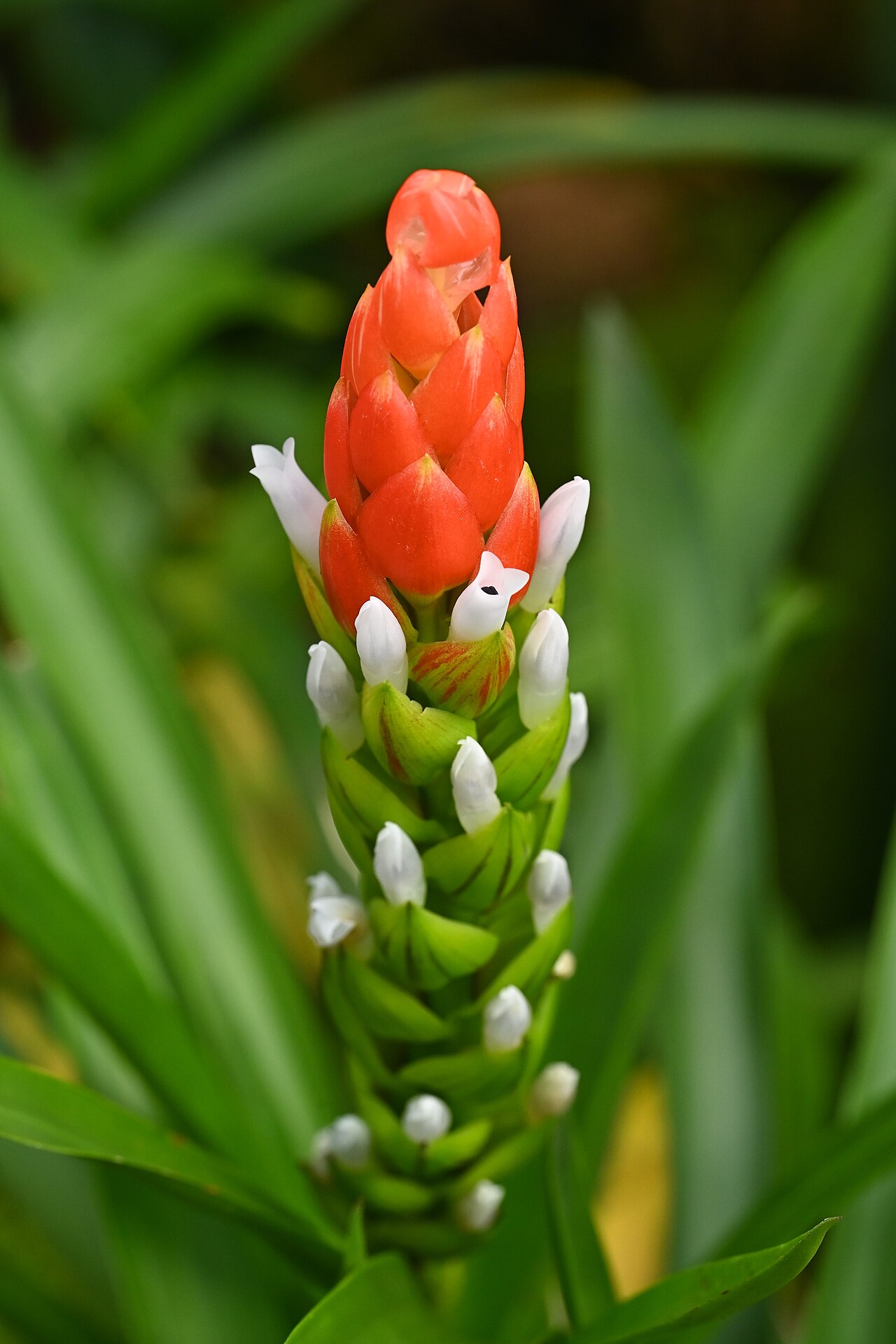
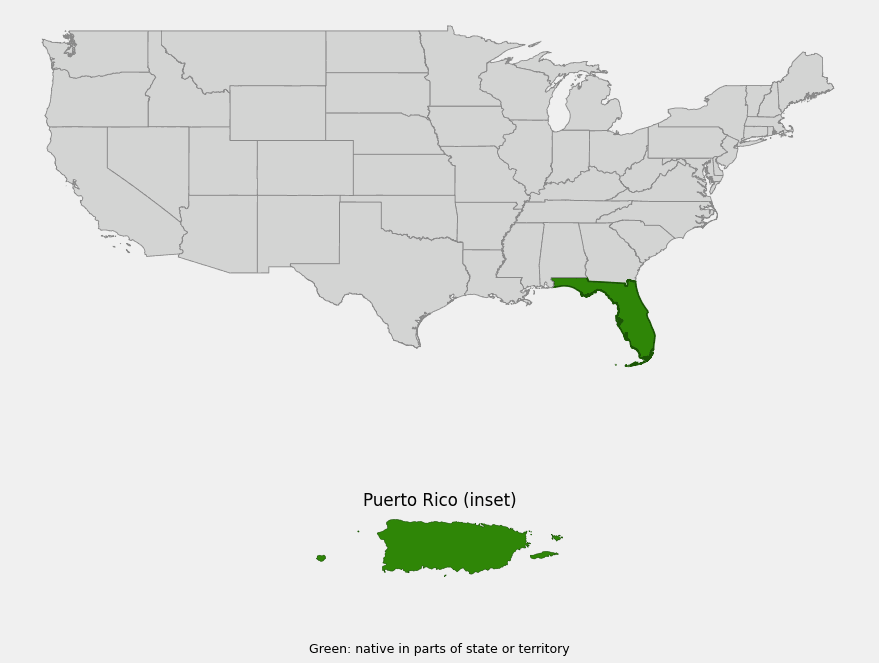
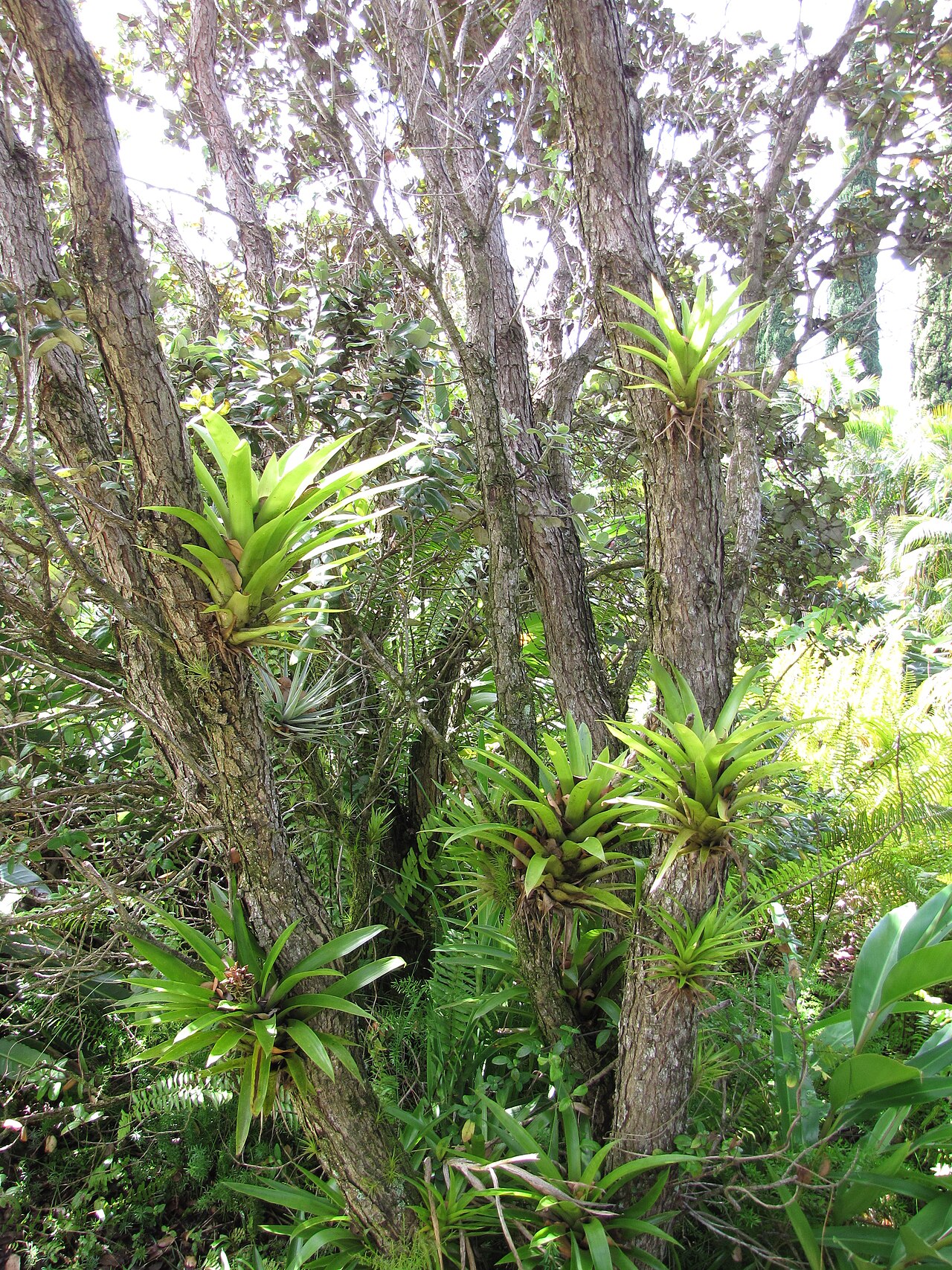
Guzmania monostachia, known as West Indian Tufted Airplant, is a tank bromeliad that perches on trees in moist forests and swamps, forming a vase of smooth, bright green, strap-shaped leaves. When it blooms it sends up a single spike (the meaning of monostachia) of overlapping bracts, green and often pinstriped with brown below and bright orange-red at the tip, with small white flowers in between. It is one of the few Guzmania species that reach the United States: USDA PLANTS lists it as native in Florida and Puerto Rico.
In Puerto Rico the Institute for Regional Conservation (IRC) records it in El Yunque National Forest, in Maricao State Forest in the western mountains, and in the northern karst forests of Cambalache and Río Abajo, mainly at middle elevations. In Florida it is a rarity of the far south, limited to swamps and hammocks in Collier, Miami-Dade and mainland Monroe counties. The Atlas of Florida Plants lists it as state Endangered, and IRC ranks it critically imperiled in South Florida, where an invasive weevil has destroyed many plants.
This guide is for gardeners and naturalists in both Puerto Rico and South Florida. It covers how to recognize the tufted airplant, where it grows, how to grow nursery-propagated plants on a tree or in a pot, and the threat facing Florida’s wild bromeliads. Buy nursery-propagated plants only; never collect bromeliads from the wild.
Identification
West Indian tufted airplant is a typical “tank” bromeliad: its leaves overlap at the base to form a cup that holds water. It is most easily recognized when flowering, by its single, cone-like spike of overlapping bracts with a colorful tip.
Rosette & Leaves
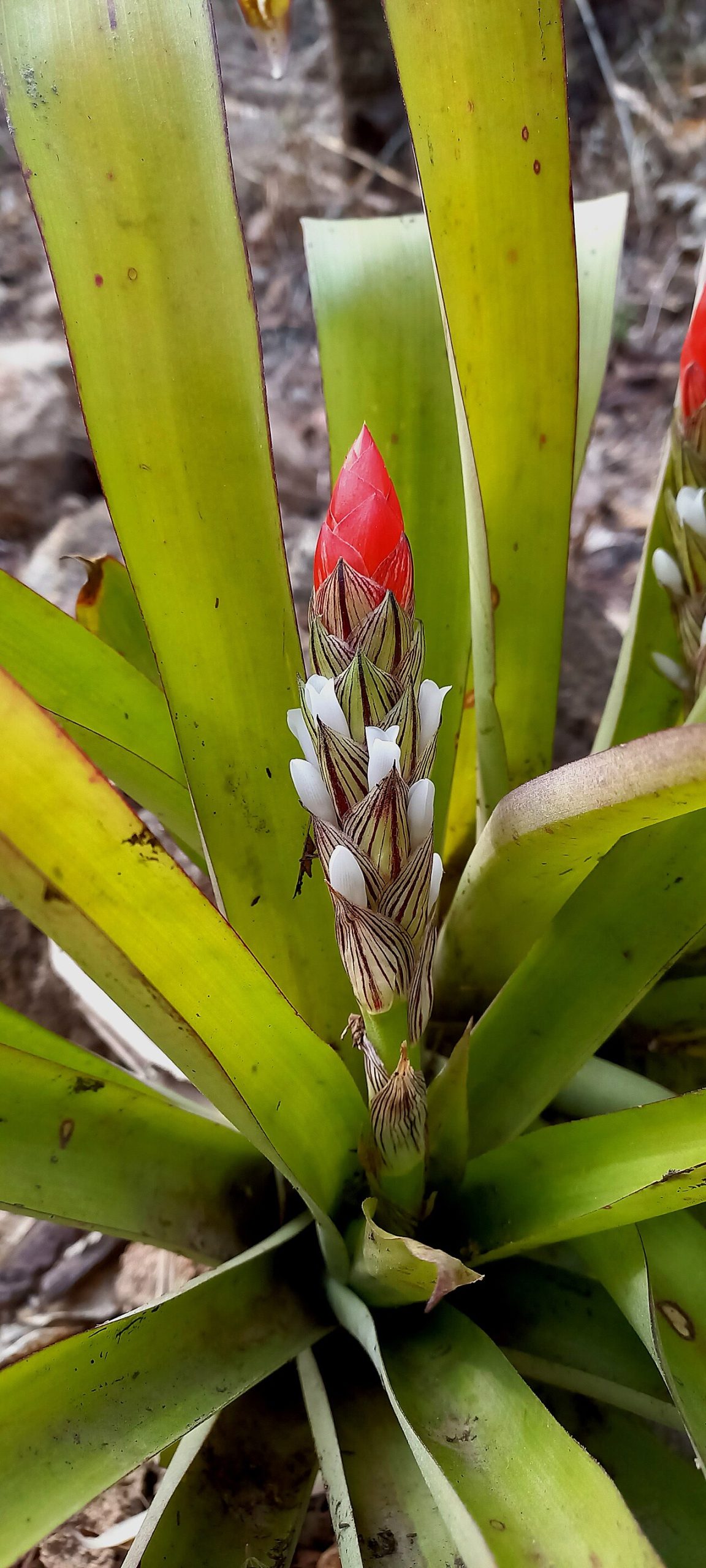
Plants form a dense, upright to spreading rosette about 1 to 2 feet tall and about as wide. The leaves are smooth, glossy, bright to yellow-green, strap-shaped and spineless, with pointed tips; they lack the gray scales that coat many Tillandsia airplants. Rosettes often grow in clumps as offsets develop around the base of the parent.
Flower Spike
The flower spike rises straight up from the center of the rosette on a short stalk. It is densely covered with overlapping bracts: the lower, fertile bracts are green to pale yellow and in many plants striped lengthwise with fine brown or purple lines, while the upper, sterile bracts at the tip turn bright orange-red. IRC’s Natives for Your Neighborhood describes the bracts as green to orange.
Flowers
The small, white, tubular flowers emerge one or a few at a time from between the lower bracts and are short-lived. IRC gives the flowering season in South Florida as spring to summer. After blooming, the rosette slowly declines and is replaced by its offsets, as in most bromeliads.
Fruit & Seeds
The fruit is a small capsule, green turning brown, that splits to release seeds with tufts of fine hairs. The seeds drift on the wind and lodge in bark, where they germinate on moist branches.
Quick Facts
| Scientific Name | Guzmania monostachia (L.) Rusby ex Mez; USDA common name: West Indian tufted airplant |
| Family | Bromeliaceae (bromeliad family) |
| Plant Type | Evergreen epiphytic tank bromeliad (occasionally terrestrial) |
| Mature Height | 1–2 ft; taller in flower |
| Mature Spread | 1–2 ft; slowly forms clumps of offsets |
| Growth Rate | Moderate |
| Sun Exposure | Light to moderate shade |
| Water Needs | High; needs constant humidity and a moist substrate |
| Soil Type | Epiphytic on bark; or a coarse, well-drained, humus-rich mix |
| Soil pH | Acidic to neutral |
| Bloom Time | Spring to summer in Florida |
| Flower Color | White flowers among green, brown-striped and orange-red bracts |
| Fall Color | None; evergreen |
| Fruit | Small capsule with hairy, wind-dispersed seeds |
| Deer Resistant | Yes; grows on tree trunks out of reach |
| USDA Hardiness Zones | 10b–12; frost-tender |
Native Range
West Indian tufted airplant is a widespread tropical American bromeliad. IRC gives its native range as the West Indies (the Bahamas and the Greater and Lesser Antilles), South Florida, Central America and northern South America; Wikipedia adds Bolivia, Brazil, Colombia, Ecuador, Peru and Venezuela, and reports it as naturalized in Hawaii. Within the area PlantNative covers, USDA PLANTS lists it as native in Florida and Puerto Rico.
In Puerto Rico IRC records it in four conservation areas: El Yunque National Forest in the Luquillo Mountains, Maricao State Forest in the western Cordillera, and Cambalache and Río Abajo state forests in the northern karst, where it also grows on limestone. Its records cluster at middle elevations of about 1,600 to 3,300 feet (500 to 1,000 m), in humid forest where mist and rain keep the air moist.
In Florida it reaches the northern edge of its range. IRC lists it from Collier and Miami-Dade counties and mainland Monroe County, in rockland hammocks, sloughs and strand swamps, including Fakahatchee Strand Preserve State Park, Big Cypress National Preserve and Everglades National Park. It is now very rare outside Collier County, and IRC lists it as presumed extirpated at some Miami-Dade hammocks; the Atlas of Florida Plants notes that it was once described as “excessively abundant on trees in the Homestead hammocks” (Simpson 1914). The Atlas lists it as state Endangered in Florida.
📋 Regional plant lists featuring West Indian Tufted Airplant: Puerto Rico · North & South Florida
Growing & Care Guide
West Indian tufted airplant is grown by bromeliad enthusiasts and some native plant nurseries. Because wild Florida populations are state Endangered and being destroyed by an invasive weevil, buy only nursery-propagated plants, never collect plants or seed from the wild in Florida or Puerto Rico, and inspect any bromeliad you bring home for weevil damage.
Light
Give it light to moderate shade, like the dappled light under a tree canopy. Strong afternoon sun yellows and burns the leaves. Wikipedia notes that the species can switch to a water-saving form of photosynthesis (CAM) under high light or drought, which helps it cope with brighter spots, but it grows best in shade.
Soil & Water
In the wild it grows on bark; in the garden mount it on a rough-barked tree, a cork slab, or grow it in a pot of coarse, fast-draining mix such as bark chips with some peat or leaf mold. Keep the central cup filled with fresh rainwater, flushing it every week or two so it does not stagnate. It needs high humidity and does not tolerate long drought, salt spray or flooding with salt or brackish water.
Planting Tips
To mount a plant, wrap a little sphagnum around the base and tie it snugly to a branch or trunk with soft wire, fishing line or plant tape until the roots take hold, usually within a few months. In Puerto Rico’s humid uplands it can live outdoors year-round; in South Florida choose a sheltered, humid spot such as a shaded hammock garden, and protect it when frost threatens.
Pruning & Maintenance
Remove the old rosette once it has flowered and begun to brown, leaving the offsets to grow on. Feed lightly, if at all, with a dilute fertilizer sprayed on the leaves. In Florida, check plants regularly for the Mexican bromeliad weevil: tunneling at the base of the rosette, a collapsing center or a flower spike that falls over are warning signs.
Propagation
The easiest method is to separate offsets (pups) when they are one-third to one-half the size of the parent and mount or pot them. It can also be raised from seed sown on a moist, sterile surface under high humidity, which is how conservation nurseries propagate it; seedlings take several years to reach flowering size.
Landscape Uses
- Tree-mounted gardens: living decoration on shade trees and palms
- Shade and fern gardens: bright green rosettes and red spikes in humid shade
- Containers and slabs: for patios and shade houses
- Conservation plantings: nursery-grown plants in hammock and swamp restoration
- Wildlife habitat: water-holding tanks for frogs and insects
Wildlife & Ecological Value
Like other tank bromeliads, West Indian tufted airplant creates small wetlands in the treetops. Its leaf cups hold rainwater and decaying leaves, which support a community of small animals.
For Pollinators
The small white flowers offer nectar to small visitors, and the bright orange-red bracts at the top of the spike make the cluster easy to spot from a distance. Many tubular-flowered bromeliads of the West Indies are visited by hummingbirds and insects.
For Birds
Birds drink water and hunt insects in the water-filled cups. In Puerto Rico, tank bromeliads also shelter tree frogs, including coquíes, and many small invertebrates that birds feed on.
For Mammals
Its main value to mammals is indirect, through the insects and other small animals that live in its tanks.
Ecosystem Role
Bromeliad tanks are tiny aquatic habitats where insect larvae, mites, small crustaceans and frogs live, and where nutrients from fallen leaves are recycled. In Florida, the loss of native bromeliads to the invasive Mexican bromeliad weevil (Metamasius callizona) is a serious conservation problem, and IRC cites weevil damage as a cause of the decline of this species in Fakahatchee Strand.
Cultural & Historical Uses
Linnaeus first described this plant in 1753 as Renealmia monostachia; the Atlas of Florida Plants gives the type locality as the Dominican Republic. It was later moved to Guzmania, a genus named for the eighteenth-century Spanish naturalist Anastasio Guzmán. Monostachia means “single spike,” for its unbranched flower cluster.
The Atlas of Florida Plants also lists the name Fuchs’ bromeliad, and IRC’s Puerto Rico database uses “variegated tufted airplant.” The striped-bract form is common in the wild, and garden selections with unusual striping are grown by collectors. Wikipedia lists the cultivar ‘Premier Amour’.
The species is also of scientific interest: Wikipedia notes that it is a facultative CAM plant, able to switch from ordinary (C3) photosynthesis to the water-saving CAM pathway, used by cacti and pineapples, when stressed by drought or strong light. That flexibility makes it a model for studying how epiphytes survive in the canopy, where water comes and goes quickly.
Frequently Asked Questions
Is West Indian tufted airplant native to Puerto Rico and Florida?
Yes. USDA PLANTS lists Guzmania monostachia as native in both. In Puerto Rico it grows in humid forests such as El Yunque, Maricao and the northern karst; in Florida it is limited to a few southern counties.
Is it protected in Florida?
Yes. The Atlas of Florida Plants lists it as state Endangered. Do not collect plants or seeds from the wild; buy nursery-propagated plants from reputable growers.
What is killing Florida’s wild bromeliads?
The Mexican bromeliad weevil (Metamasius callizona), an invasive insect whose larvae tunnel into the base of large bromeliads. IRC cites it as one cause of this species’ decline in Fakahatchee Strand.
Is it the same as the guzmanias sold as houseplants?
It is a wild species of the same genus. Most guzmanias sold in stores are hybrids or selections of other species from Central and South America; this native species has a narrower, single flower spike with green to striped bracts and an orange-red tip.
How do I care for it after it blooms?
The flowering rosette slowly dies after blooming, which is normal. Keep caring for it until offsets form around the base, then remove the old rosette once it browns and let the pups grow on.

Looking for a nursery that carries West Indian Tufted Airplant?
Our nursery directory does not yet include Puerto Rico. Browse the native plant nursery directory by state: Alabama–Arkansas · California · Colorado–Hawaii · Idaho–Kansas · Kentucky–Montana · Nebraska–Oklahoma · Oregon · Pennsylvania–Virginia · Washington · West Virginia–Wyoming